• We’re currently investigating an issue related to the forum theme and styling that is impacting page layout and visual formatting. The problem has been identified, and we are actively working on a resolution. There is no impact to user data or functionality, this is strictly a front-end display issue. We’ll post an update once the fix has been deployed. Thanks for your patience while we get this sorted.

WiFi problems? Start here.

Page 2 - Seeking answers? Join the AnandTech community: where nearly half-a-million members share solutions and discuss the latest tech.
I was just wondering because I had the router on a little table on the other side of a cinder block wall but behind the 40" Samsung LCD and I was having connection problems.
I may try putting it on a shelf, but I will have to drag it down from the Garage. It is an old shelving unit that is about 5 ft tall. I originally had the wireless router sitting on top of it.

Anyway my daughter already ordered some new gear. AT&T said they were going to install Fiber Optic cable. That should be interesting.
 
Last edited:
I noticed in your post that you mention Netstumbler as a WiFi analyzer tool. I tried running this on my laptop, but my WiFi card was not supported since it only supports a limit number or cards. I would like to mention another excellent alternative to Netstumbler that works on all versions of Windows, Mac and even Linux called inSSIDer by MetaGeek. You can scan both the 2.4 GHz and 5 Ghz bands.

http://www.metageek.net/products/inssider/

YOU CAN
– Inspect your Wi-Fi and surrounding networks
– Scan and filter hundreds of nearby access points
– Troubleshoot competing access points and clogged Wi-Fi channels
– Highlight access points for areas with high Wi-Fi concentration
– Track the strength of received signals in dBm over time
– Sort results by MAC Address, SSID, Channel, RSSI, Time Last Seen
– Export Wi-Fi and GPS data to a KML file in Google Earth

TECHNICAL
– Uses your current wireless card and connection software
– Works with Windows XP, Vista, and 7 (32 and 64 bit)
– Compatible with most GPS devices (NMEA v2.3 +)

MetaGeek_inSSIDer-v2.1_Screenshot.png
 
(I'm posting on this thread since it's a sticky, and my question seems to be well known in Google with no apparent solution yet.)

Windows 8 has a few teething problems with WiFi connection:

(a) For connections to a hidden SSID, Win8 does NOT save the login info for future auto-connection, even though you check the box. I don't think there is any user solution for that, but thought I'd throw it in here, anyway.

The main issue I have is:

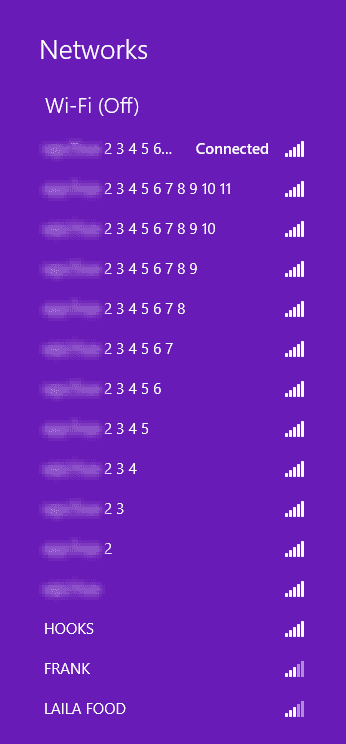
(b) Microsoft removed the "Manage wireless networks" ability from Windows 8. Probably because of the problem (a) above, I am getting a growing list of wireless networks displayed AFTER I connect with my home's hidden SSID network:

manage_WiFi.gif


In Windows 7 it was simple to delete all such redundant network listings using "Manage wireless networks."

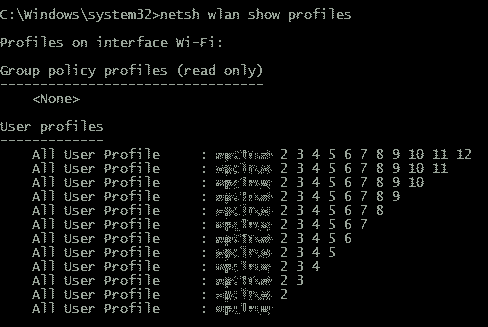
It seems to me that there should be a way to delete those entries using netsh. Can someone give me an example of a netsh syntax that would delete individual entries from:

netsh_show.gif
 
(I'm posting on this thread since it's a sticky, and my question seems to be well known in Google with no apparent solution yet.)

Windows 8 has a few teething problems with WiFi connection:

(a) For connections to a hidden SSID, Win8 does NOT save the login info for future auto-connection, even though you check the box. I don't think there is any user solution for that, but thought I'd throw it in here, anyway.

The main issue I have is:

(b) Microsoft removed the "Manage wireless networks" ability from Windows 8. Probably because of the problem (a) above, I am getting a growing list of wireless networks displayed AFTER I connect with my home's hidden SSID network:

manage_WiFi.gif


In Windows 7 it was simple to delete all such redundant network listings using "Manage wireless networks."

It seems to me that there should be a way to delete those entries using netsh. Can someone give me an example of a netsh syntax that would delete individual entries from:

netsh_show.gif

Code:
netsh wlan>delete profile ?

Usage: delete profile [name=]<string> [[interface=]<string>]

Parameters:

    Tag             Value
    name          - Name of the profile to delete.
    interface     - Interface name.

Remarks:

    Remove a wireless network profile from an interface or all interfaces.

    Parameter name is required. It is the name of the profile to be deleted.
    Parameter interface is optional. If it is given then the profile will
    be deleted from specified interface only. If it is omitted then the
    profile will be deleted from all the interfaces that have such a profile.

    Profile name can have wildcard characters and multiple profiles with
    matching name will be removed.

Examples:

    delete profile name="Profile 1" interface="Wireless Network Connection"
    delete profile name="Profile 1" i=*

netsh wlan>

Pretty sure that is still in Win8, I'll have to boot my dev and see.
 
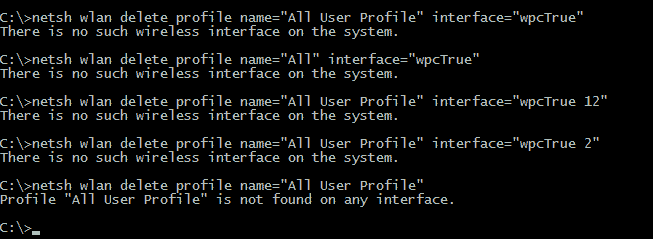
What do I use for profile name? I tried "All User Profile" (and even "All") and failed:

netsh_error.gif


Obviously, I'm not adept at using netsh. 😕
 
What do I use for profile name? I tried "All User Profile" (and even "All") and failed:

netsh_error.gif


Obviously, I'm not adept at using netsh. 😕

I don't have a sacrificial goat here [IE a test machine] to give you a screen shot but profile is not "All users Profile" it is the "fuzzyjunkyoublocked 1 2 3 4" etc

delete profile name="fuzzyjunkyoublocked 1 2 3 4" interface=*

or

delete profile name="fuzzyjunkyoublocked*" interface=*

Should wipe them all.

delete profile name=* interface=*

Will give you a clean slate.
 
Woo hoo! You nailed it for me! :thumbsup:

It was the "wpcoeTrue xx xx xx xx" that were the profile names. Doh. I deleted all but the one that is active now. After I go offline I will delete that one, as well.

You might be surprised to see how many folks are stymied by the removal of the WiFi management from Win8, and this works just as well.

THANKS!
 
That shortcut no longer works with Win8. It appears it did for the pre-RTM versions, but on my computer it doesn't do anything, and comments dated after release date indicate it doesn't work for other folks either. Oh, well. It was worth a shot.
 
"Hi guys!

I am Keith Parson I am a new member of this site. I joined this forum/site because I think we're on the same boat here.. I am also into WIFI LAN technology topics and hope to share with you some helpful tips and information regarding the matter in the future. So see you guys!:-D"

Keith
 
I'm 74yrs young and not a tech guy. Here is my problem.

I had someone install a Rosewill Wireless Router RNX N150 a couple years back.
I use it in my home for connecting a desktop and a laptop.

Recently my wife purchased an ipad and I'm trying to connect the ipad to the Rosewell router. I am unsuccessful trying. I get 'unable to join the network'.
I don't know if my router is wifi? I can't find any info to tell me if it is or not. If it is not what do I need to do?

Do I need to get a new router that has wifi and have to reinstall and configure my computers to it?

I would really appreciate any suggestion you can give me.
 
I believe this is your model.

33-166-064-TS

From Wikipedia:

The Wi-Fi Alliance defines Wi-Fi as any "wireless local area network (WLAN) products that are based on the Institute of Electrical and Electronics Engineers' (IEEE) 802.11 standards". However, since most modern WLANs are based on these standards, the term "Wi-Fi" is used in general English as a synonym for "WLAN".

Your router conforms to IEEE 802.11b/g, IEEE 802.11n Draft 2 Up to 150Mbps so the short answer to your question is, "Yes."

As to why you can't connect to it, did it prompt you for the encryption key, and do you have it?

Check these two articles on Apple's support site:

iOS: Troubleshooting Wi-Fi networks and connections

Archived - iPad: Issues connecting to Wi-Fi networks

If they don't resolve your problem, follow some of these links from searching Google for "ipad unable to join the network wifi."

Hope that helps. 🙂

FWIW, I'm just a kid a month short of 72. I was raised to respect my elders. The problem is, it keeps getting harder to find them. 😉
 
wifi problems generally occur because sometime there are lots off user or sometimes connection problems are there.
you have to aware that while you are working or doing net surfing then disconnect it properly so that no one can recoginise your connection.
give password security so that your connection remains safe.
 
I want to hook up an external antenna for better range. I can route one of the two antenna connections to an SMA adaptor mounted to the side of the case, but what I don't know is, why are there TWO antennas in the laptop? Do they simply connect in parallel, connected to the same circuit in the WiFi PCB, or, is one for transmit and one for receive? Someone thought that one might be TX and RX for 2.4ghz and the other TX and RX for the 5.8ghz band. Should I have to route BOTH antenna connections to external antennas or, is there a better one to make external? With the SMA adaptor, I can experiment with different types of antennas without going back into the laptop and risk messing something up.
 
I want to hook up an external antenna for better range. I can route one of the two antenna connections to an SMA adaptor mounted to the side of the case, but what I don't know is, why are there TWO antennas in the laptop? Do they simply connect in parallel, connected to the same circuit in the WiFi PCB, or, is one for transmit and one for receive? Someone thought that one might be TX and RX for 2.4ghz and the other TX and RX for the 5.8ghz band. Should I have to route BOTH antenna connections to external antennas or, is there a better one to make external? With the SMA adaptor, I can experiment with different types of antennas without going back into the laptop and risk messing something up.

Instead of messing around with the Laptop original Antenna (which seems that you know nothing about), get yourself and external USB WIFI and experiment with it.

Here are few examples -http://www.data-alliance.net/servlet/-strse-Alfa-Products/Categories


😎
 
If you getting the wi fi problem then fist check your wi fi connections and then then you device in which you are using the wi fi connection. and the check the manual settings of wi fi . Must be you will solve the wi fi problem with these steps.
 
i used to face the same problem when using wi-fi. one simple solution for that is reconnect to the router and start using again.
 
Back
Top