Why is taxing the rich considered so taboo by the non-rich?

Page 8 - Seeking answers? Join the AnandTech community: where nearly half-a-million members share solutions and discuss the latest tech.

Anteaus

Platinum Member
Oct 28, 2010
2,448
4
81
I think this is whats wrong about the Flat tax ideas. It just looks at the money blankly. The problem is as you go closer and closer to poverty, more of a persons income is used for nothing more than "living" so a flat tax is not fair in that sense. 20 percent of 1 million isn't taking any port of the taxes from "living", its taking it from discretionary income. 20 percent of 22k is taking away from someone ability to feed themselves or their family.

Read my whole post. Farther down I said I didn't believe in taxing the poor and that there should be a progressive tax that begins ramping up from the poverty line up to the flat 20% at a higher income level. The gist is that there is equality past that point.
 

IBMer

Golden Member
Jul 7, 2000
1,137
0
76
Read my whole post. Farther down I said I didn't believe in taxing the poor and that there should be a progressive tax that begins ramping up from the poverty line up to the flat 20% at a higher income level. The gist is that there is equality past that point.

I'd be inclined to agree with that.
 

piasabird

Lifer
Feb 6, 2002
17,168
60
91
Using your logic if you dont make the minimum you should not have to pay sales tax either. It would be unfair to tax the poor. Or how about a progressive sales tax also based on your last tax return.

The object of a FLAT tax is to not have multiple levels of taxation and no minimum tax. Just no exemptions and no need for an accountant. You could instead just have minimum amount of income before the tax kicks in. You should also count all of the welfare from churches and other sources as income. What you should realize is everyone making any amount of income say over $20,000.00 should be paying the tax, and everyone should be paying the same tax. No exemptions no nothing no targeted tax breaks for any reason for anybody. No business expenses or anything.

So if you have a job until you make $20,000 you dont pay any tax. After that you would pay the flat tax. This is kind of how social secutrity works. As you make more money, you pay a different tax rate. The exception is that there is no CAP.
 
Last edited:

Monster_Munch

Senior member
Oct 19, 2010
873
1
0
Using your logic if you dont make the minimum you should not have to pay sales tax either. It would be unfair to tax the poor. Or how about a progressive sales tax also based on your last tax return.

You can achieve that by having reduced tax on certain essential items, like food and clothing. So everyone can feed and clothe their family without paying tax, but if you want to buy a flat screen tv or a new car you pay sales tax.
 

Anteaus

Platinum Member
Oct 28, 2010
2,448
4
81
Using your logic if you dont make the minimum you should not have to pay sales tax either. It would be unfair to tax the poor. Or how about a progressive sales tax also based on your last tax return.

The object of a FLAT tax is to not have multiple levels of taxation and no minimum tax. Just no exemptions and no need for an accountant. You could instead just have minimum amount of income before the tax kicks in. You should also count all of the welfare from churches and other sources as income. What you should realize is everyone making any amount of income say over $20,000.00 should be paying the tax, and everyone should be paying the same tax. No exemptions no nothing no targeted tax breaks for any reason for anybody. No business expenses or anything.

So if you have a job until you make $20,000 you dont pay any tax. After that you would pay the flat tax. This is kind of how social secutrity works. As you make more money, you pay a different tax rate. The exception is that there is no CAP.

Well we are talking specifically about income tax. Sales tax is already a flat percentage that everyone pays, it is not progressive thus is fair. Food is already tax free for the most part for people under the poverty line (i.e. food stamps, etc). In theory your 20k abrupt switchover is sound but in reality its demeaning because i would hate to write that $4000 check to the IRS because I made $20001.00 instead of $19999.00. This is one of the few times I will side with the people who are for progressive taxation. These numbers are completely arbitrary, but I think it would be fair to start taxing at the poverty line and fit a linear curve up to say 40k or 45k where the tax rate will level out at somewhere between 20 and 25 percent.
 

SamurAchzar

Platinum Member
Feb 15, 2006
2,422
3
76
Flat tax initiatives are there to drastically simplify the tax codes, that's why no exemptions or different tax grades. In FairTax, the issue of the regressiveness is countered by providing tax "credits" on basic consumables, much like food stamps.
 

spidey07

No Lifer
Aug 4, 2000
65,469
5
76
why is eliminating welfare, cutting social security benefits and lowering taxes considered taboo?

Because you'll lose votes. This is what I was talking about earlier, the higher the percentage the population that receives government money, the more they vote to take more from people that pay into the government. You even see this very attitude in this thread "take more from the rich so we can use it!"

It eventually leads to collapse when the people taking money outnumber those paying and we're really close to that number today.
 

fskimospy

Elite Member
Mar 10, 2006
88,267
55,850
136
You have absolutely no understanding of how business operates. If a business shows 10% profit for a year, it rarely runs out and invests that 10%. What if next year is bad? At the very least, investing each year's profits prevents any possibility of investments larger than one year's profits.

Instead, a business will invest some small portion of its profits and bank the rest, which means it pays income tax on the banked portion. Assuming that profit continues, at some point that business will make major investments to become more competitive, more productive, more profitable. Major investments take many years' profits, usually with some borrowed money as well.

The more of a business' profit that government takes, the more time is required to accumulate enough capital to make a major investment. (In today's market, often 50% or more of a capital investment must be cash on hand before a business will fund it.) The more likely it is that a business will not be able to afford that major investment at all. And the more likely that the jobs represented by that investment, in direct hires as well as goods and services purchased, will be delayed or never happen at all. There are no free rides; money taken by government is not available to fund private sector job growth.

See what you did there was just spew out a bunch of crap with no evidence to back it up. You are free to spin a story of whatever mythology you choose to believe in order to convince yourself that your ideology is correct.

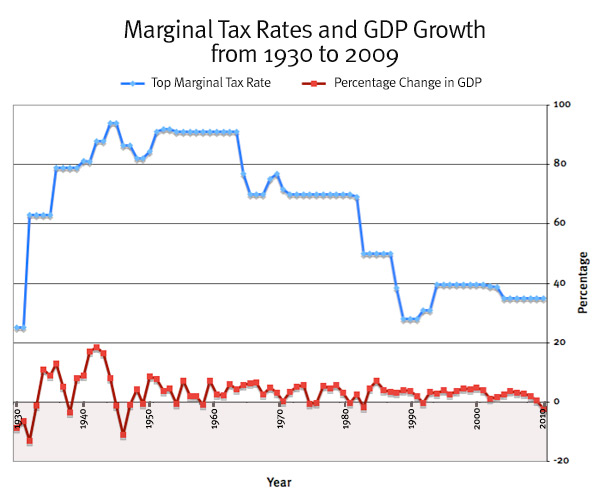
I will counter with a graph of US top marginal tax rates as they relate to GDP growth over the last 80 years. By all means, show me the correlation, any correlation.

marginalGrowth.jpg


It would appear that reality has 'no understanding of business'.
 

daishi5

Golden Member
Feb 17, 2005
1,196
0
76
The fact of the matter is that if we cut spending and raise taxes we still wouldn't have enough.

Our current deficit is at 1.2 Trillion, but that is inflated by short term non-discretionary spending. Things like unemployment and welfare went up in cost, and revenue went down. Unless this is a new economic reality, a large part of the deficit will disappear when the economy normalizes. The Military is costing us almost 1 Trillion dollars a year.

I don't know how much of the deficit will disappear when the economy picks back up, but I don't think it would be unreasonable to expect that will be less than 500 Billion a year for the remaining deficit. If we cut our Military budget in half, so that we only spend 3 times as much as the 2nd place country it would cover almost the entire deficit.

And, just to be clear, I think our deficit after economic recovery is less than I estimated, and I believe our military needs to be cut more than I suggested.

http://en.wikipedia.org/wiki/File:Deficits_vs._Debt_Increases_-_2009.png
http://en.wikipedia.org/wiki/United_States_public_debt
http://en.wikipedia.org/wiki/Military_budget_of_the_United_States
 

ModestGamer

Banned
Jun 30, 2010
1,140
0
0
I think this is whats wrong about the Flat tax ideas. It just looks at the money blankly. The problem is as you go closer and closer to poverty, more of a persons income is used for nothing more than "living" so a flat tax is not fair in that sense. 20 percent of 1 million isn't taking any port of the taxes from "living", its taking it from discretionary income. 20 percent of 22k is taking away from someone ability to feed themselves or their family.


people under 40K a year are already paying 50% or more of their income in some form of tax or another.

Total GDP 14.7t total federal,state,local etc etc etc budgets, 7.8t

that means we already pay 50% of the GDP or more in tax's directly or indirectly. Every single dollar you have in you pocket that you spend will be taxed somewhere along the way.

the real reality is that the rich and the wealthy and those with high incomes pay disproportionaly less then those with lower incomes. They already pay less per dollar.

If people want a flat tax get ready for a national 54% sales tax on everything and at the end of the day, 90% of the population won't notice becuase the goverment already confiscates that money anyways.

The only way to fix the tax problems is to adress the cuase of them.

The fact that the goverment is a wealth concerntrator and its not redistributing to the poor. It mostly redistributes to the rich. Just look where the dollars from goverment actually go.
 

spidey07

No Lifer
Aug 4, 2000
65,469
5
76
The fact that the goverment is a wealth concerntrator and its not redistributing to the poor. It mostly redistributes to the rich. Just look where the dollars from goverment actually go.

Social Security, medicare, medicaid. They disproportionately go to the "poor". It's time for the poor to pay their fair share.
 

Anteaus

Platinum Member
Oct 28, 2010
2,448
4
81
Incremental. You'd pay 20% of one dollar.

That would be a nice clean way to do it. The tax code would be ridiculously simple. Everyone simply subtracts whatever the currently poverty base (20K in our example) from their income and whatever is left gets taxed at a set percentage rate which is the same for all people).

i.e. Person makes 52K a year. Taxable income is 32K. At 20% thats $6400. Simple and concise. No need to spend all that money on complex tax booklets and time to come up with complex exemptions and progressive tax tables.

I like it. If you combine this with a tax exemption on all food, then exempt all clothes that cost less than $100 and increase the sales tax on everything else to say 9-10%, then I think it would work great. People on low income would have an easier time getting the essentials, while people with more disposable income will pay a higher premium on luxury goods.

This could be the tax baseline. Other types of taxes can be still used on their own merit.
 

biostud

Lifer
Feb 27, 2003
20,238
7,362
136
In Denmark the income taxes are roughly:
$0-6000: 5,5%
$6000-$64K: 37%
+$64K: 52%
 

Axon

Platinum Member
Sep 25, 2003
2,541
1
76
I basically oppose all tax increases from the most wealthy to the middle class. A lot of people get screwed going down that chain.

Of course, certain taxes are necessary. I use my local and national infrastructure. Part of it makes me money. Etc. I like the idea of nationalized health care, though I'm not a fan of the implementation of it. Certain things are good.

Speaking, however, as someone who is a principal of an s-type corporation in New York, my life pretty much sucks. I am taxed on money that comes in and money that I take out. Siiiigh. Making matters worse is the lack of fiscal transparency or accountability by my state and federal government. Where is my money going? Why is more always needed? Why does my metrocard cost go up seemingly twice a year? Arrgghhh.

You know, if there is a zombie apocalypse, I think I'll just cave and become a zombie so I can eat some of these fuckers.
 

MrX8503

Diamond Member
Oct 23, 2005
4,529
0
0
Then why do Democrats continue to support the idea? We send the money to the IRS, who gives it to congress, who then gives it to massive corporations and hopes that it trickles down.

The only difference between Republican trickle down and Democrat trickle down is that in the Democrat version, the government gets their grubby mitts on it and extracts a bunch first.

Thats not the trickle down theory. You just made up your own theory.

Social Security, medicare, medicaid. They disproportionately go to the "poor". It's time for the poor to pay their fair share.

You do realize that there will always be poor people right? It would be impossible to not have a support system in place and not have people die.
 
Last edited:

Engineer

Elite Member
Oct 9, 1999
39,230
701
126
Social Security, medicare, medicaid. They disproportionately go to the "poor". It's time for the poor to pay their fair share.

Other than medicaid, the poor pay the same percentage of their incomes for SS/Medicare as anyone else (7.65% combined). If you're talking about general revenues, then maybe but the above is not a good example.

Edit: I take that back. Forgot about the fucking EIC where people get back more than they pay in on ordinary income taxes (non SS/Medicare). That can more than make up for the SS/Medicare taxes paid in (in some cases).
 

wayliff

Lifer
Nov 28, 2002
11,720
11
81
That's it, but the understanding of most tax increase advocates is too shallow to get this fact.

When you raise taxes, you're hurting the upper-middle class. You could argue that a person taking home $1m/year in salary is no "middle class", but they're much closer to the average person than they are to Buffet. Basically, you screw over anyone working for a living making from 250k and into few millions.
These people are either small business owners or have free trades (lawyers/doctors/finances etc).

Above the point, the money is made by equity. When you look at the compensation of top level CEOs, the vast majority of it is in stock and stock option, and the IRS tax rates brought here don't apply in these cases. Look at top CEO compensation and you'd see they're taking home $300k-$800k in salary and the rest in stock options. Steve Jobs is the best example, taking $1 in salary but tens of millions in options and equity.

Look above the CEOs into the large shareholders and you'll see they make most their money from the equity they own - either dividends or the stock rising. This is capital taxes, not income taxes.

Even if you raised INCOME tax to 80% tomorrow, the two latter groups would hardly feel it. You'd only hurt those who've done good for themselves and still work hard every day to afford a nice life.
You just can't tax the really high earners, not without screwing the economy completely and greatly diminishing the attractiveness of US as a place to do business in.

And I'll end this post with a famous quote:


Think about that the next time you suggest to make rules specifically targeting a small portion of the population, just because you know you'll never be a part of.


What are you talking about? Where did I make any suggestions?

I agreed with another post and made a brief elaboration.
I did not rant or anything else...
 

Carmen813

Diamond Member
May 18, 2007
3,189
0
76
Using your logic if you dont make the minimum you should not have to pay sales tax either. It would be unfair to tax the poor. Or how about a progressive sales tax also based on your last tax return.

The object of a FLAT tax is to not have multiple levels of taxation and no minimum tax. Just no exemptions and no need for an accountant. You could instead just have minimum amount of income before the tax kicks in. You should also count all of the welfare from churches and other sources as income. What you should realize is everyone making any amount of income say over $20,000.00 should be paying the tax, and everyone should be paying the same tax. No exemptions no nothing no targeted tax breaks for any reason for anybody. No business expenses or anything.

So if you have a job until you make $20,000 you dont pay any tax. After that you would pay the flat tax. This is kind of how social secutrity works. As you make more money, you pay a different tax rate. The exception is that there is no CAP.

Oversimplication FTL. $20,000 where? This is the problem with taxation based on income in general, there is a varying cost of living and this the quality of life delivered by a certain income is different in different areas. That is the ultimate problem with a flat tax, it's like saying that it costs the same to live in NYC as it does on an Iowa farm.

As others have said, overtaxing the poor makes social class mobility even more difficult and stratified. The problem with trickle down theory is that our country does not have gutters installed on the borders.
 

Carmen813

Diamond Member
May 18, 2007
3,189
0
76
There's that nasty word again. Equality. I HATE equality. I don't want someone who put in less effort as me getting the same reward as me.

It isn't about equality of outcomes, but equality of opportunity.

If person A starts at 20,000 miles behind person B, it doesn't really matter how fast they run because they will never come close. Once a person realizes that, there is no motivation to even bother trying.
 

Fayd

Diamond Member
Jun 28, 2001
7,970
2
76
www.manwhoring.com
Laffer Curve my ass. I have an economist friend who went to school with Laffer's son and wouldn't stop talking about the Laffer Curve.

What makes you think we're at the optimal point on the curve?

Edit: http://www.time.com/time/magazine/article/0,9171,1692027,00.html
Virtually every economics Ph.D. who has worked in a prominent role in the Bush Administration acknowledges that the tax cuts enacted during the past six years have not paid for themselves--and were never intended to. Harvard professor Greg Mankiw, chairman of Bush's Council of Economic Advisers from 2003 to 2005, even devotes a section of his best-selling economics textbook to debunking the claim that tax cuts increase revenues.

my point was it's not a 1:1 relationship, not that we're at or near the optimal point.
 

Juddog

Diamond Member
Dec 11, 2006
7,851
6
81
See what you did there was just spew out a bunch of crap with no evidence to back it up. You are free to spin a story of whatever mythology you choose to believe in order to convince yourself that your ideology is correct.

I will counter with a graph of US top marginal tax rates as they relate to GDP growth over the last 80 years. By all means, show me the correlation, any correlation.

marginalGrowth.jpg


It would appear that reality has 'no understanding of business'.

Good graph.