Why does ATI's Flagship always compete with Nvidias 2nd Tier Card?

Page 2 - Seeking answers? Join the AnandTech community: where nearly half-a-million members share solutions and discuss the latest tech.

ViRGE

Elite Member, Moderator Emeritus
Oct 9, 1999
31,516
167
106
I am only going to say this once, so listen closely.

In spite of what has transpired so far, this is fundamentally a reasonable discussion. Therefore I am going to allow it.

However from this post on, if ANYONE trolls, posts another image macro, accuses someone else of trolling, or otherwise is a jerk, then they get a vacation. You know how to behave, so I expect you can live up to our rules.

Capiche?

-ViRGE
 

TakeNoPrisoners

Platinum Member
Jun 3, 2011
2,599
1
81
None of those cards you listed were midrange, they were higher end cards.

A better more informed question would be "Why does AMD's flagship card fail to match Nvidia's flagship card?"

ATI cards are no longer sold and AMD's flagship is never competing with Nvidia's midrange.
 

sandorski

No Lifer
Oct 10, 1999
70,858
6,393
126
I am only going to say this once, so listen closely.

In spite of what has transpired so far, this is fundamentally a reasonable discussion. Therefore I am going to allow it.

However from this post on, if ANYONE trolls, posts another image macro, accuses someone else of trolling, or otherwise is a jerk, then they get a vacation. You know how to behave, so I expect you can live up to our rules.

Capiche?

-ViRGE

What's "Reasonable" about it? It's premise is completely wrong from the outset.
 

Homeles

Platinum Member
Dec 9, 2011
2,580
0
0
From HD 4000 through HD 6000, AMD's (or ATI's -- whoever you'd like to credit) engineering has blown Nvidia out of the water. Nvidia got the crap beaten out of them with HD 4000 vs. GT 200... even when taking account for the disabled cores of GTX 260, a 256mm² die has no business competeing with a cut down 576mm² die. That's just plain embarrassing, really. Had Nvidia not been so timid with 55nm, things would have likely been quite different.

Then Thermi released... delayed, hot and power hungry as heck... but the gap closed rather significantly. Really, Fermi 1.0 was simply not very good (take a look at Beyond 3D's breakdown of the Fermi architecture) compared to Cypress. I'm going to compare it do Bulldozer here -- brilliant concept, bad execution. Of course, not nearly as awful.

Then came the 500 series. Nvidia basically fixed Fermi. It had much better tesselation and compute than its competitor, although performance per watt and perf/mm² were still lacking. Also, Nvidia had some definite reference board issues (GTX 570 in particular). AMD was able to beat Nvidia in performance per dollar rather handily.

...and then the 28nm GPUs came out. Apparently AMD got hammered when they were making these things, because they weren't a tremendous improvement over the 6000 series in anything other than compute. Rory Read apparently decided that AMD had the same brand recognition as Nvidia (lol), so the 7000 series was priced accordingly.

Then the 680 launched, and, well, Nvidia caught AMD with their pants down. Kind of. In the high end, they're beating AMD rather easily, but they've outright failed to release in the mid range and their single low end card is a gigantic piece of junk.

The one good thing that AMD has done successfully with HD 7000 is with execution -- 3 chips and 6 cards in 3 months. Meanwhile Nvidia seems rather insistent on using their GK104 for every market segment there is, with GK107 kind of slopped in their lineup. Hopefully they finally address the mid range this month or early next month...

At any rate, the difference between AMD and Nvidia has been die size. AMD's used a "small die strategy" since the 2000 series flopped, and Nvidia's been making monolithic dies of doom from GT200 onwards. The exception being Kepler of course (and yet people like to argue that GK104 had always been envisioned as the top part, rofl).

Based on the nature of GPUs, die size is a absolutely massive factor in determining how powerful a GPU can be. The fact that AMD was able to compete so well with such small dies is quite incredible, but those days are over. Nvidia changed their way of doing things with Kepler, and it's paid off. Intel's now joining the market, at least on the HPC and professional side of things, so I would strongly suspect that the gap between things in the future will be far smaller. AMD's promised to fix their driver problems, and they seem to have taken the right steps in that direction. I think that fanboyism aside, there won't be much reason to pick Nvidia over AMD (or vice versa) except for performance per dollar. It will be interesting to see how things play out over the next year -- hopefully the end result is that consumers stop getting screwed by these ludicrous prices.
 

lavaheadache

Diamond Member
Jan 28, 2005
6,893
14
81
GTX 275 - HD4870
GTX 470 - HD5870
GTX 570 - HD6970
GTX 670 - HD7970

Why cant ATI/AMD make a card that competes with Nvidia?

QUOTE]

GTX 275 wasn't out for a pretty long while after the 4870 dropped. I'm fairly certain the 4890 was out and that card traded blows with the 280/285/275.

HD5870 is more often than not faster than the 470 but it releases like what? 6 months before?

The 6970 was definately slower than the 580 but did very well against the 570

Hd 7970 released months before the 680/670 and allowed nvidia the time to clock their cards up enough to take a very small victory. The 670 is how much slower than the 680? Pretty much single digit slower. We now have or will have shortly the 7970 GHZ edtion which takes the cake.

I think you answer of *when* AMD will compete has been answered. THey have all along. None of those nvidia cards that you mentioned were midrange when released. They were all 1 sku from the top and often very close to their more powerful bretheren.
 

blackened23

Diamond Member
Jul 26, 2011
8,548
2
0
Are you saying that the HD 5870 is clearly 100% faster and not even comprable to the 470?

No, i'm saying it was released many months before the 470 was, the 5870 pretty much wiped anything nvidia offered at launch. So in this case ATIs flagship had a clear lead over nvidia offerings for 7 months and nvidia rushed the 400 series to market with disabled cores because Fermi was broken initially. 5870 didn't compete with 470, it wiped the floor with the 280/285 when it was released and nvidia didn't have an answer for some time.

Which is why I stated, perhaps you should read up on the timeframes in which these products were released. Nvidia was clearly playing catch up to AMD with the 5000 series, and they rushed the 480/470/etc to market because of it. The disabled cores should be proof positive of that.
 
Last edited:

Smoblikat

Diamond Member
Nov 19, 2011
5,184
107
106
Doh..! Too many numbers to remember. :p But replace my brain fart with 5970 and my point still stands. Obviously AMD's flagship didn't compete with Nvidia's midrange.

I wasnt referring to its location in their marketing scheme, I was talking about their numbers were the middle numbers.
 

Smoblikat

Diamond Member
Nov 19, 2011
5,184
107
106
No, i'm saying it was released many months before the 470 was, the 5870 pretty much wiped anything nvidia offered at launch. So in this case ATIs flagship had a clear lead over nvidia offerings for 7 months and nvidia rushed the 400 series to market with disabled cores because Fermi was broken initially. 5870 didn't compete with 470, it wiped the floor with the 280/285 when it was released and nvidia didn't have an answer for some time.

Which is why I stated, perhaps you should read up on the timeframes in which these products were released. Nvidia was clearly playing catch up to AMD with the 5000 series, and they rushed the 480/470/etc to market because of it. The disabled cores should be proof positive of that.

Clearly you didnt understand that I was talking about when BOTH companies had their flagship GPU's out for this generation.
 

fishsauce

Member
Oct 17, 2003
73
0
0
Clearly you didnt understand that I was talking about when BOTH companies had their flagship GPU's out for this generation.

Most people buy a video card when they need/want a video card, not when both companies are on the same "generation." They buy what's available at a given time.

If someone wanted the best video card (single gpu) available at the beginning of 2009, they would have purchased a GTX285. If it was the end of 2009 it would have been the HD 5870. If it was the middle of 2010 it would have been the GTX480.

I could put your question in another context if you like: why don't we wait for AMD's best CPUs to be on the same "generation" as Intel's best CPUs before we compare the two?
 

moonbogg

Lifer
Jan 8, 2011
10,734
3,454
136
Its easy. AMD is slipping on all fronts. How can a fortress stand when the left flank (AMD CPU's) is burning in flames?
 

flopper

Senior member
Dec 16, 2005
739
19
76
Its easy. AMD is slipping on all fronts. How can a fortress stand when the left flank (AMD CPU's) is burning in flames?

Price /performance ratio is really good with amd.
People think having the fastest sells the most or such.
Money is made from mainstream not top edge.
amd should have built thier own niche and is doing so with apu and upcoming sync with gpu/cpu.
 

lopri

Elite Member
Jul 27, 2002
13,327
708
126
I really, REALLY hate to participate in this kind of discussion, but since it's got a seal of approval from ViRGE I'll bite for once. (ONLY ONCE)

Wasn't there an AT article how ATI (now AMD) shifted its focus on timely executions over additional features? NV doesn't have the luxury of X86 license which motivates them more for expanding GPU's reach in the market. These two factors are the biggest difference between these two in my eyes.

From what I've seen since then, AMD comes out first with the "next" gen stuff. Excellent hardware with consumer-oriented feature sets, meaning its priority is on existing/developing industry-wide standards. First to support;

HDCP, H.264/VC1 acceleration, HDMI/audio-passthrough, Displayport/multi-monitor support, DX11, etc.

But AMD's marketing is pretty terrible at pushing its advantage. (Both to consumers and to developers) Fairly or not, you get the impression that their management team just assume the industry will follow the "big" standards, which seems kind of lazy from an onlooker's point of view.

NV is more creative and ambitious with their hardware, and tends to go for long-term designs that are versatile to take on new fronts. That makes its products usually come later. First to support;

SM 3.0, DX10, SLI multi-GPU and switchable graphics, GPU-accelerated physix, GPU Compute (CUDA), 3D Vision, etc.

Being late gives NV advantage to match a few important criteria (read: 3DMarks) with some help of brute-forcing and.. TWIMTBP. NV's superior marketing team usually succeeds in downplaying AMD's strengths while it catches up and keeps the halo effects of its strengths in the market. To its credit, when NV eventually catches up to AMD's feature sets, it tends to match or excel the standard AMD has set by then. Unfortunately the same can't be said for AMD.

In the end, the 5~10% performance delta is a meaningless halo. A pretty effective halo, nonetheless. OMG it's almost 15% faster! 40 FPS vs. 35 FPS! Yeah! (Also note the revisionist history being written on GTX 480 in teh forums with help of motivated-reasoning by marketing victims :biggrin:) If you look at the clock frequencies of GTX 670 and HD 7950 and you know what NV was aiming for. And look at the "new" HD 7970 GHz edition - there you have it, AMD is following suit, hoping to change your mind with 5 FPS more.
You have to give a huge credit to NV for creating new markets in the big picture, however. Things like multi-GPU and GPU Compute would not have materialized without NV's initiatives.

P.S. Above opinion doesn't take into account the current "new" gen stuff (GCN and Kepler) because I haven't experienced them yet.
 
Last edited:

Sable

Golden Member
Jan 7, 2006
1,130
105
106
this is fundamentally a reasonable discussion.
No it isn't.
extrasmashedanagffin.gif
 

joshhedge

Senior member
Nov 19, 2011
601
0
0
Surely, all of this just comes down to how conservatively either AMD or NVIDIA want to clock their cards. Hence by AMD releasing the 7970 first, NVIDIA isn't going to release a lower clocked version of the 680GTX to match the performance of the 7970, they're going to clock it higher to win.

Doesn't AMD usually release their 'next gen' cards prior too NVIDIA's and hence their flagship will never usually compete with NVIDIA's flagship?
 

Sable

Golden Member
Jan 7, 2006
1,130
105
106
GTX 275 (April 9, 2009) - HD4870 (Jun 25, 2008)
GTX 470 (March 26, 2010) - HD5870 (Sep 23, 2009)
GTX 570 (7 December 2010) - HD6970 (Dec 15, 2010) (blip)
GTX 670 (May 10, 2012) - HD7970 (Jan 9, 2012)

Just saying.
 

Lepton87

Platinum Member
Jul 28, 2009
2,544
9
81
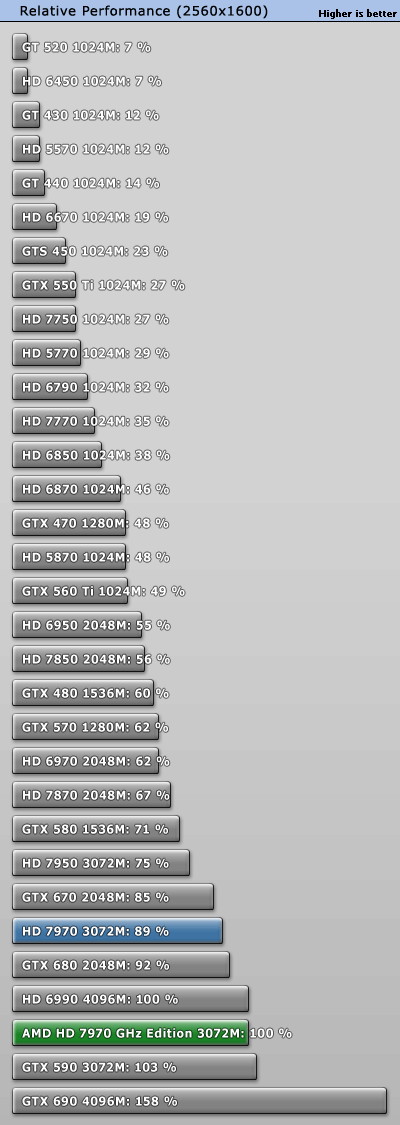
Right now you are right, 7970GE is competing with nv 2nd Tier GTX680 and clearly wining at higher resolutions and at least matching it at low resolutions that don't matter anyway for flagships cards. It's a shame that 2nd tier is all nv is willing to give us for now

perfrel_2560.gif
 

tviceman

Diamond Member
Mar 25, 2008
6,734
514
126
www.facebook.com
AMD's main focus (up until very recently with the Cayman architecture) has been graphical performance at sweet-spot die sizes. Their main goal for the past 5 years was not to make the biggest, most powerful GPU possible, but rather to create powerful GPU's with respect to performance per mm^2 without significant compromises in overall performance vs. the competition. And again, up until recently (very, very recently) they achieved those goals quite handily.

So you can look at it as AMD's best GPU usually equaling Nvidia's second tier product based off it's best GPU, or you can look at it as AMD kicking Nvidia's butt when it came to making much more efficient GPU's (at graphics). As much as I loathe AMD for the lack of innovation, developer support, and (from what some users say) untimely driver updates, they have done a great job (until recently) at keeping video card prices in check over the past few years. It matters very little to overall consumer choices which company has the "absolute fastest" GPU.
 

PrincessFrosty

Platinum Member
Feb 13, 2008
2,300
68
91
www.frostyhacks.blogspot.com
Because the very top end tier video cards aren't as profitable, while it's good PR to hold the performance crown there is way more sales, revenue and profit to be had in the mid and low tier graphics segments.

There really isn't a lot of reason to pursue the very top end segment, the R&D investment isn't going to be offset by the sales of the final product to a very tiny segment of your customers.
 

nOOky

Diamond Member
Aug 17, 2004
3,310
2,406
136
I thought my HD7970 did reasonably well against the competition up until the GTX680 came out? Was there something faster in nvidias mid-range selection at the time?
 

BallaTheFeared

Diamond Member
Nov 15, 2010
8,115
0
71
No, i'm saying it was released many months before the 470 was, the 5870 pretty much wiped anything nvidia offered at launch. So in this case ATIs flagship had a clear lead over nvidia offerings for 7 months and nvidia rushed the 400 series to market with disabled cores because Fermi was broken initially. 5870 didn't compete with 470, it wiped the floor with the 280/285 when it was released and nvidia didn't have an answer for some time.

Which is why I stated, perhaps you should read up on the timeframes in which these products were released. Nvidia was clearly playing catch up to AMD with the 5000 series, and they rushed the 480/470/etc to market because of it. The disabled cores should be proof positive of that.

I guess it depends on how you look at it.

The 5870 competed with 2 series, so AMD didn't have an answer for 4 series until after Nvidia came out with 5 series. If you're looking at it like that, how long did nvidia have an advantage over AMD with the 2 series cards?

4 series still competes with 6 series, it still has an advantage when it comes to raw performance in many situations when AMC is considered.

5xxx series may have been first to market as a DX11 card, but Nvidia brought a more well rounded card 6 months later which is still capable of decent playback of modern titles, even with tess were the 5 series isn't even an option.

The biggest factor keeping the 5xxx respectable against 4xx series is the fact that the gaming industry hasn't moved forward since DX9. If we saw more titles taking advantage of tessellation and multi-threaded driver functions Nvidia would have an even stronger position against AMD. As it were it's the gaming industry holding back gpus, not the other way around.


