
-
We’re currently investigating an issue related to the forum theme and styling that is impacting page layout and visual formatting. The problem has been identified, and we are actively working on a resolution. There is no impact to user data or functionality, this is strictly a front-end display issue. We’ll post an update once the fix has been deployed. Thanks for your patience while we get this sorted.
You are using an out of date browser. It may not display this or other websites correctly.
You should upgrade or use an alternative browser.
You should upgrade or use an alternative browser.
Question What will be the chip used in Steam Deck 2
- Thread starter marees
- Start date

marees
Platinum Member
Context
Still the Same story
Valve Says It Has a 'Pretty Good Idea' of What Steam Deck 2 Is Going to Be, Explains Why It's Holding Off for Now
Frame cap in hand.
the same things we've said in the past where we're really interested to work on what's next for Steam Deck… the thing we're making sure of is that it's a worthwhile enough performance upgrade to make sense as a standalone product,” Griffais explained.
“We're not interested in getting to a point where it's 20 or 30 or even 50% more performance at the same battery life. We want something a little bit more demarcated than that. So we've been working back from silicon advancements and architectural improvements, and I think we have a pretty good idea of what the next version of Steam Deck is going to be, but right now there's no offerings in that landscape, in the SoC [System on a Chip] landscape, that we think would truly be a next-gen performance Steam Deck.”
https://in.ign.com/steam-deck/24653...-2-is-going-to-be-explains-why-its-holding-of
marees
Platinum Member
The announcement of qualcomm arm based steam frame VR headset running steam OS on FEX translation layer has set the tongues wagging
What is your opinion
Valve won't breathe a word about the Steam Deck 2, but they're singing a different tune about Arm processors. Fresh off announcing their Arm-powered VR headset that can run Android apps, the company is already sketching out a much broader silicon strategy that could reshape portable gaming. The timing isn't coincidental.
As Nvidia reportedly preps an Arm gaming laptop and Qualcomm courts major OEMs like Razer, Valve appears ready to ride the wave rather than fight it. "I think that it paves the way for a bunch of different, maybe ultraportables, maybe more powerful laptops being Arm-based," Griffais told The Verge during a recent interview. "Handhelds, there's a lot of potential for Arm, of course, and one might see desktop chips as well at some point in the Arm world." The statement marks a significant shift for a company that built its portable gaming empire on x86 architecture.
But it's not just wishful thinking - companies are already knocking on Valve's door. Griffais confirmed that handheld manufacturers have reached out about SteamOS partnerships, with OneNetbook among those experimenting with powerful Arm chips for gaming devices.
For Valve, this represents more than just following trends - it's about expanding SteamOS beyond its current x86 limitations. "We'll keep greasing the wheels, so to speak, so that SteamOS can work on a wider variety of Arm devices, but also so that the catalog becomes more reliable there in terms of compatibility and performance," Griffais explained.
current Arm chips might not pack enough punch for Valve's flagship ambitions. When pressed about the Steam Deck 2's "generational leap in compute without sacrificing battery life," Griffais suggested today's Arm offerings compete mainly in lower-power segments. "When you get into lower power, anything lower than Steam Deck, I think you'll find that there's an Arm chip that maybe is competitive with x86 offerings in that segment," he noted with what the interviewer imagined was a wink.
marees
Platinum Member
More on steam frame & ARM gaming
👇
👇
Valve engineer on ARM
The Steam Frame (and its controllers) are designed to play VR titles, as well as traditional PC and mobile games in a resizable in-headset window that actually felt like a big-screen experience during my hands-on time with the headset. Valve engineers told me the company thinks of the Steam Frame less as a VR headset and more as “a new way to play your entire Steam library.” The Frame can do this both by streaming titles wirelessly from your PC, or running them internally on its built-in Arm-based Qualcomm Snapdragon 8 Gen 3 chip.
the company uses the Fex (officially stylized as FEX) software emulation layer that brings SteamOS to the Arm instruction set, which certainly has implications beyond this device.
For games installed and running on the headset itself, Valve tells me there will be a "Verified" game program similar to what already exists for the Steam Deck, where the company is going to test titles in the Steam catalog and provide guidance.
More software tweaks to come
Selan also says the Valve team is working on a way to pre-cache the CPU shaders, in a similar way that the company already pre-caches GPU shaders ahead of time on the Steam Deck. This should further reduce the overhead of the Fex emulation layer, but it’s not shipping yet.
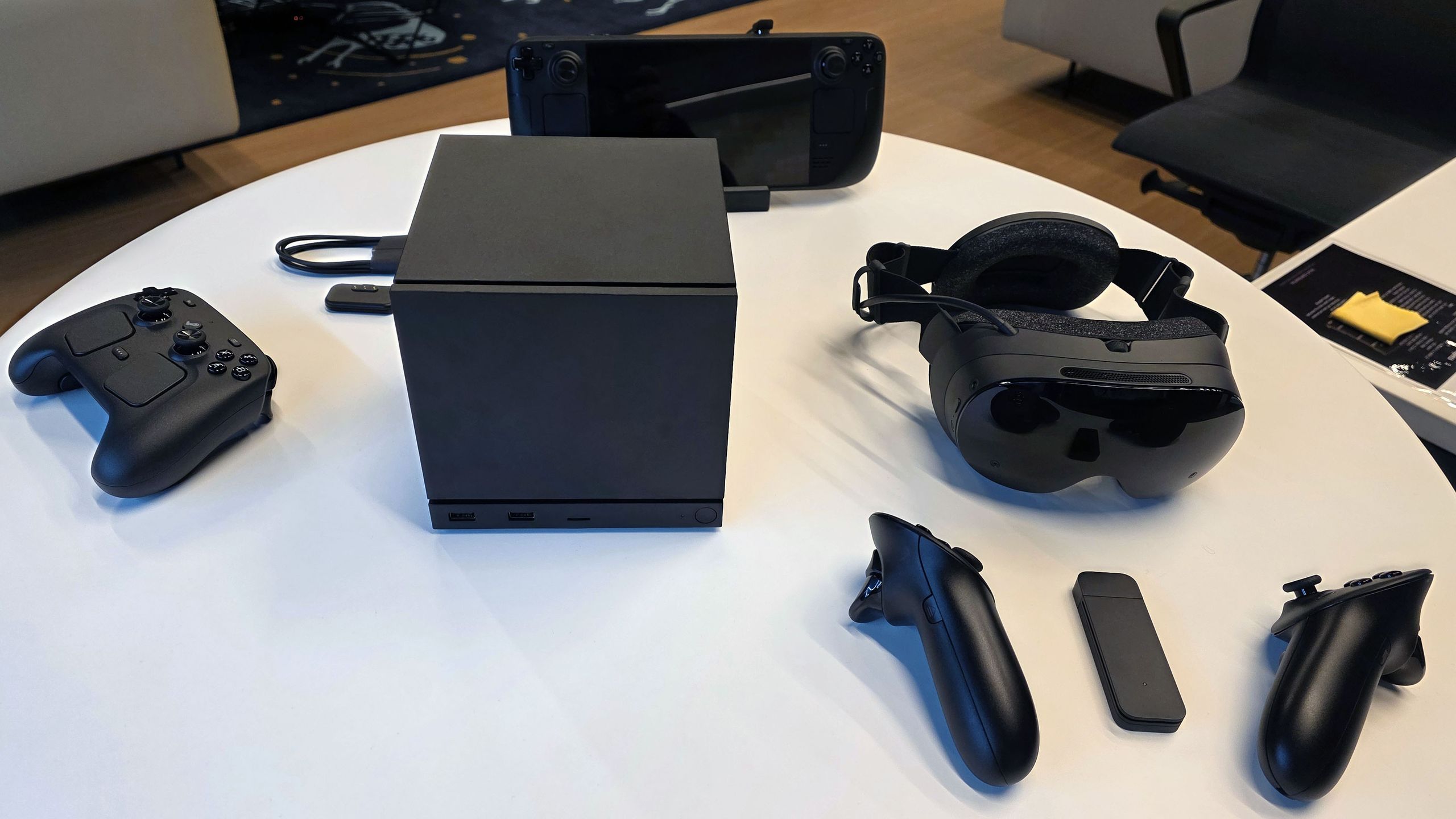
Hands-on with Valve's new Steam Frame headset — Arm-powered, mixed-mode device uses Fex translation layer for traditional x86 games
Valve doubles down on headset gaming, but it isn’t all about VR.www.tomshardware.com
marees
Platinum Member
Lots of hype for SteamOS on ARM
Valve won’t talk about a Steam Deck 2. It probably wants to keep the attention on its just-announced living room console, comfy new controller, and Arm-based headset instead. But now that the company is preparing to sell an Arm headset, one that can even run Android apps, there’s an obvious question. Is Arm a one-off experiment for Valve, or might it power future SteamOS hardware?
Valve software engineer Pierre-Loup Griffais makes it sound like the sky’s the limit. I don’t want to oversell what he said — he was excited about the potential, not any specific devices, and you’ll see that in more context when we publish the interview later this week.
But when I ask whether he thinks there’ll be other SteamOS devices with Arm chips, he says the answer is yes, and that he’s excited about it.
“I think that it paves the way for a bunch of different, maybe ultraportables, maybe more powerful laptops being Arm-based,” he begins. “Handhelds, there’s a lot of potential for Arm, of course, and one might see desktop chips as well at some point in the Arm world.” I immediately think about how Nvidia reportedly has an Arm-powered gaming laptop coming, and how Razer showed up at Qualcomm’s last coming-out party for laptop chips.
“We’ll keep greasing the wheels, so to speak, so that SteamOS can work on a wider variety of Arm devices, but also so that the catalog becomes more reliable there in terms of compatibility and performance,” says Griffais.
Griffais tells me that companies are already reaching out to Valve about handhelds, and I happen to know that one of them, One-Netbook, has recently been experimenting with (and selling) powerful handheld-grade Arm chips, too.
I get the sense that Griffais may not see enough power in Arm handheld chips just yet — at least not for a “generational leap in compute without sacrificing battery life” like Valve promised for the Steam Deck’s successor.
“When you get into lower power, anything lower than Steam Deck, I think you’ll find that there’s an Arm chip that maybe is competitive with x86 offerings in that segment,” he tells me earlier in our conversation.

 www.theverge.com
Valve thinks Arm has ‘potential’ for SteamOS handhelds, laptops, and more
Valve won’t talk about a Steam Deck 2. It probably wants to keep the attention on its just-announced living room console, comfy new controller, and Arm-based headset instead. But now that the company is preparing to sell an Arm headset, one that can even run Android apps, there’s an obvious question. Is Arm a one-off experiment for Valve, or might it power future SteamOS hardware?
Valve software engineer Pierre-Loup Griffais makes it sound like the sky’s the limit. I don’t want to oversell what he said — he was excited about the potential, not any specific devices, and you’ll see that in more context when we publish the interview later this week.
But when I ask whether he thinks there’ll be other SteamOS devices with Arm chips, he says the answer is yes, and that he’s excited about it.
“I think that it paves the way for a bunch of different, maybe ultraportables, maybe more powerful laptops being Arm-based,” he begins. “Handhelds, there’s a lot of potential for Arm, of course, and one might see desktop chips as well at some point in the Arm world.” I immediately think about how Nvidia reportedly has an Arm-powered gaming laptop coming, and how Razer showed up at Qualcomm’s last coming-out party for laptop chips.
“We’ll keep greasing the wheels, so to speak, so that SteamOS can work on a wider variety of Arm devices, but also so that the catalog becomes more reliable there in terms of compatibility and performance,” says Griffais.
Griffais tells me that companies are already reaching out to Valve about handhelds, and I happen to know that one of them, One-Netbook, has recently been experimenting with (and selling) powerful handheld-grade Arm chips, too.
I get the sense that Griffais may not see enough power in Arm handheld chips just yet — at least not for a “generational leap in compute without sacrificing battery life” like Valve promised for the Steam Deck’s successor.
“When you get into lower power, anything lower than Steam Deck, I think you’ll find that there’s an Arm chip that maybe is competitive with x86 offerings in that segment,” he tells me earlier in our conversation.
Valve thinks Arm has ‘potential’ for SteamOS handhelds, laptops, and more
Think bigger than a Steam Deck 2.
www.theverge.com
Valve lays the foundations for an Arm-based gaming handheld future with first Snapdragon-powered SteamOS VR headset
News
By Zac Bowden published 2 days ago
The new Steam Frame is coming next year and is Valve's first all-in-one headset running SteamOS, powered by a Snapdragon chip.
Now that SteamOS officially supports Arm via the Snapdragon XR SoC, it's only a matter of time before we see SteamOS running on a gaming handheld that's also powered by a Snapdragon SoC.
It's quite unlikely that this will be the only Arm-based SteamOS device going forward. With NVIDIA rumored to be launching its N1X chips next year, it's reasonable to expect we'll see NVIDIA-powered Arm-based gaming handhelds in the near future too, and SteamOS will be well prepared to support it.

Valve lays the foundations for an Arm-based gaming handheld future with first Snapdragon-powered SteamOS VR headset
The new Steam Frame is coming next year and is Valve's first all-in-one headset running SteamOS, powered by a Snapdragon chip.www.windowscentral.com
Last edited:
ToTTenTranz
Golden Member
I think a 2x Steam Deck performance with ISO power consumption is certainly possible at N3E.
6x Zen5c + 12CUs RDNA4 @ 2GHz + 16MB LLC + 128bit LPDDR5X 8000 would definitely provide those 2x performance and more. It's just that AMD isn't making that chip for Valve.
Though we're eventually getting PS6 Canis which should be considerably faster than that and I guess it's targeting 15-20W.
marees
Platinum Member
Valve plays the long game — started ARM translation layer initiative a decade ago

Steam Machine today, Steam Phones tomorrow
The Steam Frame is a Trojan horse carrying Arm’s gaming future.
Last week, the Verge has conducted interview with Valve's Pierre-Loup Griffais, one of the architects behind SteamOS and the Steam Deck. It is a good read, Pierre mentioned that Valve has been funding for Fex emulator since 2018. Pierre also explained the questions below:
- Why Arm?
- When you say “include all those options,” you’re thinking there’ll be other Arm SteamOS devices, too?
- When and how are you attracting companies to build those other kinds of devices?
- Is the Arm version of SteamOS a separate operating system?
- Can you break down those layers for us? When I’m playing a Windows game on my Steam Deck, how does that work?
- How is Wine different from Proton?
- How does all of this change when we’re running Windows games on Arm?
- How does this compare to other Windows-on-Arm emulation, like Prism for Windows on Arm?
- How long has Valve supported Fex and to what degree?
- Valve started Fex?
- The Steam Frame runs Android apps, but it’s not Android running on the headset. How?
- Will there be SteamOS phones? Will you bring non-gaming apps into the store in a big way?
- Is Arm the future of handheld gaming, or is it just something for headsets?
In case people can't assess the article, I have linked the Youtube video from NerdNest who explained each answer in detail:
it was widely reported that Valve is using the open-source Fex emulator to make it happen.
What wasn’t widely reported: Valve is behind Fex itself.
In an interview, Valve’s Pierre-Loup Griffais, one of the architects behind SteamOS and the Steam Deck, tells The Verge that Valve has been quietly funding almost all the open-source technologies required to play Windows games on Arm. And because they’re open-source, Valve is effectively shepherding a future where Arm phones, laptops, and desktops could freely do the same. He says the company believes game developers shouldn’t be wasting time porting games if there’s a better way.
Remember when the Steam Deck handheld showed that a decade of investment in Linux could make Windows gaming portable? Valve paid open-source developers to follow their passions to help achieve that result. Valve has been guiding the effort to bring games to Arm in much the same way: In 2016 and 2017, Griffais tells me, the company began recruiting and funding open-source developers to bring Windows games to Arm chips.
Fex lead developer Ryan Houdek tells The Verge he chatted with Griffais himself at conferences those years and whipped up the first prototype in 2018. He tells me Valve pays enough that Fex is his full-time job. “I want to thank the people from Valve for being here from the start and allowing me to kickstart this project,” he recently wrote.
Is the Arm version of SteamOS a separate operating system?
It’s the same exact OS components, the same exact Arch Linux base, all the same updater, all the same technologies. Depending on form factors, you might have different pieces of software that you want to be running or not running — some of them make more sense on a handheld, some more sense on a headset, some in desktop form factor, but all of those options are always available and part of the core OS.
So when you’re looking at SteamOS on Arm, you’re really looking at the same thing. Instead of downloading the normal Proton that’s built for x86 and targets x86 games, it will also be able to download a Proton that’s Arm-aware, that has a bulk of its code compiled for Arm and can also include the Fex emulator.
How does all of this change when we’re running Windows games on Arm?
First there’s an intermediate step. Anytime you’re setting up code segments, Wine is now going to try and see if it’s x86 or Arm code, because some Windows apps are targeted towards Arm or might include mixed segments, or a DLL might bundle both Arm and x86 code. If there’s x86 code, it will put it in the right spot with enough functionality to jump in and out of the Fex emulator.
The Fex emulator’s sole purpose is to provide compatibility with x86. So it takes the x86 code, and uses a just-in-time translator to emit Arm code that does the exact same thing. Proton built for Arm support will make sure that whenever it’s setting up code segments, any code segment that’s x86 will properly jump into Fex so it can be run through Fex instead of the native CPU.
All the game code is translated by Fex, so it has a bit of work to do. But when the game jumps into an API call, like, say, issuing a draw call to the graphics driver through the Vulkan or D3D12 API, it will immediately jump into Arm-native code. Because you’re running Arm-native code built as part of Proton, the area you have to emulate is only the code that’s owned by the game itself. So the performance hit of any emulation stops as soon as you cross that API boundary between Windows and Linux.
The Steam Frame runs Android apps, but it’s not Android running on the headset. How?
It’s a similar compatibility layer as Proton, just targeted at Android. There’s not a whole Android API and implementation there, just a subset mostly targeted towards games, providing the right libraries on our side, so that things typically contained in an Android executable can run. They’re already targeting Arm, so you don’t need to do emulation on the code that’s contained there. You just need to set up the libraries and executable in such a way that it can run in the first place.
marees
Platinum Member
If this works out then maybe steam deck 2 on samsung 2nm ???
forget about it, pretty much everything Zen7 is TSMC A14.
They are engaging with SF2p/x/yaddayadda PDKs but no product has been committed and in general if anything goes there it's either a client GPU or a lower end mobile part (think MDS3 lane).

adroc_thurston
Diamond Member
If Qualcomm ships SF2p, then yeah.If this works out then maybe steam deck 2 on samsung 2nm ?
TRENDING THREADS
-
 Discussion Zen 5 Speculation (EPYC Turin and Strix Point/Granite Ridge - Ryzen 9000)
- Started by DisEnchantment
- Replies: 25K
-
Discussion Intel Meteor, Arrow, Lunar & Panther Lakes + WCL Discussion Threads
- Started by Tigerick
- Replies: 25K
-

-

-
