Washington: M

The penultimate film noir. This movie was not so mush a revolution as Sergei Einstein's Battleship Potemkin, but it was the next logical evolutionary plateau for films in terms of shot selection, editing, montage, plot, lighting, and acting. M is the very first modern film, as it has more in common with the way movies are made today than how most movies were made at the time. M was so influential that even though you may not have seen it, you have seen every single shot, editing technique, and especially lighting technique used in M, in another movie made later. The basic plot and mechanics of how they unfold the story in M has been borrowed, homaged, and ripped off by almost everything that came afterward. Like Washington, M did not invent anything. Most of the shots and techniques employed by M were conceptualized and tried in European films, mainly German, but M did perfect all those same things, and like Washington was the spearhead of revolution perfected, M was the spearhead of ideals in film that will never be overshadowed. M is a very dark crime drama centered on the darkest of human appetites, the lust to violate and kill innocent children, but is doubly dark in giving the lead antagonist very real and sympathetic emotions; Peter Lorrie nearly going into an orgasmic fainting spell at the sight of the reflection of a child is quite disturbing and powerful. Mix in some unwavering comparisons between the government and organized crime, a harsh view of public hysteria, and a very hazy and gritty atmosphere, and you have the crime drama of the century. Not bad for 1931.
Jefferson: The Andalusian Dog (Un Chien Andalou)

Like Jefferson, many people have trouble with the shocking dichotomy of mind and soul that embodies the spirit of this film. On one hand we are presented with images that tickle something reptilian in all of us, while we are simultaneously assaulted by a stream of disconnection, time shifting, place shifting, and mood shifting that leaves one feeling that they have just awoken from a bad dream and are grasping at the memories of it like sand running through fingers. ...which is entirely the point. The Andalusian Dog is like a dream you don't want to have. It's a story of jealousy and murder as told through the sleeping mind's eye, and at the end you are left clutching at shadows of emotion. To say this film is revolutionary is an understatement despite the fact that there's nothing revolutionary about the making of the actual film save the conception. It's conception being that subconscious works on a different level than our organizing conscious mind and that film is a medium where this level of awareness can be reconstructed. In this it succeeds on many levels without the use of any special effects or fancy camera tricks. It success lies in bringing out that hollow icky primordial animal locked away in us to examine like a squirming slug left to dry on the sidewalk, leaving us just a little less sure of the things we see. Like Jefferson left us to decode his complex legacy of duty, the ideals of freedom, and the realities of governance, we are left to embrace this hidden reality of human duality knowing that knowledge is power and freedom, but that those things aren't always as simple and beneficial as we would hope for.
Roosevelt: Taxi Driver
For nearly two hours we are spoken to softly and then suddenly and violently beaten over the head with the proverbial big stick. Indeed for the majority of the film we hardly hear a screen-spoken word from our anti-hero protagonist, Travis Bickle, yet the whole time by narration, music, and increasingly dark scenes we are being herded ever more tightly into a slaughtering pen.
I could write a book about how great this movie is. I could probably write a book about how great Robert DiNero is in it, or about how great the cast is, or how one actor never showed up for his scene, so Scorsese himself had to sit in, and in the process created one of the most wonderfully hateful yet hilarious and empathetic scenes in movie history. But if I had to boil it down to one aspect, one nugget that makes this film more than all the others like it, it would have to be style; this film has a PhD in style. Everything about it is larger than life, either more beautiful, more colorful, more musical, more hip, darker, more desperate, and most shocking. Everything about the story and the way that it is told is a constant, steady, unrelenting buildup of guilt, frustration, hopelessness, anger, and finally rage. But even though you know it's coming, nothing prepares you for the hyper-realistic bloodbath ending, filmed in such a suffocatingly invasive manner. You feel like you are smashed in the stairwell and forced to watch it all occur as you gasp helplessly for air, and when it's over, you are left in awe of how relieved you are that this festering boil of building tension has now exploded.
Lincoln: Enter the Void
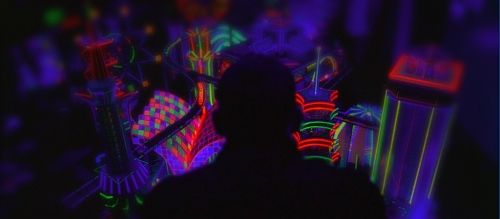
The first time I watched Enter the Void was after signing up for Netflix Instant. I didn't get to see it in theaters, and that may have turned out to be the best simple coincidence in all of my movie watching career. Had I seen this in theaters I may have walked out just as I turned it off after 15 minutes. "Garbage!" "Film school dropout grade Z pretentious science fair project, sophomoric pile of shit."
These were my very first thoughts upon trying out "something different" on this newfangled Hulu-thing. Fortunately, I hate to waste money. After watching all the science docs, and a few odd movies I always wanted to, but never got around to seeing, I went back to give it one more shot, and see if I couldn't at least finish this silly dope-school student project. Maybe there was more to it and I really do hate to waste money. Maybe I could get a little more before I let the free month run out.
Glad I did, because this movie is the freer of the slaves. This movies shows what can be achieved with all the modern equipment and techniques used correctly to convey the story rather than to simply wow the audience with the novelty of the technology itself. Computer-controlled multi-axis camera mounts, rails and dollies that stretched blocks, multi-layered exposures, CGI done by artists with an actual art background. These are things which other have done, and some done well, but mostly done for the sake of doing rather than adding anything to the narrative. This is everything Avatar wanted to achieve with special effects but failed miserably at.
French director Gaspar Noe, unleashes all of it on us in a dazzling and vivid exploration of life after death. He coaxes unrivaled performances out of a cast of nobodies that cover the full spectrum of human emotion, sometimes in a single scene, while weaving a tale of nearly infinite complexity together from the same scenes repeated over and over again but from slightly different perspectives. In the end, we are left to draw conclusions all our own and wonder what life is really all about.
There is really no more I can say about it without spoiling parts of it for someone, and I don't even want to tempt anyone with spoiler tags. Let me just say that for about 20 years, A Clockwork Orange has been my desert island movie. Though assailed by many a fine flick over the years, it has always remained a constant in its #1 slot for me, but after more than a few viewings of Enter the Void (and it will take more than one), I had to finally relegate it to the dungeon of #2.
So why these four movies if Clockwork is #2 why isn't that on the list? Well, I looked at this topic as less of, 'These are my favorites', but more these are the most important films. These are films that changed or will change the way films are done. Time will tell on Lincoln, but I envision a future where Mr. Noe is more widely acclaimed and appreciated for his most revolutionary techniques. As with Lincoln at the time, you will either love or hate this movie, and that's why it's there in his name.











 Facebook
 Twitter