Was AMD's Small Die strategy a huge mistake?

Page 3 - Seeking answers? Join the AnandTech community: where nearly half-a-million members share solutions and discuss the latest tech.

Ventanni

Golden Member
Jul 25, 2011
1,432
142
106
I love listening to my brother rant about poor AMD driver quality, to which I reply, "What issues are you having?", and he can never give me any answer...because he doesn't actually have any AMD cards to make such comments with. What's even more interesting is his 560Ti routinely crashes on him. Not for driver reasons, but because it's likely just a defect card. But, he puts up with it, and refuses to believe I haven't experienced a single driver crash in the years I've owned my Radeon 4850 and 5850.

I'm not an AMD fanatic. They were just the best bang for the buck at the time ($110 for the 4850 and $149 for the 5850 at the time of purchase). I do think Nvidia makes better drivers simply because of their influential developer relations, but I don't believe for one bit that AMD's drivers are as bad as people make them out to be. They were 10 years ago, but times have changed. AMD (ATI) isn't selling Rage cards anymore, kiddos.
 

thilanliyan

Lifer
Jun 21, 2005
12,084
2,281
126
^Haha good luck getting anyone to believe you on that...most people complaining about and drivers are probably like your brother...at least in single card scenarios.
 

3DVagabond

Lifer
Aug 10, 2009
11,951
204
106
AMD's small die strategy was not a huge mistake. They have not fallen way behind. Everything is as competitive now as it's ever been.


THIS JUST IN:

GK104 is barely doable (despite having 26 products available to purchase right now on newegg) and Kepler has suffered setbacks. Nvidia is lucky they know how to rip customers off, otherwise Kepler's setbacks would have bankrupted the company. :rolleyes:

GK104 is barely doable because it was months later than Tahiti and then was mostly out of stock for months after that. Now, yes, there's availability. It hasn't been that way for very long though.

I never accused nVidia of ripping anyone off in my post. Before Kepler there was Fermi which was late to market as well. I don't think AMD could have absorbed those setbacks. You really need to work on your reading comprehension.
 

Yuriman

Diamond Member
Jun 25, 2004
5,530
141
106
Core2 was a mid-range architecture because it was a distillation of the Pentium 3. Pentium 4 was Intel's high-end architecture. Right?

Sometimes it doesn't work out the way you planned.

The specs of the 680 compared with how nV has traditionally worked do suggest that it was intended for mid-range, but it's apparently the best nVidia can produce right now, just as the 7970 is the best AMD can produce. Whether or not a product is called "mid-range" or "top-end" is just semantics. It's a small die for nV but TSMC is having a hard time making a die that big anyway, so it's the top-est-end product that could be made realistically.

/thread


@OP, AMD's small-die strategy has been a success so far as they have remained competitive with nV for years. Sometimes those lower prices don't make it to consumers, but a smaller chip is cheaper to make.
 
Last edited:

nenforcer

Golden Member
Aug 26, 2008
1,782
24
81
The boards with these chips are far dearer than $50. The cheapest is $280. They run to over $400. The assumption that they would need more of them should mean that they would be suffering a greater shortage. They apparently aren't, though. As there is availability of all the boards. Again, this chip shortage is typical that it's someone else's fault nVidia doesn't have product.

What does AMD not updating their mobo chipset have to do with this? :\

I bring this up because AMD was first to market with PCI-E 3.0 graphics cards but their own platform still does not support PCI-E 3.0 speeds.

I am not aware of any AMD chipset based motherboards which even include this PLX bridge chip which would give them PCI-E 3.0 speeds which makes sense because no AMD 900 series motherboard costs more than $230 or so. (Crosshair V Formula)

Less than 6 months out from the launch of some new AMD FX CPU's and there is no word at all on any 10X0 series chipsets which could possibly bring PCI-E 3.0 speeds.

The rumors about the 10X0 series chipset suggests it will have native USB 3.0 but still lack PCI-E 3.0 which apparently won't come until 2013, over a full year after these cards hit the market.
 
Last edited:

BallaTheFeared

Diamond Member
Nov 15, 2010
8,115
0
71
Core2 was a mid-range architecture because it was a distillation of the Pentium 3. Pentium 4 was Intel's high-end architecture. Right?

Sometimes it doesn't work out the way you planned.

The specs of the 680 compared with how nV has traditionally worked do suggest that it was intended for mid-range, but it's apparently the best nVidia can produce right now, just as the 7970 is the best AMD can produce. Whether or not a product is called "mid-range" or "top-end" is just semantics. It's a small die for nV but TMSC is having a hard time making a die that big anyway, so it's the top-est-end product that could be made realistically.

/thread


@OP, AMD's small-die strategy has been a success so far as they have remained competitive with nV for years. Sometimes those lower prices don't make it to consumers, but a smaller chip is cheaper to make.

It's not semantics when it's $500 out of my pocket for next gen "mid-ranged" performance.

Or $600 for the 7970 prior to that goofy 680.

What it is is mid range cards occupying high end price brackets, what is it is a generation worth skipping, what it isn't is sematics as calling a fiero a high end car just because you can't get a lambo doesn't make it worth 2 million or high end.
 
Last edited:

Yuriman

Diamond Member
Jun 25, 2004
5,530
141
106
What it is is the best product that can be produced right now with current process technology. If TSMC is having problems you can be sure everyone is paying for it. It's more like calling a Lambo a mid-range car because there's a non-existent hypothetical supercar that can't really be made that's faster than it. The GTX680 is best they can make and priced is accordingly.
 
Last edited:

3DVagabond

Lifer
Aug 10, 2009
11,951
204
106
I bring this up because AMD was first to market with PCI-E 3.0 graphics cards but their own platform still does not support PCI-E 3.0 speeds.

I am not aware of any AMD chipset based motherboards which even include this PLX bridge chip which would give them PCI-E 3.0 speeds which makes sense because no AMD 900 series motherboard costs more than $230 or so. (Crosshair V Formula)

Less than 6 months out from the launch of some new AMD FX CPU's and there is no word at all on any 10X0 series chipsets which could possibly bring PCI-E 3.0 speeds.

The rumors about the 10X0 series chipset suggests it will have native USB 3.0 but still lack PCI-E 3.0 which apparently won't come until 2013, over a full year after these cards hit the market.

I'm not talking about AMD mobo's or chipsets. I'm referring to the lack of gtx-690's because of a supposed shortage of PLX chips. There are plenty of PLX chips for the Z77 mobo's being marketed by multiple vendors though.

nVidia doesn't have enough GPU's, it's TSMC's fault. nVidia doesn't have GTX-690's it's PLX Technology's fault. When are nVidia's troubles going to be nVidia's fault?
 
Last edited:

KompuKare

Golden Member
Jul 28, 2009
1,235
1,608
136
nVidia doesn't have enough GPU's, it's TSMC's fault. nVidia doesn't have GTX-690's it's PLX Technology's fault. When are nVidia's troubles going to be nVidia's fault?

Never. Or maybe when its leaders grow up...

Strange that Linus got so much criticism here recently from people who seem to have no problem that Nvidia CEO goes around bad-mouthing everyone.
 

Bobisuruncle54

Senior member
Oct 19, 2011
333
0
0
The problem is that AMD became selfish, it wasn't a case of "spoiled consumers".

The 5870 was replaced by the 6970, and the 6970 was replaced by the 7870. Looking at the data available when the cards launched, the performance gap from the 5870 to the 6970 was larger than the gap between the 6970 and the 7870. This was a huge rip off and this is why consumers reacted negatively to the 7000 series launch. The story was almost identical with the 5850 - 6950 - 7850 and to add insult to injury AMD charged 50% more over the 6970s price for the 7970, a card that at the time of release was not pulling ahead of the card by 50%, more like 40%.

In other words, the benefits of a node shrink traditionally seen from generation to generation were eliminated altogether, and this is what annoyed consumers.

The story is not nearly as bad now as prices have dropped quite dramatically, but the launch of the 7000 series was a slap in the face to anyone waiting for an upgrade (aside from the twerps on these forums spouting out rubbish like: "can't afford a 7970? Earn more.")
 

tviceman

Diamond Member
Mar 25, 2008
6,734
514
126
www.facebook.com
The 4850 was and still is an amazing gpu. All those 8800GTS/GTX, 79XX GeForce, and X19XX radeons are all obsolete and pretty much useless right now. But the 4850/4870 is alive and well. It was so successful that the secondhand market is flooded with these things for dirt cheap. It uses a lot of power compared to a 7750, but its still tolerable for a budget gamer. Combined with a G620 or i3-21xx, you can game for under 150 watts.

AMD is no longer supporting the 4800 series. No more driver updates. If you buy one today, chances are the latest games will have issues with it, even if it has enough power to play it.
 

tviceman

Diamond Member
Mar 25, 2008
6,734
514
126
www.facebook.com
Neither Fermi nor Kepler were "late" like any other wizard they arrived precisely when they meant to.

If you're going to quote Anandtech articles as being facts on subjects you are discussing (such as GK104 being middle-kepler and not the flagship to which I agree on principle), then you need to be consistent. Fermi was in fact six months late. Look no further than Anandtech's Title on their gtx480 review. Beyond that, JHH said himself in many interview Fermi had delays.

Quit twisting the truth to fit your argument, it just makes you less believable in everything else you argue about.
 

jacktesterson

Diamond Member
Sep 28, 2001
5,493
3
81
Nvidia did not copy it with kepler. gk104 was not going to be their top chip so it was pretty stripped down. once they saw that gk104 with higher clocks could roll with the 7970, it become their official top chip. if the 7970 would have been a faster card then we would have no gtx680 at this time.

Pure fiction.
 

Lonyo

Lifer
Aug 10, 2002
21,938
6
81
AMD is no longer supporting the 4800 series. No more driver updates. If you buy one today, chances are the latest games will have issues with it, even if it has enough power to play it.

Woo, some read FUD in a thread.
http://www.hardwarecanucks.com/news...4000-driver-releases-nixes-windows-8-updates/

Contrary to some rumors, AMD will not be discontinuing support for their legacy products. Rather, a new Quarterly Driver Release schedule will be put into place.

http://www.anandtech.com/show/5775/...4000-gpus-being-moved-to-legacy-status-in-may
 

HurleyBird

Platinum Member
Apr 22, 2003
2,818
1,553
136
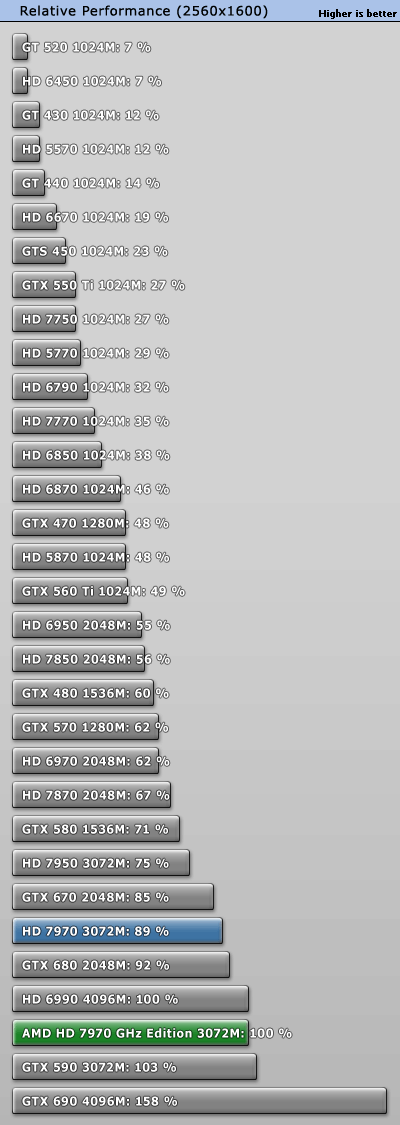
3 overclocked 470s to match OC'ed 680/7970 SLI/CF, two 470s easily beats both cards in single configurations.

No, just no. A single GHz edition is over twice as fast as a 470 at resolutions that will actually begin to utilize either setup. Without micro-stuttering, added input lag, or compatibility issues.

perfrel_2560.gif


I'd take a single 7970 or 680 over three GTX 470s any day of the week. So would anyone who knows anything about tech.

Can you please for the love of God stop bringing up your 470's in every single thread?
 
Last edited:

thilanliyan

Lifer
Jun 21, 2005
12,084
2,281
126
The problem is that AMD became selfish, it wasn't a case of "spoiled consumers".

AMD is a a publicly traded company that has to maximize profits within legal bounds...they don't exist to be "fair" to you.

It absolutely was a case of spoiled customers...do you remember prices during the X1800/X1900 days? They were in line with what we have now...sometimes worse.

We were spoiled during the 4XXX/5XXX days because AMD got it wrong with the 29XX series and lost a lot of market share. They were trying to get it back along with some goodwill probably...they could have priced the 48XX cards close to what nV were charging at the time ($650 for GTX280!!) but they didn't...why do you think that was?
 

ShintaiDK

Lifer
Apr 22, 2012
20,378
146
106
AMDs profit margin on GPUs have never had any real success. Most time it just around the 0, pretty terrible. And then we had all the stories from the dedicated crowd on how the small dies would reap in the profit and how nVidia was in trouble. nVidia makes money, real money.

For those complaining about prices. It will only go up in the future as processnode cost dont really benefit in the transistor/$ ratio. So I wouldnt be surprised if something equal to a Tahiti/Pitcairn/GK104 card would reach 800-1000$ 4-5 years down the road.
 

f1sherman

Platinum Member
Apr 5, 2011
2,243
1
0
For those complaining about prices. It will only go up in the future as processnode cost dont really benefit in the transistor/$ ratio.

Meanwhile TSMC posts record Q2 earnings, so there might be something in that NV whining about partners having to share good and bad.
 

ShintaiDK

Lifer
Apr 22, 2012
20,378
146
106
Meanwhile TSMC posts record Q2 earnings, so there might be something in that NV whining about partners having to share good and bad.

They also post record R&D and construction cost.

A 22nm factory cost 5-6billion$, a 14nm factory cost 10billion$. And if your volume didnt double, then there is only one place to get the money.