• We’re currently investigating an issue related to the forum theme and styling that is impacting page layout and visual formatting. The problem has been identified, and we are actively working on a resolution. There is no impact to user data or functionality, this is strictly a front-end display issue. We’ll post an update once the fix has been deployed. Thanks for your patience while we get this sorted.

[VR-Zone]Skylake-K coming out only 1.5 months after Broadwell-K

Page 3 - Seeking answers? Join the AnandTech community: where nearly half-a-million members share solutions and discuss the latest tech.
AMD can figure out GPU. GPU isn't holding up Intel's whole 14nm product stack, and if there were GPU issues we wouldn't see broadwell parts trickling out, rather, we wouldn't see them at all.
 
Last edited:
There's no evidence for a non-existent hyphothesis either, so I'll stick with mine till someone at Intel comes clean about the reason for CT and Broxton's delay (and if they are related).

Sweepr

I think all of the 14nm SoC products got hit with a 2 quarter delay (probably not-so-coincidentally the same length of time that Broadwell got delayed). Intel's PC business is so important in terms of revenue/profits that it probably did everything it could to protect Skylake's launch schedule.
 

From that article:

"The spec table indicates that 100-series chipsets will provide M.2 SSDs with up to four lanes of bandwidth."

Assuming that is 4x PCIe Gen 3 lanes, it means 4 GByte/s. That will provide some nice SSD speeds... 😎

No USB 3.1 though, which is a bit sad. I'd like to have USB 3.1 Type C, so a single cable could provide both power and image to the monitor. And also charge/power devices at up to 100 W.
 
working out the kinks of a new process node using an old uarch design so that they wouldn't also be debugging a new uarch is the whole point of the tick-tock strategy. the fact that intel is executing on it doesn't mean broadwell is a failure, it means that tick-tock is working.
I normally agree with your posts, but this one... doesn't make any sense to me (yet). Are you saying that it doesn't matter if either the tick or tock doesn't work correctly, as long as one of them does (then the other one is still a success)?
 
I normally agree with your posts, but this one... doesn't make any sense to me (yet). Are you saying that it doesn't matter if either the tick or tock doesn't work correctly, as long as one of them does (then the other one is still a success)?

no, i'm saying it's a risk management strategy by intel, and this is what it was designed to do. the whole point is to not have to hold up the next product in the sequence. so, skylake is not getting held up.
 
no, i'm saying it's a risk management strategy by intel, and this is what it was designed to do. the whole point is to not have to hold up the next product in the sequence. so, skylake is not getting held up.
Ah, that does sounds like a good strategy overall. Thanks for the clarification.
 
no, i'm saying it's a risk management strategy by intel, and this is what it was designed to do. the whole point is to not have to hold up the next product in the sequence. so, skylake is not getting held up.

Sound good in theory. But how does that strategy work in reality?

Let's say Intel is on a 12 month cadence, and either a tick or tock gets delayed 9 months. Is it reasonable to only provide a 3 months live span for the delayed CPU generation? What OEMs would design products based on the delayed generation, knowing that it will end up on the discount shelves in just 3 months, when the next CPU generation is released? 😕
 
Sound good in theory. But how does that strategy work in reality?

Let's say Intel is on a 12 month cadence, and either a tick or tock gets delayed 9 months. Is it reasonable to only provide a 3 months live span for the delayed CPU generation? What OEMs would design products based on the delayed generation, knowing that it will end up on the discount shelves in just 3 months, when the next CPU generation is released? 😕

to answer a question with a question: is it reasonable to intentionally sandbag (by delaying skylake so that broadwell has time on the market) performance improvements that each tick and each tock bring when the largest competitor in your market is your own installed base?

other answer: if intel keeps the CPU sockets and similar TDP targets around for both a tick and a tock (and it has) there isn't as much design involved. a lot of stuff will just bolt right up.

also: this one is more complicated by the fact that we'll be changing memory types as well and so releasing broadwell (rather than dropping it from existence) is risk management against DDR4 prices staying high (see: rambus debacle).
 
Last edited:
What OEMs would design products based on the delayed generation, knowing that it will end up on the discount shelves in just 3 months, when the next CPU generation is released? 😕
I can already imagine the conversation:
- We don't want Broadwell, we'll go straight for Skylake if you don't mind.
- Ok, but you might have to wait for a while, people who order 5th gen chips get priority for 6th chips as well. Better yet, are you sure you don't want to stockpile a few more 4th gen chips in advance? Winter is coming...

On a more serious note, some OEMs did exactly what you described.
 
I can imagine some circumstances where I'd get BW-K. For example if I could use it with my current Z87 mb and DDR3.

DDR4 is still expensive, and especially when you have 16/24/32Gb DDR3 and want at least as much.
 
I have a 5930K with 16GB DDR4 X99 in my gaming box and a 4770 non K with 16GB DDR3 Z87 in my porn box. I see nothing that Broadwell or Skylake offers for me at least. M.2/PCI-E SSDs are still up in the air and not exactly 100% standardised yet (or easily/cheaply available), more ports and slots meh, is the Skylake southbridge shrunk down to at least 22nm even? Is the creaky slow DMI link updated yet? Is Intel still screwing around with FIVR?
 
I have a 5930K with 16GB DDR4 X99 in my gaming box and a 4770 non K with 16GB DDR3 Z87 in my porn box. I see nothing that Broadwell or Skylake offers for me at least. M.2/PCI-E SSDs are still up in the air and not exactly 100% standardised yet (or easily/cheaply available), more ports and slots meh, is the Skylake southbridge shrunk down to at least 22nm even? Is the creaky slow DMI link updated yet? Is Intel still screwing around with FIVR?
True, for porn images even 8086 works, maybe Pentium 3 for videos. I remember Strip Poker on Commodore 64 would take like two minutes to draw an entire uncensored image top to bottom but the anticipation is part of the fun right? :awe:
 
to answer a question with a question: is it reasonable to intentionally sandbag (by delaying skylake so that broadwell has time on the market) performance improvements that each tick and each tock bring when the largest competitor in your market is your own installed base?

That kind of reasoning might apply to Intel, but not to OEMs. And in the end it's OEMs that will sell products with Intel CPUs in them. If their sales window for a CPU generation gets too narrow, the ROI will not be sufficient for them.
 
That kind of reasoning might apply to Intel, but not to OEMs. And in the end it's OEMs that will sell products with Intel CPUs in them. If their sales window for a CPU generation gets too narrow, the ROI will not be sufficient for them.

So we're in agreement that Intel shouldn't delay skylake on account of broadwell not getting enough time on the market
 
So we're in agreement that Intel shouldn't delay skylake on account of broadwell not getting enough time on the market

Nope, I'm not sure we agree on that. Because then no OEMs would want to create products based on Broadwell.

Also, I have a hard time seeing how even Intel can get ROI from Broadwell R&D investments in just 3 months.
 
Nope, I'm not sure we agree on that. Because then no OEMs would want to create products based on Broadwell.

Also, I have a hard time seeing how even Intel can get ROI from Broadwell R&D investments in just 3 months.

(1) we've already seen that OEMs are releasing Broadwell (mainly in product refreshes) despite the fact that Skylake is on its way;

(2) The sunk costs mostly go to developing new process technology and new architecture. They can capture a return for both with Skylake, so no need to really care that much about Broadwell. Most everything that went into Broadwell was necessary for the development of Skylake. Therefore, you can think of the Broadwell costs as part of Skylake's development costs.
 
Via Sweclockers, VR Zone (the Chinese one) has said that it now looks like Intel is not going to stagger their release but do an all-at-once release.

That means Skylake-K, the full suite. It now looks like August 15th is the date, although as VR Zone writes, that date has been moved around quite a bit so we shouldn't be surprised if it happens again.

The point is that Intel is trying to get it all out before school/university starts.
I doubt that we'll even see Broadwell K at this point, but I'm happy that we'll get Skylake-K right away. Now just get us Skylake-E this year, too.
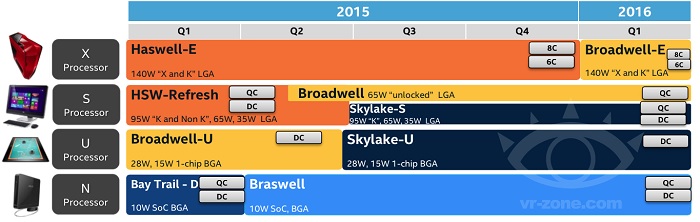
 
Via Sweclockers, VR Zone (the Chinese one) has said that it now looks like Intel is not going to stagger their release but do an all-at-once release.

That means Skylake-K, the full suite. It now looks like August 15th is the date, although as VR Zone writes, that date has been moved around quite a bit so we shouldn't be surprised if it happens again.

The point is that Intel is trying to get it all out before school/university starts.
I doubt that we'll even see Broadwell K at this point, but I'm happy that we'll get Skylake-K right away. Now just get us Skylake-E this year, too.

Yes, the date has moved around quite a bit to say the least. Previously it was June 2015 for Skylake-U:

1a.jpg


Maybe they are presenting it at Computex in June, and actual availability will be in mid-August.
 
Personally I applaud Intel for at least trying to keep to their release schedule. They could have easily pulled an nvidia and milked broadwell for a year. It's nice that even though broadwell is late, they aren't letting it affect skylake's release much. And I'm glad because I'm dying to upgrade my computer and hopefully skylake is where it's at.
 
Personally I applaud Intel for at least trying to keep to their release schedule. They could have easily pulled an nvidia and milked broadwell for a year. It's nice that even though broadwell is late, they aren't letting it affect skylake's release much. And I'm glad because I'm dying to upgrade my computer and hopefully skylake is where it's at.

Most people don't like Intel. I even read comparisons with IE6. I think people need to learn more about the physics of increasing clock speeds before saying things about which they have no knowledge and emotionally victimizing the wealthy company.
 
Most people don't like Intel. I even read comparisons with IE6. I think people need to learn more about the physics of increasing clock speeds before saying things about which they have no knowledge and emotionally victimizing the wealthy company.

In general, I dont think people really care. They just want the best product for their needs at the best price. Now these forums OTOH........
 
Back
Top
