[VC]NVIDIA GeForce GTX 980, GTX 980 SLI, GTX 970, 3DMark performance

Page 7 - Seeking answers? Join the AnandTech community: where nearly half-a-million members share solutions and discuss the latest tech.

therealnickdanger

Senior member
Oct 26, 2005
987
2
0
So if I understand the alleged leaks and rumors, GTX 980 will be a little faster than a 780Ti, have 4/8GB GDDR5, have a 30% lower TDP, and be ~$500?

Looks like it's finally time to upgrade my GTX 470 and CRT to a GTX 980 and Acer XB280HK (if it ever comes out).
 

96Firebird

Diamond Member
Nov 8, 2010
5,749
345
126
Alright that makes more sense then.

Its similar to Hawaii in die size actually. Definitely 400mm2+ which dampens my excitement somewhat since I was still thinking Maxwell mid-range at ~300mm2 like Gk104 was.

If it is close to Hawaii in die size, I guess all the people complaining that it is a mid-range product should also be complaining that Hawaii is mid-range?
 

FatherMurphy

Senior member
Mar 27, 2014
229
18
81
Isn't mid-range relative? We all know that Nvidia will release a bigger die than GM204 sooner rather than later. On the other hand, it would be unprecedented (at least from recent history) for AMD to release a bigger die than Hawaii.

I think we get carried away with die sizes. It's all about performance at the time of release.
 

SirPauly

Diamond Member
Apr 28, 2009
5,187
1
0
What you are saying is perfectly valid, we are talking about a next gen mid-range vs. previous gen flagship. But you forgot the pricing aspect:

560Ti launched at $249. Similarly, 460 1GB beat 280/285 for $230.

It's obviously unfair to expect NV to price a new mid-range architecture at $230-250 since manufacturing costs for new fabs and thus wafers have increased. However, let's say we accept your analogy once again -- 480 and 580 cost $499 and 780Ti went up to $699 or a 40% price increase.

Let's now take 980 as a 460/560Ti style replacement since you yourself admitted it to be mid-range, apply 40% price increase to $250 and we should get $350. Let's say $50 premium for performance/watt aspect that everyone is crazy about lately - $399 is really a fair price for 980, not $500-550. The 2nd reason $499 is way too much is because when NV raised 680 mid-range to $499, at least it beat 580 by 30-35%.

Ya can't do that objectively without considering competition:

Did the GTX 460 offer more performance than the HD 5870 and what was the MSRP of the HD 5870?

The reason is simple: nVidia's second tier chips compete strongly compared to AMD's finest than the past and AMD has forsaken the sweet spot strategy and raised their MSRP's.
 

Mand

Senior member
Jan 13, 2014
664
0
0
ROFL, 256-bit memory interface, peasant card Nvidia. Where is the replacement for my 780 Ti GHz? Hits 1215MHz core in game . . . . . I have no incentive to upgrade.

Ah, so when will you be trading in that 780 Ti for the GTX 280? GTX 280 is 512 bit!

Hint: Bus width isn't the sole determinant of a card's performance, or even really all that important.
 

Deders

Platinum Member
Oct 14, 2012
2,401
1
91
Ah, so when will you be trading in that 780 Ti for the GTX 280? GTX 280 is 512 bit!

Hint: Bus width isn't the sole determinant of a card's performance, or even really all that important.

Depends on the chip really, the 670 for instance could have done with a wider memory bus, the stock bandwidth 256 bit @6000MHz crippled it in certain games. Overclocking it to 7000MHz made a huge difference in Crysis 3 making it comfortable playable at the highest details, but some types of memory don't overclock as well as others so a 384 bit bus would have been very welcome here.
 

wand3r3r

Diamond Member
May 16, 2008
3,180
0
0
Ah, so when will you be trading in that 780 Ti for the GTX 280? GTX 280 is 512 bit!

Hint: Bus width isn't the sole determinant of a card's performance, or even really all that important.

That couldn't be farther from the truth. Memory bus width (bandwidth) is critical on gpus, of course it's relative to the capabilities of the gpu.

There are a few reasons it's of concern. 4k requires immense bandwidth. The card is being marketed as the fastest nv card (980, no ti yet) and will likely be priced high too. As resolutions go up, it may become a bottleneck. We don't know if nv has developed techniques to minimize bandwidth constraints, but it's a valid question and concern.
 

Cloudfire777

Golden Member
Mar 24, 2013
1,787
95
91
You can`t compare memory bus across different architectures and conclude that it will struggle in certain resolutions.
They have different ways of dealing with this stuff.
 

Vesku

Diamond Member
Aug 25, 2005
3,743
28
86
You can`t compare memory bus across different architectures and conclude that it will struggle in certain resolutions.
They have different ways of dealing with this stuff.

Kudos to Nvidia if they can compress 4K bandwidth needs down to something a 256 bit ~7GHz GDDR5 bus can handle well and not noticeably affect image quality. Will wait for 4K reviews though to see if they actually managed to pull that off.
 

MathMan

Member
Jul 7, 2011
93
0
0
If it is close to Hawaii in die size, I guess all the people complaining that it is a mid-range product should also be complaining that Hawaii is mid-range?
They'll argue that a 256 bits of DRAM is cheaper than 512 bits, and that morer is betterer and that they're entitled to the naming right of that chip.
 

Cloudfire777

Golden Member
Mar 24, 2013
1,787
95
91
Kudos to Nvidia if they can compress 4K bandwidth needs down to something a 256 bit ~7GHz GDDR5 bus can handle well and not noticeably affect image quality. Will wait for 4K reviews though to see if they actually managed to pull that off.
There is a lot of "secret sauce" about Maxwell which Anandtech wrote about in the GTX 750 Ti review that Nvidia havent shared yet.

The fact that a GTX 750 Ti with 86.4GB/s bandwidth does just as good in 900p as it does in 1600p against GTX 650 Ti Boost with 144.2GB/s bandwidth, means there are some really good optimizations done on the bandwidth part.

http://www.techpowerup.com/reviews/NVIDIA/GeForce_GTX_750_Ti/25.html

So I wouldnt worry too much about that the GM204 is only 256bit.
 

Mand

Senior member
Jan 13, 2014
664
0
0
That couldn't be farther from the truth. Memory bus width (bandwidth) is critical on gpus, of course it's relative to the capabilities of the gpu.

There are a few reasons it's of concern. 4k requires immense bandwidth. The card is being marketed as the fastest nv card (980, no ti yet) and will likely be priced high too. As resolutions go up, it may become a bottleneck. We don't know if nv has developed techniques to minimize bandwidth constraints, but it's a valid question and concern.

Bus width and bandwidth are not the same thing.

Which has more memory bandwidth, GTX 280 or GTX 780?

And even once you're talking about the right metric, bandwidth alone isn't necessarily something you can compare directly across architectures.

Bottom line: people hyperventilating about 256-bit versus 512-bit are missing the big picture. Badly.
 

piesquared

Golden Member
Oct 16, 2006
1,651
473
136
There is a lot of "secret sauce" about Maxwell which Anandtech wrote about in the GTX 750 Ti review that Nvidia havent shared yet.

The fact that a GTX 750 Ti with 86.4GB/s bandwidth does just as good in 900p as it does in 1600p against GTX 650 Ti Boost with 144.2GB/s bandwidth, means there are some really good optimizations done on the bandwidth part.

http://www.techpowerup.com/reviews/NVIDIA/GeForce_GTX_750_Ti/25.html

So I wouldnt worry too much about that the GM204 is only 256bit.

Not necessarily. Perhaps the 650 had more than it needed and lowering the bandwidth would have a minimal impact.
 

AtenRa

Lifer
Feb 2, 2009
14,003
3,362
136
The fact that a GTX 750 Ti with 86.4GB/s bandwidth does just as good in 900p as it does in 1600p against GTX 650 Ti Boost with 144.2GB/s bandwidth, means there are some really good optimizations done on the bandwidth part.

http://www.techpowerup.com/reviews/NVIDIA/GeForce_GTX_750_Ti/25.html

So I wouldnt worry too much about that the GM204 is only 256bit.

From your link,

Have a look what happens when you enable AA filters at 1080p/1600p

GTX650Ti Boost is ~14% faster
ac4_2560_1600.gif


GTX650Ti Boost is ~11% faster
bf3_2560_1600.gif


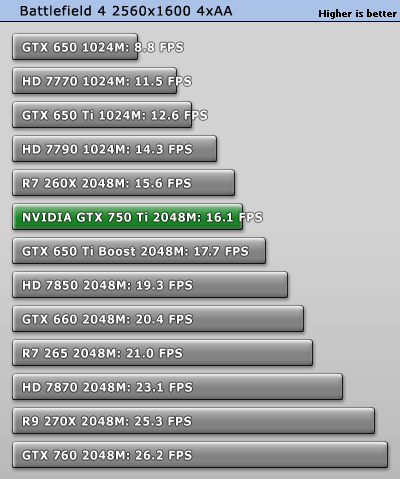
GTX650Ti Boost is ~10% faster
bf4_2560_1600.gif


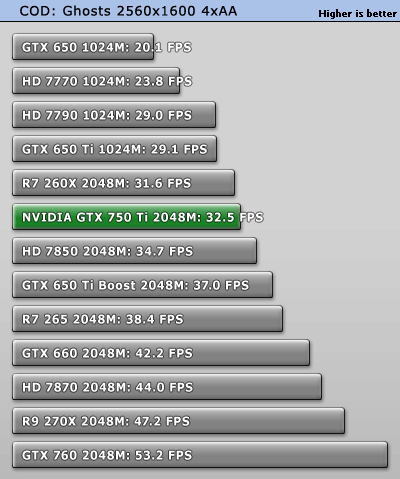
GTX650Ti Boost is ~14% faster
cod_ghosts_2560_1600.gif


GTX650Ti Boost is ~24% faster
crysis_2560_1600.gif


GTX650Ti Boost is ~24% faster
diablo3_2560_1600.gif


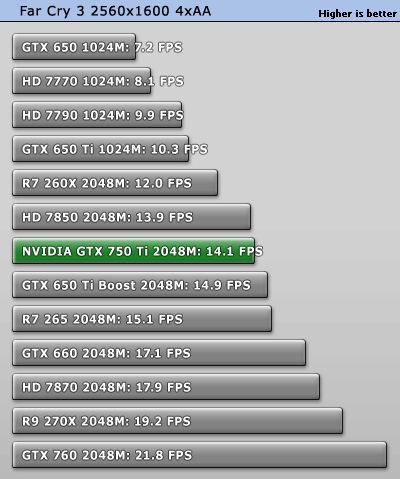
GTX650Ti Boost is ~6% faster
farcry3_2560_1600.gif


Now, Crysis 3 and Batman is the only games that 750Ti is faster than 650Ti Boost at 1600p 4x AA.
crysis3_2560_1600.gif


batman_ao_2560_1600.gif


No look what happens when no AA Filters are used,

GTX750Ti faster than GTX650ti Boost
http://tpucdn.com/reviews/NVIDIA/GeForce_GTX_750_Ti/images/bioshock_2560_1600.gif

GTX750Ti equal to GTX650ti Boost
http://tpucdn.com/reviews/NVIDIA/GeForce_GTX_750_Ti/images/coj_gunslinger_2560_1600.gif

GTX750Ti equal to GTX650ti Boost
http://tpucdn.com/reviews/NVIDIA/GeForce_GTX_750_Ti/images/metro_lastlight_2560_1600.gif

Same happen to AMD R9 285, once you enable AA filters, GPUs with fewer ROPs struggle badly. I believe we will see the same behavior with GM204 vs GK110.
 
Last edited:

Mand

Senior member
Jan 13, 2014
664
0
0
I'd be hard pressed to believe that you can isolate memory bus width as the determinant for the performance differential, however.
 

Cloudfire777

Golden Member
Mar 24, 2013
1,787
95
91
From your link,

Have a look what happens when you enable AA filters at 1080p/1600p

Same happen to AMD R9 285, once you enable AA filters, GPUs with fewer ROPs struggle badly. I believe we will see the same behavior with GM204 vs GK110.

There is very intensive games with AA where the GTX 750 Ti is better than 650 Ti Boost too.
Like Crysis 3 where it is 20% faster. Or Tomb Raider where they are equal.

Most of the games the 650 Ti is 10% above in 1600p (which is why it is 10% faster in average) but that isnt because of the bandwidth but because of the cores itself between the two.
 

AtenRa

Lifer
Feb 2, 2009
14,003
3,362
136
There is very intensive games with AA where the GTX 750 Ti is better than 650 Ti Boost too.
Like Crysis 3 where it is 20% faster. Or Tomb Raider where they are equal.

Most of the games the 650 Ti is 10% above in 1600p (which is why it is 10% faster in average) but that isnt because of the bandwidth but because of the cores itself between the two.

Same happens at 1080p when you enable AA filters. Have a look at TPU GTX750Ti review, it is almost the same situation at 1080p 4xAA and 1600p 4xAA.

Edit: I havent spoken about memory Bus or Bandwidth but ROPs. ;)

Edit 2 : GTX650Ti boost has 768 Cores at 980MHz , GTX750Ti has 640 cores at 1040MHz. The performance advantage with 4xAA of GTX650Ti Boost is clearly because of 24ROPs vs 16ROPs on the GTX750Ti and not Core performance.
 
Last edited:

wand3r3r

Diamond Member
May 16, 2008
3,180
0
0
I'd be hard pressed to believe that you can isolate memory bus width as the determinant for the performance differential, however.

Why don't you start by backing up the claim that the bus width isn't important.
 

Grooveriding

Diamond Member
Dec 25, 2008
9,147
1,330
126
Huh ? Bus width in relation to memory speed has a direct relation to memory bandwidth. More lanes from memory to GPU, more bandwidth. Now if there were faster GDDR5 than the current 7ghz stuff it would be possible for the 980 to have bandwidth closer to 780ti's and Titan Black's 336gb/s. There is not though, so gtx980 256bit bus and 7ghz vram will have 224gb/s like the gtx770.

Memory bandwidth plays a big role in high resolutions and core overclock's effect on performance scaling.

In these possible leaked benches, a 1080p bench, the 980 is only faster than a 780ti when the 780ti is crippled and forced to run at 928mhz. Otherwise they are equal. If these benches are genuine, if, the 980 will be slower at resolutions higher than 1080p versus the 780ti and slower across the board with both cards overclocked as the GK110 card should scale better with overclocks.

The closer the launch of this card gets, the slower the leaks have it performing. I don't even get the mid range vs high end card arguments at this point. It's starting to look as if this won't even be the fastest card on the market in many cases... Maybe gtx980LE, light edition, is a good name for it. Then launch a big card as the 980 next year some time.
 

Cloudfire777

Golden Member
Mar 24, 2013
1,787
95
91
Same happens at 1080p when you enable AA filters. Have a look at TPU GTX750Ti review, it is almost the same situation at 1080p 4xAA and 1600p 4xAA.

Edit: I havent spoken about memory Bus or Bandwidth but ROPs. ;)

Edit 2 : GTX650Ti boost has 768 Cores at 980MHz , GTX750Ti has 640 cores at 1040MHz. The performance advantage with 4xAA of GTX650Ti Boost is clearly because of 24ROPs vs 16ROPs on the GTX750Ti and not Core performance.

ROPs are bandwidth related.
You find just as many ROPs on GK107 GTX 650 as you do on a GM107 GTX 750Ti.

In average the 750 Ti and 650 Ti Boost are keeping the same difference on 1080p as they do on 1600p.
And I`m very inclined to say that there is a massive bandwidth usage % difference between those two resolutions which should have shown a greater difference if it was a memory bus problem. But it doesnt
 

amenx

Diamond Member
Dec 17, 2004
4,696
2,998
136
Bus width is important but also dependent on the architecture to maximize its usage and efficiency. Thats why historically we've seen many examples where lower bit bus cards (usually mid-range) beat or equal last gens higher bit bus flagships (ie 680 vs 580). Hell the 680 beat or equalled the competing 7970 from same gen even at high resolutions. Nvidia have usually been good at this, compressing more bandwidth through smaller bit buses. And I think this will prove to be the case with the 980. Although I would be interested to see how it holds up @ 4k resolution.
 

Cloudfire777

Golden Member
Mar 24, 2013
1,787
95
91
192bit GTX 660 certainly had no problems keeping up with a 384bit GTX 580.
Its 144.2GB/s vs 192.4GB/s
 

wand3r3r

Diamond Member
May 16, 2008
3,180
0
0
Bus width is important but also dependent on the architecture to maximize its usage and efficiency. Thats why historically we've seen many examples where lower bit bus cards (usually mid-range) beat or equal last gens higher bit bus flagships (ie 680 vs 580). Hell the 680 beat or equalled the competing 7970 from same gen even at high resolutions. Nvidia have usually been good at this, compressing more bandwidth through smaller bit buses. And I think this will prove to be the case with the 980. Although I would be interested to see how it holds up @ 4k resolution.

This is so, but it's a valid concern. It goes without saying it's not directly comparable across architectures as it's tied to specific architecture constraints.

At this point it would take some interesting twist to maintain performance scaling as the resolution scales. I'm not saying they can't do it, but I'll be surprised if the leaks are true and it scales better.

I would imagine nv is aware that these cards are hitting as 4k is starting to get a small base. Hopefully they've addressed it if this is their new flagship for the moment, until they trickle down another anyway.