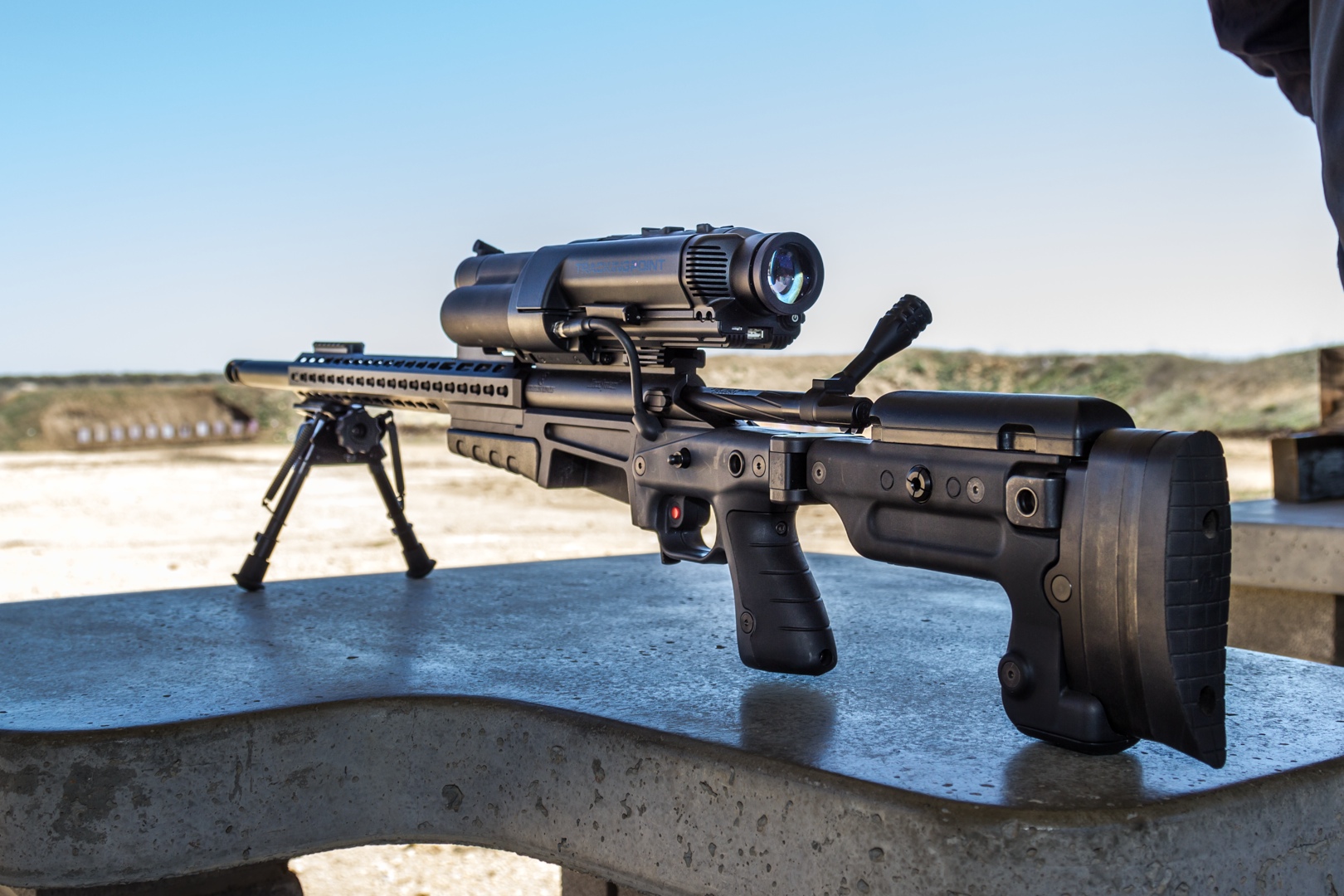
US Army tests smart-rifle scope

Page 2 - Seeking answers? Join the AnandTech community: where nearly half-a-million members share solutions and discuss the latest tech.

Paratus

Lifer
Jun 4, 2004
17,711
15,982
146
LOL That was my first thought. A rifle that won't fire is a club.


Gotta remember also that the 5.56mm was first selected by the Air Force, a branch unlikely to fire its rifles in battle. I suspect that the 5.56mm was selected as much as possible to forestall adoption of the British .280 (which ironically would make a near-perfect infantry round) and thereby retain NATO leadership for America. Also, the round was selected for general use at a time when we thought typical battle distances would be 100 - 200 meters (basically inside artillery danger close range, otherwise just send a shell) and when our immediate opponents were 100 pound men in light silk. Also need to remember that the original round was only barely stabilized and did horrendous damage. It was only when we over-stabilized the bullet (to add penetration and increase range) and especially went to short barrels that we began to see problems as the bullet no longer tumbled readily.


Wouldn't the need to adjust for wind kind of invalidate this for long range use?

It'll take wind into account if you are or have someone spotting for you:

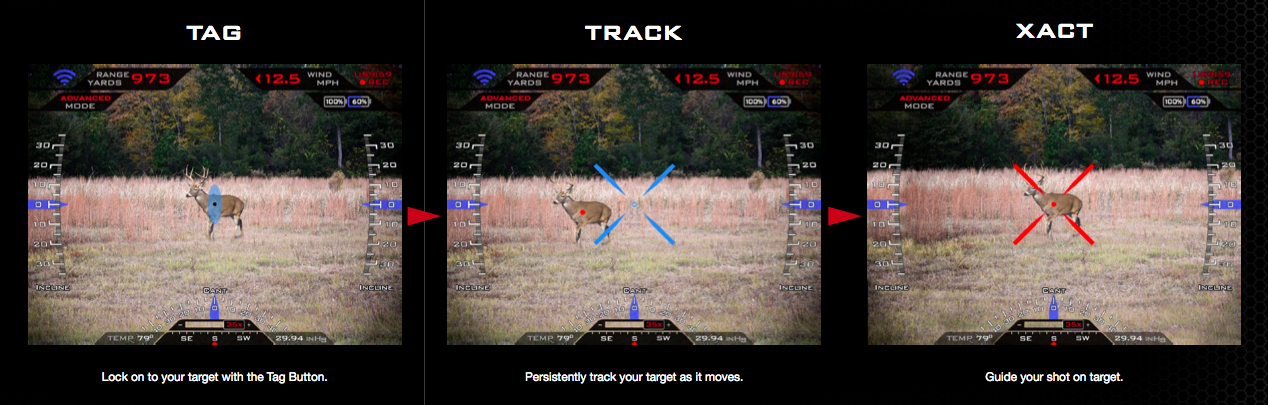
My photographer, Steve, squints through a computerized scope squatting atop a big hunting rifle. We're outdoors at a range just north of Austin, Texas, and the wind is blowing like crazy—enough so that we're having to dial in more and more wind adjustment on the rifle's computer. The spotter and I monitor Steve's sight through an iPad linked to the rifle via Wi-Fi, and we can see exactly what he's seeing through the scope. Steve lines up on his target downrange—a gently swinging metal plate with a fluorescent orange circle painted at its center—and depresses a button to illuminate it with the rifle's laser.

"Good tag?" he asks, softly.

"Good tag," replies the spotter, watching on the iPad. He leaves the device in my hands and looks through a conventional high-powered spotting scope at the target Steve has selected. The wind stops momentarily. "Send it," he calls out.

Steve pulls the trigger, but nothing immediately happens. On the iPad's screen, his reticle shifts from blue to red and drifts toward the marked target. Even though I'm expecting it, the rifle's report is startling when it fires.

A second later, the spotter calls out, "That's a hit!"

Steve has just delivered a .338 Lapua Magnum round directly onto a target about the size of a big dinner plate at a range of 1,008 yards—that's ten football fields, or a tick over 0.91 kilometers. It's his very first try. He has never fired a rifle before today.

While military snipers can already out shoot this, allowing noobs to hit targets at over 1000 yards in real conditions is pretty impressive.
 

werepossum

Elite Member
Jul 10, 2006
29,873
463
126
Maybe a squad marksman could use it. No actual sniper is gonna use this thing. They have a rangefinder, tables, their spotter, and their training which far surpass what this does.
That makes sense, as long as it has a switch to disable it for those times when it's more important that someone cease his actions than actually hitting him.

It'll take wind into account if you are or have someone spotting for you:

While military snipers can already out shoot this, allowing noobs to hit targets at over 1000 yards in real conditions is pretty impressive.
Ah, I stand corrected. Granted, it's all awesome.
 

trenchfoot

Lifer
Aug 5, 2000
15,973
8,566
136
No, and fuck no.

Any sniper making a shot like that is not going to want a computerized nanny making his decisions.

This thing can't wind dope and is no good for moving targets. It's just a ballistic compensator with a laser designator.

OK, makes sense to me. :thumbsup:

Also found out (I may be wrong) that the SEALs were using modified M-4's because of the short range to the targets (being towed at 40 yds distance in wake smoothed water).

As for myself, I wouldn't want to use those "aids" in a real shootout either as I wouldn't trust them with my life, I shoot well enough in the field without them (or used to anyway) ;) and I'd rather trust myself and my experience than have those thingies take priority over my own situational awareness and burned in target acquisition habits.

OTOH, I wouldn't mind fooling around with those things just to satisfy my curiosity. :)
 

Nebor

Lifer
Jun 24, 2003
29,582
12
76
I think the expense of the system will be a big limiting factor in it's deployment throughout conventional forces. I realize most people think combat is like Call of Duty, and you're accurately dispatching enemies inside of 100 meters with your rifle, but that's not the case for most conventional forces.

It's more like you're on patrol (vehicle or foot) and the enemy initiates contact with explosives (IED, rockets, mortars.) Then they engage from a relatively safe distance (700-1000 yards) with machine guns (RPK, PKM, DSHK if you're having a bad day.) They realize that we have a huge advantage in close and medium range combat due to superior training, weapons & optics, so they don't fight us there.

At this point the combined M4s of a platoon are essentially suppressive in nature until the heavier weapons can get on target (M240, M2, Mk19.) In modern warfare, most enemy casualties are inflicted via machine guns & air support. The idea that we're going to slap a $20,000 optic\fire control system on everyone's rifle is a little silly. Most of the time an M4 fired, it isn't with a whole lot of prior thought (ie. no time to laser designate a target and then try to place precise shots on it.)

I could see this being useful for SDMs when attached to a Mk14, but the system thus far seems geared towards M4 type rifles. And even then, I have grave reservations regarding anything that could keep a weapon from operating due to a malfunction.

ETA: I do think this is cool tech, and will likely find a home in some special operations communities, where they have the time to plan their shots, on account of them shooting first.
 

Paratus

Lifer
Jun 4, 2004
17,711
15,982
146
The article I linked too has video of the scope in action. The original version were mounted on three different bolt action long range hunting rifles.
tp-track.png


tp2-xs2-oblique.jpg
 
Last edited:

trenchfoot

Lifer
Aug 5, 2000
15,973
8,566
136
And then there's the idea that by "idiot-proofing" the target acquisition and execution process it would give an numerically superior enemy who cannot afford the time and training required to field a superior marksman the upper hand.

Bringing "fire and forget" tech down to the grunt level is, I assume, attainable somewhere in the future. However, that would bring along with it a real game changing epoch in how engagements are "strateegerized".

Having every troop being turned into a highly accurate mobile voice operated hi-tech weapons delivery platform is a field commander's wet dream come true methinks.
 

LTC8K6

Lifer
Mar 10, 2004
28,520
1,576
126
How does it work in snow/rain/smoke/fog?

How easy is it for a uniform to be made to defeat a laser rangefinder?
 

werepossum

Elite Member
Jul 10, 2006
29,873
463
126
I think the expense of the system will be a big limiting factor in it's deployment throughout conventional forces. I realize most people think combat is like Call of Duty, and you're accurately dispatching enemies inside of 100 meters with your rifle, but that's not the case for most conventional forces.

It's more like you're on patrol (vehicle or foot) and the enemy initiates contact with explosives (IED, rockets, mortars.) Then they engage from a relatively safe distance (700-1000 yards) with machine guns (RPK, PKM, DSHK if you're having a bad day.) They realize that we have a huge advantage in close and medium range combat due to superior training, weapons & optics, so they don't fight us there.

At this point the combined M4s of a platoon are essentially suppressive in nature until the heavier weapons can get on target (M240, M2, Mk19.) In modern warfare, most enemy casualties are inflicted via machine guns & air support. The idea that we're going to slap a $20,000 optic\fire control system on everyone's rifle is a little silly. Most of the time an M4 fired, it isn't with a whole lot of prior thought (ie. no time to laser designate a target and then try to place precise shots on it.)

I could see this being useful for SDMs when attached to a Mk14, but the system thus far seems geared towards M4 type rifles. And even then, I have grave reservations regarding anything that could keep a weapon from operating due to a malfunction.

ETA: I do think this is cool tech, and will likely find a home in some special operations communities, where they have the time to plan their shots, on account of them shooting first.
Shows their faith in American ROE. Were we not adamant about accepting risk to avoid civilian casualties, engaging from 700-1000 yards would be suicide. Ask the North Vietnamese about hugging the belt - and why.

"everybody hold up, I gotta reboot my rifle"
LOL +1