• We’re currently investigating an issue related to the forum theme and styling that is impacting page layout and visual formatting. The problem has been identified, and we are actively working on a resolution. There is no impact to user data or functionality, this is strictly a front-end display issue. We’ll post an update once the fix has been deployed. Thanks for your patience while we get this sorted.

updatebitsandchipsAM4 Socket will be µOPGA and it will have 1331 pins

Page 6 - Seeking answers? Join the AnandTech community: where nearly half-a-million members share solutions and discuss the latest tech.
Ye, its not pretty. And 140W in a world where 65W is the norm now for non K chips. That's not going to sell well. People want smaller packages and low power. Only the "dinosaur" people accepts 140W or higher.

I guess my new name is T-Rex!😎:thumbsup:
 
I guess my new name is T-Rex!😎:thumbsup:

https://en.wikipedia.org/wiki/World_energy_consumption#/media/File:World_energy_consumption.svg

http://i.stack.imgur.com/9apq0.png

9apq0.png


I am just evolving .. (while keeping the earth green of course). Need. More. Power.

Double the wattage, double ST performance, take my money.
 
Last edited:
Ye, its not pretty. And 140W in a world where 65W is the norm now for non K chips. That's not going to sell well. People want smaller packages and low power. Only the "dinosaur" people accepts 140W or higher.
It will, people love more power in smaller envelopes. Asrock x99 itx is permanently out of stock in microcenter compared to the rest of x99 boards. And with a 140w tdp it will certainly pack more punch than anything intel has for 65w tdp in anything but the crappiest, pure singlethreaded ipc and clockspeed dependant scenarios, as hw-e currently does now.
 
Ye, its not pretty. And 140W in a world where 65W is the norm now for non K chips. That's not going to sell well. People want smaller packages and low power. Only the "dinosaur" people accepts 140W or higher.

Funny, I live in the world where the flagship Intel i7 5960x is a 140 watt chip. I don't see you throwing that brick at Intel's glass house. Seems very, very hypocritical to me.

So is the i7 5960x a dinosaur, too? Because that's pretty much exactly what you are saying.

Even a Haswell needs a lot of electricity to feed 16 threads.
 
Funny, I live in the world where the flagship Intel i7 5960x is a 140 watt chip. I don't see you throwing that brick at Intel's glass house. Seems very, very hypocritical to me.

So is the i7 5960x a dinosaur, too? Because that's pretty much exactly what you are saying.

Even at 22nm, it takes a lot of electricity to feed 16 threads.

Because its not a mainstream part and its not running on a mainstream platform. Not sure how this can confuse you so much. But it obviously did.

If you think Intel sells much of the HEDT platform as desktops you are wrong. Its a platform that cant even exist on its own.

At 14nm you just get 10% higher clock for the same 16 threads at 140W.

If every single AM4 boards needs to support 140W it will drive up OEM cost. That's something they wont be happy about.
 
Last edited:
Because its not a mainstream part and its not running on a mainstream platform. Not sure how this can confuse you so much. But it obviously did.


At 14nm you just get 10% higher clock for the same 16 threads at 140W.

If every single AM4 boards needs to support 140W it will drive up OEM cost. That's something they wont be happy about.

So you think the 140 Watt Zen parts are going to be mainstream? That doesn't make any damn sense, either. You are twisting yourself into a pretzel to save face -- when you're just plain wrong.

AMD's mainstream parts are 95 watts for the ancient FX's -- and 95 to 100 watts for FM2+.... And you suddenly think Zen's mainstream parts are going to 140 watts with a die shrink to 14 nm FinFET? The lack of common sense is astounding to me.

The 140 watt chips are going in servers and gaming desktops that replace CPU's like the FX 9000 series. Neither of which would I'd call mainstream. And it happens to be the same TDP as Intel's parts competing for those users. So you are officially throwing bricks while living in the glass house.
 
Last edited:
I'm sorry, what part of his post implies this? I must have missed it.

Then re-read his post again. He clearly implies that Intel chips that currently have a 140 Watt TDP don't count because they aren't mainstream. Well, bottom line -- the Zen parts that have 140 watt TDP are going after the same customers. The mainstream Zen parts will likely be running between 65 to 95 watt just based on previous AMD generations.... Roughly the same TDP's to Haswell and Skylake mainstream CPU's.
 
Which is probably the same TDP of the rumored 32 core Opteron. But somehow Intel's 140 watts is better.

But Intel does use a whole different socket for it.

I think the point about new AMD CPUs from low wattage to very high wattage using the same socket is an interesting one, though I'm not sure it will matter overall.

As I said earlier, it was a bit of a problem with AM3(+) in that you could put high watt CPUs in boards that couldn't handle the power draw.

I suppose AMD could just use an alternate label for the socket that is for HEDT chips.
 
Last edited:
AMD does really need to get tougher when it comes to making motherboard manufacturers adhere to their electrical specifications; I remember they had that problem even in the Phenom II era, before those crazy 220W FXes turned up.
 
So you say that Intel needs to make all the mistakes in the book, AMD make everything right. And even then they couldn't beat the Pentium-M. And back then their R&D was much higher than today and they had a fab that was in the game. Are you saying Skylake is a P4 type disaster?
That R&D included process development and full custom CPU design without R&D centers in China and India.

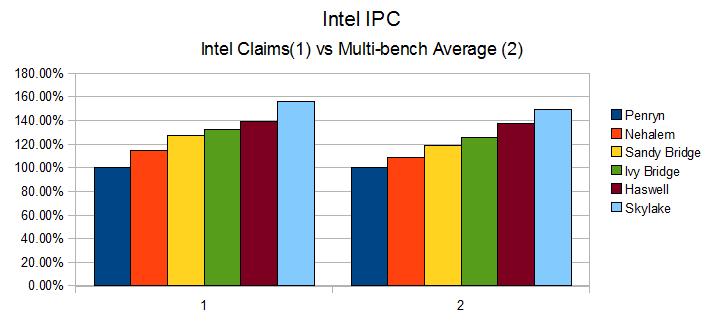
And would you say, that one of the developments shown in the following slides is driven by competition while the other is not? Or would we have seen Tejas instead with smaller improvements?
IMG_2605.JPG

900x900px-LL-1cffe6f5_CPUIPC_html_7f184e37.jpeg

(created by Looncraz)
 
Last edited:
Ye, its not pretty. And 140W in a world where 65W is the norm now for non K chips. That's not going to sell well. People want smaller packages and low power. Only the "dinosaur" people accepts 140W or higher.

Many buyers want small form factors, but workstation users still need real power. So far, Apple is the only company that managed to combine the two, but their Mac Pro hasn't been updated since 2013 and is now starting to look outdated.

Apple managed to cram an E5-2697 v2 CPU (130W TDP) and two Tahiti GPUs into a tiny, quiet cylinder. The problem isn't the TDP, it's the fact that the ATX form factor and its derivatives are badly outdated. We need a compact PC form factor that allows the use of a unified thermal core like on the Mac Pro, but user-buildable and with interchangeable parts.
 
lots of posts

Why wont you gift us with your superior knowledge and intellect and answer my question? :'(

to quote myself (cuz im that kind of guy :colbert:)

So why dont you give us a detailed run down on why you are so pessimistic on Zen based of the TECHNICAL details we know so far. Don't worry about keeping it simple go into the Gory details for us, we all might learn something.
 
So you say that Intel needs to make all the mistakes in the book, AMD make everything right.

No, I didn't say that. Please re-read my first paragraph. I said that for AMD to beat Intel outright would require massive mistakes on Intel's part, but just regaining a competitive position does not. I expect the latter, not the former. All AMD needs to do is catch up in terms of architecture to where Intel was about 5 years ago. The fact that they only have to worry about R&D on the architecture and not the process node is a benefit, not a drawback. Just by using 14LPP they'll cut Intel's process lead from two full nodes to about a half-node - and the heavy lifting was done by Samsung.

If you already need to rely on overclocking its lost. You should know that.

Overclocking is a big deal for gamers, and high-end PC gamers are still a sizable audience. You yourself have pointed out the massive sales of the GTX 970 - who do you think is buying these? Overclocking isn't viable for workstations, servers, or laptops, but for high-end gaming rigs, it's commonplace. And gaming is one of the few tasks that still cares enough about single-thread performance for overclocking to be a big deal. Workstation loads tend to be better threaded, so an 8-core CPU will easily beat Intel's quad-core offerings without having to overclock.

What 4Ghz MPUs have Samsung made on their 14lpp?

You know full well that this is irrelevant, as maximum frequency is as much a function of the chip design as of the process node. (If you ported an AMD or Nvidia GPU over to Intel's newest node, it certainly wouldn't be running at 4GHz either.)
 
But Intel does use a whole different socket for it.

I think the point about new AMD CPUs from low wattage to very high wattage using the same socket is an interesting one, though I'm not sure it will matter overall.

As I said earlier, it was a bit of a problem with AM3(+) in that you could put high watt CPUs in boards that couldn't handle the power draw.

But people are acting like this is something new. AMD made Opterons for Socket 939, AM2, AM2+, AM3 and AM3+. AMD is saving money by simply having the single socket.

Not only that, one of the reasons why many diehard AMD users stick with AMD is that they generally they can upgrade with just a processor swap and retain an existing motherboard. Intel always forces you to buy a new motherboard by changing the socket each generation.
 
Not only that, one of the reasons why many diehard AMD users stick with AMD is that they generally they can upgrade with just a processor swap and retain an existing motherboard. Intel always forces you to buy a new motherboard by changing the socket each generation.

Every other generation you mean. Which even that for consumers is totally overrated, the amount that do that is tiny. By the time you upgrade you'd want a new motherboard anyway for new features.
 
Why wont you gift us with your superior knowledge and intellect and answer my question? :'(

to quote myself (cuz im that kind of guy :colbert:)

Why don't you give us a detailed run down on why you are so optimistic on Zen based of the TECHNICAL details we know so far.
 
Not only that, one of the reasons why many diehard AMD users stick with AMD is that they generally they can upgrade with just a processor swap and retain an existing motherboard.

That's not why they stick with AMD, that is an arguing point used to try and explain away lack of performance.
 
Back
Top