I'm not naive to see that Nvidia's support for discontinued products is primarily to keep those products working, while placing emphasis of optimizations on current selling products. Unfortunate and frustrating as it is, it's the nature of the beast. In fact, the same thing happened between the HD5870 and the GTX 480. When AMD released barts and cayman, the performance of their previous year's chips (cypress, etc.) performance seemingly started tanking vs. their respective competition. WEIRD I know, but again, that's the nature of the beast.
Oh come on, you don't expect to pull off this type of a rebuttal against him. The two main reasons HD5870 tanked in performance had 0 to do with drivers: (1) 1GB of VRAM; (2) very slow tessellation engine. These are hardware, not software related. You also ignored the big price difference between HD5870 and GTX480, how HD5850 could overclock to beat a 5870, making 5870 basically pointless for overclocks who could just buy a $259 5850. 480 cost a whopping $499.
Xbitlabs quotes this very point:
"When the frequencies of the Radeon HD 5850 are increased to the level of the HD 5870 (850/4800MHz), the gap is smaller at 2% and 2.6%. When overclocked to the highest frequencies, our sample of Radeon HD 5850 is 8.2% and 6.7% faster than the senior model of the series in the respective modes."
In hindsight, the $500 GTX480 looks even more like a giant waste of $. Someone who bought a 5850/5870, saved $130-240 towards a next gen GPU upgrade which means in reality no one should have expected 5850/5870 to outlast a 470/480. The situation with Kepler was not the same at all since 670/680/770/780/Titan/780Ti were never substantially cheaper than the HD7000/R9 200 series competition. In fact, for the vast majority of GTX680/770/780/780Ti/Titan's lifespan in which these cards competed against 1Ghz 7970/R9 280X/R9 290/R9 290X, all of these NV cards cost more. That makes it inexcusable how much their performance has fallen off in some modern titles since in practice it means paying extra for 770 4GB, 780 and 780Ti/Titan was just a money sink.
When we compare HD6970 to GTX580 today, the latter leads by
just 9%. HD6970 and HD5870 are more or less very similar architecturally and driver wise. Not only that but HD6970 cost significantly less than a 580 ($370 vs. $500) and HD6950 ($299 card) could unlocked into a 6970. Therefore, you suggestion that older cards tank in performance so it's OK that Kepler's performance got thrown under the bus doesn't work with respect to older HD5000 vs. 400 or HD6000 vs. 500 series.
This is completely disturbing.
18% marketshare!!!
It's shocking. Go back just 1yr ago and it was a 40/60 split. It's like they fell off a cliff. This is bad. I can't see how this one can be down played
If you look at the chart carefully though, AMD's market share bombed from 38% to 28% moving from Q1 2014 to Q2 2014. At that point, there were no 960/970/980 cards. I kept saying on this very forum for a while that AMD's desktop discrete GPU market share bombed well before NV even launched GTX970/980 cards.
Now look at Q4 2014 to Q1 2015, AMD went from 28% in Q3 2014 (still no 970/980 cards at that point) to 23% in Q1 2015. By that point NV did start to take market share with 960/970/980 cards but there was no 980Ti yet. If we look at Q2 2015, 980Ti/Fury/Fury X are hardly a factor here because they all launched way late in Q2 2015 but yet AMD lost a whopping 5% in those 3 months alone.
Also, $550+ GPUs are hardly a major volume seller.
This highlights far deeper issues like poor inventory management by AMD, lack of OEM design wins, horrible perception of AMD's R9 200/300 series cards in the DIY sector, and lots of PC gamers upgrading to 960/970/980 during Q1 2015->Q2 2015 periods for a lot of newer games out that period like Dying Light, The Witcher 3, GTA V, Mortal Kombat X, Wolfenstein: The Old Blood, Project CARs, Batman AK, F1 2015, etc.
It looks like whoever was upgrading for those games was choosing predominantly NV cards. This isn't surprising though since the entire R9 200 series had a horrendous image so every day AMD was losing market share.
Since R9 390 series launched only
June 18, 2015, these cards also had barely any impact. This market share data basically shows us how R9 200 series had no chance of selling against GTX900 series.
And since
Fury/Fury X only launched in July and with limited quantities, the conclusions of TT about how AMD's new cards are still not enough to prevent AMD from losing a ton of market share aren't even accurate since most of the new R9 300/Fury cards had no time at all to have any major impact on Q2 2015 market share numbers.
I still expect AMD to lose more market share for 2H of 2015 but the major market share losses from Q2 2014 to Q2 2015 are almost entirely attributable to R9 200 series, not AMD's new cards.
Really? Because I get think the exact opposite is true. People bothering to check the reviews would come off with the impression that the R9 390 is the clear winner, unless power consumption was the most important metric. I think one really has to weigh the fact that with the 970 you're effectively getting a 3.5GB card.
390 is the better overall card than the 970 based on objective reviews(ers). In any event, I don't see how anyone here is drawing any conclusions about the market share successes or failures or R9 300 or Fury series vs. NV's cards since the actual product launches and wide availability, or in this case lack thereof, means that R9 300 series and Fury cards had practically no imapct on Q2 2015 market share. This is further underlined by the very fact that R9 390/390X had major shortages at launch
while Fury/Fury X didn't even launch in Q2 2015.
===================
BTW, I saw no one bringing this up so I'll do it.
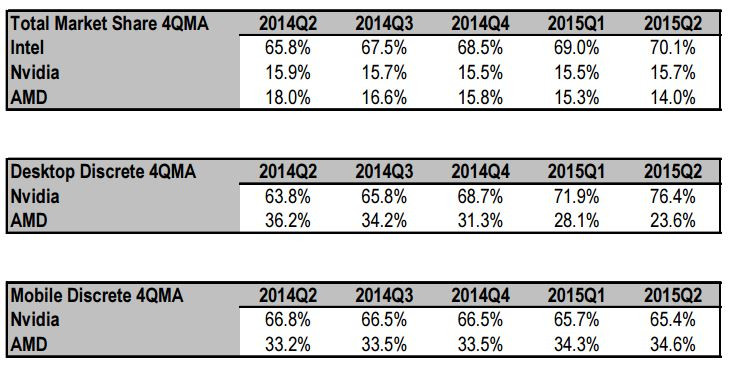
"It should be noted that in a bid to filter out oddities in share due to inventory adjustments, one-off events and other occurrences, Mercury Research reports its market share-related findings as a four-quarter volume-weighted average to smooth the noise of seasonal inventory cycles and reveal ongoing share trends. According to Dean McCarron, the average is done because both Nvidia and AMD have large spikes/downturns in shipments due to inventory adjustments, and because the inventory cycles of the companies are not aligned.
“This makes sell-in share very noisy; in contrast the sell-out does not see nearly so much share variation, so it’s an attempt to get the sell-in data to reflect reality rather than noise,” said Mr. McCarron.
While the diagram above [i.e., from TweakTown] is accurate and represents AMD’s and Nvidia’s GPU sell-in numbers (i.e., the share of GPUs that AMD and Nvidia sell to their partners), the diagram below is a four-quarter volume-weighted average, which may better represent actual sales of discrete desktop GPUs to the consumer."
Still looking awful for AMD but a lot better than 18% market share (sell-in rate to partners) vs. 23.6% market share (sell-out rate to the actual consumer).
What's more alarming are the trends for the entire discrete GPU industry. I've said for a while that the discrete GPU sector is getting wiped out with major declines from early 16-17 million dGPUs per quarter to 13-14 million and now it's closing in on 10-11 million a quarter only. The main reason NV is showing revenue growth is not through increased volume sales but through higher Average Selling Prices (aka selling mid-range 970/980 at far higher prices than historically for that level of GPUs). There is also a new trend in countries like Russia and China for people spending more on flagship cards.
"According to Mercury Research, sales of discrete graphics processing units for desktops declined by 18.2 per cent, whereas shipments of GPUs for notebooks decreased by 34.1 per cent year-over-year in the Q2 2015. The on-year decline is the worst since the Q1 2009, when sales dropped due to the deep recession and inventory correction caused by the 2008 financial crisis.
“Both desktop and mobile GPU attach rates fell in the quarter, with mobile GPU attach rates down steeply,” said Dean McCarron, the head of Mercury Research. “The declines were caused by lower OEM GPU shipments, likely due to inventory adjustments ahead of new product launches in the second half of 2015.”"
Source
Doesn't look overly promising for great prices on 16nm HBM2 GPUs.