The next bubble to burst... higher education

Page 2 - Seeking answers? Join the AnandTech community: where nearly half-a-million members share solutions and discuss the latest tech.

ShawnD1

Lifer
May 24, 2003
15,987
2
81
I read a story a couple years ago about a school that found out from market surveys people considered them a lesser quality school based on the low cost. The school raised tuition 30% and incoming applications jumped 40% the next year. I don't see that approach working in the future.

We're naturally skeptical of things that seem too good to be true. If I saw a place selling hamburgers for 25 cents, my first question would be "what's wrong with it?"

Why don't people ask what the average income of grads is for their desired major, then sit down and figure out how long it's going to take to pay off their loan debt after graduation BEFORE they commit to it?
1 - People are stupid as fuck
2 - Lots of universities have horrible websites and this data is hard to find

I honestly tried to find some data for my local university just now. All I can find is data from 2000, and the data sucks shit. Look at this thing and see if you can find anything useful in here: link

Even with the data being terribly shitty (few people respond to the survey, not categorized by major), some of the overall conclusions are interesting. Looks at these quotes from it:
Five years after graduation, 68.4% of employed respondents were working in full-time, permanent positions
So roughly 1/3 of graduates are not working full time permanent? That's just lovely.

Relevance of Program of Study to Employment (percentage):
Arts - 34.8
Business - 76.8
Dentistry - 100
Engineering - 80.5
Law - 92.9
Medicine - 96.6
Nursing - 91.9
Science - 59.4
So the key point here is that art is a huuuuuge waste of time. Only about 1/3 graduates are working in that field after 5 years. Science is another piece of shit as well. Less than 2/3 of people with a science degree are actually doing science. That sounds about right. I left chemistry a few years ago because it's basically a dead end career.

Median* Annual Incomes by Faculty and School
Six months after graduation
Arts $27,500
Business $37,500
Dentistry $67,500
Engineering $47,500
Law $27,500 (lol, you cunts deserve it)
Medicine $37,500 (?!?!?)
Nursing $47,500
Science $32,500
So both art and science degrees are completely worthless. Good to know. I really wish they would put this on the front page before thousands of students fuck themselves over with huge loans and 4 years of lost work time.


Vocational schools are a lot better with data. My local vocational school updates their stats yearly and it has a better breakdown by program. Instead of just listing "engineering" it will list electrical, mechanical, and civil as individual programs.
 

rudder

Lifer
Nov 9, 2000
19,441
86
91
Is it true that American students are forced to spend a year or more studying bullshit liberal arts subjects like American history, aesthetics, African American studies, etc? I have heard you all need a certain number of credits in subjects totally unrelated to your major, is this true?

Don't get me wrong, like anyone I recognize the American higher education system as the envy of the world, but this seems really odd to me.

A lot of degree programs require so many liberal arts credits. the stupid thing is American students go to college right out of high school... where they had classes in American History, Art, American and English lit, etc. High school has gotten so dumbed down that I guess someone somewhere feels students need more of that in college.

I am all for the appreciation of history, arts, literature, etc... but the fact is that college is expensive. More expensive than it needs to be for a lot of people.
 

CycloWizard

Lifer
Sep 10, 2001
12,348
1
81
A lot of degree programs require so many liberal arts credits. the stupid thing is American students go to college right out of high school... where they had classes in American History, Art, American and English lit, etc. High school has gotten so dumbed down that I guess someone somewhere feels students need more of that in college.

I am all for the appreciation of history, arts, literature, etc... but the fact is that college is expensive. More expensive than it needs to be for a lot of people.
I think this is actually true. If high school was worth anything, then the first year of university courses would be superfluous. I also agree that the price for undergraduate education is very high due to government interference, but I know for a fact that it still doesn't cover the cost of your education at most universities, as professors' salaries are usually covered by their research grants (at many research institutions).

There are plenty of problems with our higher education system but, as others have pointed out, it's still the best in the world. By a lot. The UK system is improving somewhat and has all of our cost worries solved - you can go to Oxford, Cambridge, or any other public school for about 1000 GBP per year if you're a citizen of the UK, albeit through huge subsidies and a near-ban on private universities (I think one exists - U of Birmingham maybe?). There is plenty more I can say, but I should probably be preparing my lecture for this afternoon...
 

QuantumPion

Diamond Member
Jun 27, 2005
6,010
1
76
Why is higher education a "bubble" that is going to "burst?" So far as I can discern from reading these posts, it's purportedly because government money (which of course corrupts everything it touches) flows into our universities. The money will stop flowing because of government debt, and then, what? You guys are saying that our higher education already sucks (with no objective facts to back it up.) Will the absence of corrupting government money make it worse? Is there a coherent theory here, aside from the opinion that 1. universities suck because they get government money, and everything to do with the government = bad, and 2. higher education sucks because learning things that don't apply to your job is a waste of time. How do those rather interesting opinions amount to a "bursting bubble?"

I am beginning to wonder if literally everything on the planet is a "bubble" now that will soon "burst." Do we ever get tired of spouting the same damn cliches on a daily basis?

- wolf

The bubble that is going to burst is the increasing widespread demand for bachelor's degrees for every industry, along with the cultural notion that everyone must get a 4-year degree. These two items have caused an increasing demand in college education, which has been met with increasing tuition prices. However, tuition has been increasing at a far greater rate than inflation or demand, because the government offers low-interest, high-availability, guaranteed, non-forgivable loans. As the Universities demand more money to spend on research/bureaucracy/feel-good programs, the government offers more loan guarantees to match.

Liberals say that everyone has the right to a college education and offer student loan programs and funding to universities. More people go to college when they probably don't need to. More and more people going to college increases the perceived need for college, and the demand. The money for this is provided largely by government-backed credit. Since the prices are only dependent on credit, and not real wealth, the system is expanding at a non-sustainable rate and will eventually fold.

It is precisely the same situation as the housing crisis. Except that people can't purge their student loan debt in a bankruptcy like they can walk away from a mortgage. Unless they go to work for the government. Hooray for socialism/slavery.
 

PricklyPete

Lifer
Sep 17, 2002
14,582
162
106
the funny part of this statement is none of my white collar friends have gotten drug tested in the past 3 years

I haven't had a drug test in 10 years of working as a IT professional. At my old company there was always the possibility...but since I've been a consultant...it was never even considered.
 

Dulanic

Diamond Member
Oct 27, 2000
9,969
592
136
I hate the whole way the system works. I have a job, a rather decent job. I work remotely a lot of time which is fantastic and saves me on other expenses. Now the downside is, I can't move up much higher because I don't have a BA/BS. They know what I can do, they know who I am, they know I have gotten 4 promotions in 4 years because I am highly capable of doing what is needed.

However, the next steps up REQUIRE a degree so I can no longer move up even if they know I can do the job.
 

nonlnear

Platinum Member
Jan 31, 2008
2,497
0
76
The bubble that is going to burst is the increasing widespread demand for bachelor's degrees for every industry, along with the cultural notion that everyone must get a 4-year degree. These two items have caused an increasing demand in college education, which has been met with increasing tuition prices. However, tuition has been increasing at a far greater rate than inflation or demand, because the government offers low-interest, high-availability, guaranteed, non-forgivable loans. As the Universities demand more money to spend on research/bureaucracy/feel-good programs, the government offers more loan guarantees to match.

Liberals say that everyone has the right to a college education and offer student loan programs and funding to universities. More people go to college when they probably don't need to. More and more people going to college increases the perceived need for college, and the demand. The money for this is provided largely by government-backed credit. Since the prices are only dependent on credit, and not real wealth, the system is expanding at a non-sustainable rate and will eventually fold.

It is precisely the same situation as the housing crisis. Except that people can't purge their student loan debt in a bankruptcy like they can walk away from a mortgage. Unless they go to work for the government. Hooray for socialism/slavery.
Actually Wolfe is right about some aspects here. This "bubble" isn't going to collapse like true bubbles - because it isn't the same kind of dynamic at all. Degrees are getting bid up in price in large part because the government is subsidizing them on the front and backsides of the industry at incredibly unhealthy levels, but also because the people making the buying decisions often make irrational choices. However that doesn't change the fact that degrees are becoming an institutional necessity in many industries, even if the degrees themselves aren't delivering the same educational value (especially per dollar) that they used to.

There are some very serious problems with higher education in the US to be sure, and it is coming to a head in the next couple decades, but to say that it is exactly the same as the housing crisis is oversimplifying things quite a bit. On that note there is an article in the new Economist (Sept. 4) on page 74 which concludes with the following:
The Economist said:
America's universities lost their way badly in the era of easy money. If they do not find it again, they may go the way of GM.
 

CPA

Elite Member
Nov 19, 2001
30,322
4
0
Modern American universities are just fancy country-club / camps. Most of what goes on around a given campus has little to do with learning and mostly to do with socializing or unrelated activities like sports. Education would be much cheaper if we focused on learning.

With that said, many people don't need to go to college or don't really have what it takes to be in a job that requires a degree, even if they can get one from a diploma mill. We need to stop telling everyone that they should go to college or that they should get advanced degrees. Odds are if you're a good student in high school (which is hard to tell these days due to grade inflation) you will want to go to college. And if you have specific career goals or love learning in college, you will get an advanced degree. We certainly don't need to subsidize people to get English degrees.

Agreed wholeheartedly.
 

kranky

Elite Member
Oct 9, 1999
21,020
156
106
There is a real opportunity for someone to bankroll a new type of university - a school that gave you the concentrated courseload of a technical school, with strict grading, a mandatory internship program and a 4 year program compressed into 3 years in order to keep the cost down. Focusing on developing job skills so that people finishing the program would be better prepared than the typical uni graduate would be appealing to employers. I'd structure it so that a graduate of this program would be equivalent to someone with 2 years experience in whatever industry.

You could beat the traditional schools at their own game.
 

Fern

Elite Member
Sep 30, 2003
26,907
174
106
Why is higher education a "bubble" that is going to "burst?" So far as I can discern from reading these posts, it's purportedly because government money (which of course corrupts everything it touches) flows into our universities. The money will stop flowing because of government debt, and then, what? You guys are saying that our higher education already sucks (with no objective facts to back it up.) Will the absence of corrupting government money make it worse? Is there a coherent theory here, aside from the opinion that 1. universities suck because they get government money, and everything to do with the government = bad, and 2. higher education sucks because learning things that don't apply to your job is a waste of time. How do those rather interesting opinions amount to a "bursting bubble?"

I am beginning to wonder if literally everything on the planet is a "bubble" now that will soon "burst." Do we ever get tired of spouting the same damn cliches on a daily basis?

- wolf

I think a simple definition of a "bubble" is when (irrationally) high demand pushes the price for something above it's actual value.

So, I suppose it could be fairly said that higher education could be a bubble if the price of tuition (and 4 years lost wages) is unreasonably high compared to benefits the BS/BA degree bring.

If people then realized this and chose not to attend universites to such an extent that we had enrollment declines we could see that bubble burst. Overall declining enrollment would represent a decreased demand and force universities into financial problems.

I earned my degree decades ago, tutition was relatively inexpensive compared to today and my starting salary was quite high for that time even though we were in a pretty big recession. So I consider my money well spent. But I'll add that it wasn't an easy degree, probably only 25% or less that started in the program made all the way through.

Howver, the kind of of money non-degreed tradesmen and the like charge has become quite high. HVAC techs, plumbers, electricians etc in my area charge per hour as much as many professionals (lawyers and CPA's).

I have seen more non-degreed people making more money than educated professions etc for some time now. If can you manage a crew, whether in contruction or cable installation etc you can make more money than just about anybody else (excepting of course Wall Street types and senior execs at large companies).

Another 'little secret' is that those with heavy equipment make heavy $'s. Start out with cheap an old used bulldozer or backhoe and keep adding on equip and soon you'll find all kinds of contracts open to you. Most people just don't realize the kind of money these people make. There are more redneck millionaires than you can shake a stick at (I find it amusing about how people now claim there is no upward mobility etc in the USA and all the ranting about how the top 2% keep making more and more $).

If and when younger people figure this out enrollment should drop at regular universities. JUCO's have all the basic courses (biz mgmt, accounting, economics, marketing, finance etc) any tradesmen wanting to start their own business would need. Then there are trade schools to focus in on the actual work you intend to do. Spending thousands of $'s and 4 years sitting around in classes you don't care about and won't use isn't the way to make big bucks. Why would it be? Anybody can do that.

Fern
 

nonlnear

Platinum Member
Jan 31, 2008
2,497
0
76
For profit universities are the biggest scams.
Not quite as big a scam as the not for profits.
Pop quiz: what's the difference between a for profit university and a not for profit university? Hint: it has nothing to do with whether they make a profit...
 

Fern

Elite Member
Sep 30, 2003
26,907
174
106
Is there even such a thing as a "for profit" university?

Fern
 

MJinZ

Diamond Member
Nov 4, 2009
8,192
0
0
Modern American universities are just fancy country-club / camps. Most of what goes on around a given campus has little to do with learning and mostly to do with socializing or unrelated activities like sports. Education would be much cheaper if we focused on learning.

With that said, many people don't need to go to college or don't really have what it takes to be in a job that requires a degree, even if they can get one from a diploma mill. We need to stop telling everyone that they should go to college or that they should get advanced degrees. Odds are if you're a good student in high school (which is hard to tell these days due to grade inflation) you will want to go to college. And if you have specific career goals or love learning in college, you will get an advanced degree. We certainly don't need to subsidize people to get English degrees.

Welcome to USA of idiots where the rest of the world takes all of your jobs and will do the manual labor ones as well.

Good bye America.
 

ShawnD1

Lifer
May 24, 2003
15,987
2
81
Is there even such a thing as a "for profit" university?

Fern

Pretty much 100% of the horrible universities nobody should attend are privately owned and for profit. Sometimes they are funny and sometimes just sad.
Game Design at Collin's College (funny)
Westwood College (very sad)
Other classics include Devry, ITT Tech, University of Phoenix, and Everest. Many of them are not accredited, their programs are not recognized by real universities, and they are not recognized by employers as being real.


Easy test to see if a university is real: real universities do not advertise on TV.
 

fskimospy

Elite Member
Mar 10, 2006
88,176
55,736
136
You dont need a degree to do some light typing to fill our forms on computers and then answer the phone if it rings (Assuming they let you answer phones). The average 8th grader in junior high can handle that. Anything that it use to take intelligence to figure out now has a computer program that does the same thing.

So this year the federal government took over all the school loans. So now if a bunch of students strart dropping out, that means you will have to pay for it! This is what O'Bammah calles hope and change. The government steals all of your hope and you are left with a handful of change that use to be your life savings.

You don't have any idea what you're talking about. The federal government took responsibility for administering federally backed student loans, not all student loans. In the past, these loans were given out by private banks, but the government 100% guaranteed the bank's investment, plus interest. So if you're concerned about being on the hook for students dropping out, you're going to need to talk to 1965.

What Obama did was eliminate a massive corporate welfare program, because banks were able to make loans and charge interest on investments to people that they could not possibly lose on. I would have thought that the elimination of welfare payments would have made you happy. (unless it's complaining about the evil 'libruls' that makes you happy)
 

BoberFett

Lifer
Oct 9, 1999
37,562
9
81
Why is higher education a "bubble" that is going to "burst?" So far as I can discern from reading these posts, it's purportedly because government money (which of course corrupts everything it touches) flows into our universities. The money will stop flowing because of government debt, and then, what? You guys are saying that our higher education already sucks (with no objective facts to back it up.) Will the absence of corrupting government money make it worse? Is there a coherent theory here, aside from the opinion that 1. universities suck because they get government money, and everything to do with the government = bad, and 2. higher education sucks because learning things that don't apply to your job is a waste of time. How do those rather interesting opinions amount to a "bursting bubble?"

I am beginning to wonder if literally everything on the planet is a "bubble" now that will soon "burst." Do we ever get tired of spouting the same damn cliches on a daily basis?

- wolf

Do you ever get tired of spouting the same talking points on a daily basis?

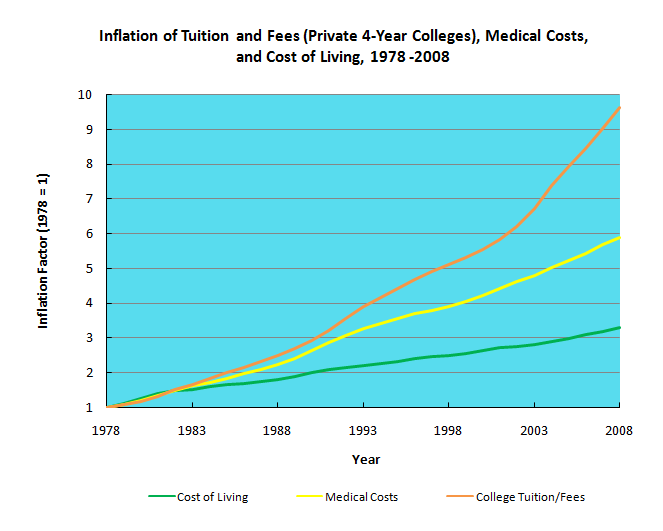
InflationTuitionMedicalGeneral1978to2008.png
 
Last edited:

Fern

Elite Member
Sep 30, 2003
26,907
174
106
All privately owned universities are for profit. Government universities are non-profit.

Pretty much 100% of the horrible universities nobody should attend are privately owned and for profit. Sometimes they are funny and sometimes just sad.
Game Design at Collin's College (funny)
Westwood College (very sad)
Other classics include Devry, ITT Tech, University of Phoenix, and Everest. Many of them are not accredited, their programs are not recognized by real universities, and they are not recognized by employers as being real.


Easy test to see if a university is real: real universities do not advertise on TV.

Not all privately owned universites are for profit. Section 501c of the internal code alows them to be non profit too. You don't need to be gov owned to be non profit.

I posted because I thought somebody may be confusing 'private' (e.g., Duke University) universities with 'for profit's'.

I'm pretty sure most private universities are organized as non profits, if only so they can receive tax deductible donations.

Fern
 

nonlnear

Platinum Member
Jan 31, 2008
2,497
0
76
Not all privately owned universites are for profit. Section 501c of the internal code alows them to be non profit too. You don't need to be gov owned to be non profit.

I posted because I thought somebody may be confusing 'private' (e.g., Duke University) universities with 'for profit's'.

I'm pretty sure most private universities are organized as non profits, if only so they can receive tax deductible donations.

Fern
Exactly. ;)
 

CycloWizard

Lifer
Sep 10, 2001
12,348
1
81
There is a real opportunity for someone to bankroll a new type of university - a school that gave you the concentrated courseload of a technical school, with strict grading, a mandatory internship program and a 4 year program compressed into 3 years in order to keep the cost down. Focusing on developing job skills so that people finishing the program would be better prepared than the typical uni graduate would be appealing to employers. I'd structure it so that a graduate of this program would be equivalent to someone with 2 years experience in whatever industry.

You could beat the traditional schools at their own game.
You would have a total enrollment of about five students. Most people don't go to school to get an education. They go to have the "college experience" and (distant second) get a job when they're done. Most of the jobs new graduates get have nothing to do with their major and are based on networking connections they've formed during internships or through family/friends along the way. The better your school, the better your connections.
 

Herr Kutz

Platinum Member
Jun 14, 2009
2,545
242
106
Is it true that American students are forced to spend a year or more studying bullshit liberal arts subjects like American history, aesthetics, African American studies, etc? I have heard you all need a certain number of credits in subjects totally unrelated to your major, is this true?

Don't get me wrong, like anyone I recognize the American higher education system as the envy of the world, but this seems really odd to me.

I recently graduated from an electrical engineering program and was forced to waste 18 (arguably more) hours on classes that were completely useless to my major. I took an average of about 16 hours per semester so without these courses I would have been able to graduate a semester earlier, or received more education relevant to my major.

Since the state I live in (and I would guess states have a program like this) has a free tuition program for residents who maintain a certain GPA level I'm sure these courses were just added to soak the state government for more money.