
• We’re currently investigating an issue related to the forum theme and styling that is impacting page layout and visual formatting. The problem has been identified, and we are actively working on a resolution. There is no impact to user data or functionality, this is strictly a front-end display issue. We’ll post an update once the fix has been deployed. Thanks for your patience while we get this sorted.

TechSpot adopts latency benchmarks in new Titan review

Page 2 - Seeking answers? Join the AnandTech community: where nearly half-a-million members share solutions and discuss the latest tech.
Like this:
Battlefield%203.JPG

Do I need to link you to a FPS graph too...if you don't know the "lingo"...why get involved in the first place....ignorance is never a good argument.


Catalyst 12.11 Performance:whiste:

http://www.anandtech.com/show/6393/amds-holiday-plans-cat1211-new-bundle
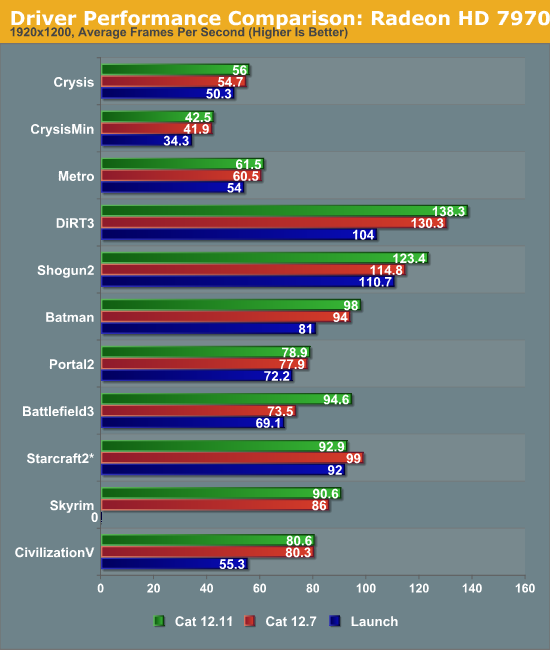

51037.png


51040.png
 
Last edited:
"My personality is who I am...my attitude depends on who YOU are"- Lawnberger

I don't think who we are will make one iota about your attitude
 
Pure min/max numbers are pointless.

If your chugging along at 60fps 99% of the time but hit 2fps for a short time due to a hitch and 300fps for a few frames because you just stared at the sky box would those min/max numbers be at all useful?

They would...if the same drop is happping across alll architechtures....if not...they tale a nice tale

And I am all for min-avg-max + frametimes to give the best Picture..but people were right...AMD's fans don't like mins...
 
Like this:
Battlefield%203.JPG

Do I need to link you to a FPS graph too...if you don't know the "lingo"...why get involved in the first place....ignorance is never a good argument.

The average number in your linked graph tells us all we need to know, so how you can type that he doesn't use max-avg-min graph is beyond me. Maximums and minimums are useless
 
Why are they benching transitional areas in the first place?

Poor review methods are no excuse.

Here is a better example.

One card gets 70 fps avg, and drops to 40 fps mins during a fire fight in Operation Swordbreaker, while another vendors card gets 80 fps avg but drops to 26 fps during a fire fight... Wouldn't you want to know that during the most heated and important time to have good fps, the higher avg card wasn't delivering?
 
At this point AT is pretty much useless for any gpu related discussions.Many review sites are heads and shoulders above them.Their pathetic excuses are getting pretty tiring.Worst is they promise all kind of followup articles in their launch review which they forget just by the end of hour.
 
Why are they benching transitional areas in the first place?

Poor review methods are no excuse.

Here is a better example.

One card gets 70 fps avg, and drops to 40 fps mins during a fire fight in Operation Swordbreaker, while another vendors card gets 80 fps avg but drops to 26 fps during a fire fight... Wouldn't you want to know that during the most heated and important time to have good fps, the higher avg card wasn't delivering?

That's why I like the graphs that [H] and a few others do showing the framerate over time. Just showing the minimum framerate doesn't tell the whole story as it may have been a one time hitch.
 
The average number in your linked graph tells us all we need to know, so how you can type that he doesn't use max-avg-min graph is beyond me. Maximums and minimums are useless

And it rears it heads Again, if we compare this:
http://www.anandtech.com/show/6774/nvidias-geforce-gtx-titan-part-2-titans-performance-unveiled/11

To this:
http://hardocp.com/article/2013/02/21/nvidia_geforce_gtx_titan_video_card_review/3
Or this:
http://www.pcper.com/reviews/Graphi...ance-Review-and-Frame-Rating-Update/Far-Cry-3
Or this:
http://techreport.com/review/22653/nvidia-geforce-gtx-680-graphics-processor-reviewed/10

Anandtech is sorely lacking behind


I say that having a single FPS number...is USELESS!
 
Why are they benching transitional areas in the first place?

Poor review methods are no excuse.

Here is a better example.

One card gets 70 fps avg, and drops to 40 fps mins during a fire fight in Operation Swordbreaker, while another vendors card gets 80 fps avg but drops to 26 fps during a fire fight... Wouldn't you want to know that during the most heated and important time to have good fps, the higher avg card wasn't delivering?

I would want to know that but min/max numbers wouldnt tell me how long or how often the fps did that so the numbers would be essentially meaningless.
 
Why are they benching transitional areas in the first place?

Poor review methods are no excuse.

Here is a better example.

One card gets 70 fps avg, and drops to 40 fps mins during a fire fight in Operation Swordbreaker, while another vendors card gets 80 fps avg but drops to 26 fps during a fire fight... Wouldn't you want to know that during the most heated and important time to have good fps, the higher avg card wasn't delivering?

Ahve you forgotten the GTX680 launch?

How the mini,ums frames made AMD look bad...and thus was declared a "bad" metric by certain people? ^^
 
Hitman results are the most interesting. AMD single cards do really well in frame latency in every other game except here. Crossfire is hit or miss in every other game except Hitman, where it's phenomenal.
 
Hitman results are the most interesting. AMD single cards do really well in frame latency in every other game except here. Crossfire is hit or miss in every other game except Hitman, where it's phenomenal.


Yeah...strange anomaly...could indicate AMD has more driverwork too do still.
 
This forum's has a AMD-bias, what do you expect? You have people hawking AMD cards, and then people who buy the AMD cards and then defend it to death based on what the first group said.

Personally I would like to see frame latency and minimum graphs. Yeah, you don't record the outliers because of hitches... in statistics you're taught how to remove outlying results. You can still have a minimum framerate chart that's meaningful. Saying these things don't matter is ignoring the evidence. If one card sustains lower minimums over another card, it's important to know. I don't care if it's the AMD card or the Nvidia card with lower mins or higher maxes, but I want to know, because ultimately it translates into a smoother experience, regardless of brand.
 
That's why I like the graphs that [H] and a few others do showing the framerate over time. Just showing the minimum framerate doesn't tell the whole story as it may have been a one time hitch.

This. I like to review the graphs rather than look at the number.
 
I also like the graphs charting the frames per second over time, it's quite informative.

Plus, I mean if you use FRAPS it automatically hands you the chart on a silver platter, you literally just need to 1) open the CSV file, and 2) click the line chart button. That's quite a low burden for reviewers, so why not just include it?
 
I also like the graphs charting the frames per second over time, it's quite informative.

Plus, I mean if you use FRAPS it automatically hands you the chart on a silver platter, you literally just need to 1) open the CSV file, and 2) click the line chart button. That's quite a low burden for reviewers, so why not just include it?

Yes indeed...wonder why such graphs are a bad thing?
What could the answer be? ^^
 
Back
Top