• We’re currently investigating an issue related to the forum theme and styling that is impacting page layout and visual formatting. The problem has been identified, and we are actively working on a resolution. There is no impact to user data or functionality, this is strictly a front-end display issue. We’ll post an update once the fix has been deployed. Thanks for your patience while we get this sorted.

Question Speculation: RDNA3 + CDNA2 Architectures Thread

Page 220 - Seeking answers? Join the AnandTech community: where nearly half-a-million members share solutions and discuss the latest tech.
It really does, since N32 is the text subject.
Like, they're not doing it in vacuum or on Strix parts actual (which should TO rather soon anyway).
RX 6800XT performance at 190W would mean ~2.6GHz clockspeed for N32.
I have to wonder If It can hit 3.25GHz(+25%) at 300W, this would be already impressive compared to N31 or N33.
That would be RTX 4070Ti level of performance in raster.
If It could hit 3.5GHz at 300W, which I don't believe, that would be RX 7900XT level of performance in raster.

Of course, It's questionable If this test subject can go >3GHz.
 
Last edited:
Higher performance or higher clock speed for that performance?

For 3.25GHz or 3.5GHz? 😀


Seriously, If they managed to do It, which I am still skeptical about, then either N32 will be expensive >$600 or they will discontinue RX 7900XT.
The more I think about, the 7800XT would need to replace the 6950XT at around $600 US, or +$50 for better AIB boards. It would need pretty high clocks to do that. Otherwise it would be a waste of wafers - even then margins wouldn’t be very enticing to AMDs C-suite.
 
The more I think about, the 7800XT would need to replace the 6950XT at around $600 US, or +$50 for better AIB boards. It would need pretty high clocks to do that. Otherwise it would be a waste of wafers - even then margins wouldn’t be very enticing to AMDs C-suite.
33% deficit in CU(WGP) would have to be compensated somehow. 🙂
But It's yet to be seen what will N32 replace.

@gdansk I think RX6800XT level of performance is pretty much given. If It can clock higher, then It can aim higher.
 
Last edited:
33% deficit in CU(WGP) would have to be compensated somehow. 🙂
But It's yet to be seen what will N32 replace.
AMD would have to had fixed some of their hardware problems. If it is still due to be released end of July - they haven’t had enough time. In that case @jpiniero is right and it’s a dud that won’t see the light of day.
 
Unless they had the problem figured out months ago so they could do another spin, I wouldn't expect anything soon. If they're still trying to work out the issues it'll take months to make design and mask changes and then additional months to fab them chips and then several more months to get those chips to the AIBs and for them to get finished cards to market.

Of course we have no clear idea where in the process anything may actually be and AMD has no incentive to tell anyone until they're either officially scrapping it and giving everyone an updated roadmap or they have a GPU to release within the quarter.
 
Unless they had the problem figured out months ago so they could do another spin, I wouldn't expect anything soon. If they're still trying to work out the issues it'll take months to make design and mask changes and then additional months to fab them chips and then several more months to get those chips to the AIBs and for them to get finished cards to market.

Of course we have no clear idea where in the process anything may actually be and AMD has no incentive to tell anyone until they're either officially scrapping it and giving everyone an updated roadmap or they have a GPU to release within the quarter.
It is exactly 8 months from the N31 announcement, and it does not mean that they could not have started working on N32 fix prior to that. So I think there was enough time to make necessary changes / fixes.

Or, if no fixes were made, just release it months ago in the same state as N31, which did not happen.

IMO, connecting the dots, I think there will be a N32 release, it will perform measurably better to N31 (proportionally), but after all this time, the release date will be whenever it is ready.
 
based but they've genuinely been putting N32 thru an Intel-style post-Si hell; for a good reason too.
I hope whatever they learn from RDNA 3 they can use to avoid making a similar mistake with RDNA 4. Like you said, considering how well their planning and execution have been for Zen, it was out of left field to see N31 miss the mark so egregiously. 1.5x - 1.7x performance targets becoming 1.3x is a big swing and a miss.
 
I hope whatever they learn from RDNA 3 they can use to avoid making a similar mistake with RDNA 4
Yea.
Like you said, considering how well their planning and execution have been for Zen
Some odd bugs aside, N10/21 were also right on perf/power target, too.
As are CDNA parts and whatever.
MI300 is millions billions times more complex than N31 but it works really well.
 
It is exactly 8 months from the N31 announcement, and it does not mean that they could not have started working on N32 fix prior to that. So I think there was enough time to make necessary changes / fixes.

Or, if no fixes were made, just release it months ago in the same state as N31, which did not happen.

IMO, connecting the dots, I think there will be a N32 release, it will perform measurably better to N31 (proportionally), but after all this time, the release date will be whenever it is ready.

I think most people are overcomplicating things.

Navi 31 isn't a bust or failure requiring fixes. I think it is performing with it's design parameters considering the spec increase. The 20% increase in CU was never going to turn into 100 percent performance increase. The double FP was never going to turn into a similar increase in graphic performance considering the cheap silicon cost(navi 23 vs Navi 33).

Navi 32, will perform like it's specs suggest I suspect, much like Navi 33.

This whole Navi 3 is busted rumor I suspect is more just a cover up story to maintain the credibility of Moore's Law is Dead. His monstrous ego will never allow him to say he is wrong and he didn't perform his due diligence about the rumors.

He has been pointing everywhere but himself. E.g AMD lied, the chip is busted, last minute changes. He just wanted hits and now he doesn't want to pay the repercussions in his credibility.

Remember he was saying things like Navi 33 was going to performance like a 6900xt or better knowing that Navi 33 was on 6nm and 200ishmm2. The fact that people still believe him and give him the time of day just show people are still doped up on copium.

I think the more likely reason for the delay of Navi 32 is AMD still has a lot of Navi 2 inventory to sell that performs on that level and if compared to Navi 32 in reviews, will damper the Navi 32 reviews.

It has been hard to get excited about any new product as a result of products being compared to last gen price/performance and launching Navi 32 in this toxic buying environment will likely lead to bad reviews and quick price drops of Navi 32 soon after launch.
 
Navi 31 isn't a bust or failure requiring fixes
Yes it is lol.
I think it is performing with it's design parameters considering the spec increase
No it doesn't; it's a speed daemon design and the N5 implementation clocks nowhere near as fast as it should.
The double FP was never going to turn into a similar increase in graphic performance considering the cheap silicon cost(navi 23 vs Navi 33).
This was designed to derive a solid chunk of its performance uplift from frequency, VOPD SIMDs were to be a cherry on the cake.
This whole Navi 3 is busted rumor I suspect is more just a cover up story to maintain the credibility of Moore's Law is Dead.
No one cares about the literally who?, ever.
I think the more likely reason for the delay of Navi 32 is AMD still has a lot of Navi 2 inventory to sell that performs on that level and if compared to Navi 32 in reviews, will damper the Navi 32 reviews.
They've cleaned off the inventory long ago, listen to their earnings calls.
Graphics maintained okay opmargin due to richer Radeon product mix despite console rev share being higher in gaming segment.
Also how does this even play into mobile N32 plans which also evaporated.
like c'mon, that's not how any of that works
 
Navi 31 isn't a bust or failure requiring fixes. I think it is performing with it's design parameters considering the spec increase. The 20% increase in CU was never going to turn into 100 percent performance increase. The double FP was never going to turn into a similar increase in graphic performance considering the cheap silicon cost(navi 23 vs Navi 33).
If N31 clocked 66% higher than N21, then you could get ~100% higher performance even with only 20% more CUs.

Navi31 increased transistors by >100% for only +20% of CUs, +50% of ROPs and +50% memory while losing 32MB IC.
N33 needed only 20% more for same specs.

So why did It so much more transistors?
 
Last edited:
The MCM approach means that the connecting chiplets need transistors for extra communication links that wouldn't otherwise need to be there.

Even though the CUs didn't increase a lot, they each are now capable of executing two FP operations per cycle. This isn't always possible or useful, but the raw compute power did increase.

They probably threw in some more RT stuff as well. Again, not always useful, but it does increase the transistors.
 
The MCM approach means that the connecting chiplets need transistors for extra communication links that wouldn't otherwise need to be there.
Analog stuff isn't that dense on logic lol.
Even though the CUs didn't increase a lot, they each are now capable of executing two FP operations per cycle. This isn't always possible or useful, but the raw compute power did increase.

They probably threw in some more RT stuff as well. Again, not always useful, but it does increase the transistors.
The whole gimmick of RDOA3 was chopping off things less-than-necessary to PPAmaxx.
So yes, but no.
 
I think most people are overcomplicating things.

Navi 31 isn't a bust or failure requiring fixes. I think it is performing with it's design parameters considering the spec increase. The 20% increase in CU was never going to turn into 100 percent performance increase. The double FP was never going to turn into a similar increase in graphic performance considering the cheap silicon cost(navi 23 vs Navi 33).

All of that ended up slightly on the a low end of expectations, but the biggest factor was the clock speed, that came almost a Gigahertz short, while consuming power as if it was running a Gigahertz faster.

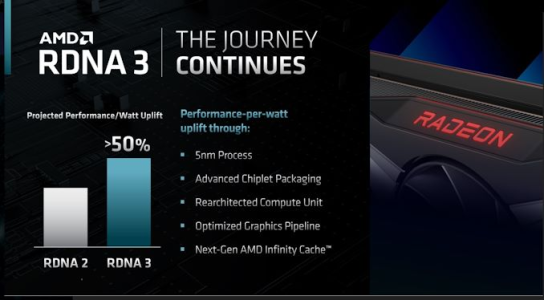
So, nearly non-existent Performance / Power gains, despite going to N5. The expectation was I think ~50% gain

Remember he was saying things like Navi 33 was going to performance like a 6900xt or better knowing that Navi 33 was on 6nm and 200ishmm2. The fact that people still believe him and give him the time of day just show people are still doped up on copium.

No, most people were surprised at the small die sizes of all of the RDNA3 cards, from N31 to N33. The expectations were for die sizes about 50% bigger.

I think the more likely reason for the delay of Navi 32 is AMD still has a lot of Navi 2 inventory to sell that performs on that level and if compared to Navi 32 in reviews, will damper the Navi 32 reviews.

It has been hard to get excited about any new product as a result of products being compared to last gen price/performance and launching Navi 32 in this toxic buying environment will likely lead to bad reviews and quick price drops of Navi 32 soon after launch.

I don't think at this point, there are any Navi 2x inventory issues are a concern any more.

Price / performance vs. last gen that is being discontinued - is an academic discussion to hold on a forum like this, but otherwise, it is meaningless as far as AMD management decision making.
 
Back
Top