• We’re currently investigating an issue related to the forum theme and styling that is impacting page layout and visual formatting. The problem has been identified, and we are actively working on a resolution. There is no impact to user data or functionality, this is strictly a front-end display issue. We’ll post an update once the fix has been deployed. Thanks for your patience while we get this sorted.

Richland & Kabini rumours

Page 42 - Seeking answers? Join the AnandTech community: where nearly half-a-million members share solutions and discuss the latest tech.
Status
Not open for further replies.
And who would have supplied the 28nm dies..?..

There was no spare capacity left at TSMC , to this day.

Either they shipped their new GFX or shrinked BC but TSMC
couldnt supply both.

Anyway , that s in line with the rest of your "arguments"...

A direct shrink of bobcat would have been 36-40mm2, or about 1600 pcx a wafer, with near perfect yield, for 5000 usd a wafer. Thats 3usd per chip ex packaging. Giving you a chip with same perf- withing 9w TDP down to 2.5W, all on a far lower leaking hkmg process. Back then - and now - i think it would have been good business instead of selling huge GPU dies. Especially when we now see they have to spend ressource on intermediate products like Richland to get the production going on GF.
 
And do you know that the norvegian fund hold 1% of all main
indices , including the SP500 or the nikkei225 or the MIB30..?....

No, they *don't* buy 1% of the main indexes. Not only because this would have been a *dumb* strategy, the Norwegian pension fund has a strategy of prioritize European assets over RoW assets. In fact, they are well below this 1% threshold you mentioned for the US, and *far* above in Europe.

Second there are rules for the SPU to invest. They can't buy an entire index because some companies breach ethical rules established by the fund, so no fund ownership for a few companies inside this same index.

Third, to buy an equity index as broad as the SP500 is exactly the opposite of a direct investment in a company. You do buy an large index when you do see a good perspective for a given market but don't want to micromanage your investment in the winning horses. Win in some, lose in some others, pie grows after all. That's *exactly* the opposite of what Mubadala is doing, in which the fate of its money is tied to AMD's fate.

Of course you ll have to buy back the stocks, but you did understand me,
that make no doubt...

Yeah, right. How do you short sell a stock (sell something you do or don't have) and buy it *back* (buy back something you already have or didn't have in the first place?) to close a position?
 
And who would have supplied the 28nm dies..?..

There was no spare capacity left at TSMC , to this day.

There was. They build their GPU there, Qualcomm manufactured Krait, Nvidia manufactured Kepler. I cannot but stress that Brazos brings more money to AMD than dGPU. If they had to chose between the two, the choice was clear. But do the right choice is too much for AMD management of lately.
 
There was. They build their GPU there, Qualcomm manufactured Krait, Nvidia manufactured Kepler. I cannot but stress that Brazos brings more money to AMD than dGPU. If they had to chose between the two, the choice was clear. But do the right choice is too much for AMD management of lately.

That's completely wrong. Brazos was using some 12k wafers a month on 40nm, there is simply no chance that AMD could have got that on 28nm last year.
 
That's completely wrong. Brazos was using some 12k wafers a month on 40nm, there is simply no chance that AMD could have got that on 28nm last year.

AMD could have outbid some other contender or even going for a smoother ramp up of the 28nm Brazos.
 
That's completely wrong. Brazos is using some 12k wafers a month on 40nm, there is simply no chance that AMD could have got that on 28nm last year.

Not to mention they needed time, money and resources to design, test and manufacture the 28nm shrink of BobCat.
In Q1 2012 TSMC 28nm was only 2% of its entire production Volume and there was no spare capacity because both NV, AMD(GPUs) and Qualcomm was using it.
 
hey Krumme,

investment community is catching on to this WSA gong show:

http://www.investorvillage.com/smbd.asp?mb=476&mn=256687&pt=msg&mid=12465762

Bernstein Research - AMD: New WSA Increases AMD Cash Burn vs. Our Prior Model - Q412 Preview

in response to:
"We have now incorporated the effects of AMD's new wafer supply agreement with GlobalFoundries.

As a result, our cash balance estimates have taken a further hit. While on the surface the new WSA

should (theoretically) save some cash (~$65M over the next 6 quarters), we realized (in a

bit of a forehead - slapping moment) that we had not been properly modeling the ~$500M that was

supposed to go to wafer purchases in Q4 anyway (implicitly assuming the company would come to

some arrangement, as taking that amount of wafers was clearly impossible). Therefore, while the

company's Q4 wafer commitment has been reduced to $115M (nominally saving them from taking

$385M in wafers they don't need), this does not really represent a change to our model. However, we

are now EXPLICITLY modeling the impact of the take-or-pay consequences ($320M in direct cash

going out over the next 6 quarters) which reduces our cash estimates for the company by a

similar amount by 2014 (where we forecast cash reaching ~$350M, uncomfortably low). Note that we

have not yet incorporated upside from the sale/leaseback of the Austin campus (which the company

believes will bring in ~$150M); it will help, but not change the picture.


We believe watching the cash balance, and identifying the potential to achieve gross margin and/or

revenue trajectory needed to halt cash burn, will be critical issues.


- Watching the cash trajectory is (in our mind) the key issue at the moment. In particular (given the new

WSA will apparently result in further cash outlay vs. our prior model), outlining the gross margin and

revenue trajectory needed to stave off the cash burn will be most critical? Following the renegotiation

of the GlobalFoundries Wafer Supply Agreement4, AMD stated that

1) they would be FCF positive by Q313 and 2) they would target a cash balance between $700M and

$1.1B (the latter being "optimal"). However, while have them close to FCF neutral in Q313, we model

the company burning significant cash in the three quarters leading into it as a result of operating losses

and GlobalFoundries payments (with more than $630M in negative cash flow from operations from

Q412-Q213). Additionally, as noted above, our estimates for AMD's cash trajectory have taken a

serious hit after modeling the impact of the new GlobalFoundries wafer supply agreement. As a result,

we model the company reaching cash levels of ~$350M by 2014. Our cash flow assumptions will be

(naturally) most sensitive to the trajectory of revenue growth and gross margins vs. our current model;

we will listen carefully for commentary on expected cash burn rates through the first half of next year,

potential requirements for further liquidity, what the path to "optimal" cash balances looks like.

"

http://www.investorvillage.com/mbthread.asp?mb=476&tid=12465762&showall=1

Now lets see if RR can get AMD out of this trap.

It simply calls for actions or they possible run out of cash.

 
That's completely wrong. Brazos was using some 12k wafers a month on 40nm, there is simply no chance that AMD could have got that on 28nm last year.

I thought more importantly that the 28nm Brazos shrink was designed for GF not TSMC.

And in got cancelled when GF screwed up and there wasn't enough time to port it to TSMC.
 
The real profit is where there is monopoly like situations.

When we educate economist on this globe we use our time learning them how to create monopolistic situations fx. use high entry bariers. We dont learn them how to create wealth. We learn them to position their investments or company in a way that minimizes competition giving monopolistic advantages. Try reading fx. Kotler marketing, its one long lesson how to create monopoly. Ofcourse without using the word. Those people regard themselves as true market liberals.

Now. Every f.....g idiot on this planet know the foundy business is the perfect place to create huge profit, because of the enormous entry cost. Mubala entered this huge gamble. They can loose 10-15B, but they can over the next 20 gain perhaps 40-100B. (in the meantime they inflate the assets worth)

....or that was what they were thinking. They just forgot, that the foundry business is the most obvious of all choices, and that every greedy pile of money, will stand next in line to take that opportunity if they succeed. Why, because you dont have to add any business innovation into the mix. You dont have to be creative on the strategic level. You just have to push using your pile of 10B.

Now adding AMD to the mix, was perhaps a good idea. Yes- if they have used the market to show what was working or not. Do they know themselves now if AMD is a profitable business in the future?

They stand with an AMD with unique competences, and IP, no money can buy. With IP in the visual side, that will continue to be more and more important.

And they use that business platform to create and produce Richland???

Its an insult.
 
Now lets see if RR can get AMD out of this trap.

It simply calls for actions or they possible run out of cash.

Nice find Krumme.

If their model is correct and the assumptions are correct too AMD is going for chapter 11 before 2014.
 
Not to mention they needed time, money and resources to design, test and manufacture the 28nm shrink of BobCat.
In Q1 2012 TSMC 28nm was only 2% of its entire production Volume and there was no spare capacity because both NV, AMD(GPUs) and Qualcomm was using it.

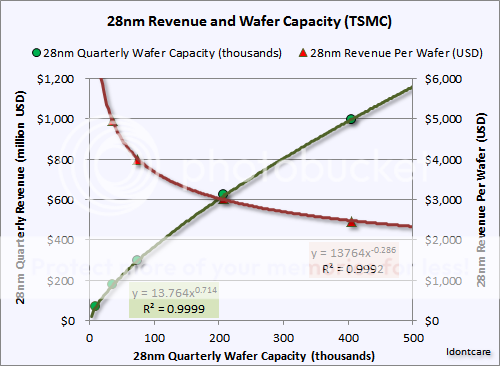
I know we are also offline discussing this but I thought I'd chime in here with some numbers I computed in analyzing TSMC's reports.

From my calculations, TSMC's 28nm wafer capacity per month by quarter has been as follows:

Q4'11 = 3.3 kwpm (thousand wafers per month)
Q1'12 = 11.9 kwpm
Q2'12 = 25 kwpm
Q3'12 = 69 kwpm
Q4'12 = 135 kwpm

(apologies if I pre-empted you by posting the numbers here)
 
I know we are also offline discussing this but I thought I'd chime in here with some numbers I computed in analyzing TSMC's reports.

From my calculations, TSMC's 28nm wafer capacity per month by quarter has been as follows:

Q4'11 = 3.3 kwpm (thousand wafers per month)
Q1'12 = 11.9 kwpm
Q2'12 = 25 kwpm
Q3'12 = 69 kwpm
Q4'12 = 135 kwpm

(apologies if I pre-empted you by posting the numbers here)

Realistically the earliest AMD could have started on Kabini was Q3'12 then, but a lot more likely to be Q4.
 
I know we are also offline discussing this but I thought I'd chime in here with some numbers I computed in analyzing TSMC's reports.

From my calculations, TSMC's 28nm wafer capacity per month by quarter has been as follows:

Q4'11 = 3.3 kwpm (thousand wafers per month)
Q1'12 = 11.9 kwpm
Q2'12 = 25 kwpm
Q3'12 = 69 kwpm
Q4'12 = 135 kwpm

(apologies if I pre-empted you by posting the numbers here)

Your numbers, your posting privileges 😉
 
I thought more importantly that the 28nm Brazos shrink was designed for GF not TSMC.

And in got cancelled when GF screwed up and there wasn't enough time to port it to TSMC.

That's the story I was told.

When we educate economist on this globe we use our time learning them how to create monopolistic situations fx. use high entry bariers. We dont learn them how to create wealth. We learn them to position their investments or company in a way that minimizes competition giving monopolistic advantages.

Unfortunately this is exactly what they teach engineers/scientists in R&D as well.

We are pushed to develop what are called "blocking IP", inventions that block out competition so that our employers can drive up margins. Can't complain though, personally speaking, as they pay us a bundle in return for us doing our part.

But there is no question, it is anti-competitive and it comes at the expense of the consumer paying higher prices and having fewer choices in the market.
 
Your numbers, your posting privileges 😉

Fair enough, but credit goes where credit is due and the credit here is yours for having "commissioned" the analysis of TSMC's results with the goal of generating numbers for the community to speak to. I would not have done the work had you not prompted/requested me to look into it :thumbsup: So, thank you!
 
If this GF stuff continues surely AMD will simply drop GF altogether in the long run, which suits nobody. There will be some hard negotiations going on for the forseeable future. AMD can make all of their chips at TSMC if they have to.
 
Realistically the earliest AMD could have started on Kabini was Q3'12 then, but a lot more likely to be Q4.

Agreed, and the price per wafer would have likely been way too rich for their blood at that time as well.

TSMC28nmwafercapacityanalysis.png


From my calculations, TSMC's average 28nm wafer price by quarter has been as follows:

Q4'11 = $7,000 (USD)
Q1'12 = $5,000
Q2'12 = $4,000
Q3'12 = $3,000
Q4'12 = $2,500

(note these are not "guesses", these numbers drop out of TSMC's published financials)
 
Agreed, and the price per wafer would have likely been way too rich for their blood at that time as well

Well, even if they could not have started in Q112, start 28nm Brazos in Q312 would be far better than sticking with Brazos until the end of Q113. The volumes were there and wafer prices by the end of the quarter were already at a significant lower price. In any case, to wait for Kabini at TSMC 28nm cost them a lot of time, and cash.
 
If this GF stuff continues surely AMD will simply drop GF altogether in the long run, which suits nobody. There will be some hard negotiations going on for the forseeable future. AMD can make all of their chips at TSMC if they have to.

AMD is contractually tied to using GloFo through some absurd far out date, like 2024 or some such.

It is a point of contention right now between AMD and the investment community because the foundry exclusivity underlying the contractual obligations combined with the egregious take-or-pay requirements effectively result in AMD having a huge off-sheet liability that no one was made publicly aware of in the process of spinning off GloFo.

They inflated the perceived value of the spin-off deal to make AMD's post-spinoff assessed market valuation higher than was merited.

But Hector was intimately involved, just as he was with the ATI acquisition, so it is of little wonder that the spin-off deal was equally tainted with creative and questionable accounting shenanigans 🙁
 
Well, even if they could not have started in Q112, start 28nm Brazos in Q312 would be far better than sticking with Brazos until the end of Q113. The volumes were there and wafer prices by the end of the quarter were already at a significant lower price. In any case, to wait for Kabini at TSMC 28nm cost them a lot of time, and cash.

Brazos 2(40nm) was released in June 6th 2012, it was in production since Q1 or early Q2. Even if they would start the 28nm in Q3, they would need 2-3 months for the production plus 2-3 months for OEMs to launch their products. That would put 28nm Brazos shrink products in Q1 2013.

So, they canceled the shrink and went for the 40nm in Q1 2012 in order to have products sooner. Not only that, it gave them time to upgrade the design for the Kabini and launch it in H2 2013.
 
whoa...this explaind why the HD 7970 is way cheaper today than at lunch
(and giving more proffits D: )

Yes and no. Its now you put more effort in paying back the R&D. Looking on the marketshare, AMD didnt lowered the HD7970 prices because they saved money on wafers. Note that AMDs GPU division makes even less money than back then.
 
oh...now competition is good for us, hum?

Yes and no again. Its a self destroying business segment that only allows one winner.

Less profit means there is now less money for the next R&D project. So good for consumers is more like a pee in the pants case. Its warm and nice now, but it will get cold and uncomfy later.
 
Status
Not open for further replies.
Back
Top