• We’re currently investigating an issue related to the forum theme and styling that is impacting page layout and visual formatting. The problem has been identified, and we are actively working on a resolution. There is no impact to user data or functionality, this is strictly a front-end display issue. We’ll post an update once the fix has been deployed. Thanks for your patience while we get this sorted.

Discussion RDNA4 + CDNA3 Architectures Thread

Page 334 - Seeking answers? Join the AnandTech community: where nearly half-a-million members share solutions and discuss the latest tech.

DisEnchantment

Golden Member

1655034287489.png
1655034259690.png

1655034485504.png

With the GFX940 patches in full swing since first week of March, it is looking like MI300 is not far in the distant future!
Usually AMD takes around 3Qs to get the support in LLVM and amdgpu. Lately, since RDNA2 the window they push to add support for new devices is much reduced to prevent leaks.
But looking at the flurry of code in LLVM, it is a lot of commits. Maybe because US Govt is starting to prepare the SW environment for El Capitan (Maybe to avoid slow bring up situation like Frontier for example)

See here for the GFX940 specific commits
Or Phoronix

There is a lot more if you know whom to follow in LLVM review chains (before getting merged to github), but I am not going to link AMD employees.

I am starting to think MI300 will launch around the same time like Hopper probably only a couple of months later!
Although I believe Hopper had problems not having a host CPU capable of doing PCIe 5 in the very near future therefore it might have gotten pushed back a bit until SPR and Genoa arrives later in 2022.
If PVC slips again I believe MI300 could launch before it :grimacing:

This is nuts, MI100/200/300 cadence is impressive.

1655034362046.png

Previous thread on CDNA2 and RDNA3 here

 
Last edited:
96 rdna3 cu's / 64 rdna4 cu's - clocks improvement = "nearly 50%".
Just simple, Annalena B. 360° math.
lol, just as I said. +42% vs 80 CU 7900GRE over a comparison of 30+ games with almost half of those comprised of RT comparisons, which give an additional ~20%-40% boost over straight raster. And that is with ~38% higher boost clocks.
 
Whose numbers do you based it on?
When I first saw the numbers I was trying to "plot" it against 5070 Ti based on TPU's and CoputerBase's graphs from 5070 Ti reviews but 9070 XT was tracking as being below 5070ti.

Thanks for doing the math btw.

(Edit: I have just retried it against TPU's review of the Palit card what has lowest OC and it still tells me 9070 XT will be below 5070 Ti on average from the games TPU had - I didn't want to put in more sources to make it even less reliable anyway.)
 
Last edited:
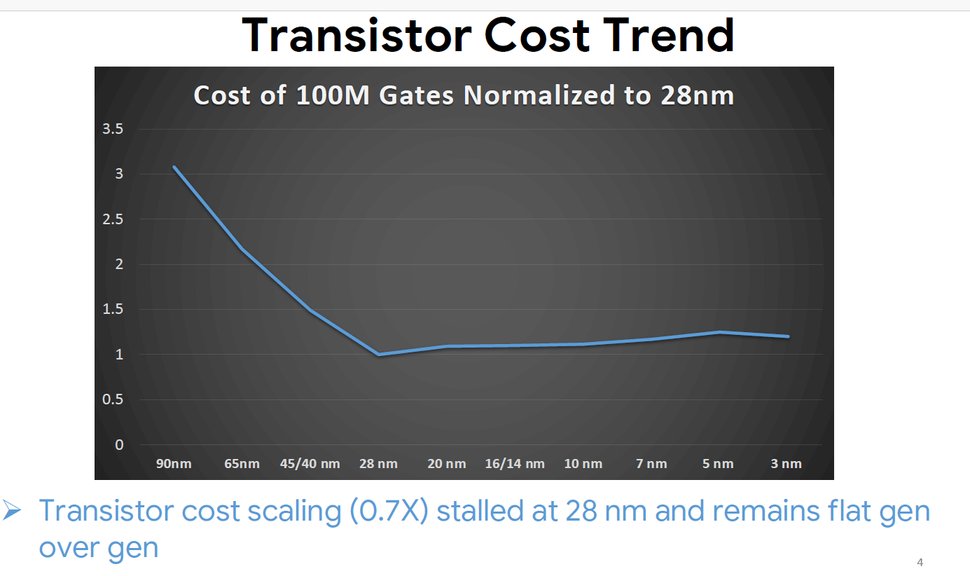
You pay for wafers not transistors. The fact that N48 is like 2x the transistor density of B580 doesn't change the price.

More advanced Nodes cost more per wafer. That is the reason that transistor price reductions have stagnated. While the graph exaggerates the point, the steep down slope of the past is over.

JWVHie5XEX4KCvj9VRdzSM-970-80.png
 
It's become more useful for comparisons than die size when using different process nodes, as node related transistor cost reductions have stagnated.

So designs with a lot more transistors usually rise in cost.
Zen 5 is many more transistors but same size. Cost per transistor decreased. It's plausible RDNA4 is DTCO cache maxxing in a similar fashion.

But I still think it is 380mm²+.
 
Zen 5 is many more transistors but same size. Cost per transistor decreased. It's plausible RDNA4 is DTCO cache maxxing in a similar fashion.

But I still think it is 380mm²+.

There are things you can do to pack in more density, to make a bit better use of a node. But there isn't a endless supply of these, so you are still faced with the flattening of the old curve.

380mm²+ is still a big die on an expensive node.
 
It's become more useful for comparisons than die size when using different process nodes, as node related transistor cost reductions have stagnated.

So designs with a lot more transistors usually rise in cost.
Transistor count is a terrible metric for comparing designs.

First off, transistor counts can vary depending on how they're measured. Unless we know that two dies are measured the same way, the count could be off.

Secondly, chips can have varying levels of transistor density, even on the same node.

An extreme example of this would be Zen5 VS Zen5c. They have the same transistor count, but the die area is way different.

A more applicable example for graphics cards would be how B580 is way less dense than AMD or Nvidia GPUs. The B580 has less than 40% as many transistors as the 9070 XT, but the die is ~70-77% as big.

Transistor count should never be used to compare chips imo. It has too much margin for error.
 
Transistor count is a terrible metric for comparing designs.

First off, transistor counts can vary depending on how they're measured. Unless we know that two dies are measured the same way, the count could be off.

Secondly, chips can have varying levels of transistor density, even on the same node.

An extreme example of this would be Zen5 VS Zen5c. They have the same transistor count, but the die area is way different.

A more applicable example for graphics cards would be how B580 is way less dense than AMD or Nvidia GPUs. The B580 has less than 40% as many transistors as the 9070 XT, but the die is ~70-77% as big.

Transistor count should never be used to compare chips imo. It has too much margin for error.

It's more useful than die size, if they are on different nodes.

If they are on the same node, then you can compare die size.

The problem is when people comparing die size across nodes, which is completely non comparable.
 
It's more useful than die size, if they are on different nodes.
Navi 21 N7 ~27B transistors
Navi 48 N4 ~53B transistors, almost 100% increase

I agree that tracking transistor costs is useful, but using it for die costs estimates of different designs might lead to very weird results. 6900 XT launched for $1000, and it looks like N48 needs even higher price for similar margins. Even if we take 6800XT MSRP as guideline, the math still looks bad.
 
It's more useful than die size, if they are on different nodes.

If they are on the same node, then you can compare die size.

The problem is when people comparing die size across nodes, which is completely non comparable.
What about libraries and the varying densities? Die area, wafer cost and defect density, not simply transistor costs.
 
It's more useful than die size, if they are on different nodes.

If they are on the same node, then you can compare die size.

The problem is when people comparing die size across nodes, which is completely non comparable.
The best way to compare costs across nodes is to multiply the die area by the cost-per-wafer.

Any comparison with a 50%+ margin for error is useless.
 
Back
Top