• We’re currently investigating an issue related to the forum theme and styling that is impacting page layout and visual formatting. The problem has been identified, and we are actively working on a resolution. There is no impact to user data or functionality, this is strictly a front-end display issue. We’ll post an update once the fix has been deployed. Thanks for your patience while we get this sorted.

Discussion RDNA4 + CDNA3 Architectures Thread

Page 104 - Seeking answers? Join the AnandTech community: where nearly half-a-million members share solutions and discuss the latest tech.

DisEnchantment

Golden Member
1655034287489.png
1655034259690.png

1655034485504.png

With the GFX940 patches in full swing since first week of March, it is looking like MI300 is not far in the distant future!
Usually AMD takes around 3Qs to get the support in LLVM and amdgpu. Lately, since RDNA2 the window they push to add support for new devices is much reduced to prevent leaks.
But looking at the flurry of code in LLVM, it is a lot of commits. Maybe because US Govt is starting to prepare the SW environment for El Capitan (Maybe to avoid slow bring up situation like Frontier for example)

See here for the GFX940 specific commits
Or Phoronix

There is a lot more if you know whom to follow in LLVM review chains (before getting merged to github), but I am not going to link AMD employees.

I am starting to think MI300 will launch around the same time like Hopper probably only a couple of months later!
Although I believe Hopper had problems not having a host CPU capable of doing PCIe 5 in the very near future therefore it might have gotten pushed back a bit until SPR and Genoa arrives later in 2022.
If PVC slips again I believe MI300 could launch before it :grimacing:

This is nuts, MI100/200/300 cadence is impressive.
1655034362046.png

Previous thread on CDNA2 and RDNA3 here

 
Last edited:
Isn't the Navi 44 rumored to also be sold with 8GB offering?

It is rumoured to have a 128bit GDDR6 bus. That means 8GB or 16GB unless you cut the bus.

8GB has a ceiling price which if N44 is less than is fine but if it does perform between the 6700XT and 7700XT (so 4060Ti ISH) then AMD can probably up the price by more than the cost of the VRAM.

A cut version that performs like the 6700XT could also charge more than the extra vram if AMD chose to go 96bit + 12GB but 128bit + 8GB at $220 would probably be okay.
 
Though the 7600 should've had 10GB minimum. AMD should've known better.
7600XT wich use the same chip has 16GB, now when it comes to perf/price a 4060 has only 10% advantage in raster but also half the RAM.
There s graphs at Computerbase for perf/price at each resolution with and without RT, you can check there.

 
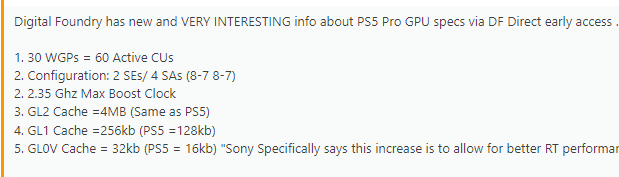
Is there something real? Except CU number
52b787ef18d5fc97ea62f032af8edff8.png
 
8-7-8-7 is the number of WGP in each Shader Array: two of the SAs have 8 WGPs and the other two have 7 WGPs.
I trust Sony will have a way to squeeze everything out of this but isn’t the lack of symmetry in this type of hardware a little odd? Is there a purpose to this that’s obvious to those in the know?
 
Is there something real? Except CU number
52b787ef18d5fc97ea62f032af8edff8.png

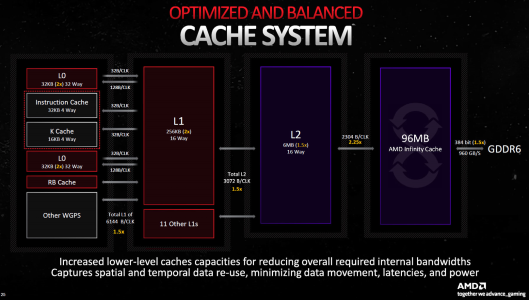
GL0V --> sounds odd. Somebody just wrote that, I doubt it is from a specification because it I don't see this on RDNA3, unless the GPU is not based on RDNA3
RDNA2-->RDNA3 doubled the L0, so, 32K. But it is not global it is local to a CU, also not even shareable at WGP level.
RDNA2-->RDNA3 doubled the L1, so, 256K
1715030692063.png
 
GL0V --> sounds odd. Somebody just wrote that, I doubt it is from a specification because it I don't see this on RDNA3, unless the GPU is not based on RDNA3
RDNA2-->RDNA3 doubled the L0, so, 32K. But it is not global it is local to a CU, also not even shareable at WGP level.
RDNA2-->RDNA3 doubled the L1, so, 256K
View attachment 98490
GL0V = Graphics L0 Vector cache, as opposed to Instruction or Scalar cache.
 
I thought so too at first, but those specs mention only 4 SA with 7 or 8 active WGP each.

I would have thought a 32 WGP RDNA3-derivative would have 4 Shader Engines, not just 2.
Those chips go into consoles whose manufacturers are notoriously stingy wrt/ die space.
Same reason why these seemingly gaming-oriented chips are equipped with only 8MB L3$ instead of 32MB for desktop equivalents, despite cache being very valuable for gaming.
 
I'm kind of surprised they don't use v-cache as a way to separate baseline and "better" model. Xbox used separate chips for their S and X models, but v-cache seems like another way to separate them as binning for hardware capability doesn't differentiate the parts enough.

Console APUs are practically perfect since they want to keep the TPD down anyway which means lower voltages.
 
Depends on the mix. If you want 85% of your sales to be the top model, then no. If it's 15%, much more doable.

At the end of the day it's really just a matter of money. What isn't feasible suddenly is for the right price.

It also depends on what you mean by console volumes. Apparently those haven't been all that great recently, or ever if you're Microsoft this generation.
 
Depends on the mix. If you want 85% of your sales to be the top model, then no. If it's 15%, much more doable.

At the end of the day it's really just a matter of money. What isn't feasible suddenly is for the right price.

It also depends on what you mean by console volumes. Apparently those haven't been all that great recently, or ever if you're Microsoft this generation.
As a console manufacturer, you don't exactly count on your volumes to be non-existent, that defeats the entire purpose.
 

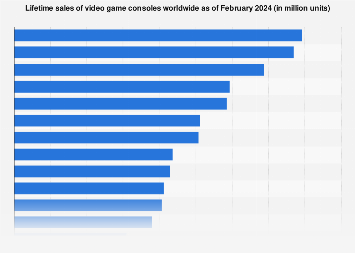
I didn't realise how poorly the PS5 has sold.
We're below XBONE.
It's between the NES and SNES, which is ridiculous considering how much bigger the market is than then.

This is pretty awful since the console is great. Sign of the economy, or sign of the future of consoles?
 
Back
Top