• We’re currently investigating an issue related to the forum theme and styling that is impacting page layout and visual formatting. The problem has been identified, and we are actively working on a resolution. There is no impact to user data or functionality, this is strictly a front-end display issue. We’ll post an update once the fix has been deployed. Thanks for your patience while we get this sorted.

Question Raptor Lake - Official Thread

Page 106 - Seeking answers? Join the AnandTech community: where nearly half-a-million members share solutions and discuss the latest tech.

Hulk

Diamond Member
Since we already have the first Raptor Lake leak I'm thinking it should have it's own thread.
What do we know so far?
From Anandtech's Intel Process Roadmap articles from July:

Built on Intel 7 with upgraded FinFET
10-15% PPW (performance-per-watt)
Last non-tiled consumer CPU as Meteor Lake will be tiled

I'm guessing this will be a minor update to ADL with just a few microarchitecture changes to the cores. The larger change will be the new process refinement allowing 8+16 at the top of the stack.

Will it work with current z690 motherboards? If yes then that could be a major selling point for people to move to ADL rather than wait.
 
Big review sites set limits, they're reviewing the CPU, not the motherboard.
Yes, but end users will slide the chip in the motherboard and get different (in this case higher) performance - albeit with a much higher power draw. For someone who doesn't want to fiddle with BIOS settings this move by motherboard makers is odd, to say the least.
 
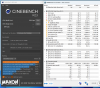
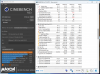
I replaced the AIO with Arctic Freezer 34 esports duo air cooler worth 50 USD. After 10 minutes of Cinebench, my max. temperature at 160W was 71°C and at 210W 90°C. Ambient is 20°C. It is in a closed computer case with poor airflow.

I believe the CPU could be run even at higher power limit with such cooler, if it would run any nonextreme loads.

airCool160W10min.pngairCool210W10min.png
 
Last edited:
For someone who doesn't want to fiddle with BIOS settings this move by motherboard makers is odd, to say the least.
The setting requires to turn on advanced settings, go to advanced CPU settings, switch power limits to manual input, type in the limit in the correct field, save the setting. This is not easy for a normal PC user.

This thing can draw 350W, if somebody used 30 min stability test in Cinebench, bad things can realistically happen.
 
Last edited:
The setting requires to turn on advanced settings, go to advanced CPU settings, swith power limits to manual input, type in the limit in the correct field, save the setting. This is not easy for a normal PC user.

This thing can draw 350W, if somebody used 30 min stability test in Cinebench, bad things can realisticaly happen.
Indeed, the process is pretty difficult for an average user. Most regular users don't even want to mess with BIOS settings, apart from some basic stuff. This can end up badly for people who are not aware that the chip can draw an excess of 300W at perceived "stock".
 
I replaced the AIO with Artic Freezer 34 esports duo air cooler worth 50 USD. After 10 minutes of Cinebench, my max. temperature at 160W was 71°C and at 210W 90°C. Ambient is 20°C. It is in a closed computer case with poor airflow.

I believe the CPU could be run even at higher power limit with such cooler, if it would run any nonextreme loads.

View attachment 69168View attachment 69169

A representative bench is to set PL1 = PL2 at the targeted 160W power, otherwise at PL1 = 4095W the chip will boost to max possible power before getting to PL2 = 160W and the perf/watt estimation will thus be flawed.

With your settings the chip will start the bench at around 335W and end it at 160W if the bench duration is long enough, that s not what can be called perf at 160W...
 
the chip will boost to max possible power before getting to PL2 = 160W
It is simply not doing that. You can see the power graphs yourself. There is some overshoot in single core power draw, but it is so short that it has no effect on the score.
 
Last edited:
No, it does not.

It is simply not doing that. You can see the power graphs yourself. There is some overshoot in single core power draw, but it is so short that it has no effect on the score.


HVinfo say that your CPU s Core 0 was idling during the two CB runs you just posted, so obviously numbers are not detected correctly by this software, also Core 1 didnt reach 100% usage, yet on CB MT all cores should be at about 100%.
 
I believe that the motherboard should have some self protection measures in place, but you never know, if they will work or if you got a weak component by chance which will not handle the stress.
 
I believe that the motherboard should have some self protection measures in place, but you never know, if they will work or if you got a weak component by chance which will not handle the stress.
Now the Fun part starts, tweaking the CPU to get the absolute best performance at the absolute most efficient power draw. I believe that by lowering the v core just a bit you will not lose any performance but stay within acceptable power usage.
 
I believe that the motherboard should have some self protection measures in place, but you never know, if they will work or if you got a weak component by chance which will not handle the stress.
Do you know what was the burning smell you felt during one of the benchmark runs? Was it from the PSU or the motherboard?
 
It was a smell of very warm electronics, it must have been the motherboard, PSU is 850W. Or 750, I do not remember now.

I will not be doing any tweaking, I do not want this computer to crash.
 
Linux performance for new chips usually improves quite a decent bit in the half year following the launch, so it should look even better.
The effect is amplified for server chips while kernel maintainers tweak the NUMA settings
 
Not bad. Considering Intel is a node behind. AMD will have a hard time going for the pref crown and efficiency crown when Intel reaches node parity in the CPU tile.

Arrow Lake will the true test for Intel and if AMD can keep up when Intel is at its best.
I don't think Raptor Lake will win over Zen 4.

BUT. They are getting so close being a node behind, I agree the future could be interesting. At least in the desktop /laptop areas. Nothing on the horizon for server for Intel that I see.
 
The huge frequency jump AMD was able to pull off from Zen 3 to Zen 4 is a double shot to Intel. Not only did were they able to produce significant IPC gains (punch #1) but also a large increase in clock speed (punch #2). Like Zen 3, Zen 4 is impressive. While the architectural changes to Zen 4 appear to be relatively mild ... kudos to the engineers because they precisely located the bottlenecks with Zen 3 and eliminated them without a major overhaul of the fundamental design. It seems like Zen 3 has a very efficient engine but didn't have the front/back ends to keep things moving through it.

Official reviews will be a treat to read when Raptor arrives.
 
This "node behind" stuff in relation to AMD is getting very tired. Raphael is more than just the compute chiplet(s) and that "more" is on the same class of node as Intel. This will only get worse with the release of something like Meteor Lake, with an even bigger smorgasbord of nodes in it. Or Raphael-X for that matter, SRAM stack ain't "5nm class" either AFAIK.

Core size v core size is more relevant, at least to most and in the context of roughly similar performance (otherwise what's the point?). And last I checked, TSMC N5 ain't 2x as dense as Intel 7... not even close. And AMD can fit in more than just 8 of 'em.
 
  • Like
Reactions: ftt
BUT. They are getting so close being a node behind, I agree the future could be interesting.

Why? Intel really has nothing for desktop until 2024 at the earliest. Unless we're still holding out hope for a high-performance desktop part in the Meteor Lake series.

Raptor Lake better be good, cuz we may not see anything else relevant to desktop for about two years.
 
  • Like
Reactions: ftt
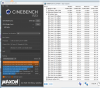
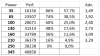
I measured two more power limits of 130 and 210W.

13900K power serie 3.png

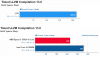
Compared to 250W, at 130W at nearly half the power draw you lose just 17,6% performance. That is the point at which you could end up if you wanted the chip to run very efficiently but at the same time you wanted high performance.

Here are the decreases in power and performance compared to 250W:

effi impr2.png
 
Last edited:
Back
Top