• We’re currently investigating an issue related to the forum theme and styling that is impacting page layout and visual formatting. The problem has been identified, and we are actively working on a resolution. There is no impact to user data or functionality, this is strictly a front-end display issue. We’ll post an update once the fix has been deployed. Thanks for your patience while we get this sorted.

Question Qualcomm's first Nuvia based SoC - Hamoa

Page 36 - Seeking answers? Join the AnandTech community: where nearly half-a-million members share solutions and discuss the latest tech.
Rumour: Qualcomm, Samsung working with AMD on FSR


Interesting developments. The way I am interpreting this rumour is that Samsung wants to have FSR on their Galaxy smartphones. Which is obvious since Exynos processors* now use AMD's RDNA GPU IP. The reason Qualcomm is involved is since Samsung dual-sources both Exynos and Snapdragon chips for their flagship S series. They want one single solution working on their phones: FSR.

Still this does leave open for further possibilities, as the commenters have noted. Will Qualcomm and AMD further collaborate on FSR, with the potentiality of FSR coming to future Snapdragon X processors ? On one hand FSR is inferior to DLSS, so it could benefit from more engineers working on it to improve it. On the other hand, Snapdragon X is a direct threat to AMD's Ryzen, so it may be detrimental for AMD to collaborate.
 
Hmm. QC already has OpenCL drivers on Android. Can they not simply be ported over to Windows?
Dunno.

IMHO at the moment no one has really good OCL drivers for Windows so it likely won't matter much anyway.

AMD made a poor effort on their driver, and nVidia pretty much kneecapped theirs from day 1 to prevent it looking like a viable CUDA alternative and thus damage their carefully engineered market monopoly.
 
OpenCL is mostly deprecated anyway, isn't it?
Certainly OCL 3 didn't sound like a step in the right direction to me.

It felt more like a Khronos capitulation and endorsement of nVidia's "I won't support anything past v1.2" strategy to artificially keep OCL marketshare low vs CUDA.
 
Snapdragon X Elite Pre-Briefing Deck 15_575px.jpeg

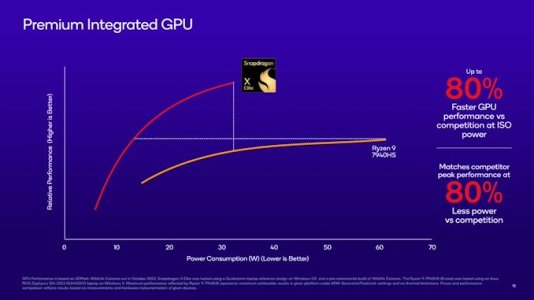
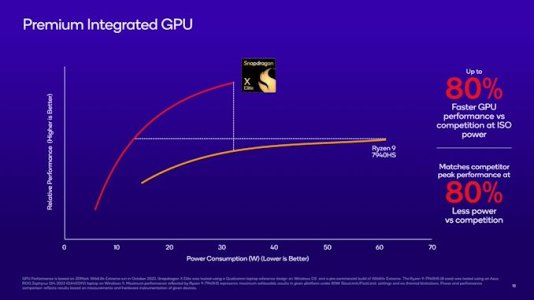
This Adreno GPU in the X Elite is pulling a lot of power. Over 30 watts.

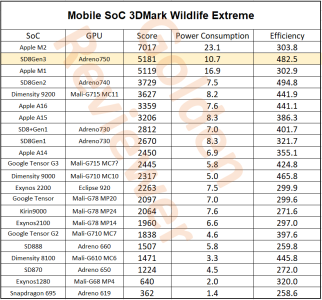
Compare that to their mobile SoCs:

F_MahhfagAAhnFn.png

8gen2 pulls 7.5 watts. 8gen3 pulls 10.7 watts.

Screenshot_20231105_195431_YouTube.jpg

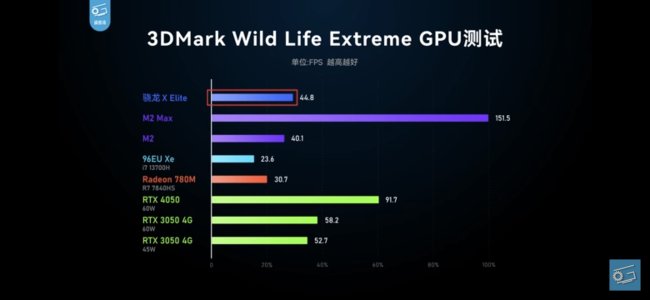
X Elite: 44 FPS @ 33W
SD8G2: 22 FPS @7.5W
SD8G3: 32 FPS @10.7W

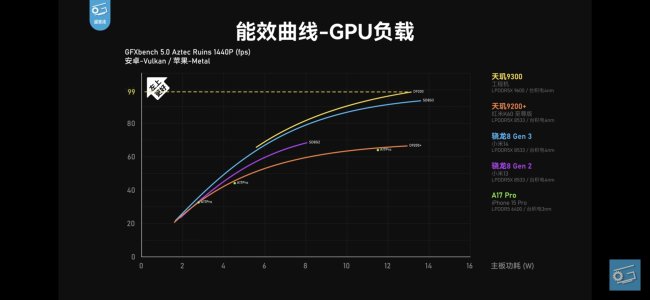
According to some rumours from Chinese forums, the X Elite's iGPU is based on the architecture of the SD8G2, and has approximately 2x the ALUs. Well, that tracks with the 2x FPS number. But what isn't tracking is the power consumption which increased by 4x.

Even if we doubt the validity of this rumour and assume the X Elite has the same iGPU as the SD8G2 but now clocked 2x higher, the graph Qualcomm has showed doesn't suit that assumption. Because then the graph would look a lot more flatter as it is pushed out of it's efficiency range.

Screenshot_20231107_124303_YouTube.jpg

*Found FPS numbers of 8g2 and 8g3 3DMark WLE from a Google image search.
 
Certainly OCL 3 didn't sound like a step in the right direction to me.

It felt more like a Khronos capitulation and endorsement of nVidia's "I won't support anything past v1.2" strategy to artificially keep OCL marketshare low vs CUDA.

So if OCL is dead, then what are the replacement/alternatives?

Since this thread doesn't really pertain to OpenCL or heterogeneous processing, I'll redirect to the last known related thread I follow on these forums:

 
I'm assuming you aren't simply taking the 33W from one graph and the 44 fps from a different table and combining the two. Without giving a link to whatever source you have the "44 fps @ 33 W" claim from, that's what it looks like you are doing.
44 FPS from Geekerwan, 33W from Qualcomm!

Dual sourcing! You know it's never a good idea to rely on solely one source, right? /s
 
In all seriousness though, both numbers originate from Qualcomm.

Snapdragon X Elite Pre-Briefing Deck 15_575px.jpeg
33W from this graph.

chrome_screenshot_1699306899603.png
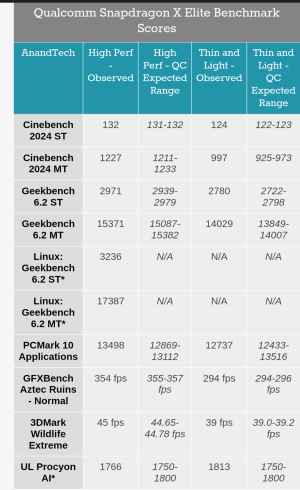
44 FPS from the Performance Preview Qualcomm held for the X Elite.
 
In all seriousness though, both numbers originate from Qualcomm.

View attachment 89004
33W from this graph.

View attachment 89006
44 FPS from the Performance Preview Qualcomm held for the X Elite.

So you took an arbitrary endpoint from the power curve and decided that's the exact wattage used to achieve the performance listed in a different table.

The 33 W endpoint was chosen for the sole reason that it maximized the delta between the X Elite and the 7940HS. Had Qualcomm marketing chosen to continue the power-performance curve to 50 W, would you have used that number instead?

I may have missed it, but there seems to be nothing that ties the 44 fps to the 33 W.
 
According to rumours and speculation floating online, the Hamoa chip was supposed to be a 2022 chip, with devices arriving in 2023.

However as things have turned out, the X Elite has been announced at the tail end of 2023, with devices launching in 2024.

2024 seems like a turbulent year. Intel Meteor Lake will be out, and AMD are launching Zen5 and all those formidable APUs.
 
Also in other news, Qualcomm has announced the Snapdragon 7 gen 3.

Hah- is this the only major thread regarding Qualcomm? We don't have a thread for discussing about Snapdragon mobile SoCs. Shall I make one?
 
According to rumours and speculation floating online, the Hamoa chip was supposed to be a 2022 chip, with devices arriving in 2023.

However as things have turned out, the X Elite has been announced at the tail end of 2023, with devices launching in 2024.

2024 seems like a turbulent year. Intel Meteor Lake will be out, and AMD are launching Zen5 and all those formidable APUs.
I feel like Lunar lake will shake up the industry like M1 did. Ultrabooks and handheld PC gaming will benefit
 
Last edited:
Like- there is literally an Apple Silicon SoC thread. I am jealous now.

Edit: Qualcomm Snapdragon Thread has been created!
 
Last edited:
Hmm. QC already has OpenCL drivers on Android. Can they not simply be ported over to Windows?
I don’t have experience with modern (Win 7/8/10/11) windows driver development, but Windows drivers are designed in a fundamentally different way compared to Linux/Android. You cannot simply “port” a driver between Linux/Windows.
 
Back
Top