
-
We’re currently investigating an issue related to the forum theme and styling that is impacting page layout and visual formatting. The problem has been identified, and we are actively working on a resolution. There is no impact to user data or functionality, this is strictly a front-end display issue. We’ll post an update once the fix has been deployed. Thanks for your patience while we get this sorted.
You are using an out of date browser. It may not display this or other websites correctly.
You should upgrade or use an alternative browser.
You should upgrade or use an alternative browser.
Discussion Qualcomm Snapdragon Thread
Page 158 - Seeking answers? Join the AnandTech community: where nearly half-a-million members share solutions and discuss the latest tech.

FlameTail
Diamond Member
Snapdragon 8 Elite
2 × Phoenix-L @ 4.32 GHz [12 MB sL2]
6 × Phoenix-M @ 3.53 GHz [12 MB sL2]
Snapdragon 7 Gen 4 (Speculation)
2 × Phoenix-L @ 3.9 GHz [8 MB sL2]
2 × Phoenix-M @ 3.2 GHz [4 MB sL2]
Will a quad core CPU be unsuitable for Android today?
Even $150 phones have '8-core CPU' nowadays.
2 × Phoenix-L @ 4.32 GHz [12 MB sL2]
6 × Phoenix-M @ 3.53 GHz [12 MB sL2]
Snapdragon 7 Gen 4 (Speculation)
2 × Phoenix-L @ 3.9 GHz [8 MB sL2]
2 × Phoenix-M @ 3.2 GHz [4 MB sL2]
Will a quad core CPU be unsuitable for Android today?
Even $150 phones have '8-core CPU' nowadays.

SteinFG
Senior member
ARM really went with a nuclear option, huh. I can see their reasoning: Arm is stuck in court for over a year already, and Qualcomm gets good in-house core, intends for this momentum to carry forward. So arm cancells the agreement at the point where oryon future is bright but slightly uncertain, best time to negotiate high % fees. ARM is betting that qualcomm doesn't want their progress to stop and they'll pay extra.
FlameTail
Diamond Member
SPEC numbers extracted from Geekerwan's graphs.
Performance wise (rough estimation);
Oryon-L : Oryon-M
100% : 60%
A18-P : A18-E
100% : 33%
Core size wise ;
Oryon-L : Oryon-M
100% : 40%
A18-P : A18-E
100% : 27%
| A18-P | A18-E | Oryon-L | Oryon-M | |
| Clock speed | 4.04 GHz | 2.2 GHz | 4.32 GHz | 3.53 GHz |
| SPEC INT | 10.7 | 3.3 | 8.9 | 5.2 |
| SPEC FP | 16.0 | 5.0 | 14.0 | 8.0 |
| Core size | 3.0 mm² | 0.8 mm² | 2.2 mm² | 0.9 mm² |
Performance wise (rough estimation);
Oryon-L : Oryon-M
100% : 60%
A18-P : A18-E
100% : 33%
Core size wise ;
Oryon-L : Oryon-M
100% : 40%
A18-P : A18-E
100% : 27%
FlameTail
Diamond Member
It's been an eventful month for ARM and Qualcomm;
- Mediatek Dimensity 9400
- Qualcomm cancels Snapdragon Dev Kit
- Qualcomm Snapdragon 8 Elite, Snapdragon Ride Elite and Cockpit Elite with 2nd gen Oryon cores
- ARM sends notice about revoking Qualcomm's ALA
- Massive Google Tensor G4/G5 leak
- Apple M4 Pro and M4 Max unveil (October 30th?).
- Mediatek Dimensity 9400
- Qualcomm cancels Snapdragon Dev Kit
- Qualcomm Snapdragon 8 Elite, Snapdragon Ride Elite and Cockpit Elite with 2nd gen Oryon cores
- ARM sends notice about revoking Qualcomm's ALA
- Massive Google Tensor G4/G5 leak
- Apple M4 Pro and M4 Max unveil (October 30th?).
I’d say the 8 Elite and the Summit as a whole was a bright spot in all of this.It's been an eventful month for ARM and Qualcomm;
- Mediatek Dimensity 9400
- Qualcomm cancels Snapdragon Dev Kit
- Qualcomm Snapdragon 8 Elite, Snapdragon Ride Elite and Cockpit Elite with 2nd gen Oryon cores
- ARM sends notice about revoking Qualcomm's ALA
- Massive Google Tensor G4/G5 leak
- Apple M4 Pro and M4 Max unveil (October 30th?).
But the rest? Ranges from meh to not good.

DrMrLordX
Lifer
Maybe Qualcomm could sell itself to Intel. Remember when Tim Horton's "bought" Burger King in a tax inversion?Yeah Qualcomm isn’t getting an x86 license unless something very very crazy happens
Do you have compiler settings that Geekerwan used? For quoting SPEC results they are essential, I mean even Qualcomm itself claims this on their slides when pointing fingers at Intel😉SPEC numbers extracted from Geekerwan's graphs.
A18-P A18-E Oryon-L Oryon-M Clock speed 4.04 GHz 2.2 GHz 4.32 GHz 3.53 GHz SPEC INT 10.7 3.3 8.9 5.2 SPEC FP 16.0 5.0 14.0 8.0 Core size 3.0 mm² 0.8 mm² 2.2 mm² 0.9 mm²
Performance wise (rough estimation);
Oryon-L : Oryon-M
100% : 60%
A18-P : A18-E
100% : 33%
Core size wise ;
Oryon-L : Oryon-M
100% : 40%
A18-P : A18-E
100% : 27%

Cardyak
Member
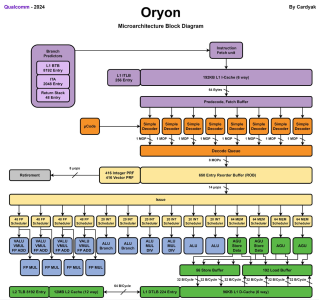
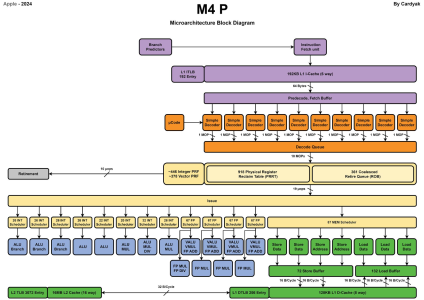
These diagrams have a few mistakes (but the overall picture is broadly correct). However: The M4 Small core does not feature 192KB L1 Instruction cache, it's 128KB. Also the uops count below the "Map and Rename" sections artificially inflate the scheduling bandwidth. For example the A18/M4 P Core cannot dispatch 10uops to each individual dispatch buffer simultaneously, there are limitations within both the allocation stage, and also the number of uops each scheduler can accept per cycle. Theres also something strange happening with the ST queue on the Oryon M core, Qualcomm themselves have stated that the Oryon L core has a ST Queue length of 56, and I'm skeptical that the smaller core will have a larger buffer. I think there's some interference here from non-scheduling queues and it's affecting the measurements.Comparison of microarchitectures.
A18 P-core and Oryon-L
View attachment 110078
A18 E-core & Oryon-M
View attachment 110080
For what it's worth my diagrams can be located here: http://bit.ly/32qLLew
There's inevitably some mistakes on these also, but over time as more testing is conducted we can hopefully collate together all of this information and present a more accurate picture.
FlameTail
Diamond Member
Snapdragon Summit 2024
Day 1 Keynote (Mobile)
Day 2 Keynote (Automotive)
Day 1 Deep Dive (Mobile)
 youtu.be
Day 2 Deep Dive (Automotive)
youtu.be
Day 1 Keynote (Mobile)
Day 2 Keynote (Automotive)
Day 1 Deep Dive (Mobile)
- YouTube
Auf YouTube findest du die angesagtesten Videos und Tracks. Außerdem kannst du eigene Inhalte hochladen und mit Freunden oder gleich der ganzen Welt teilen.
youtu.be
Day 2 Deep Dive (Automotive)
- YouTube
Auf YouTube findest du die angesagtesten Videos und Tracks. Außerdem kannst du eigene Inhalte hochladen und mit Freunden oder gleich der ganzen Welt teilen.
youtu.be
Last edited:
This should help (top right).Do you have compiler settings that Geekerwan used? For quoting SPEC results they are essential, I mean even Qualcomm itself claims this on their slides when pointing fingers at Intel😉
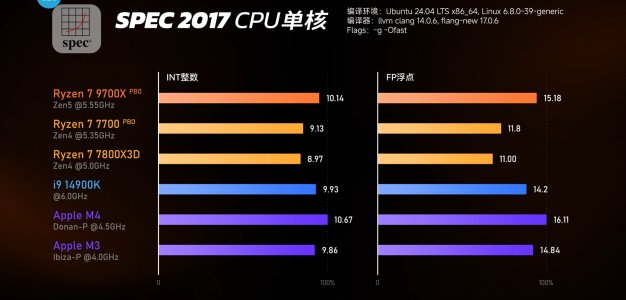
He used to add this information in the past. But glancing on his 8 Elite video I haven't seen it so the question is it still the same. He might have changed things in between, he might have not.This should help (top right).
View attachment 110177
FlameTail
Diamond Member
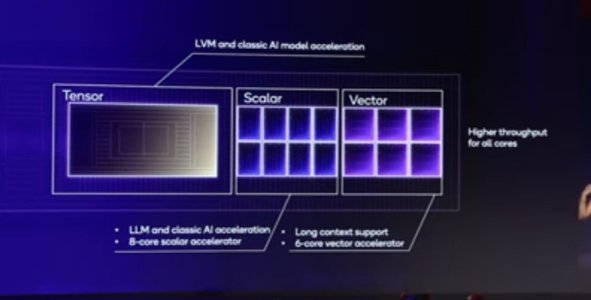
The Hexagon NPU of 8 Elite adds two more Scalar cores and 2 more Vector cores.
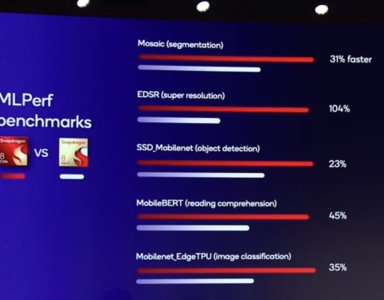
They say it's "45% faster". If that means 45% more INT8 TOPS, then we are going from 45 TOPS (8G3) to 65 TOPS (8 Elite).
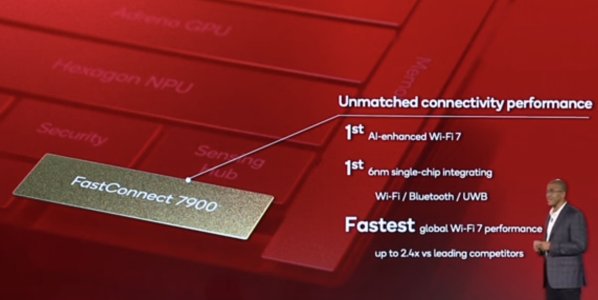
"6nm single-chip"
@Ghostsonplanets This confirms that the Fastconnect 7900 isn't integrated into the 8 Elite SoC (which is made on 3nm), but that it's a discrete chip.
Also "AI Enhanced Wifi". ROFLed at that one.
FlameTail
Diamond Member
Andrei's comment about this matter;He used to add this information in the past. But glancing on his 8 Elite video I haven't seen it so the question is it still the same. He might have changed things in between, he might have not.
Posted in Chips&Chees Discord.he's using NDK binaries on SPEC for Android which will have an inherent handicap vs iOS shared runtime libraries
it's fine given that this represents the userspace experiences between the OS', however if you would really want to look at just µarch you'd deploy glibc+jemalloc binaries on Android get get somewhat of a similar allocator behavior to what iOS does in which case the competitive performance differences here are going to be fundamentally smaller
geekbench difference is smaller because of the way it's built counteracts some of these differences at the moment, and actually if you run 6.2 (non-SME) that's probably as close as you can reasonable get for a 1:1 µarch comparison
FlameTail
Diamond Member
I wouldn't call it spamming. 2L+6M is a perfectly fine configuration for 8 Elite.But I guess no one in android space, due to marketing reasons, will dare to release a SoC with less than 8 CPU cores. Even Qualcomm had to spam M cores to keep the magical 8 number going😉
That's why I am wondering what they will do for lower tier chips?
If they are going Oryon L/M, then they'll have to put <8 cores.
A wild bit of speculation is that Qualcomm has an Oryon-S core in the works.Snapdragon 8 Elite
2 × Phoenix-L @ 4.32 GHz [12 MB sL2]
6 × Phoenix-M @ 3.53 GHz [12 MB sL2]
Snapdragon 7 Gen 4 (Speculation)
2 × Phoenix-L @ 3.9 GHz [8 MB sL2]
2 × Phoenix-M @ 3.2 GHz [4 MB sL2]
Will a quad core CPU be unsuitable for Android today?
Even $150 phones have '8-core CPU' nowadays.
If L = Large and M = Medium, doesn't that suggest that there will be a "Small" core?
Cortex X ≈ Oryon-L
Cortex A7xx ≈ Oryon-M
Cortex A5xx ≈ Oryon-S
Oryon-S would allow Qualcomm to scale the Oryon CPU all the way down to low end Snapdragon 4 series chips and Snapdragon Wearable chips.
What Andrei said is raising an interesting dillema does the end user care about uarch comparison or the actual performance in context of Geekbench version (6.2 vs 6.3). I mean I understand that introducing SME will have less impact in android ecosystem due to fragmentation, but I guess that vertically integrated Apple is already making use of it due to having much better control over software stack.Andrei's comment about this matter;
Posted in Chips&Chees Discord.
At least this gives some context to Qualcomm slides where 6.2 was used, as from uarch vs uarch it's more fair seeing SME unlike Neon is not part of the core.
On the other hand if Andrei wanted to do accurate uarch vs uarch comparisons he should have enabled AVX for x64 when doing comparisons on Qualcomm slides as the AVX units belong to the core the same Neon units do (I guess he is somewhat involved with those if the rumours are accurate). But yea, that is a digression😉
FlameTail
Diamond Member
Oryon-S doesn't even need to be an entirely new microarchitecture. To create Oryon-S, they can just take Oryon-M, tweak it a bit and massively reduce the clock speed to about 2 GHz (Oryon-M in 8 Elite runs at a crazy 3.53 GHz).A wild bit of speculation is that Qualcomm has an Oryon-S core in the works.
If L = Large and M = Medium, doesn't that suggest that there will be a "Small" core?
Cortex X ≈ Oryon-L
Cortex A7xx ≈ Oryon-M
Cortex A5xx ≈ Oryon-S
Oryon-S would allow Qualcomm to scale the Oryon CPU all the way down to low end Snapdragon 4 series chips and Snapdragon Wearable chips.
Yea I hear ya. The A18 Pro numbers match so my assumption is it’s still the same.He used to add this information in the past. But glancing on his 8 Elite video I haven't seen it so the question is it still the same. He might have changed things in between, he might have not.
FlameTail
Diamond Member
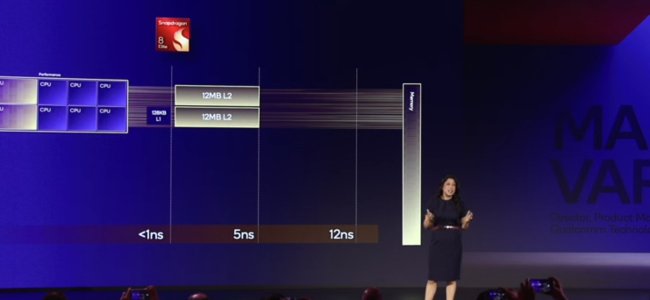
So L1 latency is same as Oryon core in X Elite, whereas L2 latency regressed by a few cycles.4 cycle L1
~21 cycle L2
Almost directly explained by the fact that Oryon -> Oryon-L, L1 capacity regressed from 192 KB -> 128 KB, but L2 capacity stayed the same at 12 MB.
Not sure it regressed, they rounded to 5ns so it's probably the same.So L1 latency is same as Oryon core in X Elite, whereas L2 latency regressed by a few cycles.
FlameTail
Diamond Member
Does Adreno 830 exclusively use Binned Direct mode?View attachment 110062
It's interesting that Qualcomm has changed the rendering technique from Tile-Based Rendering (TBR) to something more akin to the Immediate Mode Rendering (IMR) used in desktop class GPUs. It's fed by the huge 12 MB of GPU cache. This signals that Qualcomm is evolving Adreno to become a desktop class GPU architecture.
But Adreno 830 wouldn't be the first smartphone GPU without TBR. Exynos 2200 with it's AMD mRDNA2 GPU demonstrated that it's possible for a smartphone to have a non-TBR GPU.
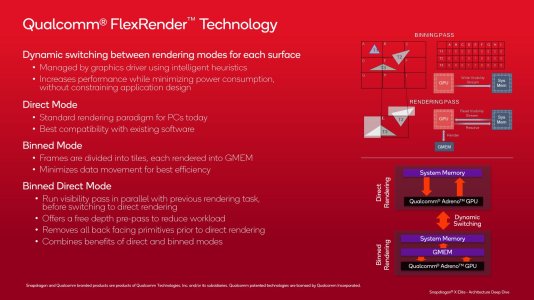
Vince suggests that Adreno 830 could be using TBIM (Tile Based Immediate Mode Rendering), which is a hybrid of the tradional mobile TBDR (Tile Based Deferred Rendering) and traditional desktop IMR (Immediate Mode Rendering).
TRENDING THREADS
-
 Discussion Zen 5 Speculation (EPYC Turin and Strix Point/Granite Ridge - Ryzen 9000)
- Started by DisEnchantment
- Replies: 25K
-
Discussion Intel Meteor, Arrow, Lunar & Panther Lakes + WCL Discussion Threads
- Started by Tigerick
- Replies: 24K
-
 Discussion Intel current and future Lakes & Rapids thread
- Started by TheF34RChannel
- Replies: 24K
-

-
