• We’re currently investigating an issue related to the forum theme and styling that is impacting page layout and visual formatting. The problem has been identified, and we are actively working on a resolution. There is no impact to user data or functionality, this is strictly a front-end display issue. We’ll post an update once the fix has been deployed. Thanks for your patience while we get this sorted.

Discussion ***Official*** 2025 Stock Market Thread 💰

Page 74 - Seeking answers? Join the AnandTech community: where nearly half-a-million members share solutions and discuss the latest tech.
Apple has spent over ONE TRILLION DOLLARS in stock buybacks in the past couple decades, and is buying back shares at a rate of ~ $100 billion a year these days.

Apple routinely buys back shares. They have returned 100s of billions in buy backs. They sat on cash for a while but they have been buying shares for years.
I guess that I didn't make myself clear when I mentioned that Apple keeps money for a rainy day. Yes, Apple bought back stock. But, Apple left over $100 billion available in cash and fairly liquid stocks for when it is needed. Intel didn't. Intel bought back stock to the point that they have virtually nothing on hand--to the point that they didn't even properly invest in equipment needed for their cash cow. And now Intel is desperate for cash.

Stock buybacks, now that they are legal, have some legitimate good reasons. But, the bad reasons far outnumber the good reasons.

A buyback can be of value when the company is flush with cash, the shares prices are low, and share prices are likely to increase (buying an increasing asset can be a great idea). Buybacks in other cases are disastrous. Buying a plummeting asset is a bad choice--especially when done to cover up your bad decisions or to prop up management's pocketbook.

The worst for me is when companies go into debt to repurchase shares. That is the quintessential recipe for creating a zombie company (go further and further into debt but just keep buying shares so you have no one to answer to). But, they are doing it anyways. https://www.cnbc.com/2019/07/29/buybacks-companies-increasingly-using-debt-to-repurchase-stocks.html

In a slightly different twist, look up Toys R Us. Leveraged buyouts often have this fate. Oodles of debt to buy shares to go bankrupt. Sure, the people who set this in motion get a nice chunk of money. But it isn't good for the company. This article sums up my beliefs: https://www.forbes.com/sites/adamha...feed-bad-financial-planning-creating-failure/
This story isn't just about debt. The very popular activity of "returning money to shareholders by repurchasing stock" is a terrible idea. Stock repurchases do not make a company more valuable, nor a stronger competitor. Instead they burn through cash to reduce the company's capitalization, and manipulate ratios like EPS (earnings per share) and P/E (price/earnings) multiple. Stock repurchases hurt companies, and make them less competitive. Good companies return money to shareholders by investing in growth, which raises sales, profits and increases the stock price making the company truly more valuable.
 
Last edited:
I guess that I didn't make myself clear when I mentioned that Apple keeps money for a rainy day. Yes, Apple bought back stock. But, Apple left over $100 billion available in cash and fairly liquid stocks for when it is needed. Intel didn't. Intel bought back stock to the point that they have virtually nothing on hand--to the point that they didn't even properly invest in equipment needed for their cash cow. And now Intel is desperate for cash.

Intel used to keep plenty of money on hand. The problem they had wasn't the buybacks, it was that they kept the buybacks and dividends going apace even when they were making less money, because they were afraid of Wall Street punishing the stock - because analysts would see it as an admission that it wasn't just a temporary blip they'd soon move past but a problem Intel was effectively admitting was more long term in nature.

In other words, I think it was Intel responding poorly to Wall Street's toxic expectations based pricing. From the standpoint of Intel's management it probably made perfect sense - their compensation/bonuses/awards are likely tied in some way to stock price. If the stock price falls it costs them money. If Intel's cash position worsens it doesn't - they mostly figure they will have or certainly can move on before the poop hits the fan. And lookie there, they mostly have! If you (as a corporate board) give management a perverse rewards system that doesn't prioritize the long term benefit of the corporation, you should expect perverse results.

It isn't the first time we've seen Intel do dumb things in the name of pleasing analysts and propping up the stock price. That "shipment" of some token 10nm chips in spring 2018 to be able to claim 10nm is shipping to meet their (already delayed) commitment kept Wall Street from punishing the stock price. But surely cost tens of millions if not more between poor yields, making masks for a single low volume low price SKU, and whatever time it took them from making 10nm working "for real". Not to mention all the stunts with "market development funds" and so forth to allow them to claim sky high ASPs and success on products they could barely give away.
 
The problem they had wasn't the buybacks, it was that they kept the buybacks and dividends going apace even when they were making less money
See, even you argue that buybacks were a major problem (see the underlined portion). And if you read my first line on the first post on the topic, I never said buybacks were the only problem. They were just the biggest problem in my view. Especially now that Intel is desperately selling itself off to any bidder to make up for their cash problem.

In other words, buybacks are okay in some situations but not to the point of destroying the company.

Business decisions based on stock prices are almost always a bad decision. In the very least focusing on stock prices keeps management focused on the far-too-short term and not on long-term needs of the company or its shareholders.
 
And Cramer once said companies should go into debt to buy back shares.

Oy vey!

In my opinion, buybacks are great if you are a shareholder but I think it ultimately harms consumers in the form of higher prices and less value.

Look at health insurance companies. In their never ending quest for higher quarterly profits and stock buybacks, coverage quality has dropped, deductibles and premiums are very high and denial rates skyrocketed.

It even led to the death of an insurance executive for non payment of claims.

No, buybacks should not be available for healthcare companies. Provided affordable coverage and deny less than 5% of claims...not 30%!

In fact United Healthcare has done just this. Reduce denial rates. The shares crashed and shareholders sued.

Are you an insurance company? Or just there to take money and give nothing or little in return?
 
Last edited:
And Cramer once said companies should go into debt to buy back shares.

Oy vey!

In my opinion, buybacks are great if you are a shareholder but I think it ultimately harms consumers in the form of higher prices and less value.

Look at health insurance companies. In their never ending quest for higher quarterly profits and stock buybacks, coverage quality has dropped, deductibles and premiums are very high and denial rates skyrocketed.

It even led to the death of an insurance executive for non payment of claims.

No, buybacks should not be available for healthcare companies. Provided affordable coverage and deny less than 5% of claims...not 30%!

In fact United Healthcare has done just this. Reduce denial rates. The shares crashed and shareholders sued.

Are you an insurance company? Or just there to take money and give nothing or little in return?

Nothing a little socialism can't solve!
 
I was waiting for something like this.

Or a container on rail that opens up the top as soon as it enters a certain region and launches a few hundred drones.
That's what Operation Spiderweb was from the Ukrainians expect it was containers on trucks instead of rail. Not sure if companies will end up selling systems like that or just the drones and it'll be the military that puts together the system they want with those drones.
 
@FelixDeCat @dasherHampton @cytg111
@dullard @jpiniero and everyone else..

What are everyone's thoughts on META?

I don't use facebook/ instagram personally.

And they had a strategy of poaching other companies best AI LLM programmers but they let them all go in the last batch of firings/ layoffs?

Seems they can't make up their minds.. and it seems to me they're also propped up on the AI circular deal making.

Can't make up my mind on them either!

What do you think? Makes sense to not touch it or buy since it's down 10% from ATH?
 
@FelixDeCat @dasherHampton @cytg111
@dullard @jpiniero and everyone else..

What are everyone's thoughts on META?

I don't use facebook/ instagram personally.

And they had a strategy of poaching other companies best AI LLM programmers but they let them all go in the last batch of firings/ layoffs?

Seems they can't make up their minds.. and it seems to me they're also propped up on the AI circular deal making.

Can't make up my mind on them either!

What do you think? Makes sense to not touch it or buy since it's down 10% from ATH?
I dont know.

Cons
- AI might be on the verge of a correction. Not a crash but a correction. That will drag META down.
- VR/AR seems to be forever just around the corner. Know anyone with the latest Meta glasses?
- The whole US market is vibrating right now, banks, tariffs, everything.

Pros
- US Dictatorship. If the US democracy truly falls, META is in a unique position to push state propaganda to the masses. Probably a bigly jump.
- Actually firing/hiring according to perceived projections in the market is a plus, it reflects a change ready company.


Personally META is outside of my comfort zone. But lots of good bets historically have been so, just an amateur.


edit2: Actually, thinking about it, META is about the only company out there trying to evolve social media beyond what it is today, with metaverse and other experiments. Hmm..
 
Actually, thinking about it, META is about the only company out there trying to evolve social media beyond what it is today, with metaverse and other experiments. Hmm..

Yeah I'd feel a lot better about a company that wanted monopoly on social media so they buy tiktok but that's not what META did.

Another question I ask myself is will facebook/ instagram still be around in 20 years? The lifespan of platforms like that isn't really that long.. I can remember friendster, myspace etc.

And we're mostly doing without twitter now and getting by fine. The only reason twitter is still operating is its designed to lose money to spread propaganda.

That's my fear with META.. I don't want to buy shares of a company that loses money full time and had no intention of changing things around. That'd leave me holding the bag despite it's current valuation and growth potential.

Maybe it's just one of those stocks that's good in an index but not for an individual hold.
 
Last edited:
Dude, you are talking 20 years out. There is a reason "serious" traders are only looking towards the next quater right now and gold+ is going to heavens. You CANT think 20 years out right now, the world is at an inflection point, means chaos, means no one has any fucking idea what vectors point where out there on the other side.

Best bet right now is to watch and see if the last couple of days shakes off and shit continues upwards. I am 60-40 on the negative side on that bet (which means I should short something I guess).
 
I personally don't buy individual stocks. META might be the greatest thing ever. Or maybe it'll be Myspace. I can't tell. So, I always buy funds that track the typical price of similar companies. That is far easier for me than trying to use a crystal ball to pick the one winner out of many. If I wanted technology companies, then I would buy something like VITAX (Vanguard information technology fund) or its ETF version, VGT.

But, if I were to buy META, I would like to buy it closer to $400/share not $731.71/share. I don't chase bubbles hoping to find a greater sucker. It is true that "buy high, sell higher" is a potentially successful trading strategy. But it is far riskier than "buy low, sell high". I buy things that are undervalued and likely to increase. I would say you missed the boat.
 
I personally don't buy individual stocks. META might be the greatest thing ever. Or maybe it'll be Myspace. I can't tell. So, I always buy funds that track the typical price of similar companies. That is far easier for me than trying to use a crystal ball to pick the one winner out of many. If I wanted technology companies, then I would buy something like VITAX (Vanguard information technology fund) or its ETF version, VGT.

But, if I were to buy META, I would like to buy it closer to $400/share not $731.71/share. I don't chase bubbles hoping to find a greater sucker. It is true that "buy high, sell higher" is a potentially successful trading strategy. But it is far riskier than "buy low, sell high". I buy things that are undervalued and likely to increase. I would say you missed the boat.

Yeah that's why I'm not buying VOO just yet.. I'll wait for a pullback.. in the mean time things go higher and higher.

Was hoping for at least a few days before TACO.
 
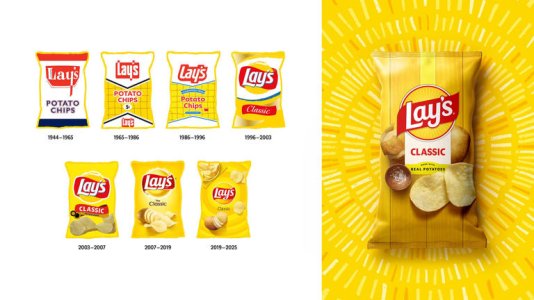
Lay's introduces a new way to get layed:

Lay's Rebrands Because Customers Apparently Didn’t Know Chips Were Made With ‘Real Potatoes’​


were-made-with-real-potatoes/ar-AA1Oolcx?ocid=hpmsn&cvid=935192ebcc664396dd08c6e6af3cad71&ei=372


1761021191082.jpeg

Ive been around since the 70s and dont recall the older bags. My memory starts with the 96 bags. Guess I never paid attention to them, just ate them.

(Im suddenly craving potato chips)
 
I asked google, 'where are we in the business cycle.'

The global business cycle is in a prolonged expansion, though growth is slowing and is expected to be its weakest since the pandemic due to factors like trade uncertainty and higher tariffs. The US is showing signs of a slowdown from its dynamic 2024 growth, with a mix of mid-cycle and late-cycle characteristics, as higher tariffs impact economic activity. While a recession is not currently predicted, there are increasing downside risks to economic growth.
If you want more proof, just look at the Fed. As of August '24 the fed funds rate was 5.33. Now it's down to 4.22%.

That's exactly what they should be doing as we head into a downturn. Thankfully, the fact that they're aware of this and behaving accordingly means that it will very, very likely be relatively soft landing.

BTW, no one actually understand what causes the business cycle, it just is. Sort of like a hurricane or tornado - you may not believe in it, but it believes in you. The only problem is that it's "plan" is to "fix" that. So sleep tight and don't let the bedbugs bite.
 
Last edited:
I don't get the precious metal trades going on. It all seems to be driven by emotions. I've heard the gold trade being called a psychological trade.
I consulted my friend Google AI and this is what it tells me:
Psychological trading in gold is driven by behavioral biases and emotions that influence investor decisions, causing the price to react to market sentiment in addition to fundamental factors. This behavior often manifests around specific price points, creating self-fulfilling prophecies. Gold's traditional status as a safe-haven asset amplifies these psychological effects, as fear, uncertainty, and greed become dominant drivers during economic turmoil.
I agree with this assessment.
 
Wonder if the Google stock dipping and mass sales are purposeful manipulation to get people to execute their stop loss as people in power/ hedgefunds want to buy the stock at a discount??

How to get stocks when people don't want to sell? Execute a stop loss auto sale.
 
I don't get the precious metal trades going on. It all seems to be driven by emotions. I've heard the gold trade being called a psychological trade.
Gold itself does not have profits to return to investors. That is unlike a company that makes profits and those profits are funneled to the investors in one form or another (dividends, stock buybacks, or investing in the company making each share more valuable). Gold doesn't have that. The only way to get profit from gold is to find a greater sucker--someone who will pay more than you did.

Thus, yes, gold is a psychological trade. It skyrockets and plummets based on the societal mood of the moment. Gold's big inflation-adjusted movements:
  • Plunged during WW1
  • Skyrocket during the great depression
  • Plunged during economic stability of the 1950s and 1960s.
  • Skyrocket in the mid 1970s inflation crisis
  • Plunged in the late 1970s.
  • Skyrocket again in the late 1970s as the inflation crisis came back
  • Plunged in the 1980s and 1990s as the economy was doing well
  • Skyrocket in the late 2000s mortgage crisis
  • Plunge when the mortgage crisis ended
  • Skyrocket in today's uncertain trade times.
These times of big movements are not based on supply and demand. They are based on raw emotions of the times.

Daily movements often coincide with starts and stops of large cultural holidays. Diwali was yesterday -- India buys tons of gold leading up to this holiday.
 
Gold itself does not have profits to return to investors. That is unlike a company that makes profits and those profits are funneled to the investors in one form or another (dividends, stock buybacks, or investing in the company making each share more valuable). Gold doesn't have that. The only way to get profit from gold is to find a greater sucker--someone who will pay more than you did.

Thus, yes, gold is a psychological trade. It skyrockets and plummets based on the societal mood of the moment. Gold's big inflation-adjusted movements:
  • Plunged during WW1
  • Skyrocket during the great depression
  • Plunged during economic stability of the 1950s and 1960s.
  • Skyrocket in the mid 1970s inflation crisis
  • Plunged in the late 1970s.
  • Skyrocket again in the late 1970s as the inflation crisis came back
  • Plunged in the 1980s and 1990s as the economy was doing well
  • Skyrocket in the late 2000s mortgage crisis
  • Plunge when the mortgage crisis ended
  • Skyrocket in today's uncertain trade times.
These times of big movements are not based on supply and demand. They are based on raw emotions of the times.

Daily movements often coincide with starts and stops of large cultural holidays. Diwali was yesterday -- India buys tons of gold leading up to this holiday.

Speaking of Diwali.. it seems a lot of people didn't celebrate it yesterday.. the parades, the fireworks were very muted compared to last year.

Maybe no one has the money anymore or they went to other parts of the world for better job prospects.

Something is definitely going on within America that we're losing people now.


That means lower growth going forward too as not many people to sell items to!
 
NBIS falling.. glad I didn't buy it at 130 due to FOMO.

But 109 still a buy price??

I have no idea whats going on with NBIS. I haven't found any really bad news like offerings or insider selling. I'm still very long (snicker).

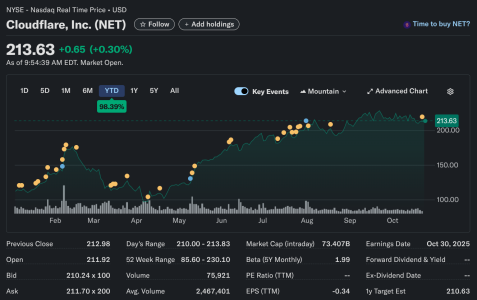
NET is down a ton as well.

I'm dumping Netflix. Probably will buy more CLSK to replace it.
 
Back
Top