• We’re currently investigating an issue related to the forum theme and styling that is impacting page layout and visual formatting. The problem has been identified, and we are actively working on a resolution. There is no impact to user data or functionality, this is strictly a front-end display issue. We’ll post an update once the fix has been deployed. Thanks for your patience while we get this sorted.

NVIDIA reveals Fermi's successor: Kepler at 28nm in 2011, Maxwell in 2013

Page 8 - Seeking answers? Join the AnandTech community: where nearly half-a-million members share solutions and discuss the latest tech.
Wow thats differnt....

Amd is putting a GPU inside a CPU, this integrated GPU, can be used with ANY 6xxx series card to get a performance boost for said dedicated card. Which I think sounds brillant (free video performance, no matter which discreet card you put into the system, from the APU). Along with that they ll enable even those without discret cards to have GPGPU avaliable, so it makes sense that they can use the horsepower of said cpu gpu area, even when not doing grafics to help do cpu stuff (though gpgpu).

Nvidia is putting a CPU, inside their GPU.... wont that just make them reach the PCIe wall of watts used limit faster? What would the onboard CPU in the grafics card do? Is that just like... a RISK cpu for netcard/soundcards? so they dont stress the real computers cpu as much?
 
Last edited:
With die shrinks they can probably stay within the envelope. What I find interesting is what does Windows 8 being able to run on ARM add to project Denver? Could we see Nvidia based PCs running on a product based around Maxwell based chipsets?
 
From the Beyond3d forums it looks like Kepler will be Fermi2, not a new architecture (have to wait till Maxwell for that). That said, nVidia will be able to pack allot a shader modules in @ 28mm with good thermals if TMSC's 28mm process is decent.

I remember reading Anand's first fermi writeup, he predicted that fermi 2 would be great at 28nm. hopefully amd has something better than "10% more performance/in^2" planned for that...
 
I remember reading Anand's first fermi writeup, he predicted that fermi 2 would be great at 28nm. hopefully amd has something better than "10% more performance/in^2" planned for that...


Amd will have hybrid crossfire with APU + any 6xxx card, and then APU + any 7xxx card. Which means AMD APU + AMD card > INTEL card + single Nvidia card (in grafics).

They re makeing them work with any 6xxx card atm, and are looking to make it give performance boosts reguardless of if its a 65xx card or a 69xx card. The extra GPU thats inside the APU might offset Nvidias egde (if they have one then), when useings AMDs apu + card.

That said... i was expecting abit more from the 69xx cards... hopefully the 7xxx series is faster.
 
Amd will have hybrid crossfire with APU + any 6xxx card, and then APU + any 7xxx card. Which means AMD APU + AMD card > INTEL card + single Nvidia card (in grafics).

They re makeing them work with any 6xxx card atm, and are looking to make it give performance boosts reguardless of if its a 65xx card or a 69xx card. The extra GPU thats inside the APU might offset Nvidias egde (if they have one then), when useings AMDs apu + card.

That said... i was expecting abit more from the 69xx cards... hopefully the 7xxx series is faster.

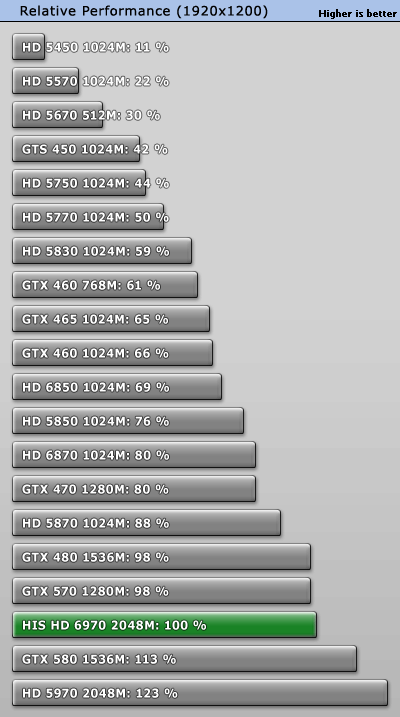
You really have no idea what the performance will be for any of these cards. I look at the graphics potential of an APU like if one could CF or SLI a low end graphics card with a high end card. How much more performance will 6970 get if it had a 5450 working along side it? Enough to make it faster than a 580? I highly doubt it.
 
perfrel_1920.gif


You really have no idea what the performance will be for any of these cards. I look at the graphics potential of an APU like if one could CF or SLI a low end graphics card with a high end card. How much more performance will 6970 get if it had a 5450 working along side it? Enough to make it faster than a 580? I highly doubt it.
a 5670 is about 30% of a 6970,.... it might be enough to boost the 6970 to match a 580 (about 13% faster), if you have a APU+6970 (working together) vs cpu+580.

I kinda doubt it too, but even if its just like 5% more... meh Id welcome it, if it happends to be around 13% to put it even with a 580.... that would be some stunt. I believe this side of the APUs is a good selling point, a reason to buy a amd APU instead of just a normal cpu. No doubt the APU GPUs will keep getting stronger, and they ll keep getting better at this hybrid crossfire stuff. Eventually it ll probably matter for people that only buy 1 or 2 discreate cards, that they can hybrid crossfire it with their APUs.

But as is,... there is about 10-13% speed advantage with a 580 over a 6970 (depending on resolution). Its probably less by now, because of the driver improvements of the 11.1a's, there where tesselation gains of up to 100% in some benchmarks (new arch, ment drivers take abit to get there, and going from 5D shaders to 4D shaders is a big step). So Im guessing the 580 is less than 10% ahead of a 6970, if you installed newest drivers on both and ran benches.

6970s are going for around ~349$ on newegg.
580's are going for around ~499$ on newegg.

for about ~10% more speed, you pay around ~43% more.

*IF* APU hybrid crossfire could take away even 5% of the 10% lead, it would be hard to justify the 43% more cost of the 580's.
 
Last edited:
Wow thats differnt....

Amd is putting a GPU inside a CPU, this integrated GPU, can be used with ANY 6xxx series card to get a performance boost for said dedicated card. Which I think sounds brillant (free video performance, no matter which discreet card you put into the system, from the APU). Along with that they ll enable even those without discret cards to have GPGPU avaliable, so it makes sense that they can use the horsepower of said cpu gpu area, even when not doing grafics to help do cpu stuff (though gpgpu).

Nvidia is putting a CPU, inside their GPU.... wont that just make them reach the PCIe wall of watts used limit faster? What would the onboard CPU in the grafics card do? Is that just like... a RISK cpu for netcard/soundcards? so they dont stress the real computers cpu as much?


LOL
"APU" is just a new name for IGP.

It will be just as usefull with a GPU, as an IGP is helpfull for a GPU today.
 
a 5670 is about 30% of a 6970,.... it might be enough to boost the 6970 to match a 580 (about 13% faster), if you have a APU+6970 (working together) vs cpu+580.

I kinda doubt it too, but even if its just like 5% more... meh Id welcome it, if it happends to be around 13% to put it even with a 580.... that would be some stunt. I believe this side of the APUs is a good selling point, a reason to buy a amd APU instead of just a normal cpu. No doubt the APU GPUs will keep getting stronger, and they ll keep getting better at this hybrid crossfire stuff. Eventually it ll probably matter for people that only buy 1 or 2 discreate cards, that they can hybrid crossfire it with their APUs.

But as is,... there is about 10-13% speed advantage with a 580 over a 6970 (depending on resolution). Its probably less by now, because of the driver improvements of the 11.1a's, there where tesselation gains of up to 100% in some benchmarks. So Im guessing the 580 is less than 10% ahead of a 6970, if you installed newest drivers on both and ran benches.

Yeah, lets forget about RAM bus speeds (an "APU need to share (the limitied compard to a GPU) bandwith with the CPU) and all the other architechtual differences between an "APU" and a GPU, exaggarate the performance...based on nothing 🙄
 
It will be just as usefull with a GPU, as an IGP is helpfull for a GPU today.

your wrong, AMD are makeing their APUs give performance boosts to ANY of the 6xxx cards, I believe I read. This is very differnt from their onboard IGPs, that only work with 1 or 2 cards (while still giveing a boost to performance).
 
your wrong, AMD are makeing their APUs give performance boosts to ANY of the 6xxx cards, I believe I read. This is very differnt from their onboard IGPs, that only work with 1 or 2 cards (while still giveing a boost to performance).

1) Link to source.
2) AMD (PR) claims a lot of things...often in contrast to reality.

I will bookmark this post for future reference...I always enjoy watching people put a noose around their own neck and hang themselfs :awe:
 
IIRC the 7*** is going to have a totally new Architecture, hopefully that's true.

isn't it going to be on a new node as well? 28nm? so potentially awesome or a catastrophe?

Why would Cayman be developed if only to be used for part of one node? Doesn't make sense in terms of an R&D investment.

28nm will most likely be a Cayman shrink, kinda like how Cypress was for 40nm.

Cayman would have never seen the light of day on 40nm if it weren't for 32nm cancellation.
 
Arkadrel. The thread is about Kepler. Your last 4 posts either start with the Acronym AMD or is one of the first few words. Wassup? Just curious.
 
1) Link to source.
2) AMD (PR) claims a lot of things...often in contrast to reality.

I will bookmark this post for future reference...I always enjoy watching people put a noose around their own neck and hang themselfs :awe:


Source:
http://www.techpowerup.com/138872/AMD-Readies-New-Multi-GPU-Technology-for-Fusion-Llano-APUs.html

After a well-received launch of the Fusion "Zacate" accelerated processing unit (APU) for nettops and entry-level PCs, AMD's higher-performance APU, codenamed "Llano", is just around the corner. Llano is intended for use on mainstream desktops, business PCs, and all-in-one PCs, it is better geared for higher-resolution, visually-intensive computing. Its competitors include Intel's Core i3 and Core i5 dual-core processors. AMD is backing up this launch with a new multi-GPU technology which is both similar and different from Hybrid CrossFireX. The similar part is that the GPU embedded in the Fusion chip will work in tandem with a discrete AMD Radeon graphics card, the difference is that it can work with any HD 6000 series graphics card, and multiply the available display connectivity.

The Fusion Llano APU will be part of AMD's Lynx mainstream desktop platform. The Llano APU embeds two x86-64 processing cores that feature the latest SIMD extensions, a DirectX 11 compliant GPU, a dual-channel DDR3 memory controller, a PCI-Express 2.0 hub, and an interconnect to the Hudson M1 chipset. The APU gives out a PCI-Express 2.0 x16 port, which is configurable using external switching. AMD also ran its own internal tests to show the performance advantage the new multi-GPU technology will give. AMD's Lynx mainstream desktop platform is expected to launch a little later this year.
I assumed this ment, any 6xxx card can do hybrid with it, and gain a small boost from doing so.


Arkadrel. The thread is about Kepler. Your last 4 posts either start with the Acronym AMD or is one of the first few words. Wassup? Just curious.

Thought it was in here I read it (looked back though thread and saw it wasnt)...sorry about going off topic.
 
Last edited:
Amd will have hybrid crossfire with APU + any 6xxx card, and then APU + any 7xxx card. Which means AMD APU + AMD card > INTEL card + single Nvidia card (in grafics).

They re makeing them work with any 6xxx card atm, and are looking to make it give performance boosts reguardless of if its a 65xx card or a 69xx card. The extra GPU thats inside the APU might offset Nvidias egde (if they have one then), when useings AMDs apu + card.

That said... i was expecting abit more from the 69xx cards... hopefully the 7xxx series is faster.

However the AMD CPU is along way behind INtel CPU, so maybe it will even out?
 
Where did he claim the apu would have GPU like performance? All I see him claiming is that it would add performance to the gpu.

Adding performance to a existing discrete gpu is far more complicated than it sounds. That goes right in to what Lucid- Hydra chip that promised= non vendor specific dual / multi-gpu performance.
Also hybrid crossfire/ sli was a MAJOR failrure =
Microsoft disses Hybrid SLI and CrossFire, won't support them in Windows 7


If you read up on how crossfire and SLI accomplishes its results, it becomes clearer that you just can't grab untapped resources and expect it to render more FPS from your gtx 580 or 6970. That would take a driver/software MIRACLE at this point.
 
Last edited:
I kinda doubt it too, but even if its just like 5% more... meh Id welcome it, if it happends to be around 13% to put it even with a 580.... that would be some stunt. I believe this side of the APUs is a good selling point, a reason to buy a amd APU instead of just a normal cpu. No doubt the APU GPUs will keep getting stronger, and they ll keep getting better at this hybrid crossfire stuff. Eventually it ll probably matter for people that only buy 1 or 2 discreate cards, that they can hybrid crossfire it with their APUs.

But as is,... there is about 10-13% speed advantage with a 580 over a 6970 (depending on resolution). Its probably less by now, because of the driver improvements of the 11.1a's, there where tesselation gains of up to 100% in some benchmarks (new arch, ment drivers take abit to get there, and going from 5D shaders to 4D shaders is a big step). So Im guessing the 580 is less than 10% ahead of a 6970, if you installed newest drivers on both and ran benches.

6970s are going for around ~349$ on newegg.
580's are going for around ~499$ on newegg.

for about ~10% more speed, you pay around ~43% more.

*IF* APU hybrid crossfire could take away even 5% of the 10% lead, it would be hard to justify the 43% more cost of the 580's.

Load balancing such two vastly different performing parts would be an impossible nightmare. It's comparable to a bodybuilder and a 10 year old kid trying to bench press the barbell off the same bench at the same time. The kid is most likely just going to get in the way and actually make the end result worse.
 
Last edited:
could it be that the apu will help offloading the gpu with other tasks like compute/ open cl. dont just focus on the rendering thing.....
 
could it be that the apu will help offloading the gpu with other tasks like compute/ open cl. dont just focus on the rendering thing.....

It could be that, and it could also be mayonnaise. Offloading compute functions are already done with NV GPUs since 8 series. As time goes on, things will become consolidated more and more until everything becomes a SoC.
Defo some interesting times ahead. But then again, aren't they always?
 
Last edited:
Amd will have hybrid crossfire with APU + any 6xxx card, and then APU + any 7xxx card. Which means AMD APU + AMD card > INTEL card + single Nvidia card (in grafics).

They re makeing them work with any 6xxx card atm, and are looking to make it give performance boosts reguardless of if its a 65xx card or a 69xx card. The extra GPU thats inside the APU might offset Nvidias egde (if they have one then), when useings AMDs apu + card.

That said... i was expecting abit more from the 69xx cards... hopefully the 7xxx series is faster.

Wishful thinking at best....
 
Why would Cayman be developed if only to be used for part of one node? Doesn't make sense in terms of an R&D investment.

28nm will most likely be a Cayman shrink, kinda like how Cypress was for 40nm.

Cayman would have never seen the light of day on 40nm if it weren't for 32nm cancellation.

Didn't Cayman get some of the features "cut" to make it more viable at 40nm? So we are likely to see "new" features at 28nm, even if they were originally scheduled for Cayman...
 
Back
Top