
-
We’re currently investigating an issue related to the forum theme and styling that is impacting page layout and visual formatting. The problem has been identified, and we are actively working on a resolution. There is no impact to user data or functionality, this is strictly a front-end display issue. We’ll post an update once the fix has been deployed. Thanks for your patience while we get this sorted.
You are using an out of date browser. It may not display this or other websites correctly.
You should upgrade or use an alternative browser.
You should upgrade or use an alternative browser.
My i7 7700k Has Arrived - Insights, Benchies & Overclocks Inside (Now With Delid!)
Page 9 - Seeking answers? Join the AnandTech community: where nearly half-a-million members share solutions and discuss the latest tech.


lopri
Elite Member
Isn't that a Thermalright Ultra 120? It should still work fine? That thing with a fan weighs 1 Kg.Quick and dirty 5Ghz OC @ 1.36v, RAM @ 2133 / C15 (by the way, still on the POS air cooling - https://s22.postimg.org/bicwzvzfl/POS_Air_Cooler.jpg):
Congrats on a sweet new chip. Maybe this one will finally retire my aging 2500K.

VirtualLarry
No Lifer
All this talk about QSync encoding... does a BLCK OC disable QSync encoding? I guess it would, if it disables the iGPU.

Phynaz
Lifer
Tech Report has noticed you guys...
http://techreport.com/news/31132/po...-7700ks-could-lead-to-big-load-temp-decreases
http://techreport.com/news/31132/po...-7700ks-could-lead-to-big-load-temp-decreases

RichUK
Lifer
yummi 😉
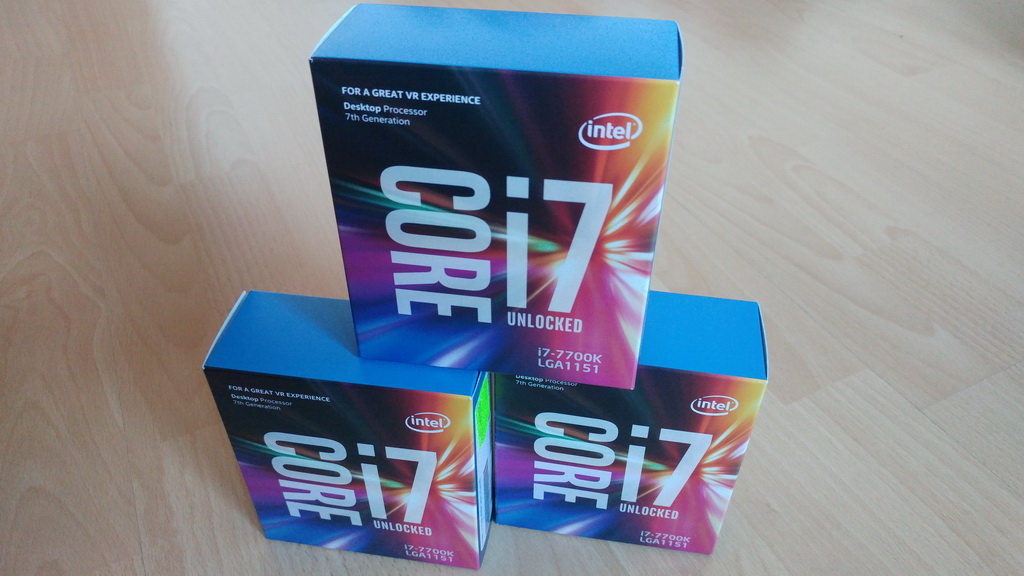
What's your plan for these? If you like, I can post your results in the OP as it seems a lot of sites are monitoring this thread.
I think batch numbers and vital statistics (volts, temps, etc) when hitting 5Ghz will be of most interest to people.
RichUK
Lifer
Looks like intel screwed up the TIM real good again. Guess they dont think they need to learn from previous mistakes because they have such a market share advantage.
The cynic in me believes Intel purposely did this to allow them to release a Devil's Canyon version should Zen get too close performance wise.
Looking at this through a business lens, Intel can release the 7700k and cause enough Internet chatter to take the focus (somewhat) away from Zen and then once Zen lands, Intel has the option to release a Devil's Canyon type 7700k to solidify their number 1 position over Zen.
Maybe, who knows.
There are loads of internet 'theories' over Intel's manufacturing process / rationale for the current TIM / IHS setup - it'd be nice to hear from an Intel engineer if there is a genuine technical reason for this.
One thing I would like to point out is it didn't appear the adhesive was raising the IHS. I should have taken some pics, but I could see a small gap between the IHS and PCB when i put the IHS on top of the naked die, so I believe this theory is false.
The cynic in me believes Intel purposely did this to allow them to release a Devil's Canyon version should Zen get too close performance wise.
Looking at this through a business lens, Intel can release the 7700k and cause enough Internet chatter to take the focus (somewhat) away from Zen and then once Zen lands, Intel has the option to release a Devil's Canyon type 7700k to solidify their number 1 position over Zen.
.
That won't happen. i7-7700k already clocks so high that another 100 or 200 Mhz increase won't really have an impact. It's 4 cores vs 8 cores after all. Not everything can be compensated with a high clock frequency.
RichUK
Lifer
That won't happen. i7-7700k already clocks so high that another 100 or 200 Mhz increase won't really have an impact. It's 4 cores vs 8 cores after all. Not everything can be compensated with a high clock frequency.
Fair point, though I'm guessing only a relatively small user base we really benefit from more cores (this is probably me being ignorant) and therefore the majority of consumer tasks will still perform better on a 7700k+.
Are you going to delid and oc all of them?yummi 😉

Dave2150
Senior member
yummi 😉
Fair point, though I'm guessing only a relatively small user base we really benefit from more cores (this is probably me being ignorant) and therefore the majority of consumer tasks will still perform better on a 7700k+.
Depends entirely on Zen's single core IPC, and single core boost levels. We haven't heard anything information about single thread performance yet, so impossible to judge. If it is Broadwell IPC, then Zen will crush any Intel quad core, though that's a massive if.

Arachnotronic
Lifer
The cynic in me believes Intel purposely did this to allow them to release a Devil's Canyon version should Zen get too close performance wise.
Looking at this through a business lens, Intel can release the 7700k and cause enough Internet chatter to take the focus (somewhat) away from Zen and then once Zen lands, Intel has the option to release a Devil's Canyon type 7700k to solidify their number 1 position over Zen.
Maybe, who knows.
There are loads of internet 'theories' over Intel's manufacturing process / rationale for the current TIM / IHS setup - it'd be nice to hear from an Intel engineer if there is a genuine technical reason for this.
One thing I would like to point out is it didn't appear the adhesive was raising the IHS. I should have taken some pics, but I could see a small gap between the IHS and PCB when i put the IHS on top of the naked die, so I believe this theory is false.
The "devil's canyon" of which you speak will be Kaby Lake-X on the HEDT platform. Same Kaby Lake CPU die, but likely solder instead of the weaksauce thermal paste found on the mainstream chips.
The reason that the cheap-o paste is used is that the 7700k is fundamentally the same product as the lower end, locked SKUs, just binned and unlocked. They aren't going to do an entirely separate packaging job just for one SKU.
RichUK
Lifer
The "devil's canyon" of which you speak will be Kaby Lake-X on the HEDT platform. Same Kaby Lake CPU die, but likely solder instead of the weaksauce thermal paste found on the mainstream chips.
The reason that the cheap-o paste is used is that the 7700k is fundamentally the same product as the lower end, locked SKUs, just binned and unlocked. They aren't going to do an entirely separate packaging job just for one SKU.
Ah, forgot about Kaby Lake-X.
Arachnotronic
Lifer
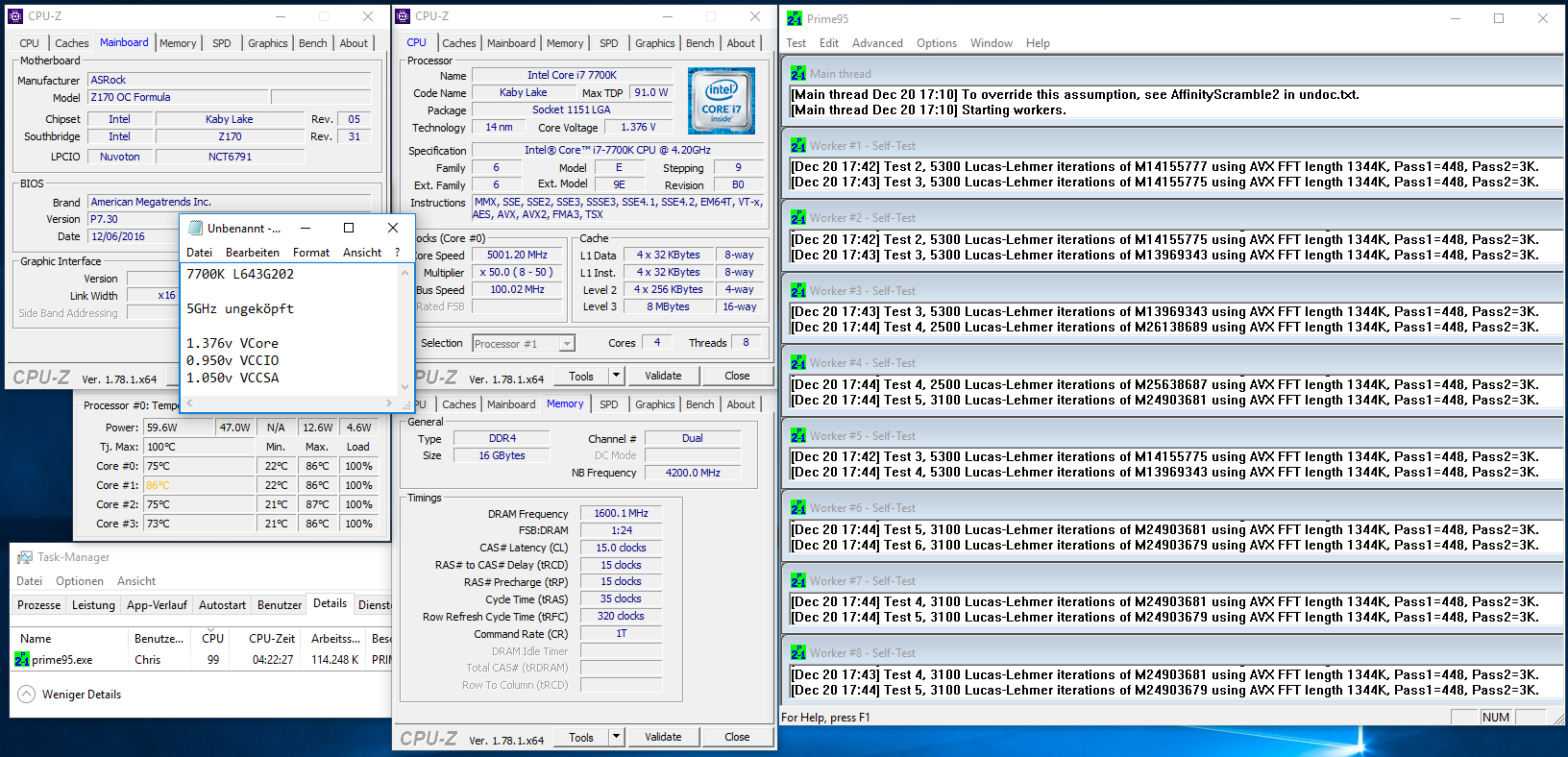
not all, i only delid the cpus which are good with stock TIM. if a cpu need more than 1.3-1.32v for 5GHz its uninteresting for me.
Please keep us posted with your OC results 🙂

thesmokingman
Platinum Member
😉


Edit: same CPU before & after delidding, 30min 1344k Prime test

Damn that is so hawt, yet not hot. You could run that setting 24/7 easy.
RichUK
Lifer
😉
Edit: same CPU before & after delidding, 30min 1344k Prime test
That is very impressive indeed! Be interesting to see what voltage is required for 5.2Ghz.

TRENDING THREADS
-
 Discussion Zen 5 Speculation (EPYC Turin and Strix Point/Granite Ridge - Ryzen 9000)
- Started by DisEnchantment
- Replies: 25K
-
Discussion Intel Meteor, Arrow, Lunar & Panther Lakes + WCL Discussion Threads
- Started by Tigerick
- Replies: 25K
-
 Discussion Intel current and future Lakes & Rapids thread
- Started by TheF34RChannel
- Replies: 24K
-

-
