

Mobile chips 2017: Qualcomm, Mediatek, Exynos and More
Page 4 - Seeking answers? Join the AnandTech community: where nearly half-a-million members share solutions and discuss the latest tech.
You are using an out of date browser. It may not display this or other websites correctly.
You should upgrade or use an alternative browser.
You should upgrade or use an alternative browser.
Architectures are designed to take advantage of the process node they will be produced and might not be suitables for older nodes. ARM works closely with TSMC while designing next architectures. The A73 consumes less static power so it will shine more over the A72 when manufactured at older processes like 28nm. Qualcomm had to clock the SD660 so low to not compete with the SD835 ( which we don't know yet if the low clocks are because of the bad yields or bad desing ).But the effectiveness will go according to the uarch?
I mean.. How escalable is the performance advantage of A73 to A72 on 16 nm compared to 28nm???
Good question... A53 was supposed to be a small core... And it already reached to their limits (thanks Mediatek), and it didn't even reached at A57 performance even at the highest clock posible (2.5 Ghz) without losing the performace/power consumption ratio.When is the a53 replaced and by what?
I go for bad process manufacturing... Even M2 can't go over 2.5 Ghz at 10nm. Let's wait how Mediatek fares on their 10nm chip on TSMC.Architectures are designed to take advantage of the process node they will be produced and might not be suitables for older nodes. ARM works closely with TSMC while designing next architectures. The A73 consumes less static power so it will shine more over the A72 when manufactured at older processes like 28nm. Qualcomm had to clock the SD660 so low to not compete with the SD835 ( which we don't know yet if the low clocks are because of the bad yields or bad desing ).
But talking about A72 at 28nm... Why it did perform better than A57 at 14nm?
Do you mean the SD652 having similar CPU performance to the Exynos7420? First,Samsung's 14nmLPE isn't a big improvement over TSMC's 28nmHPM in performance/power and it is almost offsetted by the A72 lower lower consumption so it can clock higher compared to A57 at any process node within same TDP. And cortex A72 has higher IPC to compesate for lower clocks.Good question... A53 was supposed to be a small core... And it already reached to their limits (thanks Mediatek), and it didn't even reached at A57 performance even at the highest clock posible (2.5 Ghz) without losing the performace/power consumption ratio.
I go for bad process manufacturing... Even M2 can't go over 2.5 Ghz at 10nm. Let's wait how Mediatek fares on their 10nm chip on TSMC.
But talking about A72 at 28nm... Why it did perform better than A57 at 14nm?
Actually was the SD650/652 duo have better single CPU performance against the Exynos 7420 due the A72 uarch?Do you mean the SD652 having similar CPU performance to the Exynos7420? First,Samsung's 14nmLPE isn't a big improvement over TSMC's 28nmHPM in performance/power and it is almost offsetted by the A72 lower lower consumption so it can clock higher compared to A57 at any process node within same TDP. And cortex A72 has higher IPC to compesate for lower clocks.
Also, that means the ARM A57 was a badly made uARCH that even on better process manufacturing it will fail hard compared to A72?
----------------
Anyways... time to move to other news.
----------------
Seems that Kirin 970 and Snapdragon 845 are getting some leaks...
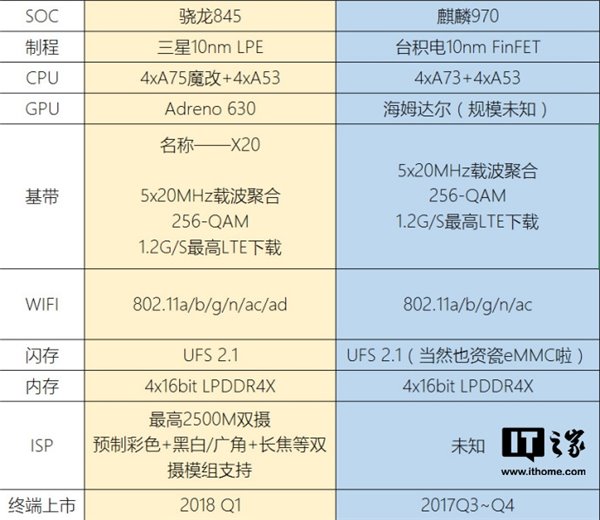
About the Kirin 970 was expected since it was ready for the Mate 10, the surprise is that is debuting a new GPU which is called Heimdallr MP... pretty weird.
On the other side the Snapdragon 845 is leaving for real the Custom/SemiCustom Cores (RIP Kryo) and using stock ARM A75 cores... wondering if this cores will not be the same dissaster like the A57.
Also new GPU finally... seems that the 600 series will delive some changes...
So this leaves Mediatek and Xiaomi evaluating the GPU to use... for Mediatek it could be PowerVR Furian since they (Imagination) will sell their GPUs on a pretty cheap price due Apple recent moves (no more PowerVR) and since Mediatek is a regular client of them... it could be interesting how them performs. Similar thing to Xiaomi. Mali is not as great as expecting for them.
Source: https://www.gizmochina.com/2017/05/19/kirin-970-snapdragon-845-details-launch-dates-leaked/
Nice scoop on the next generation ARM Cortex A75 core (if it indeed in the pipeline). But 10nm LPE for QC next generation SoC (SD845) is a bit of a red flag to me. It would be more plausible if it were to be built on 10nm LPP.Actually was the SD650/652 duo have better single CPU performance against the Exynos 7420 due the A72 uarch?
Also, that means the ARM A57 was a badly made uARCH that even on better process manufacturing it will fail hard compared to A72?
----------------
Anyways... time to move to other news.
----------------
Seems that Kirin 970 and Snapdragon 845 are getting some leaks...
About the Kirin 970 was expected since it was ready for the Mate 10, the surprise is that is debuting a new GPU which is called Heimdallr MP... pretty weird.
On the other side the Snapdragon 845 is leaving for real the Custom/SemiCustom Cores (RIP Kryo) and using stock ARM A75 cores... wondering if this cores will not be the same dissaster like the A57.
Also new GPU finally... seems that the 600 series will delive some changes...
So this leaves Mediatek and Xiaomi evaluating the GPU to use... for Mediatek it could be PowerVR Furian since they (Imagination) will sell their GPUs on a pretty cheap price due Apple recent moves (no more PowerVR) and since Mediatek is a regular client of them... it could be interesting how them performs. Similar thing to Xiaomi. Mali is not as great as expecting for them.
Source: https://www.gizmochina.com/2017/05/19/kirin-970-snapdragon-845-details-launch-dates-leaked/
Last edited:
About the SD 845 it could be super fake... But the Huawei 970 was hinted to be at 10 nm and still using ARM A73 CPU... Using a new gen GPU seems logic too since G71 is already old.An architecture that comes 2 years later to replace the previous one should be better, doesn't mean than the older was "bad". But i think the Exynos still has the edge in some workloads.
That leak looks super fake.
imported_jjj
Senior member
- Feb 14, 2009
- 660
- 430
- 136
ARM has a new core very soon ( that's not rumor or speculation, it's certain), likely announced at Computex.
Remains to be seen if it's another 600mW core or 2x that.Folks on 7nm need a server core and even mobile needs a bigger core, especially with DynamIQ and the extra flexibility it offers.
Announcing it at Computex might be a hint that it's a larger core.
Remains to be seen if it's another 600mW core or 2x that.Folks on 7nm need a server core and even mobile needs a bigger core, especially with DynamIQ and the extra flexibility it offers.
Announcing it at Computex might be a hint that it's a larger core.
Last edited:
Slides from ARM for computex have leaked:
https://videocardz.com/69814/arm-mali-g72-cortex-a55-cortex-a75
It seem the new A75 has a nice IPC improvement over A73 of 34% in Geekbench and same power consumption of the A72 which was great.
I am happy to see that DynamIQ will be ready for next year
https://videocardz.com/69814/arm-mali-g72-cortex-a55-cortex-a75
It seem the new A75 has a nice IPC improvement over A73 of 34% in Geekbench and same power consumption of the A72 which was great.
I am happy to see that DynamIQ will be ready for next year
Now time to say goodbye to Kryo and Mongoose for real... With this kind of improvement a custom core won't be useful unless they target it to server side.Slides from ARM for computex have leaked:
https://videocardz.com/69814/arm-mali-g72-cortex-a55-cortex-a75
It seem the new A75 has a nice IPC improvement over A73 of 34% in Geekbench and same power consumption of the A72 which was great.
I am happy to see that DynamIQ will be ready for next year
Also.. At best.. Finally the A55 and A75 can be added some L3 cache and that is KEY in order to improve performance even more. Hope that is HSA compatible too to make it a real menace for Apple.
Now for the GPU. This is interesting, but now I am thinking... They are on the limits and maybe is time to... Add some dedicated GDDR RAM for the GPU?
I feel that Apple will deliver that soon.
I wonder how much of it due to the architectural improvement and how much of it due to the manufacturing process improvement.Slides from ARM for computex have leaked:
https://videocardz.com/69814/arm-mali-g72-cortex-a55-cortex-a75
It seem the new A75 has a nice IPC improvement over A73 of 34% in Geekbench and same power consumption of the A72 which was great.
I am happy to see that DynamIQ will be ready for next year
Last time when they launch the A73, they did provide projected straight comparison at the same manufacturing process thus giving us the idea of how much of the improvement came from architectural side of thing.
I wonder how much of it due to the architectural improvement and how much of it due to the manufacturing process improvement.
Last time when they launch the A73, they did provide projected straight comparison at the same manufacturing process thus giving us the idea of how much of the improvement came from architectural side of thing.
It says at same process/frequency. Take a look of the slides.
Now time to say goodbye to Kryo and Mongoose for real... With this kind of improvement a custom core won't be useful unless they target it to server side.
Also.. At best.. Finally the A55 and A75 can be added some L3 cache and that is KEY in order to improve performance even more. Hope that is HSA compatible too to make it a real menace for Apple.
Now for the GPU. This is interesting, but now I am thinking... They are on the limits and maybe is time to... Add some dedicated GDDR RAM for the GPU?
I feel that Apple will deliver that soon.
If Samsung doesn't come out with a huge improvement in their custom cores I hope they drop them in the next Exynos.
If I remember correctly they have been HSA compatible for some time alredy.

Arachnotronic
Lifer
- Mar 10, 2006
- 11,715
- 2,012
- 126
A75 looks tasty. Any idea when we'll see this puppy in phones? 10nm A73 isn't really common yet, so I'd imagine that we're looking at 2H 2018?
Not only A75, but also A55 looks tasty...A75 looks tasty. Any idea when we'll see this puppy in phones? 10nm A73 isn't really common yet, so I'd imagine that we're looking at 2H 2018?
And now I can see it...
A75 - Top Tier Cores
A55 - Mid Tier Cores
A35 - Low Tier Cores
A32 - Feature Phone Cores
First Cortex A72/73 products were released the same year but by the end of it. So I expect the same for this A75. Architecture and process are not bound.A75 looks tasty. Any idea when we'll see this puppy in phones? 10nm A73 isn't really common yet, so I'd imagine that we're looking at 2H 2018?
The Qualcomm Snapdragon 835 uses Cortex A73.
Isn't the first to use A73 cores on a chip is the Kirin 960??First Cortex A72/73 products were released the same year but by the end of it. So I expect the same for this A75. Architecture and process are not bound.
The Qualcomm Snapdragon 835 uses Cortex A73.
And it came the previous year...
imported_jjj
Senior member
- Feb 14, 2009
- 660
- 430
- 136
Interesting to note that the slides mention A75 on 10nm at 3GHz but nothing mentioned about 7nm so maybe it's not targeted at 7nm and the late 2018 and beyond cycle.
It seems that A75 is targeted at late 2017 to early 2018 and there will be a new core for 7nm.
This is already a desktop class core, except a few times smaller area - assuming 0.8mm2+/- 30% on 10nm for just the core. Ofc not configured for desktop clocks and no SMT.
3GHz on 10nm is likely not quite doable with quad configs.
Also , as assumed, they do add a L3$ with DynamIQ, that's quite a substantial change.
Anyway, if ARM can squeeze 10-15% extra IPC with the next core , targeted at 7nm and push clocks above 4GHz with TSMC's HPC, they got a decent server core. In mobile, the CPU perf is already overkill. good for marketing but not required. I was hoping for a bigger core for server but this is ok.
Ofc they could go for a bigger core on 7nm and sacrifice area for even higher perf- that would work in high end mobile too but it's hard for ARM to accept that in some segments area is not that relevant.
A55 looks decent , a gain in perf and efficiency, add higher clocks with the process and will be sufficient for 95% of users.
G72 seems like a shy step forward in machine learning- at least when compared to Nvidia and ARM needs to push harder in the next 2-3 years.
PS: If TSMC starts 7nm volume prod in Q2 2018, they start shipping in Q3 (long cycle times) so it's timed for iphone launch in late Sept and we'll see SoCs with what comes after A75 on 7nm in late 2018 at best and more likely MWC 2019 timeframe for March-April retail.
It seems that A75 is targeted at late 2017 to early 2018 and there will be a new core for 7nm.
This is already a desktop class core, except a few times smaller area - assuming 0.8mm2+/- 30% on 10nm for just the core. Ofc not configured for desktop clocks and no SMT.
3GHz on 10nm is likely not quite doable with quad configs.
Also , as assumed, they do add a L3$ with DynamIQ, that's quite a substantial change.
Anyway, if ARM can squeeze 10-15% extra IPC with the next core , targeted at 7nm and push clocks above 4GHz with TSMC's HPC, they got a decent server core. In mobile, the CPU perf is already overkill. good for marketing but not required. I was hoping for a bigger core for server but this is ok.
Ofc they could go for a bigger core on 7nm and sacrifice area for even higher perf- that would work in high end mobile too but it's hard for ARM to accept that in some segments area is not that relevant.
A55 looks decent , a gain in perf and efficiency, add higher clocks with the process and will be sufficient for 95% of users.
G72 seems like a shy step forward in machine learning- at least when compared to Nvidia and ARM needs to push harder in the next 2-3 years.
PS: If TSMC starts 7nm volume prod in Q2 2018, they start shipping in Q3 (long cycle times) so it's timed for iphone launch in late Sept and we'll see SoCs with what comes after A75 on 7nm in late 2018 at best and more likely MWC 2019 timeframe for March-April retail.
Last edited:
I bet Huawei would come up with their Kirin 970 with A75 + A55 by the end of 2017 as they did with Kirin 960 (A73 + A53 end of 2016) and Kirin 950 (A72 + A53 end of 2015).A75 looks tasty. Any idea when we'll see this puppy in phones? 10nm A73 isn't really common yet, so I'd imagine that we're looking at 2H 2018?
Based on past record, Huawei is going to be the first company to come up with ARM vanilla SoC.
Yes, I just said Qualcomm because it is more common in android and it is built in 10nm as he was saying.Isn't the first to use A73 cores on a chip is the Kirin 960??
And it came the previous year...
Interesting to note that the slides mention A75 on 10nm at 3GHz but nothing mentioned about 7nm so maybe it's not targeted at 7nm and the late 2018 and beyond cycle.
It seems that A75 is targeted at late 2017 to early 2018 and there will be a new core for 7nm.
This is already a desktop class core, except a few times smaller area - assuming 0.8mm2+/- 30% on 10nm for just the core. Ofc not configured for desktop clocks and no SMT.
3GHz on 10nm is likely not quite doable with quad configs.
Also , as assumed, they do add a L3$ with DynamIQ, that's quite a substantial change.
Anyway, if ARM can squeeze 10-15% extra IPC with the next core , targeted at 7nm and push clocks above 4GHz with TSMC's HPC, they got a decent server core. In mobile, the CPU perf is already overkill. good for marketing but not required. I was hoping for a bigger core for server but this is ok.
Ofc they could go for a bigger core on 7nm and sacrifice area for even higher perf- that would work in high end mobile too but it's hard for ARM to accept that in some segments area is not that relevant.
A55 looks decent , a gain in perf and efficiency, add higher clocks with the process and will be sufficient for 95% of users.
G72 seems like a shy step forward in machine learning- at least when compared to Nvidia and ARM needs to push harder in the next 2-3 years.
PS: If TSMC starts 7nm volume prod in Q2 2018, they start shipping in Q3 (long cycle times) so it's timed for iphone launch in late Sept and we'll see SoCs with what comes after A75 on 7nm in late 2018 at best and more likely MWC 2019 timeframe for March-April retail.
You just drscibred the recent schedule of ARM cores, nothing new. They are aware that 7nm wont be ready for the companies that will use A75 first in mass production so no point. Again, architectures are not bound to any specific process that is designer decision.
Quad core Cortex A75 at 3GHz is very doable in 10nm if done well and TSMC confirmed an A72 running at >4GHz at 7nm for High Performance.
imported_jjj
Senior member
- Feb 14, 2009
- 660
- 430
- 136
Yes, I just said Qualcomm because it is more common in android and it is built in 10nm as he was saying.
You just drscibred the recent schedule of ARM cores, nothing new. They are aware that 7nm wont be ready for the companies that will use A75 first in mass production so no point. Again, architectures are not bound to any specific process that is designer decision.
Quad core Cortex A75 at 3GHz is very doable in 10nm if done well and TSMC confirmed an A72 running at >4GHz at 7nm for High Performance.
Maybe you failed to read the few posts before mine or you have certain behavioral issues, not ideal either way.
3GHz quad cores in mobile is likely not quite doable if ARM lists A73 at 2.8GHz in the same slide. They target 3GHz but usually that's a bit optimistic.The slides are rather tricky too if you don't pay attention.
They claim >20% extra perf AND same sustained perf on same process and clocks, those 2 claims are hard to reconcile.
Then they claim similar efficiency at 3GHz vs A73 at 2.8GHz - efficiency not perf.
At much higher target TDP ofc you can reach higher clocks but that's not the point.
And then Mediatek will be the 2nd one.I bet Huawei would come up with their Kirin 970 with A75 + A55 by the end of 2017 as they did with Kirin 960 (A73 + A53 end of 2016) and Kirin 950 (A72 + A53 end of 2015).
Based on past record, Huawei is going to be the first company to come up with ARM vanilla SoC.
So the Helio P4X and the X4X series will debut the ARM A75, the A55 and the A35 altogether with the Power VR Furian GPU.
Also... This might mark the end of 28 nm chips... So A55 on 16 nm for Mediatek.... Maybe Qualcomm will do something similar.
And L3 cache for top tier chips.
Maybe you failed to read the few posts before mine or you have certain behavioral issues, not ideal either way.
3GHz quad cores in mobile is likely not quite doable if ARM lists A73 at 2.8GHz in the same slide. They target 3GHz but usually that's a bit optimistic.The slides are rather tricky too if you don't pay attention.
They claim >20% extra perf AND same sustained perf on same process and clocks, those 2 claims are hard to reconcile.
Then they claim similar efficiency at 3GHz vs A73 at 2.8GHz - efficiency not perf.
At much higher target TDP ofc you can reach higher clocks but that's not the point.
I am aware they are tricky that is why I said this Cortex A75 consumes more power than A73, might be the same as the A72 because it is replacing it. Efficiency is equation between performance/power. The A73 supposedly consumes 20-25% less power compared to A72. And the latter at 2'5GHz at 16nm quad core configuration consumes ~5W. At TSMC 10nm which provides 20% more performance and if this architecture scales better with frequency I don't see any problem of a 3GHz configuration ( just a personal preference for less power consumption ).
PD: the link doesn't work anynore, they have removed it
TRENDING THREADS
-
 Discussion Zen 5 Speculation (EPYC Turin and Strix Point/Granite Ridge - Ryzen 9000)
- Started by DisEnchantment
- Replies: 25K
-
Discussion Intel Meteor, Arrow, Lunar & Panther Lakes + WCL Discussion Threads
- Started by Tigerick
- Replies: 24K
-
 Discussion Intel current and future Lakes & Rapids thread
- Started by TheF34RChannel
- Replies: 23K
-

-


AnandTech is part of Future plc, an international media group and leading digital publisher. Visit our corporate site.
© Future Publishing Limited Quay House, The Ambury, Bath BA1 1UA. All rights reserved. England and Wales company registration number 2008885.
 Facebook
 Twitter