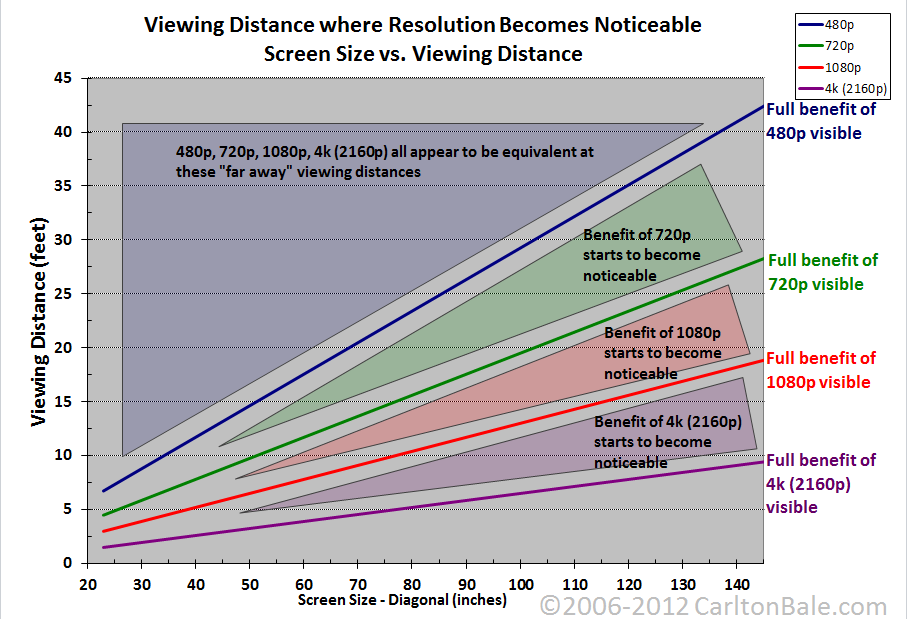
I didn't want to go down this path, but you know what, I will because your story doesn't add up once I do my research. So many people on forums keep hyping up 4K BluRay and 4K TVs. The problem is science doesn't agree with the marketing hype for several strong reasons that have been voiced by various technical publications and professionals!
The hype is irrelevant, 4K tvs and Blu Rays are coming. Even without 4K the benefit of HEVC encoding and usage is obvious at all resolutions. Eventually I expect every cheap Nvidia GPU to have a decoder like the GTX 960 has in it, and I would love to test one sooner than later.
1) How are you seeing a worthwhile difference in 4K BluRay movies over standard 4K on a modern 4K TV? If so, how close are you sitting to your 4K TV in your living room?
My main viewing areas aren't 4K for now, because they are the last plasmas. But my kitchen viewing station is 4k and I can tell a difference in the 4K material that I have pretty easily there, but I have better than 20/20 vision and I get pretty close to wash the dishes.
HEVC decode isn't all about 4k, I have been playing with encoding it myself and would prefer that in the long run for the MPEG2 stuff (like old Blu Rays or OTA recordings) I have. It is the next obvious step once the encoders are perfected.
2) When you say you want 4K decode and play 4K BluRay rips, how are you getting 4K content, renting it and ripping it to your PC?
Right now 4K content is sparse, TV demos and the like. But we know what the standard for 4K Blu Rays will be:
http://www.cnet.com/news/4k-blu-ray-discs-arriving-in-2015-to-fight-streaming-media/
The standard will be 10 bit 4K HEVC at a certain profile that the GTX 960 should support. That means the card could have a nice second life as a decoding workhorse on a secondary non-gaming station running Linux like in my kitchen, which is a good backup plan if Intel takes a few generations to get its decoding right like with H264.
I have other HEVC content from sources as well, HEVC at all resolutions brings an important advantage for bandwidth and storage space reduction. H264 is the past, H265 the future on mobile and otherwise. I am excited because the 960 is Nvidia's first shot at it, and the usually have robust decoding.
Just like every previous optical disc I expect the DRM on the discs will get hacked and I will be able to backup the discs into a more modern system. It is just a matter of time, and I can play my own content or games until then.
3) If you are downloading 4K content from online, what Internet speed do you have? Because honestly a full blown 4K movie with 100% sound quality and picture quality is likely going to approach 80-100GBs
The speed matters less than the cap, the difference is your patience. On both metrics I am fine, and I am not scared of 100GB files as I expect my movie (just movie) mediaserver to be over 25TB by the end of next year.
4) What about the cost of 4K legal content? It's
absurd!
"the Blu-ray of the first half of Breaking Bad Season 5 is over £20/$30."
http://www.techradar.com/news/home-cinema/4k-blu-ray-is-dead-tech-walking-1180545
^ If you read that article, and many others, it becomes obvious that 4K is meant more for the industry to sell TVs, BluRay players and content, rather than actually benefiting the consumer in today's form factors. The industry players needed something to entice media buffs to upgrade.....
😛
So to summarize, 4K media content on a 4K TV today sounds like a 100% marketing gimmick -- it's not widely available, it's way too expensive, requires a gigantic 4K TV that costs an arm and a leg and won't even fit in most people's apartments/homes, and the Internet speed required to stream uncompressed 4K content is hardly available to 95% of the North American population at anything resembling reasonable pricing.
Unless you can afford a 100" 4K TV and have the world's fastest unlimited Internet connection to watch 70GB+ 4K BluRay movies, it sounds to me like most are chasing 4K to have "the latest and greatest" but scientifically speaking, the benefits aren't there for most people.
See, 4K actually makes A LOT more sense for PC gaming because on a 28-37" PC monitor where a PC gamer sits 1.5-2 feet away, we can actually tell the difference. For HTPC, a less than 80" 4K TV today in the living room, makes the least amount of sense unless you sit 3-5 feet close to a TV which let's face it most of us do not.
All of that is irrelevant to me, I already have one 4k viewing station and I expect to have more. It brings an immediate benefit to the quality of text on HTPC GUIs, at further viewing distances than with moving content, and having a pretty GUI for my media and games is most of the battle for me. The rest is gravy! I will go 4k in the bedroom soon, and when the plasmas go upgrade to 4k, hopefully OLED by then. That is what is coming, they need something to sell as you said. It can't be 1080p for 20 years like with color TVs.
Let me be honest, I am not the average consumer. Just like there are some PC hardware fans who get a bigger thrill out of building the rigs, overclocking and benchmarking than playing the game I am a HTPC geek. So my thing is HTPCs, and building/finding capable devices to feed my ever growing library of media from optical disks, tuners, HD capture devices, etc. that is then delivered on-demand in my household.
I probably spend the same on GPUs in a three year period as many here, but while they buy one $300+ GPU I have bought 6 GT x30 GPUs for the HTPC ability. And some AMD ones like the 6450s and a 7850. And a few different Intel GPU generations. And some ARM devices. And....Well suffice to say the HTPC side is more of the hobby for me than the consumption or the usage. I like the challenge of the form factor, and bringing all the power of modern computer into a remote-driven set top box-ish interface.
To me personally the GTX 960's decoder has personal value because I would love to run some test clips through it and test its claims of support. I would love to see if this card's decoder is fully supported in VDPAU, and be ready to rip the first 4K disk and play it as soon as it can if the card is able. I want to be on the cutting edge of HEVC, because I think in five years it will be as common as H264 is today.
In a general HTPC sense the 960 has great potential for the lower power consumption and completely silent idle options. I want to see if AMD had a part positioned to compete with the 960 that gets near the power consumption and has decoding that is as robust as NVidia's solution. I think that is worth waiting for, plus letting the GTX 960 market settle some. If AMD doesn't get out a card that can do as well in this space then the 960 is always there, but I want to be surprised!
What I go back and forth about is the 2GB vs 4GB on the 960. I know some games already push 2GB, but it would seem to me any game with textures like that would crush the 960's 128 bit bus with either 2GB or 4GB. Without more bus bandwidth I don't know if more VRAM is superficial, and therefore isn't up to the job of dealing with the wave of console ports that are coming. If the reviews show the 4GB is no better than some of the potential of the 960 is lost for sure.