
-
We’re currently investigating an issue related to the forum theme and styling that is impacting page layout and visual formatting. The problem has been identified, and we are actively working on a resolution. There is no impact to user data or functionality, this is strictly a front-end display issue. We’ll post an update once the fix has been deployed. Thanks for your patience while we get this sorted.
You are using an out of date browser. It may not display this or other websites correctly.
You should upgrade or use an alternative browser.
You should upgrade or use an alternative browser.
Lysol / spray disinfectant: This might blow your mind, but...
- Thread starter Ichinisan
- Start date


TheGardener
Golden Member
Is it? Look at a can of Air Wick Air Freshener. Check out the contents section for ingredients. You will not find one. They refer you to a website. Now go to the website and try to find the contents. I ended up in a loop. Maybe I don't know how to search. But even if I suffer from pilot error, it should not be so hard. In the end, I couldn't find out what is in the air freshener can. So I have no idea if Air Wick has ingredients that I should be concerned about.Of course, a product specifically labeled as an "air freshener" is different.
TheGardener
Golden Member
Besides people misusing products is full employment opportunity for personal injury attorneys.
TheGardener
Golden Member
Would appreciate a citation.And most disinfectants disinfect almost nothing. And the things they do disinfect have a long list of caveats in order to work properly.


MagnusTheBrewer
IN MEMORIAM
Only a moron would think Lysol smells better than what they're trying to cover up.


Ichinisan
Lifer
Only a moron would confuse a "disinfectant" with a "air freshener". 🙄


My sister always sprayed surface disinfectant in the air. Everyone that uses the restroom at work sprays it in the air. It's for the toilet seat.
I'd wager most of the sales go to ignorant people who use it incorrectly.

Jimzz
Diamond Member
Is it? Look at a can of Air Wick Air Freshener. Check out the contents section for ingredients. You will not find one. They refer you to a website. Now go to the website and try to find the contents. I ended up in a loop. Maybe I don't know how to search. But even if I suffer from pilot error, it should not be so hard. In the end, I couldn't find out what is in the air freshener can. So I have no idea if Air Wick has ingredients that I should be concerned about.
The primary active ingredient is ethanol alcohol.
http://www.rbnainfo.com/MSDS/US/AirWick-Aqua-Mist-US.pdf

Brainonska511
Lifer
The primary active ingredient is ethanol alcohol.
http://www.rbnainfo.com/MSDS/US/AirWick-Aqua-Mist-US.pdf
Ethanol alcohol is redundant. Ethanol or ethyl alcohol.

CZroe
Lifer
I don't know why so many people expect to find ingredients for non-food/drug items. You can find the active ingredients to many things outside the purview of the FDA, but why share their secret sauce recipe if they aren't compelled to?Is it? Look at a can of Air Wick Air Freshener. Check out the contents section for ingredients. You will not find one. They refer you to a website. Now go to the website and try to find the contents. I ended up in a loop. Maybe I don't know how to search. But even if I suffer from pilot error, it should not be so hard. In the end, I couldn't find out what is in the air freshener can. So I have no idea if Air Wick has ingredients that I should be concerned about.
Would appreciate a citation.
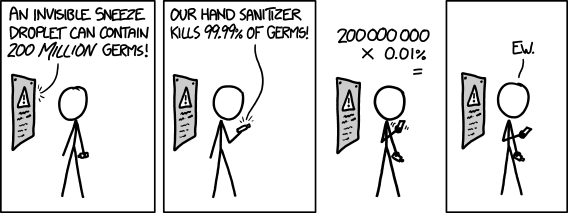
Follow the asterisk on any disinfectant. The 'kills 99.9% of germs' is usually a half dozen things or so and requires quite a bit to work properly against those things, although some do a bit more, but germs is so generic than can get away with it and let people assume it is everything.
Because this thread is about Lysol, this is what you have to do to disinfect and sanitize with their product:
Pre-clean surface prior to use. Hold can upright 6" to 8" from surface. Spray 2 to 3 seconds or till covered with mist.
To Disinfect:
Let stand for 3 minutes then allow to air dry.
Rinse toys and food contact surfaces with potable water after use.
To Sanitize:
Let stand for 30 seconds then allow to air dry.
To control and prevent mold and mildew and their odors:
Apply to pre-cleaned surface. Allow to remain wet for 3 minutes. Let air dry.
Repeat applications in weekly intervals or when mold and mildew growth appears.
Last edited:

IronWing
No Lifer
CZroe
Lifer
Follow the asterisk on any disinfectant. The 'kills 99.9% of germs' is usually a half dozen things or so and requires quite a bit to work properly against those things.
You think it *only* kills those things? It's at least as effective as alcohol and I don't see anyone complaining about that as a disinfectant. 🙄

master_shake_
Diamond Member

i like when people spray it and the floor turns in to an ice rink.
TheGardener
Golden Member
The primary active ingredient is ethanol alcohol.
http://www.rbnainfo.com/MSDS/US/AirWick-Aqua-Mist-US.pdf
Thanks for the link and an answer to my concern. Just want to note for those who didn't notice, that the details are not linked to the people who make Air Wick.
A couple points, that may be rhetorical. Is ethanol alcohol safe to breath when sprayed in the air? Under Engineering Controls it says, "for occupational exposures, ensure adequate ventilation". Of course in residential homes, we know that bathrooms are constantly well ventilated, not. If they were well ventilated, why would you need to use an air freshener? In the same section it reads, "Avoid contact with eyes, skin and clothing." Easy to do with an aerosol spray, not. I'll bet that 98% of women who could read this on the can, if it were there and printed at something greater than a 2 font, would still opt for using the spray.

lxskllr
No Lifer
Follow the asterisk on any disinfectant. The 'kills 99.9% of germs' is usually a half dozen things or so and requires quite a bit to work properly against those things, although some do a bit more, but germs is so generic than can get away with it and let people assume it is everything.
TheGardener
Golden Member
Follow the asterisk on any disinfectant. The 'kills 99.9% of germs' is usually a half dozen things or so and requires quite a bit to work properly against those things, although some do a bit more, but germs is so generic than can get away with it and let people assume it is everything.
Because this thread is about Lysol, this is what you have to do to disinfect and sanitize with their product:
You said "And most disinfectants disinfect almost nothing." I can read directions, and I try to follow those directions when I use Lysol Bathroom Cleaner. So your contention is, that I am failing to achieve my intended purpose, right? So I would like a citation for that. I am skeptical of your comment.
You said "And most disinfectants disinfect almost nothing." I can read directions, and I try to follow those directions when I use Lysol Bathroom Cleaner. So your contention is, that I am failing to achieve my intended purpose, right? So I would like a citation for that. I am skeptical of your comment.
I didn't really think of it as a contention, but merely the whole claim of kills 99.9% of germs is usually a very tiny group of select bacteria, viruses and fungus (and occasionally protozoa).
And as far as using it correctly, I'm sure some do, but I'm more confident that most do a spray, swipe and done method of cleaning.
Ichinisan
Lifer
Well that's obvious. A lump of food with Lysol sprayed on it doesn't kill the bacteria inside the lump of food.Follow the asterisk on any disinfectant. The 'kills 99.9% of germs' is usually a half dozen things or so and requires quite a bit to work properly against those things, although some do a bit more, but germs is so generic than can get away with it and let people assume it is everything.
Because this thread is about Lysol, this is what you have to do to disinfect and sanitize with their product:Pre-clean surface prior to use. Hold can upright 6" to 8" from surface. Spray 2 to 3 seconds or till covered with mist. ...


destrekor
Lifer
Lysol has an air sanitizing spray.
And I'm willing to bet there is not a significant difference between the disinfectant spray and the air sanitizing spray. Both can be used on surfaces to disinfect. Why can't the disinfectant spray neutralize airborne particles? Perhaps there is a significant difference, I can't be bothered to research it more than I have right now, but it isn't that big a stretch of the imagination.
And I'm willing to bet there is not a significant difference between the disinfectant spray and the air sanitizing spray. Both can be used on surfaces to disinfect. Why can't the disinfectant spray neutralize airborne particles? Perhaps there is a significant difference, I can't be bothered to research it more than I have right now, but it isn't that big a stretch of the imagination.
TRENDING THREADS
-
 Discussion Zen 5 Speculation (EPYC Turin and Strix Point/Granite Ridge - Ryzen 9000)
- Started by DisEnchantment
- Replies: 25K
-
Discussion Intel Meteor, Arrow, Lunar & Panther Lakes + WCL Discussion Threads
- Started by Tigerick
- Replies: 25K
-
 Discussion Intel current and future Lakes & Rapids thread
- Started by TheF34RChannel
- Replies: 24K
-

-
