Odd that they did not use the same design on both sides. The right side is how it normally should be. But if you look at my pic of the inside of that church in post #14 it looks like it's similar to the left side and they have no support under the straight part.
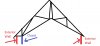
The OP's truss is a simple scissors truss design.
The flat on the bottom chord could be simply to support the closet ceiling.
It also could have been designed without it and the closet ceiling "stick-framed" with joists.
The way it was done was both cheaper and quicker (and just as safe and effective).
If you look at the "attic-right" photos, you can see that the other end of the truss is similar in that it has a vertical chord in the same location, not as in the drawing.
The asymmetry in the chord design could be from any number of variables - predominate wind load, predominate snow load, hanging loads (ceilings), chord spacing to allow ductwork, it goes on and on.
All those things and more are factors in modern prefab truss design (and there are also "standard" designs that can be used based on engineered limitations).
These days truss design is done with expensive software (and hopefully common sense), rather than calculators, in most larger truss fabs..
Since this is the upper story, I 'd be interested in the overhang and the distance from the soffit to the top of the windows.
That would help tell whether those outer vertical chords bear on the exterior wall or not.









 Facebook
 Twitter