Discussion Leading Edge Foundry Node advances (TSMC, Samsung Foundry, Intel) - [2020 - 2025]

Page 117 - Seeking answers? Join the AnandTech community: where nearly half-a-million members share solutions and discuss the latest tech.

DisEnchantment

Golden Member
Mar 3, 2017
1,779
6,798
136
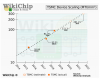
TSMC's N7 EUV is now in its second year of production and N5 is contributing to revenue for TSMC this quarter. N3 is scheduled for 2022 and I believe they have a good chance to reach that target.
1587737990547.png
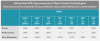
N7 performance is more or less understood.
1587739093721.png

This year and next year TSMC is mainly increasing capacity to meet demands.

For Samsung the nodes are basically the same from 7LPP to 4 LPE, they just add incremental scaling boosters while the bulk of the tech is the same.

Samsung is already shipping 7LPP and will ship 6LPP in H2. Hopefully they fix any issues if at all.
They have two more intermediate nodes in between before going to 3GAE, most likely 5LPE will ship next year but for 4LPE it will probably be back to back with 3GAA since 3GAA is a parallel development with 7LPP enhancements.


1587739615344.png

Samsung's 3GAA will go for HVM in 2022 most likely, similar timeframe to TSMC's N3.
There are major differences in how the transistor will be fabricated due to the GAA but density for sure Samsung will be behind N3.
But there might be advantages for Samsung with regards to power and performance, so it may be better suited for some applications.
But for now we don't know how much of this is true and we can only rely on the marketing material.

This year there should be a lot more available wafers due to lack of demand from Smartphone vendors and increased capacity from TSMC and Samsung.
Lots of SoCs which dont need to be top end will be fabbed with N7 or 7LPP/6LPP instead of N5, so there will be lots of wafers around.

Most of the current 7nm designs are far from the advertized density from TSMC and Samsung. There is still potential for density increase compared to currently shipping products.
N5 is going to be the leading foundry node for the next couple of years.

For a lot of fabless companies out there, the processes and capacity available are quite good.

---------------------------------------------------------------------------------------------------------------------------------------------------


FEEL FREE TO CREATE A NEW THREAD FOR 2025+ OUTLOOK, I WILL LINK IT HERE
 
Last edited:

Doug S

Diamond Member
Feb 8, 2020
3,754
6,639
136
Anandtech has more info:


They are reporting that N2P is losing BSPD, so I'm back to thinking A16 is mainly N2P with BSPD (probably with some additional tweaks but nothing major). That leaves A14 as the next full node step after N2.


In the last update TSMC was pretty clear that N2 did not have BSPDN, but it would be made available as an option six months later. That N2+BSPDN was not N2P, it was just N2 with BSPDN.

So this talk about N2P losing BSPDN is confusing. Is there no BSPDN until A16, or is that the first node that makes it standard. Or the first node that has "super power rail" and N2+BSPDN has some lesser form of BSPDN.

If BSPDN is out of N2 entirely, and they keep to this schedule where all the new nodes enter mass production in H2, I can't imagine Apple is too happy. What's the point of cooperating closely with your foundry on process development if the timing is wrong and your competition gets the latest processes before you do?
 

Hitman928

Diamond Member
Apr 15, 2012
6,749
12,477
136
In the last update TSMC was pretty clear that N2 did not have BSPDN, but it would be made available as an option six months later. That N2+BSPDN was not N2P, it was just N2 with BSPDN.

So this talk about N2P losing BSPDN is confusing. Is there no BSPDN until A16, or is that the first node that makes it standard. Or the first node that has "super power rail" and N2+BSPDN has some lesser form of BSPDN.

If BSPDN is out of N2 entirely, and they keep to this schedule where all the new nodes enter mass production in H2, I can't imagine Apple is too happy. What's the point of cooperating closely with your foundry on process development if the timing is wrong and your competition gets the latest processes before you do?

Anandtech reported that TSMC's roadmap showed BSPD came with N2P.

TSMC's N2 family will evolve and sometime in 2026, when the company plans to introduce its N2P fabrication technology. N2P that will add backside power rails to N2's Nanosheet GAA transistors.

Maybe they were mistaken, but that's where I was getting it from.


Edit:

Also here:

At its Technology Symposium 2023 the company revealed that backside PDN of its N2P will enable 10% to 12% higher performance by reducing IR droop and improving signaling, as well as reducing the logic area by 10% to 15%. Now, of course, such advantages will be more obvious in high-performance CPUs and GPUs that have dense power delivery network and therefore moving it to the back makes a great sense for them.

Backside PDN is a part of TSMC's N2P fabrication technology that will enter HVM in late 2026 or early 2027.
 

Geddagod

Golden Member
Dec 28, 2021
1,621
1,667
136
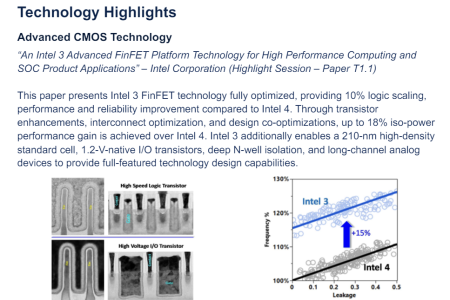
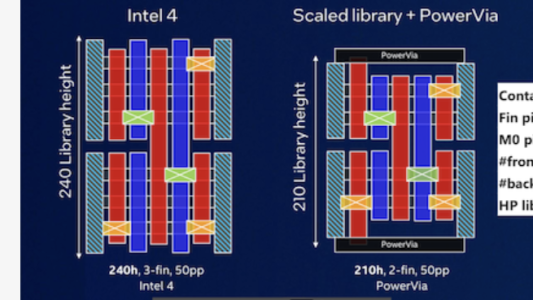
It wasn't Intel 3 HD cell height thats 210nm, but Intel 4 + BSPD HP cell height thats 210nm.
Intel is straight up saying Intel 3 HD is 210nm high.
1714510169884.png
There is literally no confusion here. Intel 3's HD cells are 210nm high.
Also, that Intel 4 + BSPD is not HP. Idk why you cropped it like the image of Intel 4 with BSPD like that....
1714510410476.png
It's "HD"- look at the fin count- it's 2-2 vs Intel 4 standard being 3-3. What fin count is exactly HP vs HD depends on node per node, but regardless, Intel 4 with BSPD has a lower fin count than Intel 4 without BSPD.
It would be pretty funny if Intel 3 HD was actually 3-3, but they were forced to call it HD because using too few fins would get it trashy performance, compared to N3 HD cells. I doubt it, but it would be pretty funny.
Whatever the reason is though, Intel 3 HD is 210nm, directly according to Intel themselves. And using their naming scheme, it should be compared to TSMC N3 HD cells.

Also, curious about your thoughts on rumors that Intel 18A's densest libs are only going to be marginally denser than N5 HD lol.
 

Ghostsonplanets

Senior member
Mar 1, 2024
774
1,228
96

Synopsys, Inc. (Nasdaq: SNPS) today announced that Samsung Electronics has achieved successful production tapeout for its high-performance mobile SoC design, including flagship CPUs and GPUs, with 300MHz higher performance using Synopsys.ai™ full stack AI-driven EDA suite and a broad portfolio of Synopsys IP on Samsung Foundry's latest Gate-All-Around (GAA) process technologies. This significant achievement underscores the close collaboration between Synopsys and Samsung to deliver exceptional performance, power and area (PPA) for mutual customers, enabling a new generation of chips with generative artificial intelligence (AI) capabilities on Samsung Foundry advanced process nodes.

Using AI driven EDA from Synopsis for GAA design (E2500/Dream?) allowed Samsung to achieve 300MHz higher clock while using 10% less dynamic power and savings weeks of manual effort.
 

Ghostsonplanets

Senior member
Mar 1, 2024
774
1,228
96

Asianometry doesn't sound optimistic regarding Intel's investment in high-NA.
Watched it yesterday. The economic structure and play for High-NA isn’t here. This much isn’t news. There's a reason why TSMC is avoiding High-NA as much as possible.

Intel silver bullet seems to be the reported Directed Self Assembly. If they can pull this off and reduce High-NA investments risks, they'll be able to leapfrog competition somewhat. But it's a risky gamble. Samsung Foundry literally was caught with their pants down trying to be the first on EUV and Gaafet/MCBFET. While TSMC preferred the slow and steady approach, which paid off in the end.

So let's see how this play from Intel Foundry will go.
 

KompuKare

Golden Member
Jul 28, 2009
1,234
1,606
136
Watched it yesterday. The economic structure and play for High-NA isn’t here. This much isn’t news. There's a reason why TSMC is avoiding High-NA as much as possible.

Intel silver bullet seems to be the reported Directed Self Assembly. If they can pull this off and reduce High-NA investments risks, they'll be able to leapfrog competition somewhat. But it's a risky gamble. Samsung Foundry literally was caught with their pants down trying to be the first on EUV and Gaafet/MCBFET. While TSMC preferred the slow and steady approach, which paid off in the end.

So let's see how this play from Intel Foundry will go.
Technically risky, but with the huge amount of corporate welfare being handed to Intel... The financial risk is Somebody Else's problem!
 

Saylick

Diamond Member
Sep 10, 2012
4,101
9,587
136
Watched it yesterday. The economic structure and play for High-NA isn’t here. This much isn’t news. There's a reason why TSMC is avoiding High-NA as much as possible.

Intel silver bullet seems to be the reported Directed Self Assembly. If they can pull this off and reduce High-NA investments risks, they'll be able to leapfrog competition somewhat. But it's a risky gamble. Samsung Foundry literally was caught with their pants down trying to be the first on EUV and Gaafet/MCBFET. While TSMC preferred the slow and steady approach, which paid off in the end.

So let's see how this play from Intel Foundry will go.
Slow and steady is the only viable option for TAMC given their clientele. Even if Intel were to catch up and beat TSMC on a few metrics, I doubt it would change the landscape all too much simply because clients value consistency of service, i.e. one hit wonder nodes don’t cut it for very demanding customers such as Apple. Those kinds of customers need to be reassured that you can offer them improvements generation after generation because their products depend on it. For this reason, it’s rather ironic that Intel is struggling to find customers for IFS at least partially because of the same reasons that allowed them to be entrenched in the server space to begin with: no one got fired for going with TSMC.
 

Aapje

Golden Member
Mar 21, 2022
1,530
2,106
106
There are customers that more opportunistically switch between suppliers, like Nvidia.
 

Saylick

Diamond Member
Sep 10, 2012
4,101
9,587
136
There are customers that more opportunistically switch between suppliers, like Nvidia.
Maybe for products which aren’t critical to their bottom line only for now, i.e. an ARM SoC for Windows on ARM.
 

maddie

Diamond Member
Jul 18, 2010
5,184
5,580
136
Maybe for products which aren’t critical to their bottom line only for now, i.e. an ARM SoC for Windows on ARM.
Nvidia as mentioned is definitely one. Pre AI boom, their gaming GPUs fabbed at Samsung was the bulk of both revenue and profits.
 

Doug S

Diamond Member
Feb 8, 2020
3,754
6,639
136
Nvidia as mentioned is definitely one. Pre AI boom, their gaming GPUs fabbed at Samsung was the bulk of both revenue and profits.

Pre AI boom Samsung's processes weren't in the complete disarray they've been mired in for the last few years. Pre EUV TSMC seemed to have a small advantage, but that may have been less important to Nvidia than other stuff like capacity or price. Going with Samsung today would appear to be pretty risky as there appears to be little evidence they can deliver in quantity on any of their sub 7nm nodes even at smartphone sizes, let alone reticle size like Nvidia's.

Intel's stated goal of becoming the #2 foundry seems easily achieveable even if they have some major missteps, because the only thing the competition has been able to produce in volume since covid started is press releases.
 
  • Like
Reactions: Saylick

DrMrLordX

Lifer
Apr 27, 2000
23,133
13,230
136
Intel's stated goal of becoming the #2 foundry seems easily achieveable even if they have some major missteps, because the only thing the competition has been able to produce in volume since covid started is press releases.
3GAP (or whatever they call it now) still could be an okay node, and Samsung should be able to offer it in higher volume than anything Intel will have through 18a.
 

Aapje

Golden Member
Mar 21, 2022
1,530
2,106
106
It's going to be an interesting few years ahead. AI bubble go boom boom? All those subsidized chip factories having to fight for customers? TSMC N2 being as good as Nenni claims? Intel getting competitive again? Someone developing a cheap and fast interconnect technology?

So many possibilities.
 

Ajay

Lifer
Jan 8, 2001
16,094
8,114
136
It's going to be an interesting few years ahead. AI bubble go boom boom? All those subsidized chip factories having to fight for customers? TSMC N2 being as good as Nenni claims? Intel getting competitive again? Someone developing a cheap and fast interconnect technology?

So many possibilities.
It'll just flatten out at some point and then stock prices will drop to 'normal' - IMHO. But, volumes could drop in a few years and then panic will crash 'AI' stocks on W$. No one really knows.
 

SpudLobby

Golden Member
May 18, 2022
1,041
702
106
3GAP (or whatever they call it now) still could be an okay node, and Samsung should be able to offer it in higher volume than anything Intel will have through 18a.
The second gen process of 3nm that doesn’t offer much difference from the first is now called SF2. Should be +22% perf and - 45% power over their 4nm standard node. The trouble with that is that their 4nm node sucks, and is like 10-15+% behind on perf still or -25-35% on power.

The next 3nm Will be used by the Exynos 2500 but they have 0 other major clients at all, and their AI customers are mainly just using 4nm and soon the SF4X which would be the version of 4nm that can actually compete with N4 and N4P in terms of power/performance - a 10-15% perf gain or 30% power reduction over 4NM LPP.

4NM LPP and LPP+ are okay, but still not really TSMC N4-caliber on power/performance, apparently a ton of variance though and 4LPP+ should genuinely be better. Still better than it was in terms of yield but not enough to take chances on a good random die I think.


But regardless, Google’s Tensor G4 2024 will be 4NM LPP+, and they are switching to TSMC N3 for Tensor G5 2025.


They lost Qualcomm, Nvidia (mostly) now Google most likely right as their 3nm would be Google’s option.

I don’t think things are going well at Samsung foundry. Improving relative to the initial 4nm and 5nm disaster yes but still.
 

Doug S

Diamond Member
Feb 8, 2020
3,754
6,639
136
I don’t think things are going well at Samsung foundry. Improving relative to the initial 4nm and 5nm disaster yes but still.

I wonder how long they can keep convince those at the top to keep investing all the billions required to try to keep up with the leading edge if they can't get things working well enough to gain any outside customers? If Samsung's phone division committed to using Exynos products across their entire line instead of in limited regions that would help. Otherwise I don't see where they are going to get any volume, and pretty soon we'll be down to only two leading edge foundries - with Intel only able to have a shot at keeping up due to a lot of government subsidies and private equity investment.
 
  • Like
Reactions: Tlh97 and SpudLobby

SpudLobby

Golden Member
May 18, 2022
1,041
702
106
I wonder how long they can keep convince those at the top to keep investing all the billions required to try to keep up with the leading edge if they can't get things working well enough to gain any outside customers? If Samsung's phone division committed to using Exynos products across their entire line instead of in limited regions that would help. Otherwise I don't see where they are going to get any volume, and pretty soon we'll be down to only two leading edge foundries - with Intel only able to have a shot at keeping up due to a lot of government subsidies and private equity investment.
Agreed. It’s a mess. They have small Korean AI customers but that’s almost like a handout, might even be subsidized and it’s just on 4NM (SF4X). Similarly AMD is only doing one cheapo Zen 5 4c part on SF4X.

So after 4 years of playing around with 5 and 4nm, and really the 4nm only started in 2021, with the 5nm being sort of a fake 7nm shrink, they just might be good enough for a small, cheapo AMD part in 2025 on a derivative tweak of it and some dead end startups.


Also funny — Intel by contrast is on the upswing. Backside power delivery working, 18A should ship some with PTL, Nova Lake also on 18A (?), and a path to some extensions of their nodes for efficiency, performance, TSV cachet etc.

Only thing against them is cost and regulation in the West really.

Edit: well, upswing but quite volatile. I mean relative to Samsung I guess.
 
  • Like
Reactions: Executor_