Discussion Leading Edge Foundry Node advances (TSMC, Samsung Foundry, Intel) - [2020 - 2025]

Page 103 - Seeking answers? Join the AnandTech community: where nearly half-a-million members share solutions and discuss the latest tech.

DisEnchantment

Golden Member
Mar 3, 2017
1,779
6,798
136
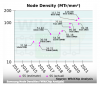
TSMC's N7 EUV is now in its second year of production and N5 is contributing to revenue for TSMC this quarter. N3 is scheduled for 2022 and I believe they have a good chance to reach that target.
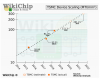
1587737990547.png
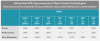
N7 performance is more or less understood.
1587739093721.png

This year and next year TSMC is mainly increasing capacity to meet demands.

For Samsung the nodes are basically the same from 7LPP to 4 LPE, they just add incremental scaling boosters while the bulk of the tech is the same.

Samsung is already shipping 7LPP and will ship 6LPP in H2. Hopefully they fix any issues if at all.
They have two more intermediate nodes in between before going to 3GAE, most likely 5LPE will ship next year but for 4LPE it will probably be back to back with 3GAA since 3GAA is a parallel development with 7LPP enhancements.


1587739615344.png

Samsung's 3GAA will go for HVM in 2022 most likely, similar timeframe to TSMC's N3.
There are major differences in how the transistor will be fabricated due to the GAA but density for sure Samsung will be behind N3.
But there might be advantages for Samsung with regards to power and performance, so it may be better suited for some applications.
But for now we don't know how much of this is true and we can only rely on the marketing material.

This year there should be a lot more available wafers due to lack of demand from Smartphone vendors and increased capacity from TSMC and Samsung.
Lots of SoCs which dont need to be top end will be fabbed with N7 or 7LPP/6LPP instead of N5, so there will be lots of wafers around.

Most of the current 7nm designs are far from the advertized density from TSMC and Samsung. There is still potential for density increase compared to currently shipping products.
N5 is going to be the leading foundry node for the next couple of years.

For a lot of fabless companies out there, the processes and capacity available are quite good.

---------------------------------------------------------------------------------------------------------------------------------------------------


FEEL FREE TO CREATE A NEW THREAD FOR 2025+ OUTLOOK, I WILL LINK IT HERE
 
Last edited:

Aapje

Golden Member
Mar 21, 2022
1,530
2,106
106
Exactly. That's also why these roadmaps are very hard to judge. What is the actual benefit we'll see from Intel 4/3/20/18/14/10 and TSMC N3E/N3P/N2/N2P/etc?
 
Jul 27, 2020
28,174
19,219
146
It may seem that Intel has the edge in process since they can hit 6.2 GHz on their binned KS samples but that could also be because they dedicated a lot of die space with additional transistors to enable that possibility. Zen 4 ported to Intel 7+++ may not be able to hit 6.2 GHz without sacrificing additional die space. Intel also couldn't figure out in time how to hit high frequences on Intel 4 so they canned MTL-S and gave us Raptor Lake Refresh instead. So it's kinda moot to discuss which process is best. The final product quality and performance is what matters in the end.
 

Aapje

Golden Member
Mar 21, 2022
1,530
2,106
106
Intel also still uses a monolith, which means that they have more die space for heat dissipation of the cores. They may have to sacrifice some clock speeds if they go to chiplets. This may be one of the reasons why the didn't bring Meteor Lake to desktop, although that is just speculation.
 

jpiniero

Lifer
Oct 1, 2010
17,214
7,588
136
This may be one of the reasons why the didn't bring Meteor Lake to desktop, although that is just speculation.

I assume it's a supply/yields/cost thing. Raptor Lake is going to be the vast majority of mobile volume in 24, and seemingly in 25 too.
 

dullard

Elite Member
May 21, 2001
26,196
4,869
126
I assume it's a supply/yields/cost thing. Raptor Lake is going to be the vast majority of mobile volume in 24, and seemingly in 25 too.
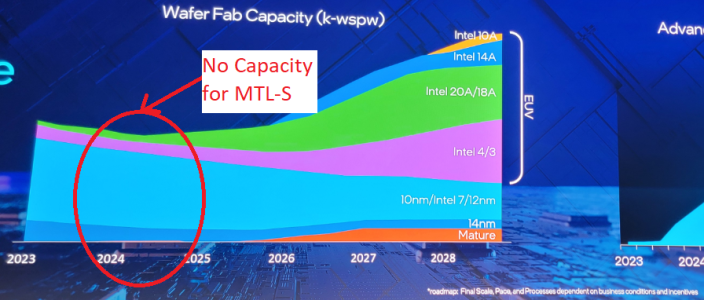
I assume it is a capacity thing. It isn't that Intel can't "figure out" how to make a desktop chip on Intel 4. It is that they can't make a desktop chip on Intel 4 as there just isn't the capacity. Years ago they underbought the equipment needed to make it today.
1709308251935.png
 

Aapje

Golden Member
Mar 21, 2022
1,530
2,106
106
I assume it is a capacity thing. It isn't that Intel can't "figure out" how to make a desktop chip on Intel 4. It is that they can't make a desktop chip on Intel 4 as there just isn't the capacity. Years ago they underbought the equipment needed to make it today.

I don't believe it was the plan to re-release the exact same chips with slight overclocks as 14th gen, because it makes no sense for that to have been the plan. If they knew that Meteor Lake could not be fabbed in enough volume on Intel 4 to enable a desktop release, they would have designed a new chip on Intel 7 instead of re-releasing Raptor Lake.

The old roadmaps also clearly show Meteor Lake as the client architecture, not next to Raptor Lake. I don't believe for a second that Intel ever intends for these architectures to be limited to just mobile. That is not what their roadmaps say, so I believe that this is just a way to somewhat salvage a failed architecture.

An Intel VP also publicly stated that Raptor Lake was actually added to the roadmap to bridge the gap to the delayed Meteor Lake. This makes no sense if Meteor Lake was never intended for desktop in the first place, because then the delay of Meteor Lake wouldn't have impacted the desktop.

And their 1H 2023 roadmap states that Arrow Lake on 20A is already going to be production ready by 1H 2024. If you look at the production volume chart, I see Intel 20A production expanding at the exact moment their earlier roadmap said that Arrow Lake would become ready. Coincidence?

So I think that their plan is to start producing sale-ready desktop Arrow Lakes from halfway 2024 and then to actually start selling them at the end of 2024. Perhaps even only at the higher end, keeping Raptor Lake for the lower end or perhaps even making lower end Arrow Lakes on Intel 4.
 

jpiniero

Lifer
Oct 1, 2010
17,214
7,588
136
Plan could have been Arrow Lake on N3 and decided it was just too expensive then.

With server sales in the dumpster, they have plenty of spare 10 nm capacity too.
 

maddie

Diamond Member
Jul 18, 2010
5,205
5,618
136
Intel 7 will be for base die or other stuff down the line. I dont think they will launch new products unless its something niche like automotive or elsewhere where mature nodes are preferred.
One would think this, but as you can see, Intel claims that "mature" is even larger than 14nm, and seemingly does not exist now. Can someone explain?
 

Khato

Golden Member
Jul 15, 2001
1,387
495
136
Let's see, what other products are soon to be released that use Intel 4/3 again? Clearly Intel just decided to use their limited Intel 4/3 production capacity on Sierra Forest and Granite Rapids instead of Meteor Lake desktop. It certainly is disappointing how dependent Intel is going to be on TSMC for a period of time due to the blatant mismanagement of the prior two CEOs.
 
  • Like
Reactions: igor_kavinski

DrMrLordX

Lifer
Apr 27, 2000
23,232
13,323
136
And I personally take offense that the subtitle equates 10A to 1 nm. 10A is meant to look like 10 Å (Angstroms), but nothing about 10A is actually 1 nm.

And nothing about Intel 7 is 7nm, while nothing about Intel 4 is 4nm, but article writers keep making those mistakes anyway. Then there's TSMC 12nm (ha ha).

edit: @SiliconFly beat me to it. Sort of.

@jpiniero

Intel may yet dump their fabs.

@maddie

WRT your inquiry about "mature" nodes, it may be a reference to 22nm, or maybe some of the "relaxed" 14nm derivatives like 22FFL.
 

DavidC1

Platinum Member
Dec 29, 2023
2,192
3,343
106
Mature nodes with IFS means other customers can use it.

Also they use to phase out their older nodes, and they won't anymore. They used to put those nodes on TSMC's older process, and they won't need to either. That's the whole point of the Tower cooperation, and now UMC.
It certainly is disappointing how dependent Intel is going to be on TSMC for a period of time due to the blatant mismanagement of the prior two CEOs.
This also has to do with the plummeting semi sales and cutting out product lines plus the awkwardness of trying to skip processes to get there faster.

For CEOs, Swan wasn't terrible, he was there for damage control to stabilize the company before Gelsinger took over. But he wasn't a visionary either. I'd say the two terrible CEOs were Otellini and Kraznich.
 
  • Like
Reactions: Executor_

DavidC1

Platinum Member
Dec 29, 2023
2,192
3,343
106
Well... Intel's products would be better if they were fabbed entirely at TSMC. And at the end of the day, Intel's a product company.
Disagree. Fab missteps exposed design team problems.

Even the venerable Pentium 4 "Northwood" wouldn't have succeeded if it wasn't for the process.

Pentium M, Core 2, and Sandy Bridge wouldn't have looked so impressive without their process team.
 
  • Like
Reactions: igor_kavinski