
-
We’re currently investigating an issue related to the forum theme and styling that is impacting page layout and visual formatting. The problem has been identified, and we are actively working on a resolution. There is no impact to user data or functionality, this is strictly a front-end display issue. We’ll post an update once the fix has been deployed. Thanks for your patience while we get this sorted.
You are using an out of date browser. It may not display this or other websites correctly.
You should upgrade or use an alternative browser.
You should upgrade or use an alternative browser.
Ivy Bridge's heat problem is indeed caused by Intel's TIM choice
Page 3 - Seeking answers? Join the AnandTech community: where nearly half-a-million members share solutions and discuss the latest tech.

It takes only about 2 mins to remove IHS, if not soldered. If have old one lying around, just pop it off. It isnt the die thats the issue, but the remaining IHSless chip is very light and somewhat flexible without IHS. Sit it in the socket, and try to have it maintain good contact with socket pins. turn on pc, while trying to maintain adequate contact, ghetto socket mod of your choice, then you will understand. I ran a few ok, trying to test temps, but I have a pic of one fried die in that thread from failure to maintain good contact with socket pins, ended up with electrical short, burned electronics smell.
Others that have removed IHS have made same comment.
Gpus dont have socket contact issues, nor light/flimsy without IHS, nor do you have to mod the mobo socket. Just removing the socket isnt adequate, as you then have to file/grind down plastic around the socket to get proper pressure, either that or get a cpu block with small, die sized base to sit down in the socket.
Didnt say it couldnt be done, but little more work involved than what I would call normal gpu bare die cooling. And I wouldnt bare die cool cpu 24/7 and if did, would double check mount after moving it, and would maintain mobo in horizontal position....but to each his own.
Others that have removed IHS have made same comment.
Gpus dont have socket contact issues, nor light/flimsy without IHS, nor do you have to mod the mobo socket. Just removing the socket isnt adequate, as you then have to file/grind down plastic around the socket to get proper pressure, either that or get a cpu block with small, die sized base to sit down in the socket.
Didnt say it couldnt be done, but little more work involved than what I would call normal gpu bare die cooling. And I wouldnt bare die cool cpu 24/7 and if did, would double check mount after moving it, and would maintain mobo in horizontal position....but to each his own.
A while ago, another site removed the IHS and found that there was no temperature difference without it

http://www.overclock.net/t/1249419/...-3770k-temperature-measured-without-ihs/0_100
http://www.overclock.net/t/1249419/...-3770k-temperature-measured-without-ihs/0_100
By "another site" I assume you mean one random message board post.
Why don't people check sources? Geez.
Looked pretty legit to me:
http://www.microsofttranslator.com/...http://bbs.pceva.com.cn/thread-43705-1-1.html
http://webcache.googleusercontent.com/search?q=cache:http://bbs.pceva.com.cn/thread-43705-1-1.html

Last edited:
It's one anecdote that basically defies the laws of physics. Pardon my skepticism from one random guy (though from the number of times that single forum post is referenced indirectly, you'd think there were hundreds of data points). There hasn't been any rigorous testing.

Joseph F
Diamond Member
OK, sorry to sound stupid, but could someone explain exactly what these abbreviations mean and exactly what Intel and the tech site did? I am not at all familiar with the internal parts of a CPU. Dont know what TIM and IHS mean even. Sorry for my lack of knowledge, but I am a bit confused by what is going on here.
TIM: Thermal Interface Material. (Thermal paste)
IHS: Integrated Heat Spreader, the metal cap that protects the CPU die.
In the old days, CPUs didn't have IHSs, (Well, from PII-PIII, anyway) and you risked cracking your die if you weren't careful when you installed your heatsink.
Edit: Didn't notice that someone had already answered this. 😳
Last edited:

IntelUser2000
Elite Member
A while ago, another site removed the IHS and found that there was no temperature difference without it
There is a difference between the two tests though. The PCWatch(recent) test put the IHS back on after they applied the thermal paste, while the first test with IHS off did bare die testing.

cantholdanymore
Senior member
So who's gonna man up and pop the lid off their Ivy CPU?
We need verification. Just like I was the first one to bios flash my 7850 we need a pioneer to prove that this works.
This looks like a job for IDC()🙂
I haven't seen him post in the longest time. He's the "Administrator" now. :whiste:This looks like a job for IDC()🙂
Intel has no good reason to do that ..I'm just hoping they put soldered TIM back under the hood when Haswell-E rolls around.
Making overclockers happy does not figure into their road map ...
Besides, what ' Haswell-E ' are you referring to ?
There is a difference between the two tests though. The PCWatch(recent) test put the IHS back on after they applied the thermal paste, while the first test with IHS off did bare die testing.
Exactly! Getting enough pressure on the bare die was probably impossible. So the two tests are not the same at all.
beginner99
Diamond Member
if really true, just think you are a manager at intel:
- competition sucks, no need to deliver anything special
-> hence safe miney were possibe
-> use cheap TIM
No idea but if that saves 1 $ per chip compared to soldering...
- competition sucks, no need to deliver anything special
-> hence safe miney were possibe
-> use cheap TIM
No idea but if that saves 1 $ per chip compared to soldering...

Look, what I find suspicious about these new results is the fact that rarely if ever will switching to a better TIM result in a 10C drop in temps, let alone 20C as per the article posted in the OP.
Perhaps there is something to this, but really I could see a 5C-10C drop in temps, not 20C. Maybe the other site that did the testing didn't have enough pressure on the HSF. *shrug*
Perhaps there is something to this, but really I could see a 5C-10C drop in temps, not 20C. Maybe the other site that did the testing didn't have enough pressure on the HSF. *shrug*
Without filing down plastic/metal around the socket, after removing the socket, you wouldnt get enough pressure on an IHSless cpu, unless using a waterblock designed for bare die cooling that fits in that smaller area.
Also cant compare tim1 (die to IHS) results to tim2 (between IHS/block), different animals, tim1 much more important, and much more effect on gradient given surface area is much smaller.
That being said, I expected more of 10C difference max per 100W, but who knows. Tempted to buy a 3570 non-k model and run with high vcore, then change out tim1 and try again.
Also cant compare tim1 (die to IHS) results to tim2 (between IHS/block), different animals, tim1 much more important, and much more effect on gradient given surface area is much smaller.
That being said, I expected more of 10C difference max per 100W, but who knows. Tempted to buy a 3570 non-k model and run with high vcore, then change out tim1 and try again.
Without filing down plastic/metal around the socket, after removing the socket, you wouldnt get enough pressure on an IHSless cpu, unless using a waterblock designed for bare die cooling that fits in that smaller area.
Also cant compare tim1 (die to IHS) results to tim2 (between IHS/block), different animals, tim1 much more important, and much more effect on gradient given surface area is much smaller.
That being said, I expected more of 10C difference max per 100W, but who knows. Tempted to buy a 3570 non-k model and run with high vcore, then change out tim1 and try again.
I have some stuff on the way and am seriously considering de-lidding my 3770k, lapping the IHS and my H100. Using NT-H1 between the die and IHS, and Indigo Xtreme between the IHS and the H100.
I just am not sure how to go about re-attaching the IHS. Any suggestions?
Simple non foam double sided tape would work, like what PC Watch did. If you're certain on reassembling everything afterwards permanently, use epoxy.I just am not sure how to go about re-attaching the IHS. Any suggestions?
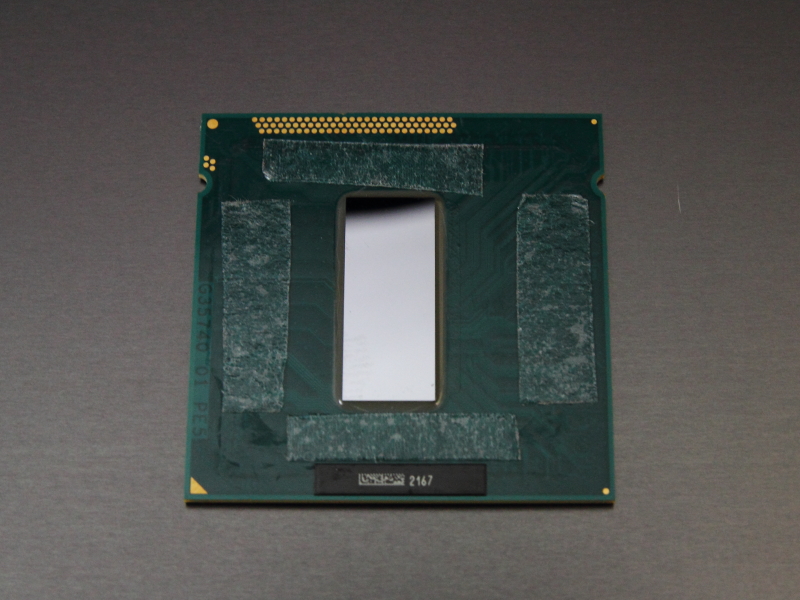

r3pshow
Member
Simple non foam double sided tape would work, like what PC Watch did. If you're certain on reassembling everything afterwards permanently, use epoxy.
Not a bad idea ... just the Temps am worried about ... the foam needs to BEAR with high temps for the long term ..!
I'm thinking before I do this I should probably buy a spare 3770k just in case. If I destroy mine, I won't be without a PC. If I don't, I can return for a refund minus restocking fee.
Intel's $20 overclocking warranty wouldn't happen to cover de-lidding the IHS, would it? :biggrin:
Intel's $20 overclocking warranty wouldn't happen to cover de-lidding the IHS, would it? :biggrin:
I swear, your chip's temp is so high OC'ed that it vaporized your adhesive holding the IHS on, and then it transformed your TIM in to this other TIM, and *melted* the surface of the IHS such that when it cooled, it was perfectly shiny! Don't reject my RMA!
(Yes, I'm not being serious because the temp is so high exactly because it can't get the heat out fast enough in order to do those things)
TRENDING THREADS
-
 Discussion Zen 5 Speculation (EPYC Turin and Strix Point/Granite Ridge - Ryzen 9000)
- Started by DisEnchantment
- Replies: 25K
-
Discussion Intel Meteor, Arrow, Lunar & Panther Lakes + WCL Discussion Threads
- Started by Tigerick
- Replies: 25K
-
 Discussion Intel current and future Lakes & Rapids thread
- Started by TheF34RChannel
- Replies: 24K
-

-
