
-
We’re currently investigating an issue related to the forum theme and styling that is impacting page layout and visual formatting. The problem has been identified, and we are actively working on a resolution. There is no impact to user data or functionality, this is strictly a front-end display issue. We’ll post an update once the fix has been deployed. Thanks for your patience while we get this sorted.
You are using an out of date browser. It may not display this or other websites correctly.
You should upgrade or use an alternative browser.
You should upgrade or use an alternative browser.
Itanium still Lives!
Page 2 - Seeking answers? Join the AnandTech community: where nearly half-a-million members share solutions and discuss the latest tech.
Charles Kozierok
Elite Member
Wow, I never expected this. Is there even demand for this instruction set at this point?
I did, but only after reading a few months back that HP is basically bankrolling Itanium development due to having quite a few eggs in the basket. If not for that, I think it would be dead.


Olikan
Platinum Member
so...No, its a design that can still scale relatively easy.
they doubled the performance because of "yes, we can" ?, or because itanium was losing suport?
poulsonNow just waiting for IBM to release Power 8 in response.
11 instructions @ 2.53Ghz - compiler based
power 7+
8 instructions @ 4.4Ghz - OoO based
IBM seems fine to me, but i don't know much about these CPUs
Last edited:

ShintaiDK
Lifer
so...
they doubled the performance because of "yes, we can" ?, or because itanium was losing suport?
So by your logic Intel should have doubled performance from P4 to Core 2? Yet it was "only" 40%? And actually only 20% compared to Pentium-M. Not exactly fitting into competition conspiracy is it?
The reason why Itanium scales better is because its a much younger design without the same limitations (yet). There is simply much more lower hanging fruits to be picked from IA64 designs still. Also why Itanium have already grown from 6 issue wide to 11 issue wide. x86 simply doesnt scale that way. As Intel even said, the 4th issue wide on x86 gave maybe 5%. Not 33% if the design had scaled perfectly.
Last edited:
Ivy Bridge doesn't have twice the cores and the benchmark data that Intel's
own press release is showing are for server benchmarks which love moar cores.
I think you are being a bit unfair here. Performance does not scale linearly with core count and neither does clock in some benches. So the fact they doubled the performance is no small feat.
From what I could get they made a lot of changes on the architecture. Do you know if those benches are compiled specifically for Poulson? You would not do that for a mass market processor like Core or Bulldozer, but for tailor-made servers like Integrity, you would not only recompile but also optimize specifically for it too.
Olikan
Platinum Member
So by your logic Intel should have doubled performance from P4 to Core 2? Yet it was "only" 40%? And actually only 20% compared to Pentium-M. Not exactly fitting into competition conspiracy is it?
nop.... 40% is alot
and, i would be very happy with a 20% increase with haswell to ivy
but 8, 9, 10%..... booooo!

WhoBeDaPlaya
Diamond Member
Details in ISSCC paper :
http://www.intel.com/content/dam/ww.../white-papers/itanium-poulson-isscc-paper.pdf
This is Intel's 20ft dildo of the CPU world 😱
http://www.intel.com/content/dam/ww.../white-papers/itanium-poulson-isscc-paper.pdf
This is Intel's 20ft dildo of the CPU world 😱

Magic Carpet
Diamond Member
Numbers please.Intel says that in its internal benchmarks on a variety of commercial workloads that matter for Itanium, the eight-core Poulson are seeing somewhere between 2 and 2.4 times the performance of a quad-core Tukwila chip. But HP says it can do better than that, thanks to software tuning. "We have systems in the labs that are significantly above 3X," bragged Lewis. So you could get something on the order of three times the bang for the buck.

Tsavo
Platinum Member
Thats one epic update. Very nice to see Itanium still kicking. It was wierd to see they jumped over 45nm.
But damn, Poulson basicly moves Itanium up in the top again. And 54MB cache 😱
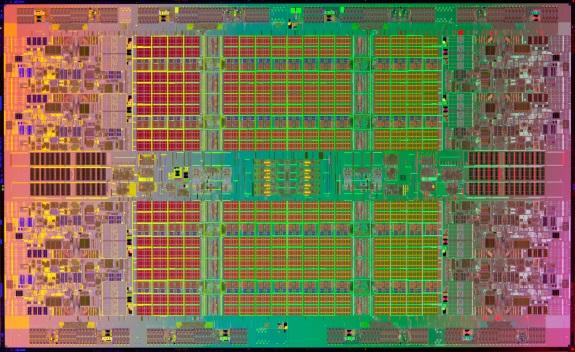
Soon(tm) you can freely change between Itanium and Xeons on a board. Thats pretty amazing too.
Is that actual size?
Oh wait, that'd be Bulldozer.
hamunaptra
Senior member
wtf .. 2x performance increase? And on x86 we're struggeling to get another 10%?
Envy much?
Yes.
Im pretty sure because x86 has been around for ages, tons more R&D went into stretching optimizing the way x86 code is handled at the hardware level for a while. Whereas Itanium ISA is fairly recent by comparison. It has much more room to further optimized.

ShintaiDK
Lifer
nop.... 40% is alot
and, i would be very happy with a 20% increase with haswell to ivy
but 8, 9, 10%..... booooo!
You get 10-15% in unoptimized code with Haswell and up to double the performance for pure optimized code. Plus frequency on top.
Core 2 gave you 20% IPC over Pentium M, and thats with alot more than a single year in between.
If competition is the reason, why are ARM cores so dull and turtle slow in terms of performance increase? Or AMD chips for that matter?
I mean obvious you must have the answer to back up the "conspiracy", so please, explain.
Or maybe the tick/tock is confusing you.
Last edited:
Olikan
Platinum Member
If competition is the reason, why are ARM cores so dull and turtle slow in terms of performance increase? Or AMD chips for that matter?
I mean obvious you must have the answer to back up the "conspiracy", so please, explain.
conspiracy? WHAT? WHERE?
LOL, create a thread and try to explain why the lack of competition is good for the consumers...(oh...don't forget to use lub)
ShintaiDK
Lifer
conspiracy? WHAT? WHERE?
LOL, create a thread and try to explain why the lack of competition is good for the consumers...(oh...don't forget to use lub)
Its you who claims that its the lack of competition that holds us back. yet you cant prove it does, since high competition segments shows exactly the same behaviour. So how does that work out? 🙄

cytg111
Lifer
Its you who claims that its the lack of competition that holds us back. yet you cant prove it does, since high competition segments shows exactly the same behaviour. So how does that work out? 🙄
- I have a counter-proposal for you: Prove that lack of competition is good for innoivation.
I dunno, to me it seems simple, but you may have an illuminating argument?
Olikan
Platinum Member
yes...Its you who claims that its the lack of competition that holds us back. yet you cant prove it does, since high competition segments shows exactly the same behaviour. So how does that work out? 🙄
atom
tick-tock model of 2 years cadence
but for some odd reason, intel accelarated it to 1 year...
i am sure that bobcat and ARM progress have nothing to do about it 🙄

Edrick
Golden Member
yes...
atom
tick-tock model of 2 years cadence
but for some odd reason, intel accelarated it to 1 year...
i am sure that bobcat and ARM progress have nothing to do about it 🙄
What are you talking about? Intel is still on a 2 year cadence, Tock every 2 years and Tick every 2 years.
Edrick
Golden Member
Itanium: A solution in search of a problem.
Trendy little quote....that has no bearing here.
It was a failed solution to a very big problem.
Olikan
Platinum Member
What are you talking about? Intel is still on a 2 year cadence, Tock every 2 years and Tick every 2 years.
this:

this:
Eagerly awaiting Future Product (although a bit strange for an architecture name).
I did, but only after reading a few months back that HP is basically bankrolling Itanium development due to having quite a few eggs in the basket. If not for that, I think it would be dead.
More like all their high-end eggs in that basket - Itanium is nearly 100% HP as they basically contract Intel to design and manufacture the CPU for them. It's like Intel's Itanium is HP's outsourced CPU arm. Not even sure if this arrangement costs them less / provides them better results than having kept Alpha or PA RISC.
Olikan
Platinum Member
I will believe it when I see it. Atom has been slower than 2 years for awhile. If 2014 gets Atom to 14nm, then I will agree with you. Until that happens, I disagree 🙂
if they manage to do this or don't t doesn't matter...it's the competition that made intel atleast think about doing it
ShintaiDK
Lifer
- I have a counter-proposal for you: Prove that lack of competition is good for innoivation.
I dunno, to me it seems simple, but you may have an illuminating argument?
Competition already makes sure you need government support to change hard locked segments with multiple companies in it. Since the risk for a company to radically innovate is too high in terms of what the other company or companies can counter economicly cheap. hcen you need someone else to
Competition also have a tendency to drive quality to the bottom. Something that is shown way too often. Often as a chance to destroy another competitor with higher quality products on a short run.
And lastly, lack of competition is beneficial in a segment where costs for progress inhibits healthy competition. And x86 is one of those areas. The volume and market is simply too small for 2 players. Discrete cards is the next one where there will only be room for one.
Dont get me wrong, competition is the best case in 70-80% of all cases. However its not the great saviour as often portraited.
Last edited:
TRENDING THREADS
-
 Discussion Zen 5 Speculation (EPYC Turin and Strix Point/Granite Ridge - Ryzen 9000)
- Started by DisEnchantment
- Replies: 25K
-
Discussion Intel Meteor, Arrow, Lunar & Panther Lakes + WCL Discussion Threads
- Started by Tigerick
- Replies: 25K
-
 Discussion Intel current and future Lakes & Rapids thread
- Started by TheF34RChannel
- Replies: 24K
-

-
