• We’re currently investigating an issue related to the forum theme and styling that is impacting page layout and visual formatting. The problem has been identified, and we are actively working on a resolution. There is no impact to user data or functionality, this is strictly a front-end display issue. We’ll post an update once the fix has been deployed. Thanks for your patience while we get this sorted.

Intel to Omit Release of Enthusiast-Class "Ivy Bridge" Processors This Year.

Page 2 - Seeking answers? Join the AnandTech community: where nearly half-a-million members share solutions and discuss the latest tech.
Intel hasn't had any competition at the high-end since 2006. I think there are other reasons for this.

I'm an "enthusiast" but I can't see myself buying an "Extreme" CPU anyway when the "Performance Mainstream" CPUs can be overclocked to the same level of performance. Back in the day, "Enthusiasts" used the Celeron 300A, not the Pentium II 500 MHz... 😉
 
Hopefully Intel is leaving a window of opportunity open for AMD catch up by releasing some Piledriver AM3+ cores along with some new 10XX series chipsets to compete at the high end.

Otherwise they are just holding back so they don't get to large of a lead and have to deal with some Monopoly and Antitrust charges.
 
well said by one poster from xbitlabs

Yes, a good comment. Of course there is the qualifier 'in the opinion of the customers buying them' To which Intel will say, but not say, 'It's more profitable this way'

I would like to know more about the backstory of how Intel ran away with it after Conroe. AMD was doing well with A64 and it all went to pot. Was it Intel's success with Conroe at the right time, do they have better brains on design, more money has given them the advantage of better R&D towards better process tech, failures at AMD, marketing etc.

Intel hit some sort of critical mass and has run away with the show. I'd love to know what their engineering stars are contemplating in terms of what and how future processors are going to look like and be manufactured with.

They've got to already be looking ahead beyond what they are doing right now to how it will be done 30 years from now.
 
I initially thought it was about the S1155 unlocked chips getting delayed. Put me in the "can't give a crap about this" category.
 
It probably has more to do with tick+ than anything AMD has or has not done. Given the choice I'm sure Intel would prefer to have new chips out every twelve months, as their original intent was with tick/tock, since that will generate much more revenue than warehousing product they've already paid billions to develop and manufacture.
 
I would like to know more about the backstory of how Intel ran away with it after Conroe. AMD was doing well with A64 and it all went to pot. Was it Intel's success with Conroe at the right time, do they have better brains on design, more money has given them the advantage of better R&D towards better process tech, failures at AMD, marketing etc.

From what I understand it was a combination of AMD doing really well and intel choosing a really poor path for advancement. If intel didn't choose to go ultra-long pipelines and max hertz AMD probably would be behind just due to budget difference. I'm not one to really follow this stuff though.
 
Yes, a good comment. Of course there is the qualifier 'in the opinion of the customers buying them' To which Intel will say, but not say, 'It's more profitable this way'

I would like to know more about the backstory of how Intel ran away with it after Conroe. AMD was doing well with A64 and it all went to pot. Was it Intel's success with Conroe at the right time, do they have better brains on design, more money has given them the advantage of better R&D towards better process tech, failures at AMD, marketing etc.

Intel hit some sort of critical mass and has run away with the show. I'd love to know what their engineering stars are contemplating in terms of what and how future processors are going to look like and be manufactured with.

They've got to already be looking ahead beyond what they are doing right now to how it will be done 30 years from now.

in 30 years there won't be a desktop PC, it'll all be in your cellphone.
in 5 years there won't be a home desktop PC. It'll all be in your cellphone.
 
I can't say about 30 years. But I promise you that in the next 5 years, AT users will still be on desktop PCs, perhaps more portable due to some slightly different form factor, but desktop PCs nevertheless. Not sure about 15 years though 🙂
 
It probably has more to do with tick+ than anything AMD has or has not done. Given the choice I'm sure Intel would prefer to have new chips out every twelve months, as their original intent was with tick/tock, since that will generate much more revenue than warehousing product they've already paid billions to develop and manufacture.

It's totally Amd's fault. If they actually had something that performed and not that garbage known as bulldozer intel wouldn't keep delaying new processors.
 
How unfortunate. I guess I will stick with my x58 system for a while now 😀
 
It probably has more to do with tick+ than anything AMD has or has not done. Given the choice I'm sure Intel would prefer to have new chips out every twelve months, as their original intent was with tick/tock, since that will generate much more revenue than warehousing product they've already paid billions to develop and manufacture.

Intel has been solely competing against itself for a while now. Yours is pretty much the only scenario that makes sense. I guess we will find out in enough time.

Though no emotionally invested someone would admit that their years’ worth of declarations and projections were wrong. Just like their admonitions of the next nearest competitor have neglected to calculate Intel's 10x more capital and resources.
 
Filiprino said:
High-end should have the absolute latest in process and architecture tech. It should be the pinnacle of what the company has to offer, not an after thought like Intel has given use in Sandy Bridge, Ivy Bridge and Haswell.

The high-end should be the first chips to come out to début the latest and greatest. If Intel expects you to pay a premium for the high-end then part of that premium should be getting new architecture first.

well said by one poster from xbitlabs

The problem with that scenario, and the very reason it doesn't work that way in business, is that this particular individual feels that the customer should be the one defining the product attributes and features instead of the manufacturer.

The world of business just doesn't work that way, not at Intel, not at Nike, not at Toyota, not at McDonalds, not anywhere.

Intel defines what is "high end", if it is last year's process technology and microarchitecture just "doubled-up" then so be it.

The customer's did not get to define AMD's highend either. AMD says the 8150 bulldozer is their high-end, but I'm pretty sure the highend customer's would have probably preferred AMD to have taken Thuban and did a shrink, added two cores, and let the 32nm process tech take the clocks up over 4GHz stock.

In college they taught us there are two phrases - publicly you say "the customer is always right" but privately you think "never do what the customer wants". The reason for the former is obvious, customer's like to be diva's so you better cater to that. But the latter is less obvious, however the reasoning behind it is simply that customer's are the most short-sighted entity in the supply chain.

If you thought today's CEOs were shortsighted "cut R&D and boost this quarters earnings" then wait till you get demographic feedback from "the customer", they'll make the CEO look like a long-range strategist.

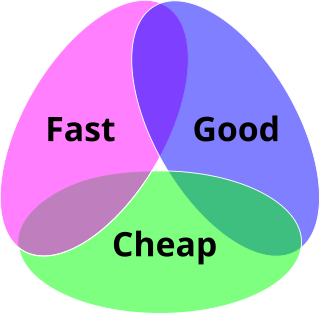
Listening to the customer, letting them define your market strategy, will lead you straight to ruin because the truth of it is that the customer rarely knows what they want, bu they all think they know what they want. And hardly any of them understand that you can only have 2 out of 3 in the project management triangle.

320px-Project-triangle.svg.png


Customer's assume that they can have all three, and when it doesn't work out like that then they blame the business for being greedy (Intel) or slow (AMD).

Look at the quote you gave, that guy clearly thinks that Intel should prioritize (spend more R&D) making the largest, lowest yielding, most difficult to validate CPU's first and foremost before making the smaller and easier to validate/yield cpu's on new process tech. Does he want them to cost $5k?

Because Intel could do exactly what he's asking, but I bet he hasn't taken the time to think through the economics of what he claims he wants to have happen.

Rule 1 - tell your customer they are always right

Rule 2 - don't listen to your customer because they have no clue as to what they really want and they will drive you to ruin in pursuit of their pot of gold at the end of their rainbow
 
It's totally Amd's fault. If they actually had something that performed and not that garbage known as bulldozer intel wouldn't keep delaying new processors.

You can all sit there happily blaming AMD but if you actually wanted competition, buy AMD. The only way AMD is going to re-evaluate their desktop range and actually gain R&D money and make decent CPU's is if you buy them :L
 
Technology is a big part of our society now. I just want a future where we aren't artificially slowed down by patents, big companies that nickel and dime you, release purposely sabotaged goods so they can sell a higher tier/future product etc.
 
Its most likely more about problems with the 22nm process than anything else. It has nothing to do with AMD. The recent delays shows that everything isn't all that peachy for Intel with 22nm.
 
Last edited:
Technology is a big part of our society now. I just want a future where we aren't artificially slowed down by patents, big companies that nickel and dime you, release purposely sabotaged goods so they can sell a higher tier/future product etc.
We have a choice, not to use/buy it though. There is more in this life other than "technology" as we know it.
 
IBe is effectively cancelled
What nonsense! :thumbsdown:

SB-E followed SB after almost 12 months, same will be true for IVB-E. Intel is not going to abandon the large socket customers due to Haswell. Why would Haswell affect anything adversly? Are they not selling SB-E alongside IVB?

The small socket (presently LGA 1155) and large socket (presently LGA 2011) serve two very different segments. Haswell won't change anything, mainstream will continue to be served with a smaller socket whereas pure performance crowd will always have the larger socket. Let us not forget the larger socket Xeons are total cash cows.

All this has already been settled in 'leaked' roadmaps months ago, this is a complete non-news and wrong interpretation of the same.
 
We should have seen this coming when they named it 3960X instead of 2960X. Developing for a very small market (extreme enthusiast) is nonsensical financially.

But if they have difficulties what would become of the 22nm Xeons?
 
in 30 years there won't be a desktop PC, it'll all be in your cellphone.
in 5 years there won't be a home desktop PC. It'll all be in your cellphone.

Anyone here who is a Ray Kurzweil fan will believe that in thirty years:
we will be at the singularity where robots are granted human rights;
we will be computing beyond the power of the human brain with quantum computers;
the 'computer' itself will be integrated into our consciousness, forming a neural network which itself will be a hardware only form.
 
Intel is not going to abandon the large socket customers due to Haswell. Why would Haswell affect anything adversly?

who said anything about abandoning large socket customers or being something adverse? This is a GOOD thing. Instead of the enthusiast platform using trailing-edge tech, it will move back to leading-edge, as in the 1366 days

Are they not selling SB-E alongside IVB?

That was never the plan and never what they wanted. They were forced into this position because of MONUMENTAL screwups with the 2011 platform. Really it should have been released 8-9 months ago or more.

The small socket (presently LGA 1155) and large socket (presently LGA 2011) serve two very different segments. Haswell won't change anything, mainstream will continue to be served with a smaller socket whereas pure performance crowd will always have the larger socket. Let us not forget the larger socket Xeons are total cash cows.

You're missing the point. HWe will be released near-simultaneously or perhaps even a little before HW, ie right around the time people are predicting IBe now. So it's a whole generation leap without any extra waiting.

All this has already been settled in 'leaked' roadmaps months ago, this is a complete non-news and wrong interpretation of the same.

It's a necessary outcome, they just haven't admitted it to themselves yet. But anyone can look at the situation and see the obvious: IBe is dead dead dead.
 
The customer's did not get to define AMD's highend either. AMD says the 8150 bulldozer is their high-end, but I'm pretty sure the highend customer's would have probably preferred AMD to have taken Thuban and did a shrink, added two cores, and let the 32nm process tech take the clocks up over 4GHz stock.
phenomx8.jpg
 
Back
Top