
-
We’re currently investigating an issue related to the forum theme and styling that is impacting page layout and visual formatting. The problem has been identified, and we are actively working on a resolution. There is no impact to user data or functionality, this is strictly a front-end display issue. We’ll post an update once the fix has been deployed. Thanks for your patience while we get this sorted.
You are using an out of date browser. It may not display this or other websites correctly.
You should upgrade or use an alternative browser.
You should upgrade or use an alternative browser.
Intel processors crashing Unreal engine games (and others)
Page 59 - Seeking answers? Join the AnandTech community: where nearly half-a-million members share solutions and discuss the latest tech.

igor_kavinski
Lifer
The most dangerous thing in the Universe is a FOCUSED mind. <<<< Quote from a boxing movie I forgot the name of.It scares me that there are people out there with such patience that they are willing to try such a long shot.
I remember AMD used to have mass layoffs right before a disastrous earning report. Maybe Intel is stalling to address the mass recall or refund decision until after their Thursday earning report because if earning is bad and then you pile on most of the CPU sold in the past 1.5 years will have to be recalled...omg
Typical scenario is to get these bad things out before or at the earnings conference. Call it "One Time Charge", and that makes the investors think that the worst is over, it will only get better from here.
Last edited:

If you sort the Amazon reviews for 14th gen by most recent, the bad reviews are coming in. Or check the one star reviews - one star reviews
The snowball is getting bigger and picking up speed.
The snowball is getting bigger and picking up speed.

coercitiv
Diamond Member
They're doing it for the science, mostly in universities , and in the long run it's a win for all of us.It scares me that there are people out there with such patience that they are willing to try such a long shot.
As a funny offtopic, a while ago there was a very nasty attempt to compromise Linux security that took years to setup and got denied by someone obsessively benchmarking CPU cycle utilization while trying to discover the cause of an otherwise minor performance regression. That day nitpicking brought down a worldwide spying op.

What we know about the xz Utils backdoor that almost infected the world
Malicious updates made to a ubiquitous tool were a few weeks away from going mainstream.
 arstechnica.com
This isn't going to help - Intel to Cut Thousands of Jobs to Reduce Costs, Fund Rebound
E.U. members on PCMR confirming they should have recourse with the retailers. And that most or all of those businesses have to take it up with Intel to get compensated, because regardless, they will have to replace or refund. I am certain the retailers are all delighted about that prospect.
Most of the top posts there when sorting by hot are about raptor at the moment. With 10s of thousands of upvotes between them; Streisand effect indeed.
I don't know what their source is, since this was not in the Bloomberg article you linked, but according to "sources close to Bloomberg", the number of layoffs is to be 10,000, from current workforce of 110,000.
This is horrible, probably higher number than anyone expected, and I feel bad for the Intel people affected by this.
igor_kavinski
Lifer
And since the Intel workplace is so rife with politics, there will be a lot of people among the terminated who didn't deserve it and those who deserved it, slipped through to do still more damage to the company, thanks to their politics.This is horrible, probably higher number than anyone expected, and I feel bad for the Intel people affected by this.
What does this mean?... the Intel workplace is so rife with politics ...
It's who you know not what you know. Sycophants and friends despite being low value, keep their jobs while better qualified and more productive employees are laid off.What does this mean?
I've said it before, messing with pay, bonuses, retirement contributions, job security, and morale, is a formula for fail. Handing 10K more their walking papers is not going to result in superior products and services IMO.
I don't know how this raptor lake fiasco will end, but costs that cannot be easily projected or calculated seem to be piling up fast. Would these layoffs need to happen if raptor was not big, power hungry, possibly defective, and Meteor Lake had worked out for enthusiast desktop?
techjunkie123
Member
Buildzoid has a new video where he limits Vcore to 1.4 V, applies Intel default "safe" values, and a -0.1V undergolt to get basically the same performance as unlimited power in both nT and 1T. So maybe the new microcode will not limit performance that much after all...
CakeMonster
Golden Member
I wonder how long the trend of massive layoffs is going to continue. It has crippled quality and motivation at every company I've heard of (based on anecdotes of course).
Is undervolting not highly silicon quality dependent though?
Buildzoid has a new video where he limits Vcore to 1.4 V, applies Intel default "safe" values, and a -0.1V undergolt to get basically the same performance as unlimited power in both nT and 1T. So maybe the new microcode will not limit performance that much after all...
Some will be fine with this, but if part of the reason for the high voltage was because only some of the dies actually were stable at the lower voltage then those with the "poorer" silicon might see a large drop in performance.
Back in the day when CPUs/GPUs were not pre-overclocked (although manufacturers prefer to call it boosting), stock was stock and anything an overclocker could achieve beyond that was a bonus. Now that things are so tight, with those high voltages performance may suffer.
Sorry but undervolting when there are problems with stability is the dumbest thing ever.Buildzoid has a new video where he limits Vcore to 1.4 V, applies Intel default "safe" values, and a -0.1V undervolt
100mV is also a HUGE undervolt. A completely new Raptor can crash with just 150mV undervolt.
techjunkie123
Member
Yes, absolutely. We will have to wait until the microcode releases to see what Intel ends up doing for "stock" performance.Is undervolting not highly silicon quality dependent though?
Some will be fine with this, but if part of the reason for the high voltage was because only some of the dies actually were stable at the lower voltage then those with the "poorer" silicon might see a large drop in performance.
Back in the day when CPUs/GPUs were not pre-overclocked (although manufacturers prefer to call it boosting), stock was stock and anything an overclocker could achieve beyond that was a bonus. Now that things are so tight, with those high voltages performance may suffer.
Buildzoid states that a typical undervolt of -0.05 to -0.15V should be possible. But of course depends on the silicon quality. He used -0.1V and his chip was stable.
Also it is not clear if capping the Vcore to 1.4V will be enough to stop degradation. Time will tell.
techjunkie123
Member
Stability problems are caused by chip degradation. If your chip is unstable/degraded, of course undervolting will not do anything. This is presumably preventative.Sorry but undervolting when there are problems with stability is the dumbest thing ever.
100mV is also a HUGE undervolt.
Apparently many motherboards apply a default (default profile, not Intel ones) undervolt of 150-200 mV, which of course is not stable. 100 mV seems somewhat stable but of course would depend on silicon quality.
Cart before horse? Could it be that layoffs are the result of a failing venture not the reverse, or maybe, a self reinforcing death spiral? A long term investor, if such exist anymore, would seriously question the supposed bright future awaiting Intel.I wonder how long the trend of massive layoffs is going to continue. It has crippled quality and motivation at every company I've heard of (based on anecdotes of course).
Hee is an interesting post with instructions and advice for what to look for in the event viewer. Along with scooby clues going back to early '23. https://community.intel.com/t5/Proc...-defective-from-factory-no-event/td-p/1619582
Others are saying Intel has stopped responding to requests for updates on their RMAs. Perhaps sending out replacement CPUs that don't have the new microcode is getting reevaluated? Or they don't have the parts on hand to honor the RMA?
Others are saying Intel has stopped responding to requests for updates on their RMAs. Perhaps sending out replacement CPUs that don't have the new microcode is getting reevaluated? Or they don't have the parts on hand to honor the RMA?
igor_kavinski
Lifer
My new intel i7 14700k failed in intel processor diagnostic tool
Dear concerned, I hope you are doing well. I have newly build my pc to use as workstation and gaming. But recently I tried to run some simulation and it gets failed and suddenly pc get restart. I tried several times and it keeps happening. Then from the previous inquiries in the forum, I tried...
community.intel.com
New 14700K failing the moment the ALU gets going in Intel's own diagnostic utility!
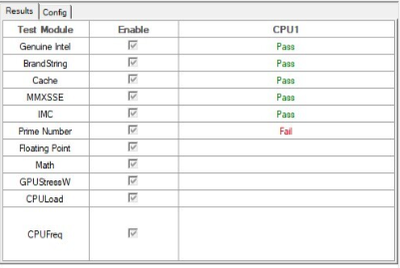
Some guidance here:
Updated Guidance RE: Reports of 13th/14th Gen Unlocked Desktop Processor Stability Issues
We are continuing to investigate with our partners the recent user reports of instability in certain workloads on these processors. In the interim, the following BIOS settings are recommended to help maximize stability for currently installed processors while Intel continues investigating root...
community.intel.com
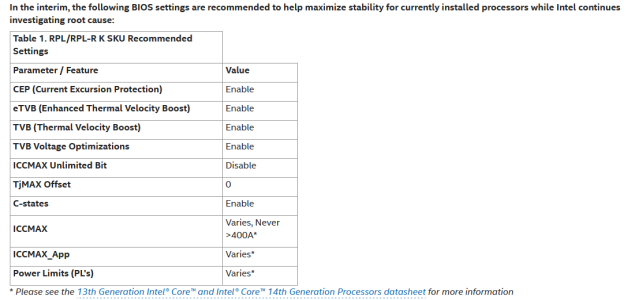
Look at this guy: https://community.intel.com/t5/Proc...est-and-CPU-Issues-with-14th-Gen/td-p/1619446
Clearly spent quite some time creating that post in the hope that his prayers will finally be answered!
@igor_kavinski results like that make me wonder how many RPL systems were problematic from the beginning and were just silently having issues until they installed a UE5 game that actually checked the decompression/compilation output and flagged it, which was the first real test the user ever did that checked stability.
igor_kavinski
Lifer
One thing I find weird is, how come none of the launch day reviewers said anything about instability? Were they given properly validated golden samples???
Or are we witnessing a chemistry problem, whereby some new ingredient was added to the manufacturing process to make it hit higher speeds but that substance starts degrading at a molecular level with time, even when the CPU is just sitting in its shrink-wrapped box??? That above example of a brand new 14700K failing the first math test is raising all sorts of alarms in my head!
Or are we witnessing a chemistry problem, whereby some new ingredient was added to the manufacturing process to make it hit higher speeds but that substance starts degrading at a molecular level with time, even when the CPU is just sitting in its shrink-wrapped box??? That above example of a brand new 14700K failing the first math test is raising all sorts of alarms in my head!
Degradation typically happens over time, possibly when exposed to higher voltage.One thing I find weird is, how come none of the launch day reviewers say anything about instability?
I don't think reviewers needed golden samples to avoid encountering the problem when the chips were new.
igor_kavinski
Lifer
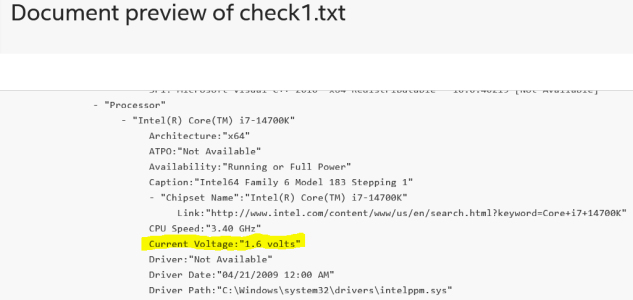
Never mind. Issue found 😀
igor_kavinski
Lifer
And it's an older BIOS overvolting the poor CPU!


"Older"
TRENDING THREADS
-
 Discussion Zen 5 Speculation (EPYC Turin and Strix Point/Granite Ridge - Ryzen 9000)
- Started by DisEnchantment
- Replies: 25K
-
Discussion Intel Meteor, Arrow, Lunar & Panther Lakes + WCL Discussion Threads
- Started by Tigerick
- Replies: 24K
-
 Discussion Intel current and future Lakes & Rapids thread
- Started by TheF34RChannel
- Replies: 24K
-

-
