Discussion Intel Meteor, Arrow, Lunar & Panther Lakes + WCL Discussion Threads

Page 773 - Seeking answers? Join the AnandTech community: where nearly half-a-million members share solutions and discuss the latest tech.

Tigerick

Senior member
Apr 1, 2022
910
829
106
Wildcat Lake (WCL) Preliminary Specs

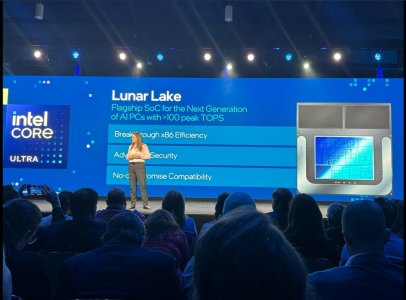
Intel Wildcat Lake (WCL) is upcoming mobile SoC replacing ADL-N. WCL consists of 2 tiles: compute tile and PCD tile. It is true single die consists of CPU, GPU and NPU that is fabbed by 18-A process. Last time I checked, PCD tile is fabbed by TSMC N6 process. They are connected through UCIe, not D2D; a first from Intel. Expecting launching in Q2/Computex 2026. In case people don't remember AlderLake-N, I have created a table below to compare the detail specs of ADL-N and WCL. Just for fun, I am throwing LNL and upcoming Mediatek D9500 SoC.

Intel Alder Lake - NIntel Wildcat LakeIntel Lunar LakeMediatek D9500
Launch DateQ1-2023Q2-2026 ?Q3-2024Q3-2025
ModelIntel N300?Core Ultra 7 268VDimensity 9500 5G
Dies2221
NodeIntel 7 + ?Intel 18-A + TSMC N6TSMC N3B + N6TSMC N3P
CPU8 E-cores2 P-core + 4 LP E-cores4 P-core + 4 LP E-coresC1 1+3+4
Threads8688
Max Clock3.8 GHz?5 GHz
L3 Cache6 MB?12 MB
TDP7 WFanless ?17 WFanless
Memory64-bit LPDDR5-480064-bit LPDDR5-6800 ?128-bit LPDDR5X-853364-bit LPDDR5X-10667
Size16 GB?32 GB24 GB ?
Bandwidth~ 55 GB/s136 GB/s85.6 GB/s
GPUUHD GraphicsArc 140VG1 Ultra
EU / Xe32 EU2 Xe8 Xe12
Max Clock1.25 GHz2 GHz
NPUNA18 TOPS48 TOPS100 TOPS ?


PPT1.jpg
PPT2.jpg
PPT3.jpg


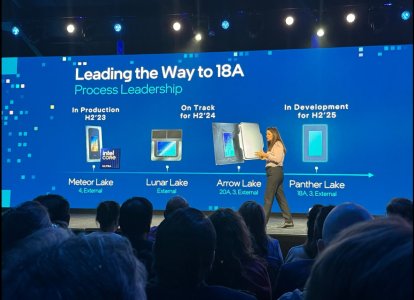
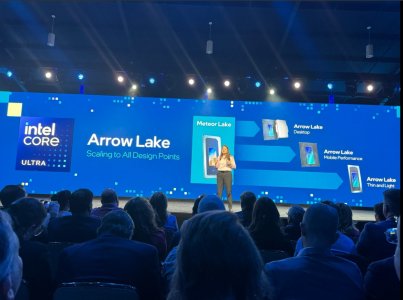
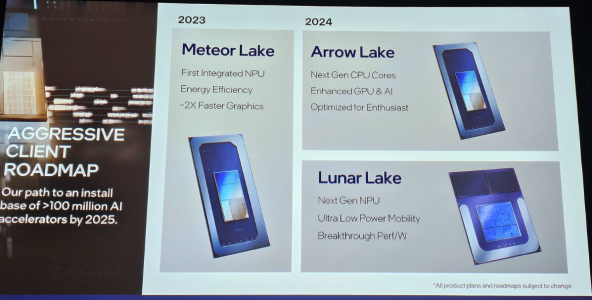
As Hot Chips 34 starting this week, Intel will unveil technical information of upcoming Meteor Lake (MTL) and Arrow Lake (ARL), new generation platform after Raptor Lake. Both MTL and ARL represent new direction which Intel will move to multiple chiplets and combine as one SoC platform.

MTL also represents new compute tile that based on Intel 4 process which is based on EUV lithography, a first from Intel. Intel expects to ship MTL mobile SoC in 2023.

ARL will come after MTL so Intel should be shipping it in 2024, that is what Intel roadmap is telling us. ARL compute tile will be manufactured by Intel 20A process, a first from Intel to use GAA transistors called RibbonFET.
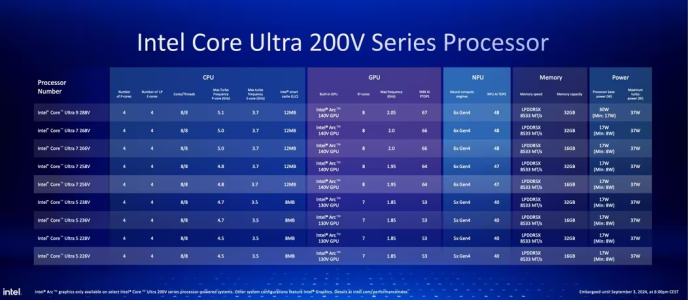


LNL-MX.png
 

Attachments

  • PantherLake.png
    PantherLake.png
    283.5 KB · Views: 24,034
  • LNL.png
    LNL.png
    881.8 KB · Views: 25,527
  • INTEL-CORE-100-ULTRA-METEOR-LAKE-OFFCIAL-SLIDE-2.jpg
    INTEL-CORE-100-ULTRA-METEOR-LAKE-OFFCIAL-SLIDE-2.jpg
    181.4 KB · Views: 72,435
  • Clockspeed.png
    Clockspeed.png
    611.8 KB · Views: 72,321
Last edited:

511

Diamond Member
Jul 12, 2024
5,011
4,524
106
I find your lack of faith in AMD copying everything Intel made very disturbing.
You put too much faith in AMD not copying everything anyway this is my last post regarding this there is no point in Further continuing this discussion.
 

Win2012R2

Golden Member
Dec 5, 2024
1,236
1,276
96
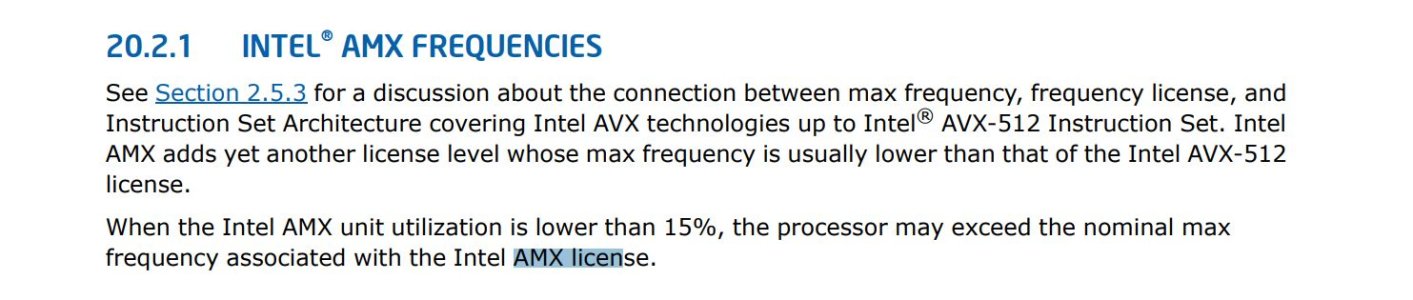
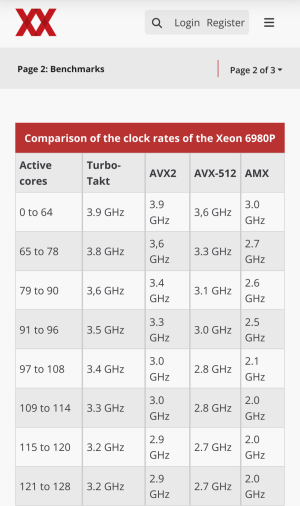
Found a better thing but AMX Down locks heavily as of now.
It does, that's why base freq on Intel server CPUs is so laughably low - it's because they have to declare the worst case scenario, which is running heavy AMX code.

Half pumping won't work around this one, AMD won't touch it with a bargepole, even if they did not have GPUs on offer.

AMX case closed, class dismissed.
 

511

Diamond Member
Jul 12, 2024
5,011
4,524
106
It does, that's why base freq on Intel server CPUs is so laughably low - it's because they have to declare the worst case scenario, which is running heavy AMX code.

Half pumping won't work around this one, AMD won't touch it with a bargepole, even if they did not have GPUs on offer.

AMX case closed, class dismissed.
There will be some other way it's up to Intel/AMD Engineers to figure it out.
 

LightningZ71

Platinum Member
Mar 10, 2017
2,622
3,307
136
AMD has something that Intel doesn't, the MIXXX series of AI processors. Intel essentially dead ended Falcon Shores and HAS to have AMX to be able to provide "something" for that space. AMD can sell you an all-in-one unit that is at least hardware competitive. I don't see AMD pushing AMX for Zen 6 and probably not Zen 7 either. They are certainly investigating it, and likely have continency designs ready to go with it if someone comes up with something amazing to use it for, but I don't expect to see if in volume production silicon for a while.
 

Win2012R2

Golden Member
Dec 5, 2024
1,236
1,276
96
There will be some other way it's up to Intel/AMD Engineers to figure it out.
It's already done and called GPUs. AMD just needs to figure out how to get CUDA compatibility working, APIs are not copyrightable, they should do clean room implementation that runs very well on their hardware.
 
  • Haha
Reactions: reb0rn and 511

dullard

Elite Member
May 21, 2001
26,135
4,791
126
See my discussion above. How will Nova Lake compete in the general desktop and laptop markets with such an expensive platform?
1) I personally don't see the 52 core Nova Lake in the general desktop and laptop markets. That will likely be the single chip 26 core Nova Lake. To me, the 52 core is intended for the workstation class.
2) You already know DDR6 prices? If so, please inform us. Since it is 4 channels within the same memory module, there could be fewer motherboard parts needed.
 
  • Like
Reactions: GTracing

511

Diamond Member
Jul 12, 2024
5,011
4,524
106
1) I personally don't see the 52 core Nova Lake in the general desktop and laptop markets. That will likely be the single chip 26 core Nova Lake. To me, the 52 core is intended for the workstation class.
2) You already know DDR6 prices? If so, please inform us. Since it is 4 channels within the same memory module, there could be fewer motherboard parts needed.
i think they will be willing to sell it to desktop just at $1000-1200 which is a fair price imo for so many cores.
 

Abwx

Lifer
Apr 2, 2011
11,912
4,890
136
Typical cheap approach from AMD, very much same attitude taken with ray tracing.

The cheap approach was actualy Intel s one.
One advantage of 3DNow! is that it is possible to add or multiply the two numbers that are stored in the same register. With SSE, each number can only be combined with a number in the same position in another register. This capability, known as horizontal in Intel terminology, was the major addition to the SSE3 instruction set.
3DNow and SSE are totally different. 3DNow acts on the MMX registers, which are in turn aliased on the x87 registers, and only uses 64 bit vectors. It also inherited all the MMX problems of mixing with x87 code. SSE introduces completely new 128 bit vector registers separate from the x87 ones. It's a completely different (and better) instruction set.
Better.?
Read the above.
 

Win2012R2

Golden Member
Dec 5, 2024
1,236
1,276
96
The cheap approach was actualy Intel s one.
It was cheap because of bad reuse of registers, same cheap approach they use for ray tracing.

Intel created something new that had far more success and in later revision improved what they had with the minor improvement AMD created, as we all know 3DNow! died a death such a long time ago, where as Intel stuff is the baseline that kept for a many years, only until very recently AVX2 finally became new baseline.
 

Abwx

Lifer
Apr 2, 2011
11,912
4,890
136
It was cheap because of bad reuse of registers, same cheap approach they use for ray tracing.

Intel created something new that had far more success and in later revision improved what they had with the minor improvement AMD created, as we all know 3DNow! died a death such a long time ago, where as Intel stuff is the baseline that kept for a many years, only until very recently AVX2 finally became new baseline.
So good that SSE2 has to be released 2-3 years later because SSE was just a stop gap, indeed 3Dnow brought way more perfs to AMD than SSE did for Intel.
 

Win2012R2

Golden Member
Dec 5, 2024
1,236
1,276
96
So good that SSE2 has to be released 2-3 years later because SSE was just a stop gap, indeed 3Dnow brought way more perfs to AMD than SSE did for Intel.
Yes, great, it had revisions, just like original AVX was rubbish, but got pretty good with AVX2 - they made good basement with bigger registers, that wasn't cheap - future oriented good effort.

It wasn't a cheap effort like AMDs, which was also dead end - what could possible be done further with MMX registers given issues with x87? AMD understood it pretty quickly and moved to SSE, it was far superior long term solution that can be built upon, probably cost a few extra bucks in silicon though.
 

Abwx

Lifer
Apr 2, 2011
11,912
4,890
136
It was cheap because of bad reuse of registers, same cheap approach they use for ray tracing.

Intel created something new that had far more success and in later revision improved what they had with the minor improvement AMD created, as we all know 3DNow! died a death such a long time ago, where as Intel stuff is the baseline that kept for a many years, only until very recently AVX2 finally became new baseline.

They moved to SSE exlusively because of Intel s market dominance, that s the only
reason, because software wise 3Dnow and later 3Dnow! Pro were more convenient
than SSE.
 

inquiss

Senior member
Oct 13, 2010
579
844
136
It's already done and called GPUs. AMD just needs to figure out how to get CUDA compatibility working, APIs are not copyrightable, they should do clean room implementation that runs very well on their hardware.
Why would they? Then they would be beholden to Nvidia changing what cuda does over time and then always being gens behind.

GPU agnostic languages are growing anyway. What's the point?
 

inquiss

Senior member
Oct 13, 2010
579
844
136
1) I personally don't see the 52 core Nova Lake in the general desktop and laptop markets. That will likely be the single chip 26 core Nova Lake. To me, the 52 core is intended for the workstation class.
2) You already know DDR6 prices? If so, please inform us. Since it is 4 channels within the same memory module, there could be fewer motherboard parts needed.
Agreed on point 1.

Point 2...look at any new memory standard introduced....low volume initially with very high prices. Don't need a crystal balls here
 
  • Like
Reactions: 511

Win2012R2

Golden Member
Dec 5, 2024
1,236
1,276
96
Why would they?
Enables lots and lots of software to run NOW without changes, then add your own extentions to speed some stuff up if it's done better.

They moved to SSE exlusively because of Intel s market dominance, that s the onlyreason, because software wise 3Dnow and later 3Dnow! Pro were more convenient than SSE.
They moved because ops over 128 bits will beat 64 bits big time, plus it was terrible cheap choice to reuse registers for MMX, writing it was highly undesirable. Yes good thing Intel was dominant AND forward looking at the time, otherwise we'd still use MMX.
 

Schmide

Diamond Member
Mar 7, 2002
5,751
1,042
126
Enables lots and lots of software to run NOW without changes, then add your own extentions to speed some stuff up if it's done better.


They moved because ops over 128 bits will beat 64 bits big time, plus it was terrible cheap choice to reuse registers for MMX, writing it was highly undesirable. Yes good thing Intel was dominant AND forward looking at the time, otherwise we'd still use MMX.
They were so dominate they had to use artificial means to keep their dominance.