• We’re currently investigating an issue related to the forum theme and styling that is impacting page layout and visual formatting. The problem has been identified, and we are actively working on a resolution. There is no impact to user data or functionality, this is strictly a front-end display issue. We’ll post an update once the fix has been deployed. Thanks for your patience while we get this sorted.

Discussion Intel Meteor, Arrow, Lunar & Panther Lakes + WCL Discussion Threads

Page 585 - Seeking answers? Join the AnandTech community: where nearly half-a-million members share solutions and discuss the latest tech.

Tigerick

Senior member
Wildcat Lake (WCL) Specs

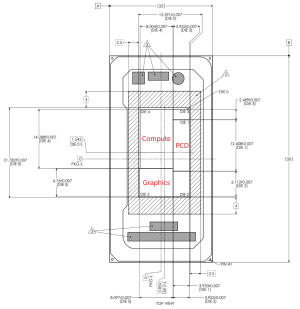
Intel Wildcat Lake (WCL) is upcoming mobile SoC replacing Raptor Lake-U. WCL consists of 2 tiles: compute tile and PCD tile. It is true single die consists of CPU, GPU and NPU that is fabbed by 18-A process. Last time I checked, PCD tile is fabbed by TSMC N6 process. They are connected through UCIe, not D2D; a first from Intel. Expecting launching in Q1 2026.
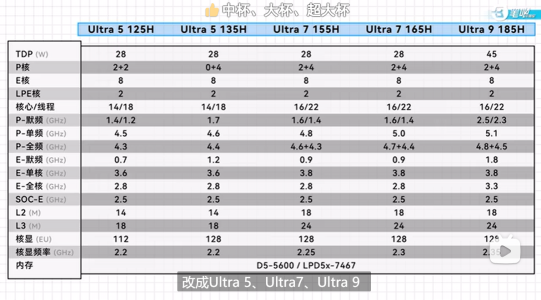
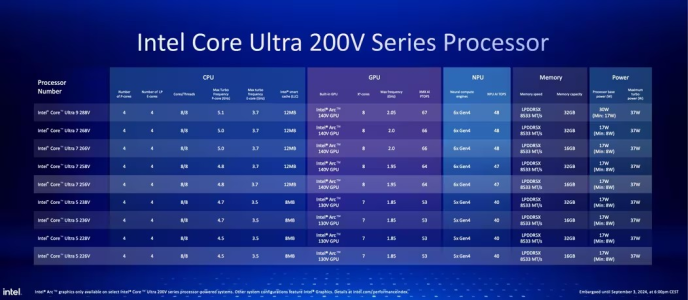
Intel Raptor Lake UIntel Wildcat Lake 15WIntel Lunar LakeIntel Panther Lake 4+0+4
Launch DateQ1-2024Q2-2026Q3-2024Q1-2026
ModelIntel 150UIntel Core 7 360Core Ultra 7 268VCore Ultra 7 365
Dies2223
NodeIntel 7 + ?Intel 18-A + TSMC N6TSMC N3B + N6Intel 18-A + Intel 3 + TSMC N6
CPU2 P-core + 8 E-cores2 P-core + 4 LP E-cores4 P-core + 4 LP E-cores4 P-core + 4 LP E-cores
Threads12688
Max Clock5.4 GHz4.8 GHz5 GHz4.8 GHz
L3 Cache12 MB6 MB12 MB12 MB
TDP15 - 55 W15 - 35 W17 - 37 W25 - 55 W
Memory128-bit LPDDR5-520064-bit LPDDR5x-7467128-bit LPDDR5x-8533128-bit LPDDR5x-7467
Size96 GB48 GB32 GB128 GB
Bandwidth83 GB/s60 GB/s136 GB/s120 GB/s
GPUIntel GraphicsIntel GraphicsArc 140VIntel Graphics
RTNoNoYESYES
EU / Xe96 EU2 Xe8 Xe4 Xe
Max Clock1.3 GHz2.6 GHz2 GHz2.5 GHz
NPUGNA 3.017 TOPS48 TOPS49 TOPS


PPT1.jpg
PPT2.jpg
PPT3.jpg


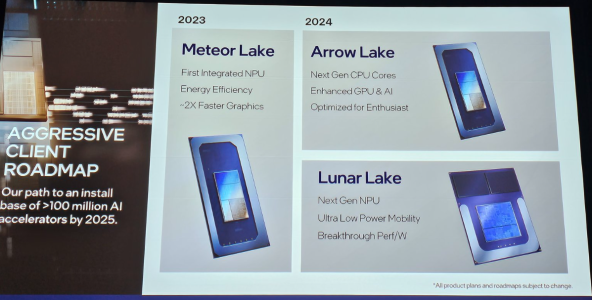
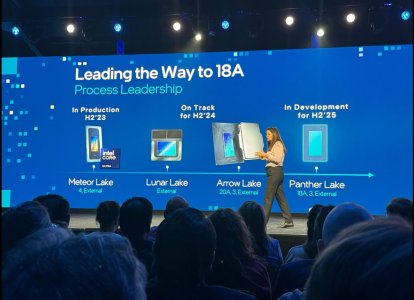
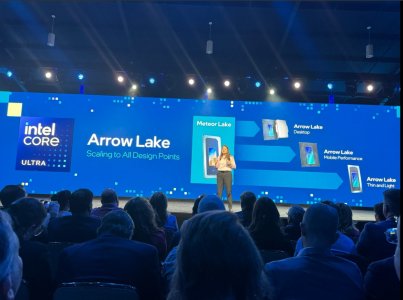
As Hot Chips 34 starting this week, Intel will unveil technical information of upcoming Meteor Lake (MTL) and Arrow Lake (ARL), new generation platform after Raptor Lake. Both MTL and ARL represent new direction which Intel will move to multiple chiplets and combine as one SoC platform.

MTL also represents new compute tile that based on Intel 4 process which is based on EUV lithography, a first from Intel. Intel expects to ship MTL mobile SoC in 2023.

ARL will come after MTL so Intel should be shipping it in 2024, that is what Intel roadmap is telling us. ARL compute tile will be manufactured by Intel 20A process, a first from Intel to use GAA transistors called RibbonFET.


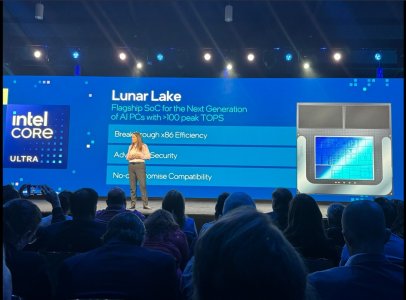
LNL-MX.png
 

Attachments

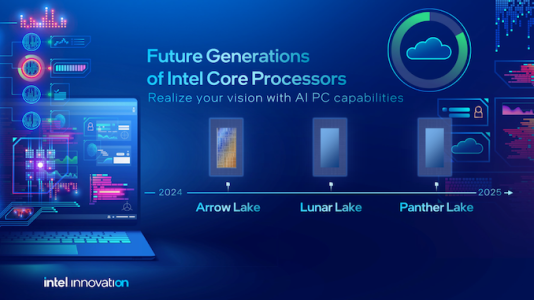
  • PantherLake.png
    PantherLake.png
    283.5 KB · Views: 24,049
  • LNL.png
    LNL.png
    881.8 KB · Views: 25,534
  • INTEL-CORE-100-ULTRA-METEOR-LAKE-OFFCIAL-SLIDE-2.jpg
    INTEL-CORE-100-ULTRA-METEOR-LAKE-OFFCIAL-SLIDE-2.jpg
    181.4 KB · Views: 72,443
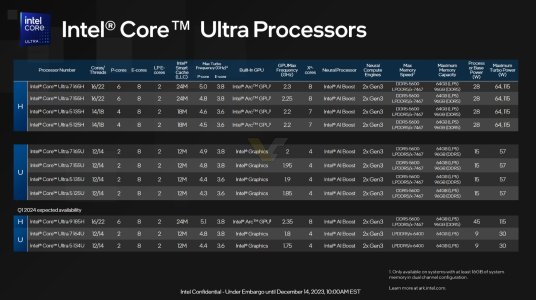
  • Clockspeed.png
    Clockspeed.png
    611.8 KB · Views: 72,329
Last edited:
What precisely do you use it for? Other than image generation which often requires a lot of manual tweaking once you obtain the output, web search summary is the only thing I use it for (because its default for most browsers now), and thats not particularly a must have feature to me.
Anything that benefits from matrix multiplication, really. Many workloads that are GPU accelerated can be performed on an NPU for better perf/watt.

Tensor cores, RTX cores, NPUs, Optical Flow accelerators - the future is *more* task specific accelerators, not less. General purpose CPU performance and GPU rasterization improvements are slowing, and progress will come from other sources.

Consumers already routinely use NPUs on their phones. From image processing and editing, separating foreground and background in images and video, search, text to speech, speech to text.

Intel even Demo'd some 3rd party software last week that runs on the NPU that allows physically handicap people to control games through face and head gestures in a Webcam.

Sure GPUs were previously used for many of these tasks, but NPUs are more specialized and can do the same job with less wattage.

NPUs absolutely aren't going anywhere. But their existence will fade into the background of consumer minds just like it already did on their phones.

As NPUs proliferate, developers will find use cases for them. We weren't going to see software that benefits from an NPU in widespread use *before* NPUs were in the market for a few years.
 
What precisely do you use it for? Other than image generation which often requires a lot of manual tweaking once you obtain the output, web search summary is the only thing I use it for (because its default for most browsers now), and thats not particularly a must have feature to me.
I tend to use it for writing a bunch of stuff. Whether my boss wants a summary of a big document, or if I need to write a carefully email delicately threading between a rock and a hard place. Or if I just don't know where to begin (condolence letters or similar).

I'd rather throw a dozen documents at AI and then proof read and correct AI's writing than do all the work myself, especially when it is for an unimportant check-the-box document that no one reads.

I tend to be extremely matter of fact (I'm probably further up on the Autism spectrum than most and also geeky). My writing is quite off-putting for some people. So, I frequently write something and then ask AI to make it friendlier. It seems to work quite well.

I normally like to edit my photos carefully and can do a pretty decent job at it. But, AI is almost as good and sometimes I'd rather spend my time doing other tasks. So, I'll ask AI to remove people or background problems from my images.

I've done just a little instant translation with AI. Helped when working with someone who speaks only Catalan and even the native Spanish person on my team couldn't understand.

I'd say it saves well over half of my time and gets better results.
 
As NPUs proliferate, developers will find use cases for them. We weren't going to see software that benefits from an NPU in widespread use *before* NPUs were in the market for a few years.


Yeah Microsoft sorta had to set some requirements, otherwise AMD and Intel would do what they do best, and market segment NPUs into a niche so it would take far longer before there were enough NPU equipped PCs for developers to bother.

Then they'd see all the new stuff AI can do coming on smartphones and Macs, with Windows being left behind.
 
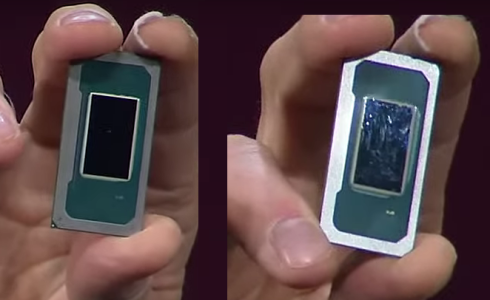
Is the resolution enough?

Also this die shot essentially confirms that Panther Lake won't have on-package memory like Lunar Lake.

I do wonder, will Panther Lake keep the multiple-PMIC design introduced by Lunar Lake? It's said that it improves efficiency.

I believe that was already known. LNL may be a one off according to some people. It's like the LP-ecores from MTL, seems like Intel was looking into adhoc solution to be perf/watt competitive but once they get the manufacturing process up to speed and bring in the new archs there is really no need for custom solutions.

Although I do expect Lunar Lake succesor in 2026, with a two year release cadence to bring significant power savings gen-on-gen. Right now the N3B to 18A jump doesn't seem high enough to justify another product.
 
Idf true, this means it's not an ARM/Qualcomm exclusive laptop, as many believed initially.
Probably the commercial variant.
It's like the LP-ecores from MTL, seems like Intel was looking into adhoc solution to be perf/watt competitive but once they get the manufacturing process up to speed and bring in the new archs there is really no need for custom solutions.
No. The answer is cost.
It's just about cost. Need to get stuff cheaper and gooder.
 
I believe that was already known. LNL may be a one off according to some people. It's like the LP-ecores from MTL, seems like Intel was looking into adhoc solution to be perf/watt competitive but once they get the manufacturing process up to speed and bring in the new archs there is really no need for custom solutions.
Manufacturing process won't result in a device with better battery life. That was true in the P3 days without advanced power management. Process basically only helps in load.

System-level engineering is required to get good battery life, and Pantherlake loses few key factors that Lunarlake has. It's probably going to be better than the horrible regressions of Alderlake-Raptorlake era but that's not saying much.

@adroc_thurston BoM is not the only important thing. If they lose marketshare again to Qualcomm in PTL-U then few $ difference in BoM won't matter, because they'll lose entire chip being in a design. A 10 year old can tell you 10% lower margin is preferable to zero revenue.

Same backward thinking as Otellini losing iPhone deal.
Although I do expect Lunar Lake succesor in 2026, with a two year release cadence to bring significant power savings gen-on-gen. Right now the N3B to 18A jump doesn't seem high enough to justify another product.
There are only few notable jumps. Pentium M, Haswell-Broadwell, Lunarlake. None of which are process related. Arrandale = regression, Alder/Raptor = regression.
I am thinking if we get the Alder Lake -N sucessor. Small cores of Lunar Lake are really impressive.
No Skymont based successor yet. The next one is Twin Lake, which is a refresh of Alderlake-N.
 
Last edited:
Back
Top