Discussion Intel Meteor, Arrow, Lunar & Panther Lakes + WCL Discussion Threads

Page 979 - Seeking answers? Join the AnandTech community: where nearly half-a-million members share solutions and discuss the latest tech.

Tigerick

Senior member
Apr 1, 2022
942
859
106
Wildcat Lake (WCL) Specs

Intel Wildcat Lake (WCL) is upcoming mobile SoC replacing Raptor Lake-U. WCL consists of 2 tiles: compute tile and PCD tile. It is true single die consists of CPU, GPU and NPU that is fabbed by 18-A process. Last time I checked, PCD tile is fabbed by TSMC N6 process. They are connected through UCIe, not D2D; a first from Intel. Expecting launching in Q1 2026.
Intel Raptor Lake UIntel Wildcat Lake 15W?Intel Lunar LakeIntel Panther Lake 4+0+4
Launch DateQ1-2024Q2-2026Q3-2024Q1-2026
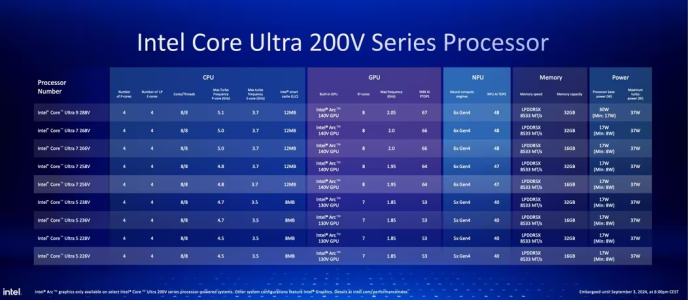
ModelIntel 150UIntel Core 7Core Ultra 7 268VCore Ultra 7 365
Dies2223
NodeIntel 7 + ?Intel 18-A + TSMC N6TSMC N3B + N6Intel 18-A + Intel 3 + TSMC N6
CPU2 P-core + 8 E-cores2 P-core + 4 LP E-cores4 P-core + 4 LP E-cores4 P-core + 4 LP E-cores
Threads12688
Max Clock5.4 GHz?5 GHz4.8 GHz
L3 Cache12 MB12 MB12 MB
TDP15 - 55 W15 W ?17 - 37 W25 - 55 W
Memory128-bit LPDDR5-520064-bit LPDDR5128-bit LPDDR5x-8533128-bit LPDDR5x-7467
Size96 GB32 GB128 GB
Bandwidth136 GB/s
GPUIntel GraphicsIntel GraphicsArc 140VIntel Graphics
RTNoNoYESYES
EU / Xe96 EU2 Xe8 Xe4 Xe
Max Clock1.3 GHz?2 GHz2.5 GHz
NPUGNA 3.018 TOPS48 TOPS49 TOPS


PPT1.jpg
PPT2.jpg
PPT3.jpg


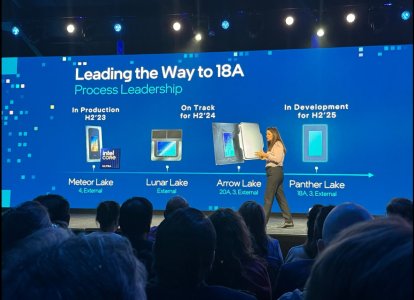
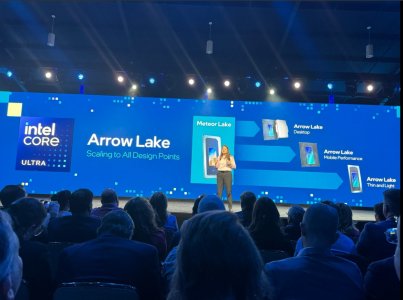
As Hot Chips 34 starting this week, Intel will unveil technical information of upcoming Meteor Lake (MTL) and Arrow Lake (ARL), new generation platform after Raptor Lake. Both MTL and ARL represent new direction which Intel will move to multiple chiplets and combine as one SoC platform.

MTL also represents new compute tile that based on Intel 4 process which is based on EUV lithography, a first from Intel. Intel expects to ship MTL mobile SoC in 2023.

ARL will come after MTL so Intel should be shipping it in 2024, that is what Intel roadmap is telling us. ARL compute tile will be manufactured by Intel 20A process, a first from Intel to use GAA transistors called RibbonFET.


LNL-MX.png
 

Attachments

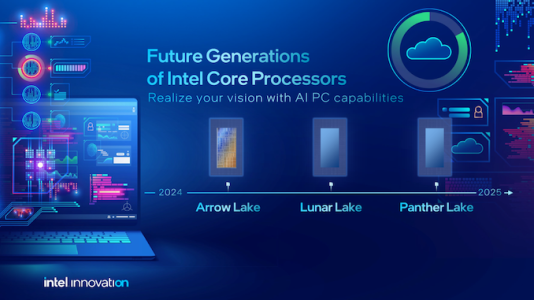
  • PantherLake.png
    PantherLake.png
    283.5 KB · Views: 24,044
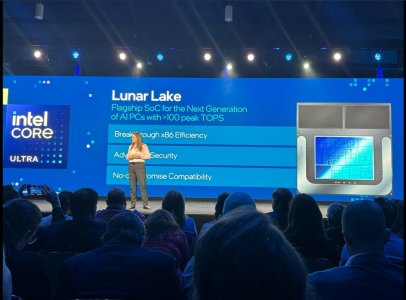
  • LNL.png
    LNL.png
    881.8 KB · Views: 25,531
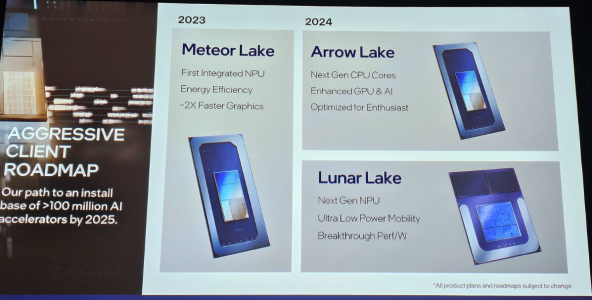
  • INTEL-CORE-100-ULTRA-METEOR-LAKE-OFFCIAL-SLIDE-2.jpg
    INTEL-CORE-100-ULTRA-METEOR-LAKE-OFFCIAL-SLIDE-2.jpg
    181.4 KB · Views: 72,440
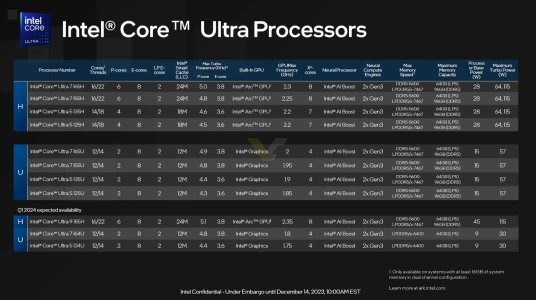
  • Clockspeed.png
    Clockspeed.png
    611.8 KB · Views: 72,327
Last edited:

LightningZ71

Platinum Member
Mar 10, 2017
2,717
3,421
136
Thank the deity of your choice that Intel canned Optane then. All those budget books with 4GB ram and a 16GB Optane being pedaled with mechanical HDDs were all horrid.
 

DavidC1

Platinum Member
Dec 29, 2023
2,196
3,353
106
They are there for area efficiency for MT application that can benefit from them. Intel can get you more MT compute for your dollar with the E cores, that is their reasoning.

If cost wasn't a concern they could just make a couple of huge tiles full of P cores and run themselves out of business because manufacturing cost is too high.
E cores are allowing both to happen, optimize for ultra low power or for density. Remember when they had Y class chips with 7W P core chips? It sucked. The N series using E cores outperformed them in MT, because they couldn't scale down low.

It also seems whatever optimization they made to Pantherlake reduced the gap between LPE and E cores significantly, to the point where it's mostly a toss up between the two per clock. I think Geekerwan tests showed ~5% difference? Lunarlake's LPE was substantially slower than Arrowlake's E.
It was a solution in search of a problem. Sad part is, you can buy tiny 16GB generic 3DXP modules for real cheap, but they're almost completely useless.
I still think they could have done it better. Another guy did a test of limiting Windows to 2GB RAM and had Windows on a Optane drive. He said it was usable. I know from experience it's a horrible experience on an SSD. So since it was premium either way they should have marketed as cheap RAM extension. They named it Optane Memory, but treated it as a HDD cache drive. I know partly the reason they did this because they saw only $ signs in front of their eyes charging $500 or something extra for the Optane server "Memory Drive" feature.

RAM isn't just performance, but you need enough for compatibility reasons. Then the future generations could have been literally slow RAM with the DDR versions.
 
  • Like
Reactions: Tlh97

DavidC1

Platinum Member
Dec 29, 2023
2,196
3,353
106
Pantherlake:
habhbhdbaaalruh-jpg.138429

Lunarlake:
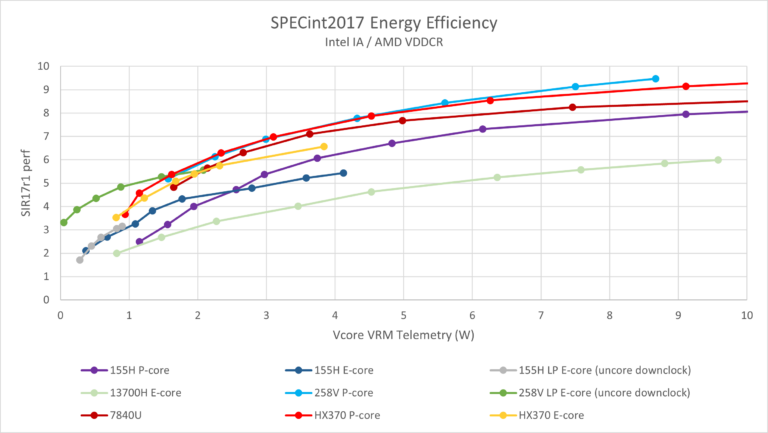
LunarLake-1T-IA-768x433.png


It looks like they made noticeable performance gain, while keeping low power efficiency.
 
  • Like
Reactions: Tlh97 and hemedans

DavidC1

Platinum Member
Dec 29, 2023
2,196
3,353
106
You can see from the above results that E core is indeed more energy efficient below about 2.8W compared to a P core and scales down much further. It just scales lower as an LPE configuration. In Meteorlake that's true as well. Meteorlake data shows why it didn't do well as Intel hoped - there's no power advantage for LPE at all over regular E cores, I assume likely due to having to power up another tile and external interconnect. AMD results show that there's a crossover point too, but their E core is less power efficient in all other power ranges and is a pure density play.

-At 2W, energy efficiency over Raptorlake E core is 70% per watt, at 3W it's 58%, and maintains 60% advantage all the way. It only requires 2.75W for Pantherlake E to achieve same perf as Raptorlake E at 10W.
-Pantherlake's LPE is 100-120% more performance at same power. Alternatively it takes anywhere from 4x to 5x more power for Raptor E to match Pantherlake LPE. 2W PTL LPE is outperforming 9.5W Arrowlake E
-LPE is ~10-15% over E, or equal to being on a more than half a node when power normalized. Consider a full node is at 15-20%. Power normalized, it's ~50% better.

Pantherlake's LPE is more optimized for higher performance than Lunarlake. The curve is steeper so it's overall superior, but Lunarlake can reach lower absolute levels, combined with memory PHY having 40% lower power. Realistically though their engineering made a good balance. It's unlikely you'll see many cases where either platform is better in battery life. Lunarlake would be better in almost nothing scenarios, Pantherlake would be countering that under anything more than near idle.
 
Last edited:

DavidC1

Platinum Member
Dec 29, 2023
2,196
3,353
106
LPE in Lunarlake is significantly slower compared to LPE in Arrowlake: https://old.chipsandcheese.com/2024/12/20/skymont-in-desktop-form-atom-unleashed/

That seems to be no longer the case in Pantherlake. C&C tested desktop Arrowlake as being 25% faster compared to laptop lunarlake. If you consider ~5% for laptop vs desktop, it means Pantherlake LPE is ~15-20% faster per clock than Lunarlake LPE. Wow, so 3.3GHz LPE in Pantherlake is outperforming 3.7GHz LPE in Lunarlake by 10%.
So here is the brief on MTL/ARL the LP-E is crestmont and are on N6 in SoC without any type of cache to help them.
In LNL/PTL they are in the compute tile on N3B/18A and has special cache Called Memory Side Cache that's for LP-E so they don't starve it's a power optimized cache just to keep power low.

The Darkmont/Skymont are exactly the same cores otherwise like physically the same I have actually matched their dishots.
This is also true for Lunarlake. They "fixed" LPE performance on Pantherlake. Perhaps the MSC is not useless anymore. I gotta say, execution-wise they delivered with Pantherlake.
 
Last edited:
  • Like
Reactions: hemedans and 511