Discussion Intel Meteor, Arrow, Lunar & Panther Lakes + WCL Discussion Threads

Page 941 - Seeking answers? Join the AnandTech community: where nearly half-a-million members share solutions and discuss the latest tech.

Tigerick

Senior member
Apr 1, 2022
935
848
106
Wildcat Lake (WCL) Specs

Intel Wildcat Lake (WCL) is upcoming mobile SoC replacing Raptor Lake-U. WCL consists of 2 tiles: compute tile and PCD tile. It is true single die consists of CPU, GPU and NPU that is fabbed by 18-A process. Last time I checked, PCD tile is fabbed by TSMC N6 process. They are connected through UCIe, not D2D; a first from Intel. Expecting launching in Q1 2026.
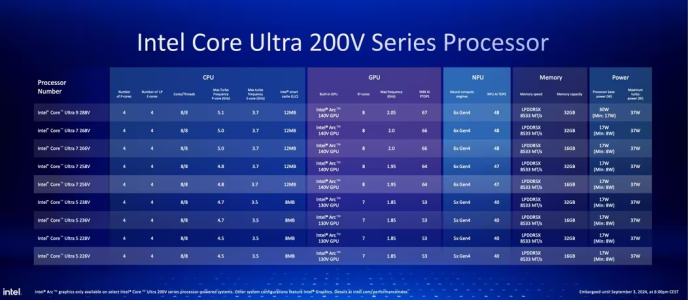
Intel Raptor Lake UIntel Wildcat Lake 15W?Intel Lunar LakeIntel Panther Lake 4+4+4
Launch DateQ1-2024Q2-2026Q3-2024Q1-2026
ModelIntel 150UIntel Core 7Core Ultra 7 268VCore Ultra 7 365
Dies2223
NodeIntel 7 + ?Intel 18-A + TSMC N6TSMC N3B + N6Intel 18-A + Intel 3 + TSMC N6
CPU2 P-core + 8 E-cores2 P-core + 4 LP E-cores4 P-core + 4 LP E-cores4 P-core + 4 LP E-cores
Threads12688
Max Clock5.4 GHz?5 GHz4.8 GHz
L3 Cache12 MB12 MB12 MB
TDP15 - 55 W15 W ?17 - 37 W25 - 55 W
Memory128-bit LPDDR5-520064-bit LPDDR5128-bit LPDDR5x-8533128-bit LPDDR5x-7467
Size96 GB32 GB128 GB
Bandwidth136 GB/s
GPUIntel GraphicsIntel GraphicsArc 140VIntel Graphics
RTNoNoYESYES
EU / Xe96 EU2 Xe8 Xe4 Xe
Max Clock1.3 GHz?2 GHz2.5 GHz
NPUGNA 3.018 TOPS48 TOPS49 TOPS


PPT1.jpg
PPT2.jpg
PPT3.jpg


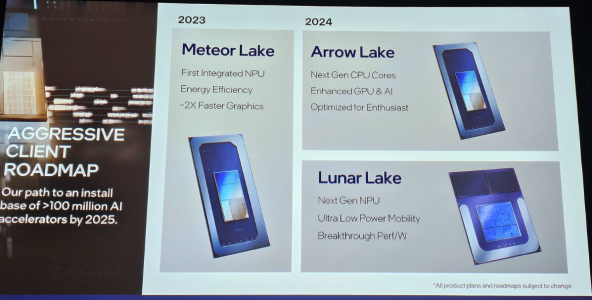
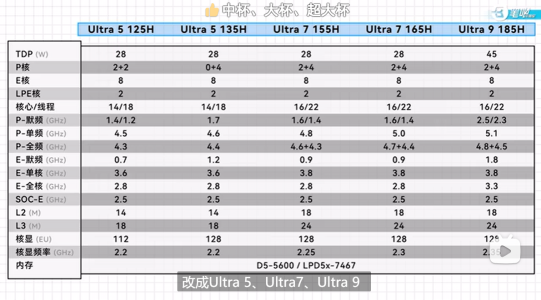
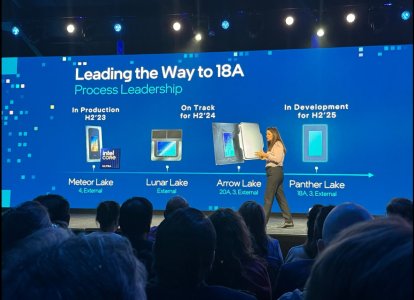
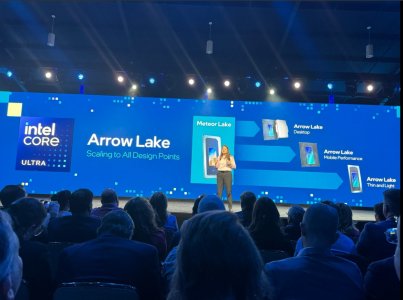
As Hot Chips 34 starting this week, Intel will unveil technical information of upcoming Meteor Lake (MTL) and Arrow Lake (ARL), new generation platform after Raptor Lake. Both MTL and ARL represent new direction which Intel will move to multiple chiplets and combine as one SoC platform.

MTL also represents new compute tile that based on Intel 4 process which is based on EUV lithography, a first from Intel. Intel expects to ship MTL mobile SoC in 2023.

ARL will come after MTL so Intel should be shipping it in 2024, that is what Intel roadmap is telling us. ARL compute tile will be manufactured by Intel 20A process, a first from Intel to use GAA transistors called RibbonFET.


LNL-MX.png
 

Attachments

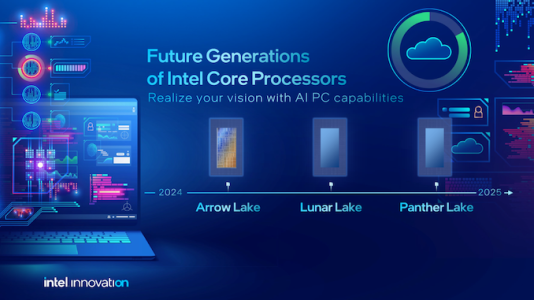
  • PantherLake.png
    PantherLake.png
    283.5 KB · Views: 24,040
  • LNL.png
    LNL.png
    881.8 KB · Views: 25,528
  • INTEL-CORE-100-ULTRA-METEOR-LAKE-OFFCIAL-SLIDE-2.jpg
    INTEL-CORE-100-ULTRA-METEOR-LAKE-OFFCIAL-SLIDE-2.jpg
    181.4 KB · Views: 72,436
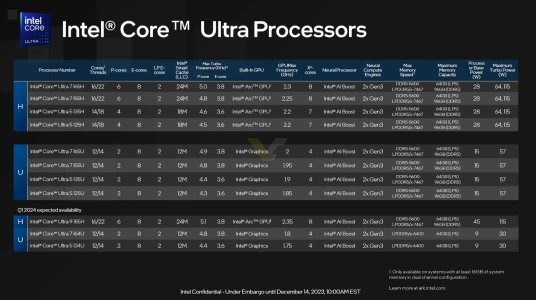
  • Clockspeed.png
    Clockspeed.png
    611.8 KB · Views: 72,323
Last edited:

jdubs03

Golden Member
Oct 1, 2013
1,429
994
136
There's nothing wrong with Geekbench. But it suffers from all user-submitted benchmark problems: lack of consistency. That's why sorting is a big deal, because you need to compare peak non-OC results using same OS, and then they are comparable. The peak scores are those free from OS, driver, configuration, and random fluke variations. That goes same with @poke01 GB results.
True true, but I just went by the median though.
Even still, the performance/clock is significantly better.
 

poke01

Diamond Member
Mar 8, 2022
4,711
6,053
106
True true, but I just went by the median though.
Even still, the performance/clock is significantly better.
but the median you picked for panther lake is just for one result and that a reference board result which is likely set to a very high TDP lol
 

Hulk

Diamond Member
Oct 9, 1999
5,291
3,971
136
honestly all these charts from Intel are just confusing. Hopefully the embargo breaks next week
I agree. Thing is we're hoping to be happily surprised. I'm not sure that's to happen. I think Panther CPU performance is going to be a bit better than HX370 at full tilt, and perhaps significantly better at low powers. But I'm not sure because if that was the case Intel would have their crappy no units plots showing that big low power win.
 

DavidC1

Platinum Member
Dec 29, 2023
2,082
3,211
106
Well Intel cooked the L3/Uncore in meteor lake also this
The uncore differences aren't that noticeable for most single thread. Plus in Meteorlake we didn't get proper comparisons because it's a laptop.
Redwood Cove is a dog. It's an outliar and still beats Crestmost once it's over about 2.2 Watts. Lunar Lake and Zen 5 P's, which are well executed are top of the heap.
An efficient core is also disadvantaged by a inefficient platform. This is shown by how much lower power Tremont is versus Gracemont, because the latter is burdened with the much bigger uncore. Also in Skymont, that floor gets raised to 5W.
 

Hulk

Diamond Member
Oct 9, 1999
5,291
3,971
136
Battery life is going to be great except in pure idle, which isn't realistic as that means not using computer. Icelake also had great idle. We know it works from Lunarlake. Meteor/Arrow's LPE was too slow to be useful.

"LPE" in Lunar and Panther is more like a power efficient version of the E, rather than the useless LPE in Meteor/Arrow. The LPE in Arrowlake is an insignificant contributor to MT performance. So for MT it's 6P+8E vs 4P+8E+4LPE.

If they kept LPE like on Arrow, then the battery life would have been poor as Arrow.

Yes, but Intel themselves didn't point that out, because it didn't do anything really. In Pantherlake they are. If they were insignificant as Pantherlake, they couldn't claim equivalence or in some cases better than Arrowlake.
Both are on the ring so the difference is 2.5 max for Panther, 3.7 or Arrow. You are right in that does make up for some of the difference. But still Darkmont at 3.7 does not equal Cougar Cove at 3.7, much less 4.2 or 4.4. They saved some die space and gave up some performance and efficiency.
 
  • Like
Reactions: 511

DavidC1

Platinum Member
Dec 29, 2023
2,082
3,211
106
Both are on the ring so the difference is 2.5 max for Panther, 3.7 or Arrow. You are right in that does make up for some of the difference. But still Darkmont at 3.7 does not equal Cougar Cove at 3.7, much less 4.2 or 4.4. They saved some die space and gave up some performance and efficiency.
I'm saying that the LPE in Arrowlake and Meteorlake is useless for performance. And Intel themselves quoted it only saves 0.15W in local video playback, which is 0.5 hours if you are already at 12 hours or more. And it does nothing elsewhere. You can treat pre-Lunar LPE as nonexistent.

@511's post at https://forums.anandtech.com/thread...-wcl-discussion-threads.2606448/post-41558318

Shows that P core is only more efficient at 5W or more. The LPE in Pantherlake runs at 3.7GHz, versus 4 or 4.5GHz max for the regular E cores. Efficiency-wise, the E cores are no less than P cores, because the LPE is quite a bit under the peak clocks.
They saved some die space and gave up some performance and efficiency.
4x LPE is faster than 2x P. Lion Cove is only about 10% faster than Skymont, and Cougar Cove maybe 5-10% on top of that, and Darkmont itself is getting few % by itself. Even with the higher clocks there's 2x the LPE versus the P. and the LPE is a huge contributor to light to mid load(including gaming) battery life.
 
Last edited:

Hulk

Diamond Member
Oct 9, 1999
5,291
3,971
136
It's like
I'm saying that the LPE in Arrowlake and Meteorlake is useless for performance. And Intel themselves quoted it only saves 0.15W in local video playback, which is 0.5 hours if you are already at 12 hours or more. And it does nothing elsewhere. You can treat pre-Lunar LPE as nonexistent.

@511's post at https://forums.anandtech.com/thread...-wcl-discussion-threads.2606448/post-41558318

Shows that P core is only more efficient at 5W or more. The LPE in Pantherlake runs at 3.7GHz, versus 4 or 4.5GHz max for the regular E cores. Efficiency-wise, the E cores are no less than P cores, because the LPE is quite a bit under the peak clocks.

Not likely in MT, and the LPE is a huge contributor to light to mid load(including gaming) battery life.
Correct me if I'm wrong, but an 8 core all-P CPU will beat an 8 core all-E CPU in overall performance and efficiency except for some niche barely on cases perhaps. But of course die area isn't free and as Intel told us way back at the introduction of Alder Lake, the E cores are not for power efficiency, they are for area efficiency. My point is only that Panther Lake would have been more performant and efficient in 6+8+2 configuration albiet at great cost, either for Intel, the consumer, or both.
 

DavidC1

Platinum Member
Dec 29, 2023
2,082
3,211
106
It's like

Correct me if I'm wrong, but an 8 core all-P CPU will beat an 8 core all-E CPU in overall performance and efficiency except for some niche barely on cases perhaps. But of course die area isn't free and as Intel told us way back at the introduction of Alder Lake, the E cores are not for power efficiency, they are for area efficiency. My point is only that Panther Lake would have been more performant and efficient in 6+8+2 configuration albiet at great cost, either for Intel, the consumer, or both.
You said performance and efficiency right?

+2 LPE is useless, so we're back to Arrowlake levels of battery life. So the 4 LPE in Pantherlake is critical to achieving this. So for majority of your workloads, 6+8+2 doesn't work. In Pantherlake Intel says even in gaming it prioritizes the E for more efficiency, so the efficiency part does play a large part for majority of uses.

8P will be faster than 8E, but did we not see Intel get 2x MT performance at same power by going from 8P to 8P+16E? And power results showed that 8P itself in Alderlake was enough to nearly saturate the 250W TDP, while the additional 16E gains substantial performance with nearly same power. Even if core-to-core the efficiency is similar, the virtue of having more cores is more efficient for multi-thread because the common denominator is power limit.

Since both CPUs have same amount of E cores, and the LPE in Arrowlake is useless from a performance perspective, the comparison is simple and comes down to 2P vs 4 LPE. The latter of which is better for MT. Because it has more theoretical performance, rest of the cores can clock lower for better efficiency, ala Alderlake. The differences might be small so it all comes down to details, internal CPU algorithm firmware, BIOS, optimization.
 
  • Like
Reactions: MoistOintment

Hulk

Diamond Member
Oct 9, 1999
5,291
3,971
136
You said performance and efficiency right?

+2 LPE is useless, so we're back to Arrowlake levels of battery life. So the 4 LPE in Pantherlake is critical to achieving this. So for majority of your workloads, 6+8+2 doesn't work. In Pantherlake Intel says even in gaming it prioritizes the E for more efficiency, so the efficiency part does play a large part for majority of uses.

8P will be faster than 8E, but did we not see Intel get 2x MT performance at same power by going from 8P to 8P+16E? And power results showed that 8P itself in Alderlake was enough to nearly saturate the 250W TDP, while the 16E gains substantial performance with nearly same power.

Since both CPUs have same amount of E cores, and the LPE in Arrowlake is useless from a performance perspective, the comparison is simple and comes down to 2P vs 4 LPE. The latter of which is better for MT.
Okay I see. If 2E is useless, even with the stronger Darkmont core and higher clocks, then 4E had to happen. I get it.
 

DavidC1

Platinum Member
Dec 29, 2023
2,082
3,211
106
Okay I see. If 2E is useless, even with the stronger Darkmont core and higher clocks, then 4E had to happen. I get it.
2E Darkmont may not be useless, but you are comparing to Arrowlake, which has 2x Crestmont, that is also substantially clocked lower, and it also has to fire up another die to use it which is a loss in efficiency. Because on Pantherlake and Lunarlake it's on the same die, it can respond fast enough to actually aid in performance as well. I also cannot see how 4x LPE is a disadvantage in performance vs 2x P, when the two are still so close to each other.

Part of the reason I speculate they only had 2E on the tile is because it's on the IO die which is smaller plus it's N6. On Lunar and Panther they are on the compute die with latest node and much faster. Plus each E core cluster consists of 4 of them.

I think alternatively Intel could have done 6P+8E+4LPE.

I have to wonder how the x86 team can be so bad at execution sometimes. I would think they could have had their internal testers setup a Tremont with 2 cores and clocked enough to simulate a low clocked Crestmont and see if that's usable.

There's a guy online that took a desktop motherboard and made it idle to 6-8W or something. He didn't just pick low power components and PicoPSU. He analyzed each component and where the power goes and desoldered things to get it there. I'm pretty sure Intel/AMD could do the same and could have achieved Lunarlake battery life 10 years ago. And why doesn't AMD care at all in this regard? So much for AMD's great execution as people say.
 
Last edited:

jdubs03

Golden Member
Oct 1, 2013
1,429
994
136
but the median you picked for panther lake is just for one result and that a reference board result which is likely set to a very high TDP lol
Even taking the highest value for the 285H, perf/clock is still better with the 388H. Let’s revisit in 2 weeks. I’m sure we’ll all have plenty to talk about.
 

Hulk

Diamond Member
Oct 9, 1999
5,291
3,971
136
Check out this MLID prediction I copied a few years ago.
It's actually not too terrible.

Computer Architecture
MLID October 6, 2023
Desktop
H2 2026
Intel 16A/14A or whatever Intel calls this node and/or TSMC N2P
16+32+4, with rentable unit P cores, Artic Wolf E cores, 4 LP E cores.
20 to 40% single thread performance improvement over Arrow Lake is the target.
Up to 140/188MB Last Level Cache
 
  • Haha
Reactions: 511

511

Diamond Member
Jul 12, 2024
5,277
4,704
106
Check out this MLID prediction I copied a few years ago.
It's actually not too terrible.

Computer Architecture
MLID October 6, 2023
Desktop
H2 2026
Intel 16A/14A or whatever Intel calls this node and/or TSMC N2P
16+32+4, with rentable unit P cores, Artic Wolf E cores, 4 LP E cores.
20 to 40% single thread performance improvement over Arrow Lake is the target.
Up to 140/188MB Last Level Cache
he only got the core count right and the TSMC N2 Node lol
 

coercitiv

Diamond Member
Jan 24, 2014
7,450
17,765
136
Check out this MLID prediction I copied a few years ago.
It's actually not too terrible.
Only one problem, the parts he got wrong are completely incompatible with the architecture we're about to receive from Intel. Rentable unit P cores and 40% higher ST perf describe a completely different architecture.

LLC, release date are pretty good actually.
Even the miss of the exact bLLC size should tell you something. He was likley working with very thin leaked material.
 
  • Like
Reactions: Hulk and 511

eek2121

Diamond Member
Aug 2, 2005
3,471
5,142
136
500 MHz clock regression on the E core. I don't need any more than that to see it's a flop.

285H is 4.5GHz, that's 500MHz.
You are blaming the wrong thing for clock regression.

Intel is trying very hard to catch up in performance/watt and also perf/area.

18A does have some clocking issues compared to TSMC, however the chip was never designed for high clocks to begin with.
 
  • Like
Reactions: 511