Discussion Intel Meteor, Arrow, Lunar & Panther Lakes + WCL Discussion Threads

Page 741 - Seeking answers? Join the AnandTech community: where nearly half-a-million members share solutions and discuss the latest tech.

Tigerick

Senior member
Apr 1, 2022
941
857
106
Wildcat Lake (WCL) Specs

Intel Wildcat Lake (WCL) is upcoming mobile SoC replacing Raptor Lake-U. WCL consists of 2 tiles: compute tile and PCD tile. It is true single die consists of CPU, GPU and NPU that is fabbed by 18-A process. Last time I checked, PCD tile is fabbed by TSMC N6 process. They are connected through UCIe, not D2D; a first from Intel. Expecting launching in Q1 2026.
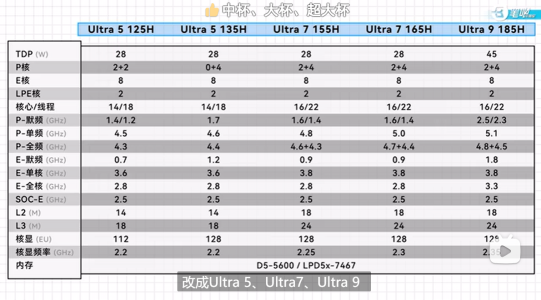
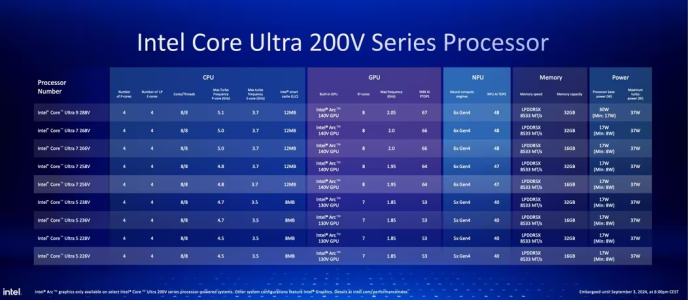
Intel Raptor Lake UIntel Wildcat Lake 15W?Intel Lunar LakeIntel Panther Lake 4+0+4
Launch DateQ1-2024Q2-2026Q3-2024Q1-2026
ModelIntel 150UIntel Core 7Core Ultra 7 268VCore Ultra 7 365
Dies2223
NodeIntel 7 + ?Intel 18-A + TSMC N6TSMC N3B + N6Intel 18-A + Intel 3 + TSMC N6
CPU2 P-core + 8 E-cores2 P-core + 4 LP E-cores4 P-core + 4 LP E-cores4 P-core + 4 LP E-cores
Threads12688
Max Clock5.4 GHz?5 GHz4.8 GHz
L3 Cache12 MB12 MB12 MB
TDP15 - 55 W15 W ?17 - 37 W25 - 55 W
Memory128-bit LPDDR5-520064-bit LPDDR5128-bit LPDDR5x-8533128-bit LPDDR5x-7467
Size96 GB32 GB128 GB
Bandwidth136 GB/s
GPUIntel GraphicsIntel GraphicsArc 140VIntel Graphics
RTNoNoYESYES
EU / Xe96 EU2 Xe8 Xe4 Xe
Max Clock1.3 GHz?2 GHz2.5 GHz
NPUGNA 3.018 TOPS48 TOPS49 TOPS


PPT1.jpg
PPT2.jpg
PPT3.jpg


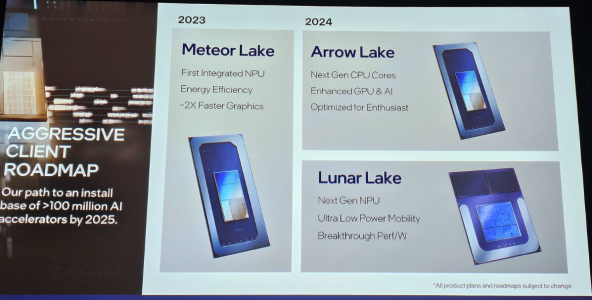
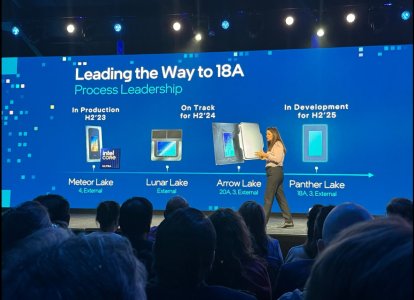
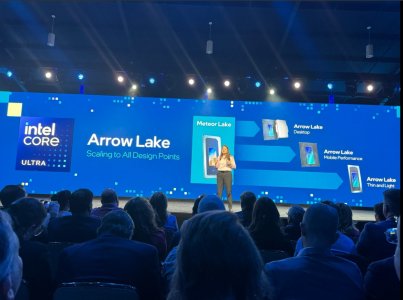
As Hot Chips 34 starting this week, Intel will unveil technical information of upcoming Meteor Lake (MTL) and Arrow Lake (ARL), new generation platform after Raptor Lake. Both MTL and ARL represent new direction which Intel will move to multiple chiplets and combine as one SoC platform.

MTL also represents new compute tile that based on Intel 4 process which is based on EUV lithography, a first from Intel. Intel expects to ship MTL mobile SoC in 2023.

ARL will come after MTL so Intel should be shipping it in 2024, that is what Intel roadmap is telling us. ARL compute tile will be manufactured by Intel 20A process, a first from Intel to use GAA transistors called RibbonFET.


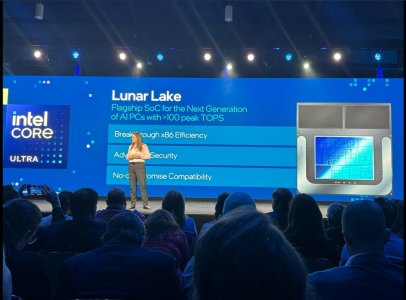
LNL-MX.png
 

Attachments

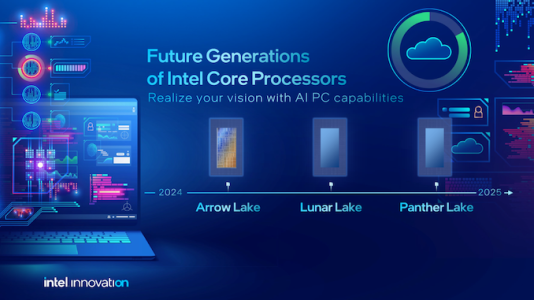
  • PantherLake.png
    PantherLake.png
    283.5 KB · Views: 24,042
  • LNL.png
    LNL.png
    881.8 KB · Views: 25,531
  • INTEL-CORE-100-ULTRA-METEOR-LAKE-OFFCIAL-SLIDE-2.jpg
    INTEL-CORE-100-ULTRA-METEOR-LAKE-OFFCIAL-SLIDE-2.jpg
    181.4 KB · Views: 72,439
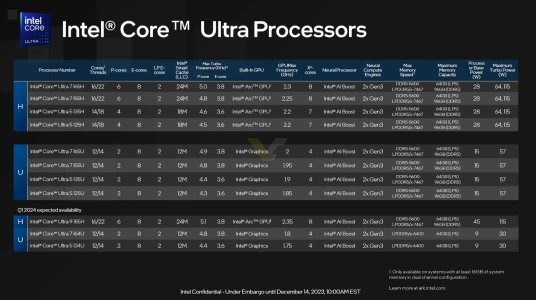
  • Clockspeed.png
    Clockspeed.png
    611.8 KB · Views: 72,326
Last edited:
Jul 27, 2020
28,173
19,210
146
Thank god Itanium failed. Otherwise, all x86 processors would still be Quad core.
I think HP is cursed. They were going to revolutionize the future of computing with the memristor. So much hype.


Andddddd NOTHING. Not a single memristor in any device on the market. Big or small.
 

511

Diamond Member
Jul 12, 2024
5,424
4,843
106
Are we going to get increase in core count sizes with Nova like we can get 8+24 ?
 

OneEng2

Senior member
Sep 19, 2022
999
1,200
106
Intel's cooking something very interesting. The fact they've foregone desktop next year and committed all resources to NVL says they're working hard on it. Nova Lake is the first true All Pat design. And it should be very interesting. I'm guessing it's a major departure from LNC.
I suspect it is a tweaked ARL. Maybe most seriously tweaked in the memory and latency portion of the architecture.

I wouldn't expect too much improvement over LNL single core in most situations, but a hearty improvement over ARL H in laptop.... Which is more important for Intel anyway.

Mostly, they need to get their cost and latency down. I bet this does the trick.
More important is the impact on CWF IMO. NVL will be out first glimpse into what might be possible for a high core next generation Intel DC processor.
 

511

Diamond Member
Jul 12, 2024
5,424
4,843
106
I would prefer they make it 16+8. Eight weak cores are enough for background stuff.
E cores will have same IPC as P cores by Nova Lake and full ISA compatibility if i were to guess each E core will be as powerful as a 13900K P core at 5.8Ghz
 

Magio

Senior member
May 13, 2024
206
243
76
Why have a P-core then? Just give it 2 P-cores and 32 E-cores.

Same IPC doesn't necessarily mean same performance. For example, Skymont is already quite close to Lion Cove in IPC, but it doesn't clock anywhere near as high so it ends up a long way off in pure performance.

Even if that is probably the eventual goal (and Arctic Wolf is the first step in that direction), it will take at least a few generational enhancements for the E-core to start trampling on the P-core's turf, and until then you'll still need a bunch of P-cores.
 

MarkizSchnitzel

Senior member
Nov 10, 2013
476
121
116
I don't get this talk of E-core vs P-core, and E-core getting closer in performance..

Whichever core has the highest performance is a P-core.
If they develop Skymont strain so that it matches Lion Cove P-core in performance, but at better efficiency, it just becomes a better more efficient P-core, right?

But they will then also need/want a new low power even higher efficiency e-core for low end tasks?

It seems like they are only pushing Skymont because Lion Cove is not very good and they need MT performance.
If Lion Cove was better, they could instead focus on getting Skymont more EFFICIENT, instead of more performant.
 

OneEng2

Senior member
Sep 19, 2022
999
1,200
106
E cores will have same IPC as P cores by Nova Lake and full ISA compatibility if i were to guess each E core will be as powerful as a 13900K P core at 5.8Ghz
I disagree.

As mentioned, there is the matter of clock speed, there is also the matter of performance in WHAT workload?

At the end of the day, raising clock speed on a transistor raises power greatly (and transistor design changes). Keeping performance high is often more about how many threads you can keep busy and full, which is more about SMT and low latency cache design that strict IPC measurements.

I don't disagree with the P Core and E Core design strategy, but I do question Intel's use of totally different cores to achieve this vs AMD's approach of utilizing the same core design with transistor and cache modifications.

Time will tell which approach wins out.
 
  • Like
Reactions: Tlh97 and KompuKare

OneEng2

Senior member
Sep 19, 2022
999
1,200
106
Yep. Arctic Wolf E core at max clocks should have similar performance to RPL P core at max clocks. But it should be a tad bigger than Sykmont.


NVL P core is expected to have higher performance.
Seems like a bit of a stretch to be predicting Arctic Wolf E core performance at this time. Also, comparisons to RPL P core also seem a bit off base.

How will AW E Core compare to the Cove core of that time window ..... or Zen 6 C .... and in what workloads.

I do agree that the current "Cove" performance APPEARS to be lackluster from a PPA standpoint compared to Zen 5 (as an example); however, the current Cove is suffering from insane latency issues to its L3 cache and ring bus.

Everyone seems to believe that Intel is filled with dottering morons that are allowed to run amok with their designs in some kind of cult like tunnel within the company. I am relatively sure the design engineers were told to get the compute tile size down for cost and yield concerns, and that the time they had to do it in left a few latency holes that are crippling the core.

I personally think (here is a counter prediction) that it is more likely that Cove will become the backbone single unifying architecture and that "mont" will go away ;).

Now .... stick that in your pipe and smoke it :).

FWIW, you could all be correct and Cove may be so totally flawed that it can not be saved.
 
  • Haha
Reactions: 511 and SiliconFly
Jul 27, 2020
28,173
19,210
146
I personally think (here is a counter prediction) that it is more likely that Cove will become the backbone single unifying architecture and that "mont" will go away ;).
May be possible if they do something like an E-core within a P-core where the high performance parts of the core only wake up during strenuous workloads and the benefit would be in terms of context switch latency and shared cache (thus saving die area for separate caches) to move the thread onto the P-core structures for high speed processing.
 

cannedlake240

Senior member
Jul 4, 2024
247
138
76
Seems like a bit of a stretch to be predicting Arctic Wolf E core performance at this time. Also, comparisons to RPL P core also seem a bit off base.

How will AW E Core compare to the Cove core of that time window ..... or Zen 6 C .... and in what workloads.

I do agree that the current "Cove" performance APPEARS to be lackluster from a PPA standpoint compared to Zen 5 (as an example); however, the current Cove is suffering from insane latency issues to its L3 cache and ring bus.

Everyone seems to believe that Intel is filled with dottering morons that are allowed to run amok with their designs in some kind of cult like tunnel within the company. I am relatively sure the design engineers were told to get the compute tile size down for cost and yield concerns, and that the time they had to do it in left a few latency holes that are crippling the core.

I personally think (here is a counter prediction) that it is more likely that Cove will become the backbone single unifying architecture and that "mont" will go away ;).

Now .... stick that in your pipe and smoke it :).

FWIW, you could all be correct and Cove may be so totally flawed that it can not be saved.
What's wrong with monts lol, ISA/avx512? That's solvable, especially if they redesign it as a full fledged P core. Lack of SMT? New Coves don't have it either. Arrow is not the only implementation of the P core. Lunar lake has the fixed version without latency problems, yet still lags Apple, QC Oryon 2, arm x925 on a similar node.