• We’re currently investigating an issue related to the forum theme and styling that is impacting page layout and visual formatting. The problem has been identified, and we are actively working on a resolution. There is no impact to user data or functionality, this is strictly a front-end display issue. We’ll post an update once the fix has been deployed. Thanks for your patience while we get this sorted.

Discussion Intel Meteor, Arrow, Lunar & Panther Lakes + WCL Discussion Threads

Page 222 - Seeking answers? Join the AnandTech community: where nearly half-a-million members share solutions and discuss the latest tech.

Tigerick

Senior member
Wildcat Lake (WCL) Specs

Intel Wildcat Lake (WCL) is upcoming mobile SoC replacing Raptor Lake-U. WCL consists of 2 tiles: compute tile and PCD tile. It is true single die consists of CPU, GPU and NPU that is fabbed by 18-A process. Last time I checked, PCD tile is fabbed by TSMC N6 process. They are connected through UCIe, not D2D; a first from Intel. Expecting launching in Q1 2026.
Intel Raptor Lake UIntel Wildcat Lake 15WIntel Lunar LakeIntel Panther Lake 4+0+4
Launch DateQ1-2024Q2-2026Q3-2024Q1-2026
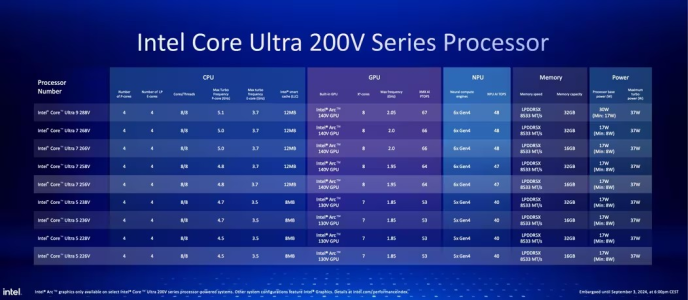
ModelIntel 150UIntel Core 7 360Core Ultra 7 268VCore Ultra 7 365
Dies2223
NodeIntel 7 + ?Intel 18-A + TSMC N6TSMC N3B + N6Intel 18-A + Intel 3 + TSMC N6
CPU2 P-core + 8 E-cores2 P-core + 4 LP E-cores4 P-core + 4 LP E-cores4 P-core + 4 LP E-cores
Threads12688
Max Clock5.4 GHz4.8 GHz5 GHz4.8 GHz
L3 Cache12 MB6 MB12 MB12 MB
TDP15 - 55 W15 - 35 W17 - 37 W25 - 55 W
Memory128-bit LPDDR5-520064-bit LPDDR5x-7467128-bit LPDDR5x-8533128-bit LPDDR5x-7467
Size96 GB48 GB32 GB128 GB
Bandwidth83 GB/s60 GB/s136 GB/s120 GB/s
GPUIntel GraphicsIntel GraphicsArc 140VIntel Graphics
RTNoNoYESYES
EU / Xe96 EU2 Xe8 Xe4 Xe
Max Clock1.3 GHz2.6 GHz2 GHz2.5 GHz
NPUGNA 3.017 TOPS48 TOPS49 TOPS


PPT1.jpg
PPT2.jpg
PPT3.jpg


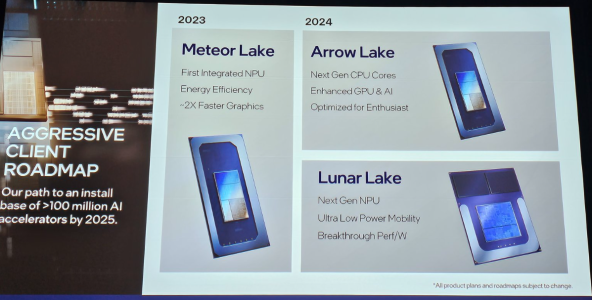
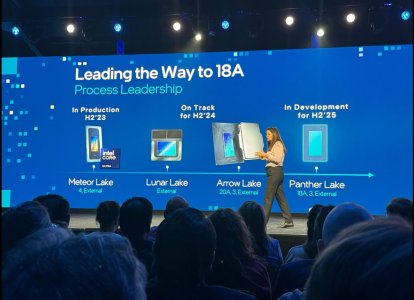
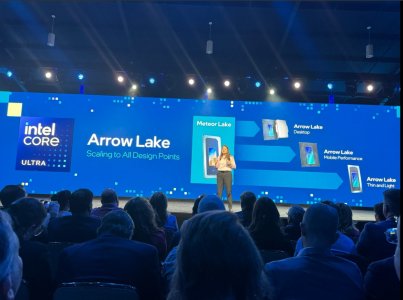
As Hot Chips 34 starting this week, Intel will unveil technical information of upcoming Meteor Lake (MTL) and Arrow Lake (ARL), new generation platform after Raptor Lake. Both MTL and ARL represent new direction which Intel will move to multiple chiplets and combine as one SoC platform.

MTL also represents new compute tile that based on Intel 4 process which is based on EUV lithography, a first from Intel. Intel expects to ship MTL mobile SoC in 2023.

ARL will come after MTL so Intel should be shipping it in 2024, that is what Intel roadmap is telling us. ARL compute tile will be manufactured by Intel 20A process, a first from Intel to use GAA transistors called RibbonFET.


LNL-MX.png
 

Attachments

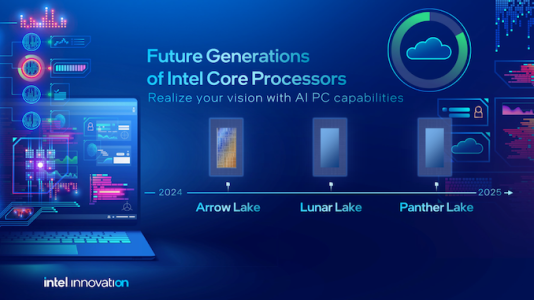
  • PantherLake.png
    PantherLake.png
    283.5 KB · Views: 24,049
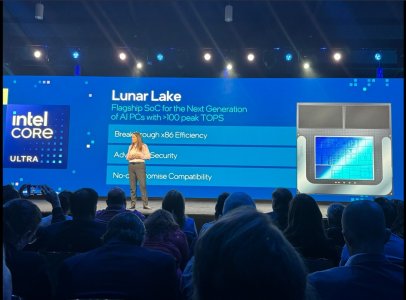
  • LNL.png
    LNL.png
    881.8 KB · Views: 25,534
  • INTEL-CORE-100-ULTRA-METEOR-LAKE-OFFCIAL-SLIDE-2.jpg
    INTEL-CORE-100-ULTRA-METEOR-LAKE-OFFCIAL-SLIDE-2.jpg
    181.4 KB · Views: 72,443
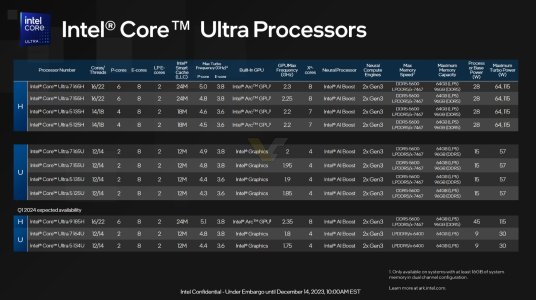
  • Clockspeed.png
    Clockspeed.png
    611.8 KB · Views: 72,329
Last edited:
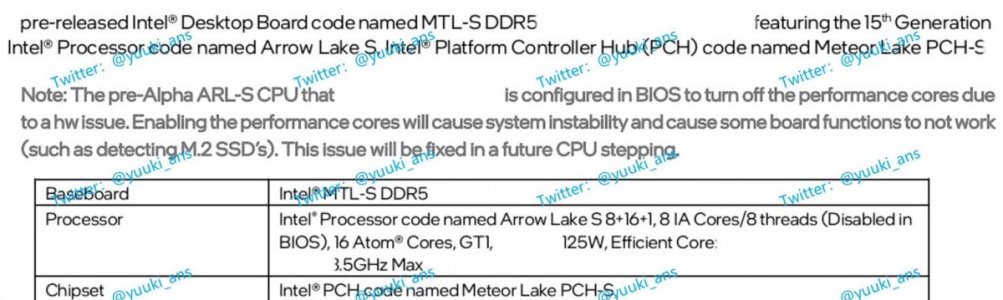
These documents which are leaked by yuuki_ans seems imply the Hyperthreading(SMT) is still there in the ARL P core, but it cause some mobo function like M2 SSD misfunction the SMT was turned of on initial ES ARL SKUs.
Some terminology/key words are expunged(by yuuki_ans?) and leave blank, but it is easy to guess though.

INTEL-ARROW-LAKES-4-1200x359.jpg
 
These documents which are leaked by yuuki_ans seems imply the Hyperthreading(SMT) is still there in the ARL P core, but it cause some mobo function like M2 SSD misfunction the SMT was turned of on initial ES ARL SKUs.
Some terminology/key words are expunged(by yuuki_ans?) and leave blank, but it is easy to guess though.

View attachment 92133
I’m understanding it a bit differently, I’m reading it as the 8c 8t P Cores(“IA cores”) are disabled in bios due to instability bug with only e cores enabled
 
I’d also like to point out this is “pre alpha” probably for power on and early validation. So it is not ES1 or ES2. Assuming it says 3.5Ghz, that is quite good for Skymont E cores on such an early chip
 
If 144C require 360W it doesnt make sense to cram 288C for this TDP, that s silicon waste as long as it s with the same process.
Bergamo is around 400W. So, SF 288C can comfortably go up to 450W which should be quite sufficient.
 
Last edited:
It does look like only HT has been turned off rather than a specific ST only design. Welp, I guessed as much last year.
It's been shown before Skylake/ADL without HT gains ~24% (outliers 31%) for ST. Since the MT gains aren't as large as Zen's ofc it means Intel's has a bigger loss in MT mode for the 1st thread and 2nd thread. Since Zen is able to keep higher rates for the 1st and 2nd threads and only gets ~12% w/o SMT. Zen would have more too lose so this cheap trick won't work for Zen. Sooner or later HT will have to return imho.
 
It does look like only HT has been turned off rather than a specific ST only design. Welp, I guessed as much last year.
It's been shown before Skylake/ADL without HT gains ~24% (outliers 31%) for ST. Since the MT gains aren't as large as Zen's ofc it means Intel's has a bigger loss in MT mode for the 1st thread and 2nd thread. Since Zen is able to keep higher rates for the 1st and 2nd threads and only gets ~12% w/o SMT. Zen would have more too lose so this cheap trick won't work for Zen. Sooner or later HT will have to return imho.
That's what the E cores are for, and ARM CPUs doesn't use SMT but is still competitive in MT
 
It does look like only HT has been turned off rather than a specific ST only design. Welp, I guessed as much last year.
It's been shown before Skylake/ADL without HT gains ~24% (outliers 31%) for ST. Since the MT gains aren't as large as Zen's ofc it means Intel's has a bigger loss in MT mode for the 1st thread and 2nd thread. Since Zen is able to keep higher rates for the 1st and 2nd threads and only gets ~12% w/o SMT. Zen would have more too lose so this cheap trick won't work for Zen. Sooner or later HT will have to return imho.
LNC is a grounds up new design. So, HT hasn't been turned off. It was never implemented. Starting with LNC, they're trying to follow the likes of Apple Silicon which offers higher performance without HT or SMT. So, HT isn't coming back.

And considering the numerous cores CPUs have these days, HT doesn't make sense anymore. HT is purely for MT gains, and it offers performance benefit only when all the existing cores are already maxed out. HT based thread context switching is significantly faster when compared to a OS based context switch. That is it's sole purpose. Throwing more E cores into the mix and improving the performance of E cores should take care of MT perf without HT. Keeps P core design neat & clean.

Also, I remember reading that the new LNC P cores are going to be larger than RWC P cores! Don't know how far it's true, but looks like that might be the case. LNC's primary focus seems to be ST performance more than MT performance.
 
If it's MTL-U refresh on intel 3, then it's not worth anybody's time. 🙁
Eh.
What actually sucks is that it’s MTL, not Intel 3. That part is interesting. Should see see real performance/watt and density gains. Not enough to take away from the primary issue with MTL — or ARL’s crap — but still. Academically interesting.
 
Since Intel 3 is refined Intel 4, clock speeds should be higher. That said I am not sure about Intel's strategy here. Anyway we will know details probably around September when Intel On event is hosted.
 
Keeps P core design neat & clean.

Also, I remember reading that the new LNC P cores are going to be larger than RWC P cores!
I personally wouldn't think of calling those monster P cores whose size was the reason to introduce E cores to begin with "neat & clean". Also I find it really odd that HT gets removed but the design apparently is not redone enough to make the area usage any more efficient.
 
Also I find it really odd that HT gets removed but the design apparently is not redone enough to make the area usage any more efficient.
I would not be surprised if SMT circuitry is still there. Remember when they told us they had removed AVX512 transistors from Lakefield?
Knowing that Lakefield was going to have to take the lowest common denominator from the two core designs, Intel probably should physically removed the very bulky AVX-512 unit from the Sunny Cove core. Looking at the die shot, it's still there - there was some question going into the recent disclosures as to whether it would still be there, but Intel has stated on the record repeatedly that they removed it. The die shot of the compute silicon shows that not to be the case.
 
...I find it really odd that HT gets removed but the design apparently is not redone enough...
Wrong. LNC is a grounds up new design started under Keller's supervision. So, HT hasn't been "removed". It was never implemented. Starting with LNC, they're trying to follow the likes of Apple Silicon which offers higher performance without HT or SMT.
 
Wrong. LNC is a grounds up new design started under Keller's supervision. So, HT hasn't been "removed". It was never implemented. Starting with LNC, they're trying to follow the likes of Apple Silicon which offers higher performance without HT or SMT.
Don't you think it's highly worrying that LNC is supposed to be a ground up new design but supposedly already larger than RWC?
 
Back
Top