• We’re currently investigating an issue related to the forum theme and styling that is impacting page layout and visual formatting. The problem has been identified, and we are actively working on a resolution. There is no impact to user data or functionality, this is strictly a front-end display issue. We’ll post an update once the fix has been deployed. Thanks for your patience while we get this sorted.

Discussion Intel Meteor, Arrow, Lunar & Panther Lakes + WCL Discussion Threads

Page 161 - Seeking answers? Join the AnandTech community: where nearly half-a-million members share solutions and discuss the latest tech.

Tigerick

Senior member
Wildcat Lake (WCL) Specs

Intel Wildcat Lake (WCL) is upcoming mobile SoC replacing Raptor Lake-U. WCL consists of 2 tiles: compute tile and PCD tile. It is true single die consists of CPU, GPU and NPU that is fabbed by 18-A process. Last time I checked, PCD tile is fabbed by TSMC N6 process. They are connected through UCIe, not D2D; a first from Intel. Expecting launching in Q1 2026.
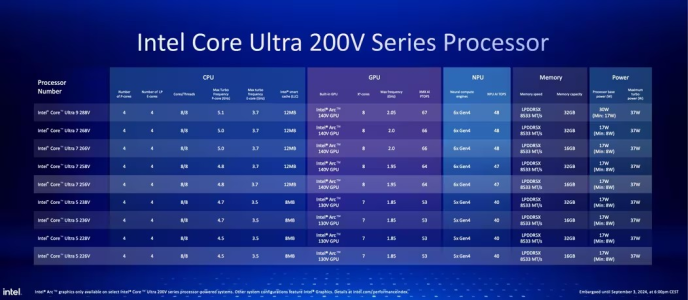
Intel Raptor Lake UIntel Wildcat Lake 15WIntel Lunar LakeIntel Panther Lake 4+0+4
Launch DateQ1-2024Q2-2026Q3-2024Q1-2026
ModelIntel 150UIntel Core 7 360Core Ultra 7 268VCore Ultra 7 365
Dies2223
NodeIntel 7 + ?Intel 18-A + TSMC N6TSMC N3B + N6Intel 18-A + Intel 3 + TSMC N6
CPU2 P-core + 8 E-cores2 P-core + 4 LP E-cores4 P-core + 4 LP E-cores4 P-core + 4 LP E-cores
Threads12688
Max Clock5.4 GHz4.8 GHz5 GHz4.8 GHz
L3 Cache12 MB6 MB12 MB12 MB
TDP15 - 55 W15 - 35 W17 - 37 W25 - 55 W
Memory128-bit LPDDR5-520064-bit LPDDR5x-7467128-bit LPDDR5x-8533128-bit LPDDR5x-7467
Size96 GB48 GB32 GB128 GB
Bandwidth83 GB/s60 GB/s136 GB/s120 GB/s
GPUIntel GraphicsIntel GraphicsArc 140VIntel Graphics
RTNoNoYESYES
EU / Xe96 EU2 Xe8 Xe4 Xe
Max Clock1.3 GHz2.6 GHz2 GHz2.5 GHz
NPUGNA 3.017 TOPS48 TOPS49 TOPS


PPT1.jpg
PPT2.jpg
PPT3.jpg


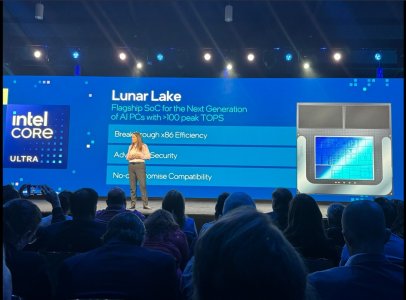
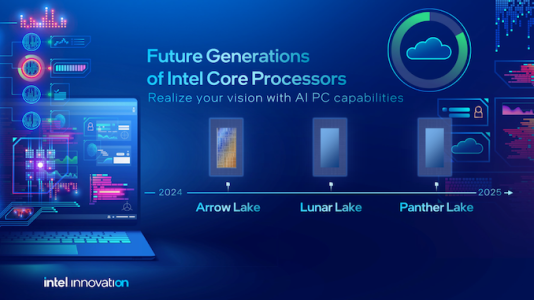
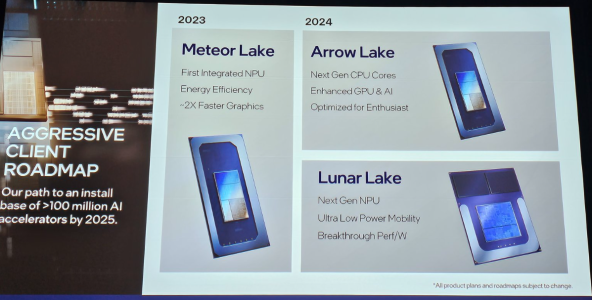
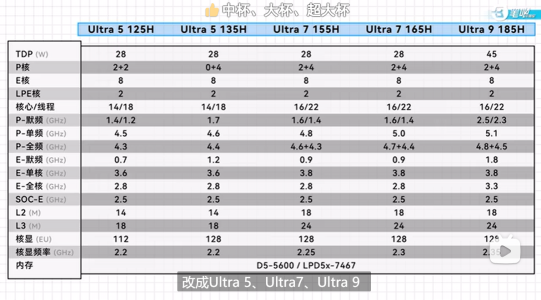
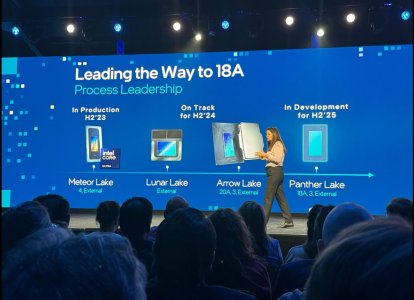
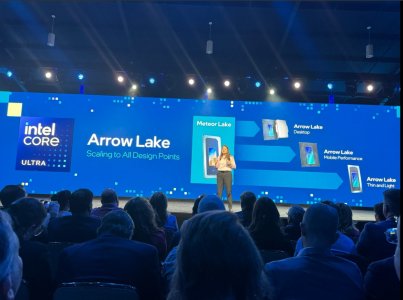
As Hot Chips 34 starting this week, Intel will unveil technical information of upcoming Meteor Lake (MTL) and Arrow Lake (ARL), new generation platform after Raptor Lake. Both MTL and ARL represent new direction which Intel will move to multiple chiplets and combine as one SoC platform.

MTL also represents new compute tile that based on Intel 4 process which is based on EUV lithography, a first from Intel. Intel expects to ship MTL mobile SoC in 2023.

ARL will come after MTL so Intel should be shipping it in 2024, that is what Intel roadmap is telling us. ARL compute tile will be manufactured by Intel 20A process, a first from Intel to use GAA transistors called RibbonFET.


LNL-MX.png
 

Attachments

  • PantherLake.png
    PantherLake.png
    283.5 KB · Views: 24,049
  • LNL.png
    LNL.png
    881.8 KB · Views: 25,534
  • INTEL-CORE-100-ULTRA-METEOR-LAKE-OFFCIAL-SLIDE-2.jpg
    INTEL-CORE-100-ULTRA-METEOR-LAKE-OFFCIAL-SLIDE-2.jpg
    181.4 KB · Views: 72,443
  • Clockspeed.png
    Clockspeed.png
    611.8 KB · Views: 72,329
Last edited:
These laptops being compared have different battery sizes and chassis. We need an apples/apples test with both of these chips in the same chassis like what JarrodTech did with 13700H vs 7840HS.

The only improvement we should expect is what is shown below.

View attachment 90068

Lots of the uncore/IO of the chip won't see this kind of improvement so you won't get this straight forward of benefit at a chip level. Additionally, it seems that Intel has eaten away any efficiency gains from the process with the complexity overhead of the tile design.
 
I'm pretty sure they actually marketed RPL + Keem Bay m.2 addon for a bit.

Never saw anything like that on the consumer side, must of just been to system builders/integrators. I'm guessing no one bit since there haven't been any end products with that configuration, at least that I'm aware of.
 
If MTL has worse or ~ same perf/watt than RPL, it's gonna be ICL all over again lol
There is one misconception about MTL that keeps popping up pretty often. MTL's PPW under full load will definitely be closer to RPL. Absolutely no doubts there. It's the same exact RPL core in a fancy new tile.

MTL's efficiency is not about when the CPU tile runs under full load. It's all about when the CPU tile is NOT running under full load. Especially when the CPU & GPU tiles are off which is most of the time for most users.

Also. MTL is guaranteed to fall flat in power-efficiency benchmarks that stresses the CPU tile cos MTL isn't designed for that. We'll be needing new benchmarks. Either way, real world data will be available in a few days from now.

Imho, MTL's efficiency is all about lighter real-world loads only. Nothing else.
 
Last edited:
Especially when the CPU & GPU tiles are off which is most of the time for most users.

I'm still skeptical of this claim. Anything interactive, apps, web browsing, emails, are going to be run on a P-core for responsiveness. I don't think most users will see much benefit from the new ELP cores. Maybe in long idle battery or video playback scenarios but even then, I'm not sure how much better it may be versus a monolithic design that can power down pretty much anything it needs to anyway. Obviously we'll have to wait for the tests to see, but I'm not that hopeful on this point.
 
I'm still skeptical of this claim. Anything interactive, apps, web browsing, emails, are going to be run on a P-core for responsiveness. I don't think most users will see much benefit from the new ELP cores. Maybe in long idle battery or video playback scenarios but even then, I'm not sure how much better it may be versus a monolithic design that can power down pretty much anything it needs to anyway. Obviously we'll have to wait for the tests to see, but I'm not that hopeful on this point.
That’s no longer the case with MTL. They’ve changed to taking an Apple approach by changing how quickly it ramps clocks and what cores are targeted for certain tasks. It doesn’t automatically target P cores first anymore. It begins with LP e-cores -> e-cores -> p-cores.
 
wow nice goalpost move.
No goalpost moves. It's hard to understand MTL until you actually look into it's design goals.

Like I said, it's primary purpose is to improve efficiency using the LP E cores in lighter real-world loads and nothing else. Thats where the 2X mythical efficiency claims come from.

"MTL's efficiency is not about when the CPU tile runs under full load. It's all about when the CPU tile is NOT running under full load. Especially when the CPU & GPU tiles are off which is most of the time for most users."

Stress testing the CPU tile is just plain wrong and useless in case of MTL as it doesn't work that way. It will fail.

Did it ever occur to you that since the LP E cores will be active most of the time, the most important power curve we should be considering is that of the LP E cores and not the MLID's useless power curve of the CPU tile itself? MLID is wrong which is understandable, but you are better than that.
 
That’s no longer the case with MTL. They’ve changed to taking an Apple approach by changing how quickly it ramps clocks and what cores are targeted for certain tasks. It doesn’t automatically target P cores first anymore. It begins with LP e-cores -> e-cores -> p-cores.

That will be interesting to follow. I believe it was AMD's 4000 series that tried a slower ramp with the cores to save power and they got harshly criticized for it. If they're going through multiple layers to then ramp the p-cores, it may not be well received. Maybe they'll handle it better though, we'll see. Even still, I imagine the vast majority of what users do on a computer will quickly shuffle to the P-core, so I still don't know if it will be a saving grace here but if Intel pulls it off well, I'm all for it.
 
No goalpost moves. It's hard to understand MTL until you actually look into it's design goals.

Like I said, it's primary purpose is to improve efficiency using the LP E cores in lighter real-world loads and nothing else. Thats where the 2X mythical efficiency claims come from.

"MTL's efficiency is not about when the CPU tile runs under full load. It's all about when the CPU tile is NOT running under full load. Especially when the CPU & GPU tiles are off which is most of the time for most users."

Stress testing the CPU tile is just plain wrong and useless in case of MTL as it doesn't work that way.

Did it ever occur to you that since the LP E cores will be active most of the time, the most important power curve we should be considering is that of the LP E cores and not the MLID's useless power curve of the CPU tile itself? MLID is wrong which is understandable, but you are better than that.

The battery tests shown in the leak suggest either this configuration isn't working correctly (possible especially if it was under Win10) or it's not having the desired effect. Looking forward to actual trusted 3rd party reviews.
 
The battery tests shown in the leak suggest either this configuration isn't working correctly (possible especially if it was under Win10) or it's not having the desired effect. Looking forward to actual trusted 3rd party reviews.
Those HXL leaks are stress tests where MTL will surely fail, cos MTL's efficiency drops like a rock in these type of stress tests. Other way of looking at it is, if in a efficiency benchmark, MTL's P cores are active most of the time, MTL will surely fail that test and will perform similar or worse than RPL.

A new benchmark that prioritizes MTL's LP E cores will actually give better results. But one such benchmark doesn't exist yet. Until then, we'll have to rely on real world numbers when MTL releases in a few days.
 
Those HXL leaks are stress tests where MTL will surely fail, cos MTL's efficiency drops like a rock in these type of stress tests
Which is embarrassing
Other way of looking at it is, if in a efficiency benchmark, MTL's P cores are active most of the time, MTL will surely fail that test and will perform similar or worse than RPL.
It's on a better node, if it does so it's literally embarrassing lol
 
It's on a new node. Free PPW.

It literally is. The CPU tile is on a new node.

It's on a better node, if it does so it's literally embarrassing lol
There will be some node gains. But 2X efficiency gains is just not possible with node gains alone. If they ever hit 2X, it'll be due to the new architecture & the LP E cores only.
 
Those HXL leaks are stress tests where MTL will surely fail, cos MTL's efficiency drops like a rock in these type of stress tests. Other way of looking at it is, if in a efficiency benchmark, MTL's P cores are active most of the time, MTL will surely fail that test and will perform similar or worse than RPL.

A new benchmark that prioritizes MTL's LP E cores will actually give better results. But one such benchmark doesn't exist yet. Until then, we'll have to rely on real world numbers when MTL releases in a few days.

I'm talking about the Bilibili leak, not the HXL leak. The Bilibili leak had actual battery life tests, not stress tests, and MTL did not have an impressive showing. That said, there are a lot of details left out but it's not a great first impression.
 
One would hope there should be at least >10% gains from the node. You literally just said MTL will perform similarly or worse than RPL iso power.
There probably will be, we don't have any real data yet. We're comparing across different laptops with different power delivery and battery capacities. We're also using data from Core 7 155H that’s a 28W processor that's 3 tiers below the top SKU.

We don’t even have perf/watt graphs. Just screenshots of benchmark scores and rumors of how much power was used.

I'm talking about the Bilibili leak, not the HXL leak. The Bilibili leak had actual battery life tests, not stress tests, and MTL did not have an impressive showing. That said, there are a lot of details left out but it's not a great first impression.
The battery life test compared laptops with different battery capacities.
 
Last edited:
The node itself is fine. There’s really no need to jump to conclusions yet. We need to compare same laptop with both RPL & MTL under same conditions to get real data.

Also, some of these test apparently were done on Win10 and I wouldn't be surprised if the new thread director was not used either.
 
Back
Top