• We’re currently investigating an issue related to the forum theme and styling that is impacting page layout and visual formatting. The problem has been identified, and we are actively working on a resolution. There is no impact to user data or functionality, this is strictly a front-end display issue. We’ll post an update once the fix has been deployed. Thanks for your patience while we get this sorted.

Discussion Intel Meteor, Arrow, Lunar & Panther Lakes + WCL Discussion Threads

Page 476 - Seeking answers? Join the AnandTech community: where nearly half-a-million members share solutions and discuss the latest tech.

Tigerick

Senior member
Wildcat Lake (WCL) Specs

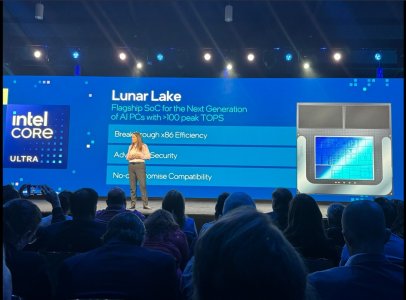
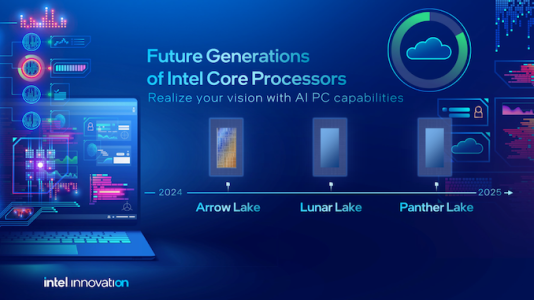
Intel Wildcat Lake (WCL) is upcoming mobile SoC replacing Raptor Lake-U. WCL consists of 2 tiles: compute tile and PCD tile. It is true single die consists of CPU, GPU and NPU that is fabbed by 18-A process. Last time I checked, PCD tile is fabbed by TSMC N6 process. They are connected through UCIe, not D2D; a first from Intel. Expecting launching in Q1 2026.
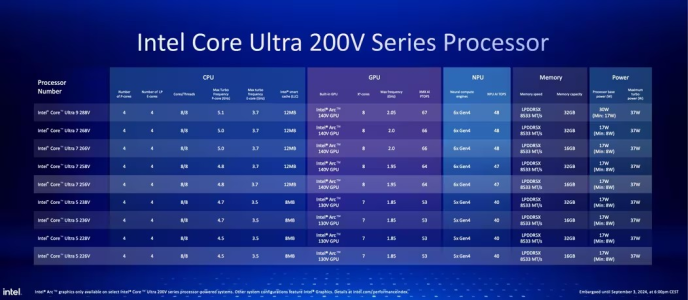
Intel Raptor Lake UIntel Wildcat Lake 15WIntel Lunar LakeIntel Panther Lake 4+0+4
Launch DateQ1-2024Q2-2026Q3-2024Q1-2026
ModelIntel 150UIntel Core 7 360Core Ultra 7 268VCore Ultra 7 365
Dies2223
NodeIntel 7 + ?Intel 18-A + TSMC N6TSMC N3B + N6Intel 18-A + Intel 3 + TSMC N6
CPU2 P-core + 8 E-cores2 P-core + 4 LP E-cores4 P-core + 4 LP E-cores4 P-core + 4 LP E-cores
Threads12688
Max Clock5.4 GHz4.8 GHz5 GHz4.8 GHz
L3 Cache12 MB6 MB12 MB12 MB
TDP15 - 55 W15 - 35 W17 - 37 W25 - 55 W
Memory128-bit LPDDR5-520064-bit LPDDR5x-7467128-bit LPDDR5x-8533128-bit LPDDR5x-7467
Size96 GB48 GB32 GB128 GB
Bandwidth83 GB/s60 GB/s136 GB/s120 GB/s
GPUIntel GraphicsIntel GraphicsArc 140VIntel Graphics
RTNoNoYESYES
EU / Xe96 EU2 Xe8 Xe4 Xe
Max Clock1.3 GHz2.6 GHz2 GHz2.5 GHz
NPUGNA 3.017 TOPS48 TOPS49 TOPS


PPT1.jpg
PPT2.jpg
PPT3.jpg


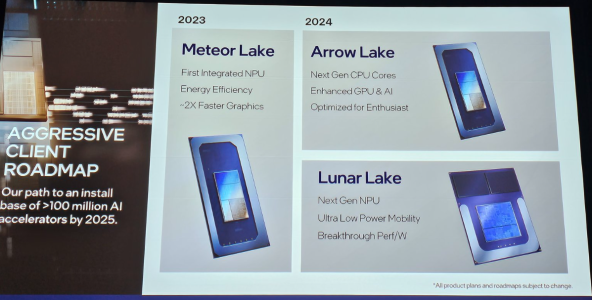
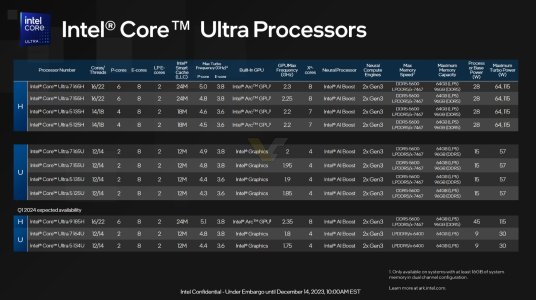
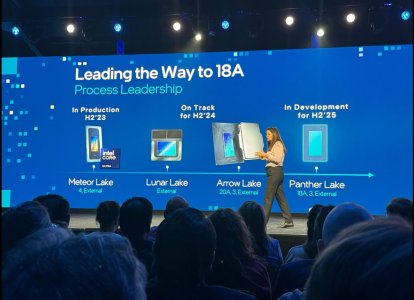
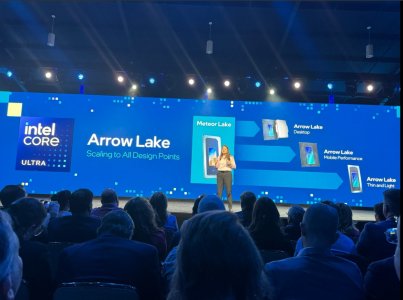
As Hot Chips 34 starting this week, Intel will unveil technical information of upcoming Meteor Lake (MTL) and Arrow Lake (ARL), new generation platform after Raptor Lake. Both MTL and ARL represent new direction which Intel will move to multiple chiplets and combine as one SoC platform.

MTL also represents new compute tile that based on Intel 4 process which is based on EUV lithography, a first from Intel. Intel expects to ship MTL mobile SoC in 2023.

ARL will come after MTL so Intel should be shipping it in 2024, that is what Intel roadmap is telling us. ARL compute tile will be manufactured by Intel 20A process, a first from Intel to use GAA transistors called RibbonFET.


LNL-MX.png
 

Attachments

  • PantherLake.png
    PantherLake.png
    283.5 KB · Views: 24,049
  • LNL.png
    LNL.png
    881.8 KB · Views: 25,534
  • INTEL-CORE-100-ULTRA-METEOR-LAKE-OFFCIAL-SLIDE-2.jpg
    INTEL-CORE-100-ULTRA-METEOR-LAKE-OFFCIAL-SLIDE-2.jpg
    181.4 KB · Views: 72,443
  • Clockspeed.png
    Clockspeed.png
    611.8 KB · Views: 72,329
Last edited:
PNL/CWF/DNR are all on track and are very promising! If they deliver as promised, competition is in very serious trouble considering their already minuscule market share both in clients AND servers!
Yeah. At least one whole year for Intel to fend off vultures and hostile takeover groups and investor lawsuits!
 
AMD wasn't full of absolute morons working against each other.

Intel's teams and management are used to having too much resources at their disposal. AMD has ALWAYS been lean. They don't know what excess is.

Going from having anything available to limited resources doesn't immediately lead to better execution. It will actually cause a lot of teething pains as they discover how to do things with limited budgets and those unable to thrive in such an environment will quit and leave gaping holes in skills and expertise.

Their stupid Meteor Lake hot lots fiasco is a direct result of them thinking they can do anything with their resources, in other words, waste investor money!

AMD, even under Lisa, fired thousands of employees between late 2000s and mid 2010s. You are clearly ignorant about the matter.

“ AMD has ALWAYS been lean. They don't know what excess is.”

 
AMD, even under Lisa, fired thousands of employees between late 2000s and mid 2010s. You are clearly ignorant about the matter.

“ AMD has ALWAYS been lean. They don't know what excess is.”

They have always been a fraction of Intel's workforce. That's why they have been number two for so long. Never made enough to get as big as Intel.
 
Anyway, carry on, folks with your happy talk about Intel's future. I just wanted ya all to think more clearly. Stepping out for a bit so gonna go silent.
 
Intel need to cut fat but the right fat that is something only time will tell they need to become lean and flexible and be ready for next bing thing something trinity got right closest comparison would be huang
 
Last edited:
Back on topic here, have y'all seen the Cinebench R24 single core scores of the 288V? 13% faster than Strix @ same clock speed.

If that carries to Arrow Lake, 285K is going to be over 150, and likely ~2500 in R23 if the same uplift applies there. Thats what Im talking about.

Depending on pricing, AMD will have have to lower Zen 5 significantly, their 4nm Zen 5 is going to get trounced by 3nm Lion Cove quite handily. Seems AMD miscalculated in using 4nm for client in Zen 5, but maybe they had no choice / no capacity after Intel bought it all up.

*EDIT - corrected confusion about source of the score, thought it was from a 258V CPU in Yoga laptop, it is not.

Yoga Slim Lunar Lake.png
 
Last edited:
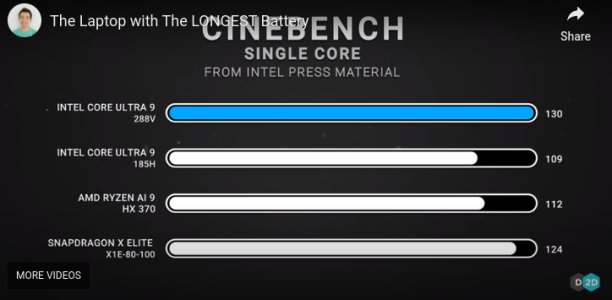
Back on topic here, have y'all seen the Cinebench R24 single core scores of the Yoga Slim Lunar Lake laptop?? 130 @4.8GHz max boost clock. If true, this destroys Zen5 Strix which averages 115 @5.1GHz max boost.
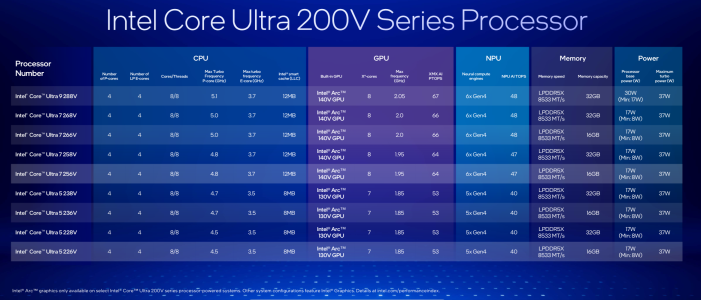
288V Max Boost is 5.1 though, but yeah ST would be faster on Lion Cove, on desktop and Mobile.
 
Back on topic here, have y'all seen the Cinebench R24 single core scores of the Yoga Slim Lunar Lake laptop?? 130 @4.8GHz max boost clock. If true, this destroys Zen5 Strix which averages 115 @5.1GHz max boost.

That is very impressive. Its about 13% faster than HX 370 ST average, and with only a 4.8 max boost??. If that carries to Arrow Lake, 285K is going to be over 160, and likely >2500 in R23 if the same uplift applies there. Thats what Im talking about.

Depending on pricing, AMD will have have to lower Zen 5 significantly, their 4nm Zen 5 is going to get trounced by 3nm Lion Cove quite handily. Seems AMD miscalculated in using 4nm for client in Zen 5, but maybe they had no choice / no capacity after Intel bought it all up.

View attachment 107018
I would take this with a grain of salt and also i would make it out as the best case i would expect it to be around 126-127 cause the fact 5.1 requires TB 3.0.It is rare to live up in laptops due to cooling constraints
 
I would take this with a grain of salt and also i would make it out as the best case i would expect it to be around 126-127 cause the fact 5.1 requires TB 3.0.It is rare to live up in laptops due to cooling constraints

This. I’d wait until independent reviews come out.
 
Back on topic here, have y'all seen the Cinebench R24 single core scores of the Yoga Slim Lunar Lake laptop?? 130 @4.8GHz max boost clock. If true, this destroys Zen5 Strix which averages 115 @5.1GHz max boost.

That is very impressive. Its about 13% faster than HX 370 ST average, and with only a 4.8 max boost??. If that carries to Arrow Lake, 285K is going to be over 160, and likely >2500 in R23 if the same uplift applies there. Thats what Im talking about.

Depending on pricing, AMD will have have to lower Zen 5 significantly, their 4nm Zen 5 is going to get trounced by 3nm Lion Cove quite handily. Seems AMD miscalculated in using 4nm for client in Zen 5, but maybe they had no choice / no capacity after Intel bought it all up.

View attachment 107018
1725713151182.png
(Higher quality image, in case @Tigerick wants to use that in the OP)

IMG_4373.png
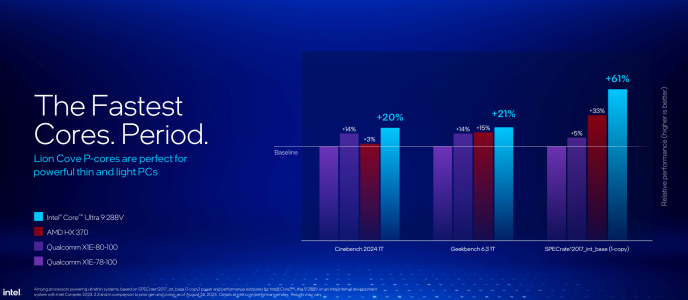
Based on the Intel slide^ (slide 20) showing the single thread performance compared to AMD and Qualcomm in CB24/GB6.3/spec2017int, I was thinking it’d be around 133-135 if going by the HX370 percentage difference (scores 115-116); and the statement and claim slide (says X1E84 and not the X1E80 on the slide itself).
Which is odd because the 130 score does lineup more with the X80 difference. But I doubt 130 is unreasonable though.
I think ARL will be around 150 based on the IPC increase of 14% and clock frequency reduction (using the 14900K single thread score of 139).
 
Last edited:
288V Max Boost is 5.1 though, but yeah ST would be faster on Lion Cove, on desktop and Mobile.
Ah, you are correct-- the Yoga laptop has max 4.8 boost with a 258V, but the R24 slide number is not from the that unit, its from 288V in an unknown unit/power profile. Still, if we assume ISO frequency, it looks like 13% higher R24 IPC vs Strix, still very impressive.
 
Yeah. Thats Apple. But are you trying to compare Apple with AMD? :tearsofjoy:


After many many years, competition is all set to be hot this year. In clients, Lion Cove + Skymont has already surpassed Zen 5 (by a small margin). In servers, Granite Rapids is all set to catch up with competition. Interesting times ahead.
To refresh the mind , as it seems it sometimes slips. You were the one claiming that because Intel still has the dominant share in servers, everything is fine for them. What did you write? Intel is in trouble, maybe they will recover.


"Oopsie. For a while I was under the impression that AMD server market share would've be around or over 50% when compared to Intel. Seeing these numbers is quite shocking.

AMD is not even at 25%, but just 23% in servers. I think the upcoming Intel server products should be able to stop the market share loss."


You are failing to note that when it comes to the profit share, Intel is trailing far behind AMD, and profits are the values that matter. Delusion and deceit is now a big part of our existence and it seems some relish doing little parts in the overall game. Maybe it's a generational thing.
 
Ah, you are correct-- the Yoga laptop has max 4.8 boost with a 258V, but the R24 slide number is not from the that unit, its from 288V in an unknown unit/power profile. Still, if we assume ISO frequency, it looks like 13% higher R24 IPC vs Strix, still very impressive.
I don't think its too wise to make such nuanced IPC comparisons with R24.. the scores are obviously influenced by other factors. A 9950X for e.g does ~140cb @ 5.7Ghz

Not downplaying the performance advantage here , it's a strong win SoC vs SoC and should of course count towards its performance along with every other workload , but it's just not something i'd use as an indication of comparative IPC on average.
 
I don't think its too wise to make such nuanced IPC comparisons with R24.. the scores are obviously influenced by other factors. A 9950X for e.g does ~140cb @ 5.7Ghz

Not downplaying the performance advantage here , it's a strong win SoC vs SoC and should of course count towards its performance along with every other workload , but it's just not something i'd use as an indication of comparative IPC on average.
R24 is much easier to gauge than something like Geekbench-- 9950X does around 132-138 in R24 ST depending on the review you look at. Anandtech put 9950X and 9900X at 132 and 131 respectively in their review. That is right in line with the 11.8% clock increase over HX 370 ST average of 115.

Im not using it for average IPC, but specifically R24. If the number cited is real, Lion Cove is looking like ~10-13% faster per clock than Zen 5 Nirvana core in R24.
 
R24 is much easier to gauge than something like Geekbench-- 9950X does around 132-138 in R24 ST depending on the review you look at. Anandtech put 9950X and 9900X at 132 and 131 respectively in their review. That is right in line with the 11.8% clock increase over HX 370 ST average of 115.

Im not using it for average IPC, but specifically R24. If the number cited is real, Lion Cove is looking like ~10-13% faster per clock than Zen 5 Nirvana core in R24.
R24 is memory subsystem dependant what makes it different to R23. I suggest checking out Chips&Cheese review of the benchmark. AT is using stock memory, while other outlets are using 6000MHz+ RAM. In case of Lunar Lake vs Strix, Lunar is enjoying both bandwidth and latency advantage. Since there exists memory subsystem dependency L3 size might also be of importance.
 
Back
Top