• We’re currently investigating an issue related to the forum theme and styling that is impacting page layout and visual formatting. The problem has been identified, and we are actively working on a resolution. There is no impact to user data or functionality, this is strictly a front-end display issue. We’ll post an update once the fix has been deployed. Thanks for your patience while we get this sorted.

Discussion Intel Meteor, Arrow, Lunar & Panther Lakes + WCL Discussion Threads

Page 385 - Seeking answers? Join the AnandTech community: where nearly half-a-million members share solutions and discuss the latest tech.

Tigerick

Senior member
Wildcat Lake (WCL) Specs

Intel Wildcat Lake (WCL) is upcoming mobile SoC replacing Raptor Lake-U. WCL consists of 2 tiles: compute tile and PCD tile. It is true single die consists of CPU, GPU and NPU that is fabbed by 18-A process. Last time I checked, PCD tile is fabbed by TSMC N6 process. They are connected through UCIe, not D2D; a first from Intel. Expecting launching in Q1 2026.
Intel Raptor Lake UIntel Wildcat Lake 15WIntel Lunar LakeIntel Panther Lake 4+0+4
Launch DateQ1-2024Q2-2026Q3-2024Q1-2026
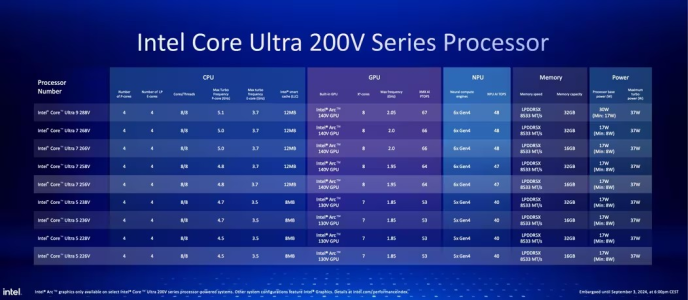
ModelIntel 150UIntel Core 7 360Core Ultra 7 268VCore Ultra 7 365
Dies2223
NodeIntel 7 + ?Intel 18-A + TSMC N6TSMC N3B + N6Intel 18-A + Intel 3 + TSMC N6
CPU2 P-core + 8 E-cores2 P-core + 4 LP E-cores4 P-core + 4 LP E-cores4 P-core + 4 LP E-cores
Threads12688
Max Clock5.4 GHz4.8 GHz5 GHz4.8 GHz
L3 Cache12 MB6 MB12 MB12 MB
TDP15 - 55 W15 - 35 W17 - 37 W25 - 55 W
Memory128-bit LPDDR5-520064-bit LPDDR5x-7467128-bit LPDDR5x-8533128-bit LPDDR5x-7467
Size96 GB48 GB32 GB128 GB
Bandwidth83 GB/s60 GB/s136 GB/s120 GB/s
GPUIntel GraphicsIntel GraphicsArc 140VIntel Graphics
RTNoNoYESYES
EU / Xe96 EU2 Xe8 Xe4 Xe
Max Clock1.3 GHz2.6 GHz2 GHz2.5 GHz
NPUGNA 3.017 TOPS48 TOPS49 TOPS


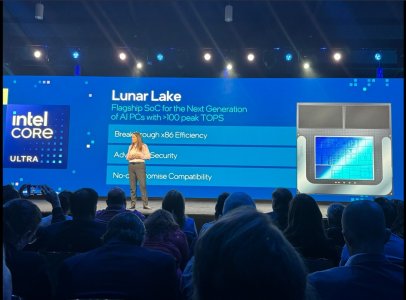
PPT1.jpg
PPT2.jpg
PPT3.jpg


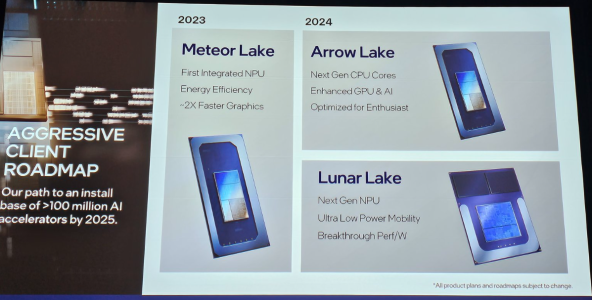
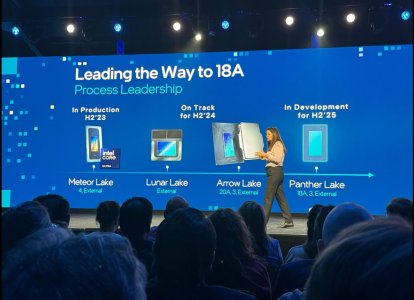
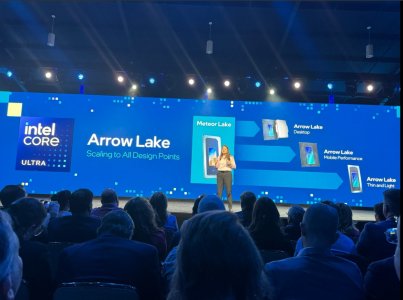
As Hot Chips 34 starting this week, Intel will unveil technical information of upcoming Meteor Lake (MTL) and Arrow Lake (ARL), new generation platform after Raptor Lake. Both MTL and ARL represent new direction which Intel will move to multiple chiplets and combine as one SoC platform.

MTL also represents new compute tile that based on Intel 4 process which is based on EUV lithography, a first from Intel. Intel expects to ship MTL mobile SoC in 2023.

ARL will come after MTL so Intel should be shipping it in 2024, that is what Intel roadmap is telling us. ARL compute tile will be manufactured by Intel 20A process, a first from Intel to use GAA transistors called RibbonFET.


LNL-MX.png
 

Attachments

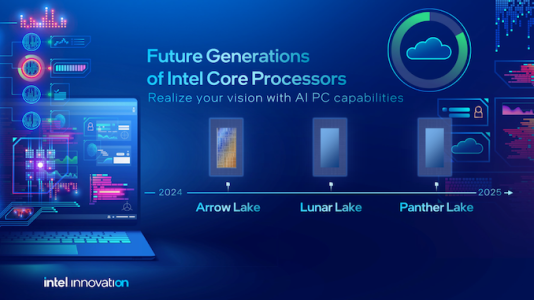
  • PantherLake.png
    PantherLake.png
    283.5 KB · Views: 24,049
  • LNL.png
    LNL.png
    881.8 KB · Views: 25,534
  • INTEL-CORE-100-ULTRA-METEOR-LAKE-OFFCIAL-SLIDE-2.jpg
    INTEL-CORE-100-ULTRA-METEOR-LAKE-OFFCIAL-SLIDE-2.jpg
    181.4 KB · Views: 72,443
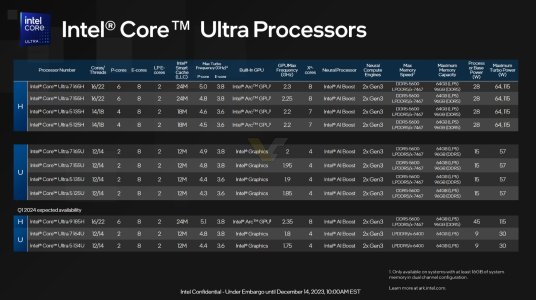
  • Clockspeed.png
    Clockspeed.png
    611.8 KB · Views: 72,329
Last edited:
TS score(Highest for the given TDP from notebookcheck database):
15W 8840U -> 2688 (100%)
17W LNL -> 3438 (128%)
64/20W MTL 185H -> 3537 (132%)

28W 7840U -> 3232 (100%)
64/28W MTL 155H -> 3710 (115%)
30W LNL -> 4151 (128%)

At low TDPs It looks the most impressive. If Intel will keep improving their drivers, then It could be interesting.
Xe2 with the hardware changes will do better than Xe. Xe's deficiency likely makes it harder for the driver team.

Look at what Tom Petersen has been saying:
-SIMD16 internals allow much more games to run OOB, meaning it won't need Day 1 changes just to make it work
-Draw/Execute Indirect boosts performance, especially in UE5 games
-Fast Clear native hardware for Xe2.

The strong demand on the iGPUs from synthetic benchmarks such as Time Spy makes Alchemist look better than it is. Realistically Xe2 will do better in games because of the changes. Supporting Fast Clear only now is a big surprise too. Someone said AMD/Nvidia had it for more than a decade or something? Fast Clear also means needing less memory BW per performance.

Also note that 155H's Arc 7 tops at 2.25GHz GPU Turbo, while Lunarlake is only 2.05GHz. So it's faster even though the top clocks are lower.
 
It's already kinda established that those 2 Crestmont LPE cores in MTL SoC tile aren't powerful enough to handle the background tasks. If the same cores are gonna feature in ARL, they're still not gonna be very useful. Or am I missing something crucial?
I guess we will get similar Crestmont cores. Probably, they won't be exposed to the system.

I think Intel would like to use the SoC from Meteor Lake in Arrow Lake, but it won't match Microsoft's 40 TOPs requirement. So, Intel probably has to make some changes to the SoC tile. Maybe we will get Skymont cores and the Side Cache there, but it's unlikely.
 
Lunar Lake is going to be a big improvement for small form factor laptops. Imagine a low power laptop with 8 Raptor Cove cores. Pretty good. Now imagine 4 Lion Cove + 4 Raptor Cove. Even better. Top of the stack parts might well compete with the 14500.
I would wait for reviews, but so far nT performance doesn't look very strong against competition, which is kinda expected considering It has only 8 cores and no HT.
Compared to Ultra 5 135U 59/18W (2P+8E+2LP), which managed higher 9315pts in CB R23 this one should still be better in comparison from 1->8 threads.

It won't be a bad SoC or anything.
Yes, If you check raw performance of the CPU part then It will loose against Strix maybe even against Kraken at the same TDP, but mostly due to higher core count or SMT or both.
Still, I can agree that not many users would realistically need more than 8 cores or use more than 8 threaded Apps, so this limitation shouldn't be a real problem.
The question is at what price It will be sold compared to competition.
 
LNL has a new GPU architecture, so we don't know If TS score will be inflated or not or by how much compared to MTL.
On the other hand, even If It is inflated, It is not a low value.
If It was TS Graphics, It would be better, but whatever.

TS score(Highest for the given TDP from notebookcheck database):
15W 8840U -> 2688 (100%)
17W LNL -> 3438 (128%)
64/20W MTL 185H -> 3537 (132%)

28W 7840U -> 3232 (100%)
64/28W MTL 155H -> 3710 (115%)
30W LNL -> 4151 (128%)

At low TDPs It looks the most impressive. If Intel will keep improving their drivers, then It could be interesting.
Is the 15W 8840U score with a 15W PL1/2, or just a 15W PL1? Because the guy who gave the 17W LNL score confirmed it's 17W PL1/PL2.
 
Xe2 with the hardware changes will do better than Xe. Xe's deficiency likely makes it harder for the driver team.

Look at what Tom Petersen has been saying:
-SIMD16 internals allow much more games to run OOB, meaning it won't need Day 1 changes just to make it work
-Draw/Execute Indirect boosts performance, especially in UE5 games
-Fast Clear native hardware for Xe2.

The strong demand on the iGPUs from synthetic benchmarks such as Time Spy makes Alchemist look better than it is. Realistically Xe2 will do better in games because of the changes. Supporting Fast Clear only now is a big surprise too. Someone said AMD/Nvidia had it for more than a decade or something? Fast Clear also means needing less memory BW per performance.

Also note that 155H's Arc 7 tops at 2.25GHz GPU Turbo, while Lunarlake is only 2.05GHz. So it's faster even though the top clocks are lower.
155H uses ARC 8 at 2.25GHz and even If LNL has lower turbo, It's highly possible It can keep higher sustained clocks than MTL, so I wouldn't make conclusions based on It.

So the question is how much better will Battlemage do than Alchemist in games. We don't know that yet.

@Magio I edited my original post, It is 15W PL1/PL2 GPD Win Mini Zen 4
 
Last edited:
155H uses ARC 8 at 2.25GHz and even If LNL has lower turbo, It's highly possible It can keep higher sustained clocks than MTL, so I wouldn't make conclusions based on It.

So the question is how much better will Battlemage do than Alchemist in games. We don't know that yet.

@Magio I edited my original post, It is 15W PL1/PL2 GPD Win Mini Zen 4
Alchemist is shown by C&C to have significant flaws that it can't take advantage of neither the 512GB/s memory nor the full architecture unless it has higher workload, which is why it's significantly better on 4K and high setting setups. It sounds like you didn't read all of my post.

Also without the Day 1 driver optimizations it often does not work out of the box which Peterson said the SIMD16 will make it have many more games work without changes.

The changes highlighted doesn't sound like something trivial. It sounds like it'll be quite a bit better on games too. Like I said, 3DMark benchmarks pummel iGPUs with mostly unplayable frame rates, which favors Alchemist. Battlemage will do better without some unforseen errors.

Look at the graph where Intel says it's "1.5x" performance. It calculates out to be 1.3x at the high end, so if you assume similar clocks it's 1.5x faster.
 
Look at the graph where Intel says it's "1.5x" performance. It calculates out to be 1.3x at the high end, so if you assume similar clocks it's 1.5x faster.
1.5x performance was calculated based on TS and against MTL 165U and that one has 4 XEs at 2GHz.😀
And you have an actual TS score for LNL, unless that is a fake.
 
1.5x performance was calculated based on TS and against MTL 165U and that one has 4 XEs.😀
And you have an actual TS score, unless that is a fake.
Take a look at the Lunarlake presentation.

1.5x is against the -U but at far lower power. It performs 2.25x as fast in it's full envelope. It's more than 1.3x over -H. They sandbagged it. I bet that's not over.
 
Take a look at the Lunarlake presentation.

1.5x is against the -U but at far lower power. It performs 2.25x as fast in it's full envelope. It's more than 1.3x over -H. They sandbagged it. I bet that's not over.
I don't need to look at anything from Intel's presentation, we already have LNL scores in TS at 17W and 30W unless they are fake.
We just don't know how It performs in actual games and this we won't know for some time unless another leak is out.
 
But aren't they reusing the exact same TSMC N6 SoC tile from MTL? If thats the case, how can we expect any improvement? 🙁
I didn't realize there were no changes. If so, then we'd only get scheduling improvements (and possibly different power levels available but that wouldn't change much).
 
OMG!!! Is this even REAL??? or FAKE?

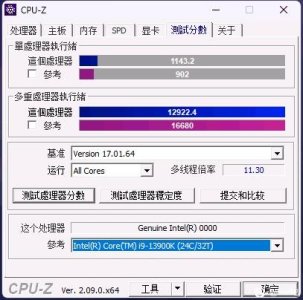
Thats a massive 27% single-core uplift. That too against RPL. Against MTL, it'll be well above 30%.

Assuming it's real, it's time for me say "I told you so" to around a dozen people here.

Hold on! @SiliconFly is typing...
I.ve already said desktop lion cove will be 25% or 30% plus over raptor cove.. in the forum they said its using 20A node 🤔
 
  • CPU-Z has never been considered a valid/good/decent benchmark.
  • Arrow Lake is at least Q4/2024, it's too early for such leaks. Intel last weak announced they had starting to tap out Lunar Lake CPUs.
  • Such a screenshot is too easy to photoshop. Don't get your hopes high. We've already seen fabricated Zen 5 screenshots from China.
GB6/GB5 ST results will show a much better picture. MT not so much.
 
  • CPU-Z has never been considered a valid/good/decent benchmark.
  • Arrow Lake is at least Q4/2024, it's too early for such leaks. Intel last weak announced they had starting to tap out Lunar Lake CPUs.
  • Such a screenshot is too easy to photoshop. Don't get your hopes high. We've already seen fabricated Zen 5 screenshots from China.
GB6/GB5 ST results will show a much better picture. MT not so much.
It is a alright benchmark that at least scales compared to GB6. CPU-Z is a good indicator if compared against other Intel CPUs.
Chips and Cheese analyzed the bench and came to the conclusion that the instruction mix does not accurately resemble consumer workloads.
I call half BS on that, which bench really resembles consumer workloads SPEC - FP or INT, Cinebench, all the other crazy SIMD benches ?
I think the bench got overcriticized because AMD is slow in it, showing that the Zen4 core is less wide AND SLOWER, which it is.

I cannot make this sh... up, wait for GB6 benches and don't trust CPU-Z.....

The leaks seem possible, E-Cores are buffed beyond 50% and the P core are min +15% faster with additional news of the new layout.
Current System (13700K@1,34V 2P@5,8 6P@5,7 8P@5,5 8E@4,4 = CPU-Z : ST=938, MT= 13100), so quite realistic.
 
All conspiracy with no evidence. SKL is faster than Zen1 in all cases.

Lol, it s documented by CPU Z themselves, they explained the "reasons" for such a downgrade after they revised the 1.73 version wich was released in december 2016 and "updated" in may 2017 after they noticed the surprisingly good score of the 1800X.
 
Back
Top