• We’re currently investigating an issue related to the forum theme and styling that is impacting page layout and visual formatting. The problem has been identified, and we are actively working on a resolution. There is no impact to user data or functionality, this is strictly a front-end display issue. We’ll post an update once the fix has been deployed. Thanks for your patience while we get this sorted.

Discussion Intel Meteor, Arrow, Lunar & Panther Lakes + WCL Discussion Threads

Page 378 - Seeking answers? Join the AnandTech community: where nearly half-a-million members share solutions and discuss the latest tech.

Tigerick

Senior member
Wildcat Lake (WCL) Specs

Intel Wildcat Lake (WCL) is upcoming mobile SoC replacing Raptor Lake-U. WCL consists of 2 tiles: compute tile and PCD tile. It is true single die consists of CPU, GPU and NPU that is fabbed by 18-A process. Last time I checked, PCD tile is fabbed by TSMC N6 process. They are connected through UCIe, not D2D; a first from Intel. Expecting launching in Q1 2026.
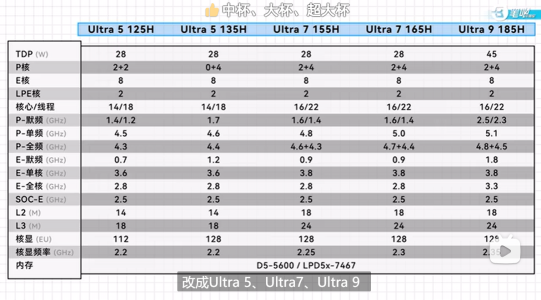
Intel Raptor Lake UIntel Wildcat Lake 15WIntel Lunar LakeIntel Panther Lake 4+0+4
Launch DateQ1-2024Q2-2026Q3-2024Q1-2026
ModelIntel 150UIntel Core 7 360Core Ultra 7 268VCore Ultra 7 365
Dies2223
NodeIntel 7 + ?Intel 18-A + TSMC N6TSMC N3B + N6Intel 18-A + Intel 3 + TSMC N6
CPU2 P-core + 8 E-cores2 P-core + 4 LP E-cores4 P-core + 4 LP E-cores4 P-core + 4 LP E-cores
Threads12688
Max Clock5.4 GHz4.8 GHz5 GHz4.8 GHz
L3 Cache12 MB6 MB12 MB12 MB
TDP15 - 55 W15 - 35 W17 - 37 W25 - 55 W
Memory128-bit LPDDR5-520064-bit LPDDR5x-7467128-bit LPDDR5x-8533128-bit LPDDR5x-7467
Size96 GB48 GB32 GB128 GB
Bandwidth83 GB/s60 GB/s136 GB/s120 GB/s
GPUIntel GraphicsIntel GraphicsArc 140VIntel Graphics
RTNoNoYESYES
EU / Xe96 EU2 Xe8 Xe4 Xe
Max Clock1.3 GHz2.6 GHz2 GHz2.5 GHz
NPUGNA 3.017 TOPS48 TOPS49 TOPS


PPT1.jpg
PPT2.jpg
PPT3.jpg


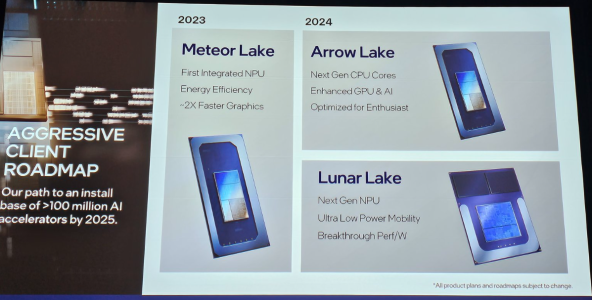
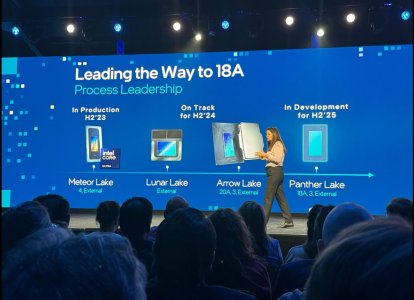
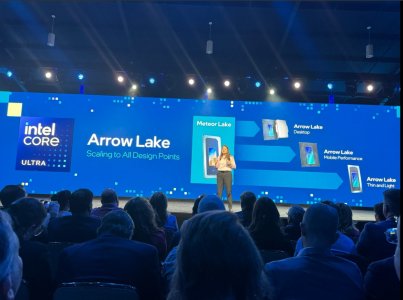
As Hot Chips 34 starting this week, Intel will unveil technical information of upcoming Meteor Lake (MTL) and Arrow Lake (ARL), new generation platform after Raptor Lake. Both MTL and ARL represent new direction which Intel will move to multiple chiplets and combine as one SoC platform.

MTL also represents new compute tile that based on Intel 4 process which is based on EUV lithography, a first from Intel. Intel expects to ship MTL mobile SoC in 2023.

ARL will come after MTL so Intel should be shipping it in 2024, that is what Intel roadmap is telling us. ARL compute tile will be manufactured by Intel 20A process, a first from Intel to use GAA transistors called RibbonFET.
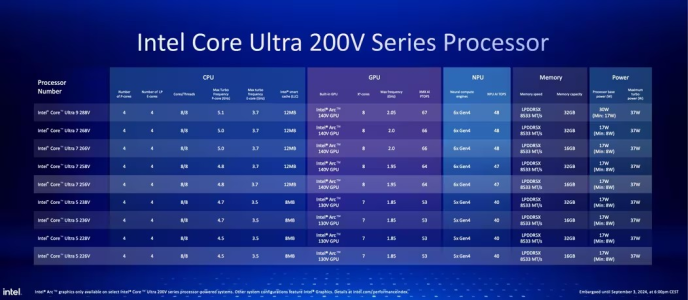


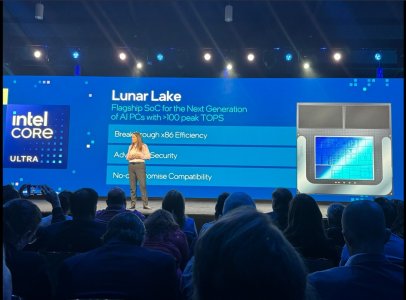
LNL-MX.png
 

Attachments

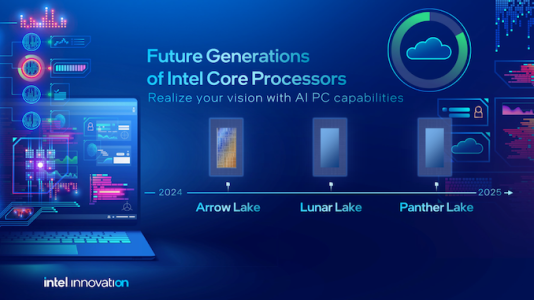
  • PantherLake.png
    PantherLake.png
    283.5 KB · Views: 24,049
  • LNL.png
    LNL.png
    881.8 KB · Views: 25,534
  • INTEL-CORE-100-ULTRA-METEOR-LAKE-OFFCIAL-SLIDE-2.jpg
    INTEL-CORE-100-ULTRA-METEOR-LAKE-OFFCIAL-SLIDE-2.jpg
    181.4 KB · Views: 72,443
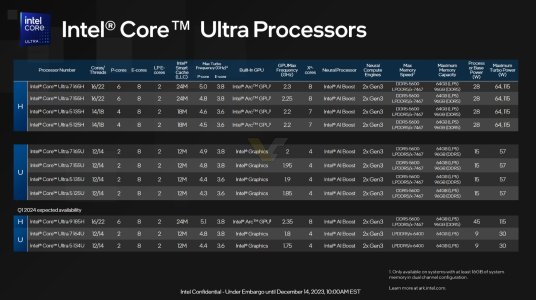
  • Clockspeed.png
    Clockspeed.png
    611.8 KB · Views: 72,329
Last edited:
It was supposed to come out later this year. As for the delay, it was due to a supposed new die above G21 that they were working on. Who knows if it will still come to market though.

Supposedly G21 is ready to go though.
The only thing we know about Battlemage discrete release date is rumors and the leaked roadmap a while ago.

Considering how much more efficient Xe2 is, it would be a shame not to have the dGPU version that clearly outclasses A770.
 
LNL 16GB is a single rank memory configuration. Dual rank memory can be up to 10% faster for faster iGPUs. It's certainly not a best case there. 50% over MTL-U 15W was a little off.
So they were sandbagging.

Looks like it's almost 50% faster at the same power compared to Meteorlake's Alchemist and 2x faster than the 15W Alchemist.
 
IGP looks pretty good, but CB nT is weaker than 7840U at comparable TDPs.
7840U manages ~12,385 pts at 30 W PL2 / Short Burst, 25 W PL1 / Sustained. Link
LNL manages 10,212? pts at 30W.
That's not a good result.
 
IGP looks pretty good, but CB nT is weaker than 7840U at comparable TDPs.
7840U manages ~12,385 pts at 30 W PL2 / Short Burst, 25 W PL1 / Sustained. Link
LNL manages 10,212? pts at 30W.
That's not a good result.
Not always. 7840U scores around 8K at 15W too, and LNL is competitive there. But yeah, by 20W 7840U jumps to around 10K already, so LNL does definitely fall off at higher TDPs, but for a 4+4 part with no HT, that's a really good result still.

(Numbers are from my own testing on my GPD Win Mini).
 
Not always. 7840U scores around 8K at 15W too, and LNL is competitive there. But yeah, by 20W 7840U jumps to around 10K already, so LNL does definitely fall off at higher TDPs, but for a 4+4 part with no HT, that's a really good result still.

(Numbers are from my own testing on my GPD Win Mini).

At 30W the 6C/12T 7540U score 10k, while at 15W the 2C + 4c 7545U score about 7.5k, that s the only chips LNL is competititive with CPU wise, 7840U is in another category, and so will be KRK to an even bigger extent.

 
Not always. 7840U scores around 8K at 15W too, and LNL is competitive there. But yeah, by 20W 7840U jumps to around 10K already, so LNL does definitely fall off at higher TDPs, but for a 4+4 part with no HT, that's a really good result still.

(Numbers are from my own testing on my GPD Win Mini).
Don't forget 7840U is the previous gen and the missing HT was Intel's choice, which they didn't compensate by using more E-cores.
Kraken 4+4 would offer even better performance in comparison.

If you want high nT performance at low TDP, then LNL doesn't look very competitive.
 
Last edited:
If you want high nT performance at low TDP, then LNL doesn't look very competitive.
You are looking at a pre-production chip, with single rank memory, and preliminary drivers. So take things with a little grain of salt. But, that said, I want to know more about this use case where people want to do workstation tasks (such as 3D rendering and modeling) on an ultraportable laptop. All while using a mid-range Lunar Lake pushed to it's power limit. Why is it that this is the specific use case that you point out as important to know about?
 
Last edited:
You are looking at a pre-production chip, with single channel memory, and preliminary drivers. So take things with a little grain of salt.
How much does single channel affect CB score? 1%, 3%, 5%, 10%, 20% or more?
But, that said, I want to know more about this use case where people want to do workstation tasks (such as 3D rendering and modeling) on an ultraportable laptop. All while using a mid-range Lunar Lake pushed to it's power limit.
Then I can argue why would anyone buy an 8-core LNL, If they will only use It for web and video, never fully loading the CPU.

edit:
Why is it that this is the specific use case that you point out as important to know about?
If you didn't notice I am talking about nT performance. I hope you don't want to say that's not important.
 
Last edited:
IGP looks pretty good, but CB nT is weaker than 7840U at comparable TDPs.
7840U manages ~12,385 pts at 30 W PL2 / Short Burst, 25 W PL1 / Sustained. Link
LNL manages 10,212? pts at 30W.
That's not a good result.

16 threads vs 8 threads? 30W is too high for LNL with 8 cores/8 threads, 17W is a much better sweetspot which is why only 1 SKU is rated with 30W. And by the way he tested a Pre-QS, we have to be careful with these results.


You are looking at a pre-production chip, with single channel memory, and preliminary drivers. So take things with a little grain of salt. But, that said, I want to know more about this use case where people want to do workstation tasks (such as 3D rendering and modeling) on an ultraportable laptop. All while using a mid-range Lunar Lake pushed to it's power limit. Why is it that this is the specific use case that you point out as important to know about?


Single rank not single channel.
 
16 threads vs 8 threads?
It was Intel's decision. Without using HT for all cores, It would still result in lower score.
I will have to check, If I can't deactivate SMT on my 7840HS and test CB with and without SMT at 30W.
30W is too high for LNL with 8 cores/8 threads, 17W is a much better sweetspot which is why only 1 SKU is rated with 30W. And by the way he tested a Pre-QS, we have to be careful with these results.
You still see 25% higher CB score from 30W TDP, that is not such a bad result.
Unless they are fake, I don't expect more than 5% gain.
 
How much does single channel affect CB score? 1%, 3%, 5%, 10%, 20% or more?

If you didn't notice I am talking about nT performance. I hope you don't want to say that's not important.
I didn't quickly find a benchmark on Cinebench with single vs. dual rank memory. Igor's Lab has some testing on other software that ranges from 2% to 18% difference and average of 5.4% boost: https://www.igorslab.de/en/performa...in-theory-and-practice-with-cyberpunk-2077/3/

I did notice about the performance you are talking about. The very case that is probably the least likely to be used on an ultraportable laptop CPU. Had this been Arrow Lake then I could almost see someone caring about that, even though a workstation is still the right product for that person. That is why I am asking what use cases that you foresee where will this be important. What 3D modeler gets an ultralight laptop to do intensive 3D modeling work (you know, the reason that you are talking about Cinebench)?
 
I didn't quickly find a benchmark on Cinebench with single vs. dual rank memory. Igor's Lab has some testing on other software that ranges from 2% to 18% difference and average of 5.4% boost: https://www.igorslab.de/en/performa...in-theory-and-practice-with-cyberpunk-2077/3/
This is no longer important, as @mikk already pointed out, It is dual-channel.
I did notice about the performance you are talking about. The very case that is probably the least likely to be used on an ultraportable laptop CPU. Had this been Arrow Lake then I could almost see someone caring about that, even though a workstation is still the right product for that person. That is why I am asking what use cases that you foresee where will this be important.
If I want an ultrabook with <=30W TDP, then unless there is a big difference in price I would choose the one with higher nT performance.
It's not important If I have a use case for It or not.
Simply put, I won't buy a weaker SoC(APU) for the same price just because I can't use all the cores.
 
This is no longer important, as @mikk already pointed out, It is dual-channel.

If I want an ultrabook with <=30W TDP, then unless there is a big difference in price I would choose the one with higher nT performance.
It's not important If I have a use case for It or not.
Simply put, I won't buy a weaker SoC(APU) for the same price just because I can't use all the cores.
Yes, mikk corrected my error. I have edited my post above, I meant to type single-rank not single-channel. It still matters, since this is the slowest memory configuration that you are looking at. The link I provided shows an average of 5.4% gain when going to dual-rank memory.

So you have no use case, can't think of one, yet you specifically pick out one and only one of the multithreaded benchmarks in the leak to talk about? It just isn't a very relevant benchmark for this CPU's target market. I can't wait to play Cinebench on a MSI Claw! https://videocardz.com/newz/msi-con...graded-to-lunar-lake-no-plans-for-amd-version
 
Yes, mikk corrected my error. I have edited my post above, I meant to type single-rank not single-channel. It still matters, since this is the slowest memory configuration that you are looking at. The link I provided shows an average of 5.4% gain when going to dual-rank memory.

So you have no use case, can't think of one, yet you specifically pick out one and only one of the multithreaded benchmarks in the leak to talk about? It just isn't a very relevant benchmark for this CPU's target market. I can't wait to play Cinebench on a MSI Claw! https://videocardz.com/newz/msi-con...graded-to-lunar-lake-no-plans-for-amd-version

I kind of agree with you, but to be fair, MacBook Airs get compared with Cinebench, Blender, etc., so I don’t see why LNL shouldn’t be compared with these as well.
 
I'll be honest, I don't think the CPU benchmarks are gonna get much better from here. Especially not something like R23 which sits almost entirely in cache anyway.
They might not. So, here is a comparison as close as I could find with the CPU that TESKATLIPOKA suggested (same base frequency, both Windows 11--albeit different versions, same memory size):

Of course, power consumed isn't listed, but at least we can get rough performance guesses.
 
I kind of agree with you, but to be fair, MacBook Airs get compared with Cinebench, Blender, etc., so I don’t see why LNL shouldn’t be compared with these as well.
Yes, there is value to Cinebench data. It is just of less importance to other benchmarks. I'm mostly wondering why he picked the one benchmark of all leaks that shows Lunar Lake in the worst light with the least likely use case to make his conclusion.

I would have used multiple benchmarks and multiple chips at the very least before concluding here (even if just based on preliminary data).
 
If these are the final benchmark results (or close to), I just don't know what the point of LNL is besides making for a good handheld gaming PC chip (but likely an expensive one).

You want something that's good at low power? M series chips destroy it even fanless, and first gen Snapdragon X Elite handily beats it when thermally limited to 20W. Even power limiting Strix to 15W or around there is likely to run circles around it.

And this isn't gonna be a cheap chip, the packaging is advanced, it's N3B, ... So who is this for? Is the entire pitch the fact that it targets 17W on x86 and isn't completely terrible?
 
If these are the final benchmark results (or close to), I just don't know what the point of LNL is besides making for a good handheld gaming PC chip (but likely an expensive one).

You want something that's good at low power? M series chips destroy it even fanless, and first gen Snapdragon X Elite handily beats it when thermally limited to 20W. Even power limiting Strix to 15W or around there is likely to run circles around it.

And this isn't gonna be a cheap chip, the packaging is advanced, it's N3B, ... So who is this for? Is the entire pitch the fact that it targets 17W on x86 and isn't completely terrible?
We don’t know how Strix performs at <20W, I’m also not sure if SDXE would outperform it under 20W either.

Why not wait until we get a bit more info before declaring anything dead? It’s a different segment than both Strix and SDXE. This is designed to compete with M2 or M3 in MacBook Air with both of them being 8C/8T designs. For chips that have more multicore performance that scales with power there’s ARL-U (MTL on Intel 3) and ARL-H.
 
This is designed to compete with M2 or M3 in MacBook Air with both of them being 8C/8T designs.
But based on this, it doesn't really do that. It barely competes with M2, doesn't get anywhere close to M3, and it will launch against M4. I'm not even saying it has to be as good as M4, but be less than 2 gens behind when it launches should have been an attainable goal.

So if the goal was to send the message that they can't compete with Apple Silicon at all but can make a product that's sorta OK in the segment, then those scores are fine but if not they're worrying.
 
Back
Top