Discussion Intel Meteor, Arrow, Lunar & Panther Lakes Discussion Threads

Page 440 - Seeking answers? Join the AnandTech community: where nearly half-a-million members share solutions and discuss the latest tech.

Tigerick

Senior member
Apr 1, 2022
696
602
106
PPT1.jpg
PPT2.jpg
PPT3.jpg


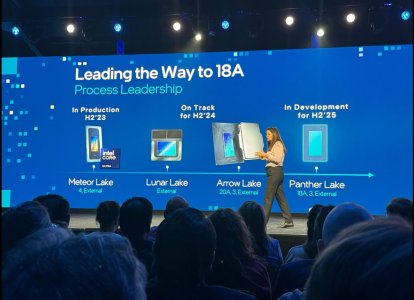
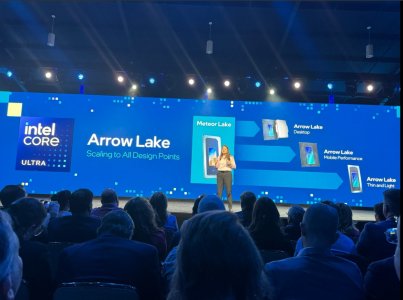
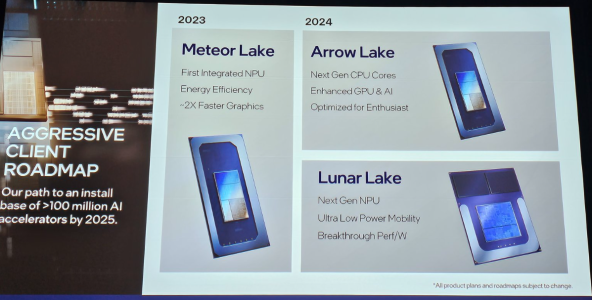
As Hot Chips 34 starting this week, Intel will unveil technical information of upcoming Meteor Lake (MTL) and Arrow Lake (ARL), new generation platform after Raptor Lake. Both MTL and ARL represent new direction which Intel will move to multiple chiplets and combine as one SoC platform.

MTL also represents new compute tile that based on Intel 4 process which is based on EUV lithography, a first from Intel. Intel expects to ship MTL mobile SoC in 2023.

ARL will come after MTL so Intel should be shipping it in 2024, that is what Intel roadmap is telling us. ARL compute tile will be manufactured by Intel 20A process, a first from Intel to use GAA transistors called RibbonFET.
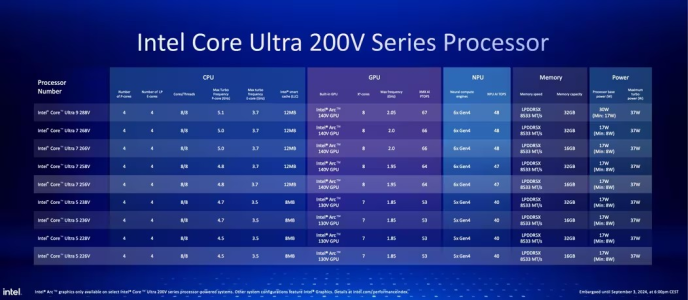


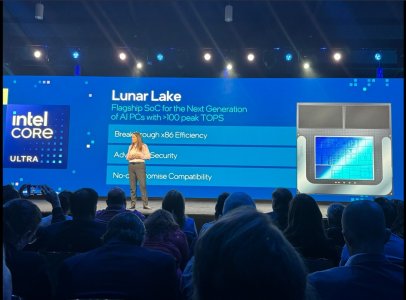
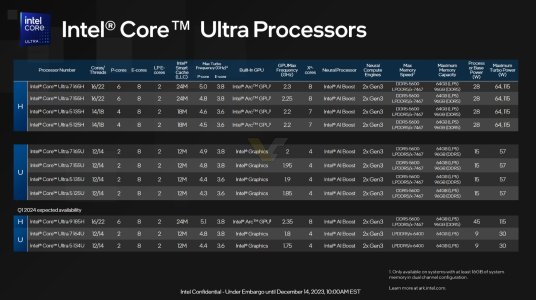
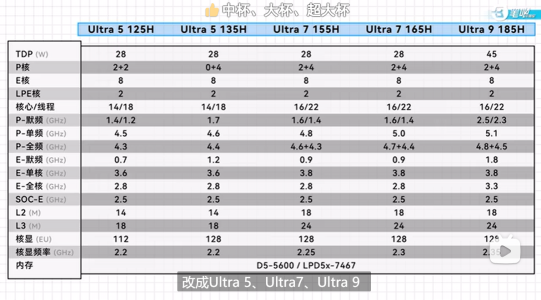
Comparison of upcoming Intel's U-series CPU: Core Ultra 100U, Lunar Lake and Panther Lake

ModelCode-NameDateTDPNodeTilesMain TileCPULP E-CoreLLCGPUXe-cores
Core Ultra 100UMeteor LakeQ4 202315 - 57 WIntel 4 + N5 + N64tCPU2P + 8E212 MBIntel Graphics4
?Lunar LakeQ4 202417 - 30 WN3B + N62CPU + GPU & IMC4P + 4E08 MBArc8
?Panther LakeQ1 2026 ??Intel 18A + N3E3CPU + MC4P + 8E4?Arc12


Comparison of die size of Each Tile of Meteor Lake, Arrow Lake, Lunar Lake and Panther Lake

Meteor LakeArrow Lake (20A)Arrow Lake (N3B)Lunar LakePanther Lake
PlatformMobile H/U OnlyDesktop OnlyDesktop & Mobile H&HXMobile U OnlyMobile H
Process NodeIntel 4Intel 20ATSMC N3BTSMC N3BIntel 18A
DateQ4 2023Q1 2025 ?Desktop-Q4-2024
H&HX-Q1-2025
Q4 2024Q1 2026 ?
Full Die6P + 8P6P + 8E ?8P + 16E4P + 4E4P + 8E
LLC24 MB24 MB ?36 MB ?12 MB?
tCPU66.48
tGPU44.45
SoC96.77
IOE44.45
Total252.15

LNL-MX.png

Intel Core Ultra 100 - Meteor Lake

INTEL-CORE-100-ULTRA-METEOR-LAKE-OFFCIAL-SLIDE-2.jpg

As mentioned by Tomshardware, TSMC will manufacture the I/O, SoC, and GPU tiles. That means Intel will manufacture only the CPU and Foveros tiles. (Notably, Intel calls the I/O tile an 'I/O Expander,' hence the IOE moniker.)


Clockspeed.png
 

Attachments

  • PantherLake.png
    PantherLake.png
    283.5 KB · Views: 24,006
  • LNL.png
    LNL.png
    881.8 KB · Views: 25,490
Last edited:

dullard

Elite Member
May 21, 2001
25,511
4,009
126
The average is low because Blender has several cycles, at the start it is idling for 15s and then it goes at full throughput for 3 phases with some interrupts, the 275W are the phases of full throughput, that s not just short peaks as you seems to believe.

For the rest there will be reviews in less than two moths, and we ll surely have some leaks in the meantime, so we ll see how things pan out in the next weeks or so.
So now you ignore point #1 and #2. Okay Abwx, you do you. Changing the goalpost and posting conflicting information isn't making your case though.

Up to 10 ms is the limit of time for power spikes above PL2 unless Computerbase had malfunctioning equipment. That isn't what I personally call a long duration.
 

H433x0n

Golden Member
Mar 15, 2023
1,209
1,572
96
Problem is not the 14900K as such, it s that in the 2 ST benchs already known they are below not only this CPU but also below the 9950X, we are no more talking of GB here but of actual browsing perf, so far the IPC in those tests is below Zen 5, i posted them in my previous post and here they are again.

Guess that currently Intel is devising about the exact power they ll use since at 250W they will have a win only in CB R20/R23 for MT, and a marginal one.

They may well set 297W as PL2, or use an extended 297W PL4 since that s their apps performance profile for ARL, otherwise they ll lose in too much benches to be convincing, so we ll surely be good for another round of exagerated TDPs.

And likely that AMD limiting their CPU at 200W has somewhat disrupted their plans as they surely expected 230W, wich would had rendered their own 250W/297W TDP acceptable.
Those aren’t verified real web browsing results. The GB5/GB6 scores are at least tangibly verified.

As far as web browsing performance, ARL seems ahead of Zen 5 in the HTML5 & text processing subtests in GB. Who knows how it ends up when we get actual benchmark results for WebXprt and Speedometer. In the IgorsLab leak, both of those were projected to be up by a decent margin.
 

SiliconFly

Golden Member
Mar 10, 2023
1,541
897
96
So now you ignore point #1 and #2. Okay Abwx, you do you. Changing the goalpost and posting conflicting information isn't making your case though.

Up to 10 ms is the limit of time for power spikes above PL2 unless Computerbase had malfunctioning equipment. That isn't what I personally call a long duration.
He has no clue what he’s talking about. Just wants to say competition is better than intel with aome useless numbers.

Let me put it straight. ARL & competition, when it comes to power efficiency, is gonna be in the same ballpark. Overall power usage per hour under normal circumstances is gonna be very similar.
 

SiliconFly

Golden Member
Mar 10, 2023
1,541
897
96
That was obvious when he confused PL2 and PL4 and then in defense again confused peak power with PL2. I'm just enjoying seeing how deep of a hole he'll dig for himself.
I sincerely hope somebody reminds him ARL isn’t on Intel 7 like 14900K, but is actually on hyper efficient N3B.
 

ondma

Diamond Member
Mar 18, 2018
3,005
1,528
136
That was obvious when he confused PL2 and PL4 and then in defense again confused peak power with PL2. I'm just enjoying seeing how deep of a hole he'll dig for himself.
He has no clue what he’s talking about. Just wants to say competition is better than intel with aome useless numbers.

Let me put it straight. ARL & competition, when it comes to power efficiency, is gonna be in the same ballpark. Overall power usage per hour under normal circumstances is gonna be very similar.
That particular poster has a long history on this forum, going back to the Bulldozer days, of being somewhat shall we say "selective" in his posts and benchmark choices. I thought he had disappeared for a while, but unfortunately he has returned. Trying to have an objective discussion with him is an exercise in futility. Better to just put him on ignore and not waste your time.
 

SiliconFly

Golden Member
Mar 10, 2023
1,541
897
96
That particular poster has a long history on this forum, going back to the Bulldozer days, of being somewhat shall we say "selective" in his posts and benchmark choices. I thought he had disappeared for a while, but unfortunately he has returned. Trying to have an objective discussion with him is an exercise in futility. Better to just put him on ignore and not waste your time.
And miss out on all the fun? 🤩
 
  • Like
Reactions: rosetta

MarkPost

Senior member
Mar 1, 2017
322
616
136

dullard

Elite Member
May 21, 2001
25,511
4,009
126
I really dont know what "average" means there, because rendering a scene with Blender doesnt sit in those suposed average values, at all.
I assume it is what Abwx alluded to on this graph here:
https://forums.anandtech.com/thread...akes-discussion-threads.2606448/post-41282823

Basically the test lets the CPU sit idle, then runs the benchmark, then lets it go idle again. That way they measure the idle power, peak power, and probably average the whole thing together. It would simulate how a user typically runs a computer (some idle, some high power) but it is not how we typically think of power consumption during a task and ignoring idle power.

From the computerbase benchmark site (translated)
"The Blender benchmark is suitable for various considerations regarding the CPU's power consumption thanks to its staggered testing method and three subtests. First, the PC does nothing for a few seconds, then it goes into full load, sometimes it is only partially loaded, and then it disappears into sleep mode again at the end. In this way, in addition to the lowest energy consumption, the maximum and an average can be derived in the test."
 

SiliconFly

Golden Member
Mar 10, 2023
1,541
897
96
I assume it is what Abwx alluded to on this graph here:
https://forums.anandtech.com/thread...akes-discussion-threads.2606448/post-41282823

Basically the test lets the CPU sit idle, then runs the benchmark, then lets it go idle again. That way they measure the idle power, peak power, and probably average the whole thing together. It would simulate how a user typically runs a computer (some idle, some high power) but it is not how we typically think of power consumption during a task and ignoring idle power.

From the computerbase benchmark site (translated)
"The Blender benchmark is suitable for various considerations regarding the CPU's power consumption thanks to its staggered testing method and three subtests. First, the PC does nothing for a few seconds, then it goes into full load, sometimes it is only partially loaded, and then it disappears into sleep mode again at the end. In this way, in addition to the lowest energy consumption, the maximum and an average can be derived in the test."
He’s obsessed with irrelevant power usage numbers. Every single post he keeps mentioning watts, watts & watts as though competition is 8000% more efficient than Intel. Where as, reality is quite different. The efficiency difference this generation I expect won’t be that much for average users. N3B means business afaik.

And more importantly, performance is key. Probably the most important metric to date. And ARL beating competition by 3.5% in performance doesn’t go well with a few. Hence unwanted diversions.
 

Wolverine2349

Senior member
Oct 9, 2022
428
132
86
Maybe a 12 p core arrow lake is coming?

Intel has Core Ultra 285K and then 265K

The 285K is 8 + 16 and 265k is 8 + 12.

Where is the 275K. It's missing. Maybe intel sandbagging and the 275k is a 12 p core only gaming chip.

Probably not but one can hope.

Though it is interesting they are skipping 275k all the way down to 265k for 8 + 16 to 8 + 12.

Makes you wonder given the i9 to i7 was 8 + 16 to 8 + 12???
 

dullard

Elite Member
May 21, 2001
25,511
4,009
126
Wouldn't they change the digit 2 to 3?
They could do that. They are just identifiers after all. But it would bump into Panther Lake numbers, making them confusing. And they'd run out of 3 digit numbers quite quickly.

They are moving from generations to series in their numbering. It makes sense to keep all Arrow Lake chips, including refreshes, in the same series.

Arrow Lake and Lunar Lake are the 2 series.
 
Last edited:
  • Like
Reactions: Thunder 57

DavidC1

Senior member
Dec 29, 2023
941
1,475
96
N3B means business afaik.
This isn't black and white you know? Intel processes and designs are absolutely optimized for high frequency. Thus it's easier for them to reach high frequencies than others. The sacrifice is density and the ability to perform well on lower clocks.

If you look at say Alderlake mobile and desktop, the desktop chip uses less voltage to reach the same frequency as the mobile part. The mobile part can't clock as high without consuming more. So why do it this way? Because battery life is determined significantly by idle power, and it is affected by leakage. The mobile parts reduce leakage significantly.

Intel themselves admit that compared to the predecessor, it has 18% perf/w gain at the lower clocks but gets to only little over 10% at the peak. It's because TSMC process has a steeper curve that benefits low power chips. They optimized it for low power on the 22nm process but after the backlash on Ivy Bridge, they must have changed it for 14nm and future process generations again.

TSMC isn't getting low power efficiency for free, and Intel isn't getting high frequency advantage for free either. They are tradeoffs each decided to make.
 

Abwx

Lifer
Apr 2, 2011
11,557
4,349
136
So now you ignore point #1 and #2. Okay Abwx, you do you. Changing the goalpost and posting conflicting information isn't making your case though.

Up to 10 ms is the limit of time for power spikes above PL2 unless Computerbase had malfunctioning equipment. That isn't what I personally call a long duration.

For the other opoints about fixing the power so far there s no official info about the power that is dedicated for ARL, so how can you say that it s already fixed..?

As for allegedly changing the goalpost fdrom PL1 to PL2 same answer, there s no official TDP, so i can make any speculation and it cant be negated by any official number, what is sure is that at 250W they ll be good against a 253W limited 14900K but not against the competiton.


Those aren’t verified real web browsing results. The GB5/GB6 scores are at least tangibly verified.

As far as web browsing performance, ARL seems ahead of Zen 5 in the HTML5 & text processing subtests in GB. Who knows how it ends up when we get actual benchmark results for WebXprt and Speedometer. In the IgorsLab leak, both of those were projected to be up by a decent margin.

The slide at IGL say 7-10% and 9-13% for WebXPRT an Sepeedometer in respect of the 13900K wich is clocked 0.97x the 14900K, so those numbers in respect of the latter are 4-7% and 6-10% respectively, this also apply to GB btw.
 

dullard

Elite Member
May 21, 2001
25,511
4,009
126
For the other opoints about fixing the power so far there s no official info about the power that is dedicated for ARL, so how can you say that it s already fixed..?

As for allegedly changing the goalpost fdrom PL1 to PL2 same answer, there s no official TDP, so i can make any speculation and it cant be negated by any official number, what is sure is that at 250W
I looked up, your post still says that Intel is currently changing power levels. So, no your post it isn't fixed. I would not associate the word "fixed" with my recent posts to you.

Again you are confusing power levels. You specifically stated PL2 is going to 297 W. As "proof" you posted an estimate that PL4 is 297 W in an extreme profile of two chips. Then as more "proof" you posted a 275 W peak example (and remember peak is PL4, peak is not PL2). And now all of a sudden, out of the blue, you mention PL1. Do you know what the 4 power levels are and how they are used? For a hint, I posted the link to you.

There definitely is a set known official TDP shared between Intel, corporate customers, and suppliers. The public just haven't seen it yet from Intel. It is not currently being "devised" as you claim. You can feel free to speculate what it is, but the actual value is set in stone not currently being devised.
 

Hulk

Diamond Member
Oct 9, 1999
4,525
2,519
136
Umm...A win using 24 real threads vs. 16 real and 16 virtual threads is worth celebrating? What happens if AMD brings a 24 real core part to the party, with SMT?
They will price themselves out of the game. There is a reason Intel is 8+16 currently and AMD is 16, die size.
 

poke01

Platinum Member
Mar 8, 2022
2,208
2,805
106
Umm...A win using 24 real threads vs. 16 real and 16 virtual threads is worth celebrating? What happens if AMD brings a 24 real core part to the party, with SMT?
Doesn't matter One has SMT and one doesn't. What matters is the end result.

If you want really be fussy then it's 8P+16E vs 16P cores so I would say it evens out. Now if it was 24P cores on the Ultra 9 then that's not a fair comparison.
 

majord

Senior member
Jul 26, 2015
493
641
136
They will price themselves out of the game. There is a reason Intel is 8+16 currently and AMD is 16, die size.

Doubt it.. A 24c part would wipe the floor with top arrow lake so bad it could command a decent price premium as a halo part. Not sure what chiplet sizes we'd be roughly looking at on 3nm, nothing drastic though I don't think.
 

Hulk

Diamond Member
Oct 9, 1999
4,525
2,519
136
Doubt it.. A 24c part would wipe the floor with top arrow lake so bad it could command a decent price premium as a halo part. Not sure what chiplet sizes we'd be roughly looking at on 3nm, nothing drastic though I don't think.
You'll notice I wrote "currently."

That would be another chiplet. Not insignificant.
 

Abwx

Lifer
Apr 2, 2011
11,557
4,349
136
I looked up, your post still says that Intel is currently changing power levels. So, no your post it isn't fixed. I would not associate the word "fixed" with my recent posts to you.

Again you are confusing power levels. You specifically stated PL2 is going to 297 W. As "proof" you posted an estimate that PL4 is 297 W in an extreme profile of two chips. Then as more "proof" you posted a 275 W peak example (and remember peak is PL4, peak is not PL2). And now all of a sudden, out of the blue, you mention PL1. Do you know what the 4 power levels are and how they are used? For a hint, I posted the link to you.

There definitely is a set known official TDP shared between Intel, corporate customers, and suppliers. The public just haven't seen it yet from Intel. It is not currently being "devised" as you claim. You can feel free to speculate what it is, but the actual value is set in stone not currently being devised.

If you know something about Intel s communications with OEMs please let us know, for the time the general public is aware of nothing and can rely only on past Intel s behaviours.