• We’re currently investigating an issue related to the forum theme and styling that is impacting page layout and visual formatting. The problem has been identified, and we are actively working on a resolution. There is no impact to user data or functionality, this is strictly a front-end display issue. We’ll post an update once the fix has been deployed. Thanks for your patience while we get this sorted.

Discussion Intel Meteor, Arrow, Lunar & Panther Lakes + WCL Discussion Threads

Page 416 - Seeking answers? Join the AnandTech community: where nearly half-a-million members share solutions and discuss the latest tech.

Tigerick

Senior member
Wildcat Lake (WCL) Specs

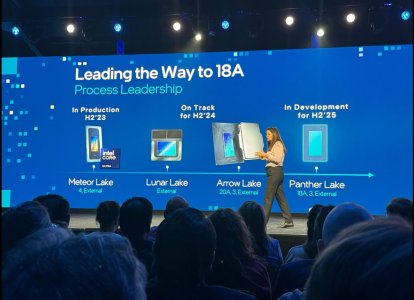
Intel Wildcat Lake (WCL) is upcoming mobile SoC replacing Raptor Lake-U. WCL consists of 2 tiles: compute tile and PCD tile. It is true single die consists of CPU, GPU and NPU that is fabbed by 18-A process. Last time I checked, PCD tile is fabbed by TSMC N6 process. They are connected through UCIe, not D2D; a first from Intel. Expecting launching in Q1 2026.
Intel Raptor Lake UIntel Wildcat Lake 15WIntel Lunar LakeIntel Panther Lake 4+0+4
Launch DateQ1-2024Q2-2026Q3-2024Q1-2026
ModelIntel 150UIntel Core 7 360Core Ultra 7 268VCore Ultra 7 365
Dies2223
NodeIntel 7 + ?Intel 18-A + TSMC N6TSMC N3B + N6Intel 18-A + Intel 3 + TSMC N6
CPU2 P-core + 8 E-cores2 P-core + 4 LP E-cores4 P-core + 4 LP E-cores4 P-core + 4 LP E-cores
Threads12688
Max Clock5.4 GHz4.8 GHz5 GHz4.8 GHz
L3 Cache12 MB6 MB12 MB12 MB
TDP15 - 55 W15 - 35 W17 - 37 W25 - 55 W
Memory128-bit LPDDR5-520064-bit LPDDR5x-7467128-bit LPDDR5x-8533128-bit LPDDR5x-7467
Size96 GB48 GB32 GB128 GB
Bandwidth83 GB/s60 GB/s136 GB/s120 GB/s
GPUIntel GraphicsIntel GraphicsArc 140VIntel Graphics
RTNoNoYESYES
EU / Xe96 EU2 Xe8 Xe4 Xe
Max Clock1.3 GHz2.6 GHz2 GHz2.5 GHz
NPUGNA 3.017 TOPS48 TOPS49 TOPS


PPT1.jpg
PPT2.jpg
PPT3.jpg


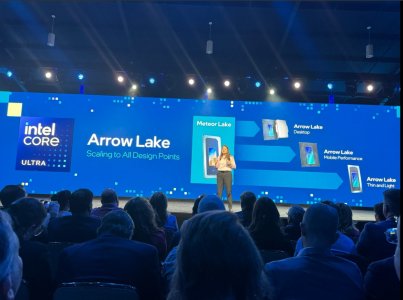
As Hot Chips 34 starting this week, Intel will unveil technical information of upcoming Meteor Lake (MTL) and Arrow Lake (ARL), new generation platform after Raptor Lake. Both MTL and ARL represent new direction which Intel will move to multiple chiplets and combine as one SoC platform.

MTL also represents new compute tile that based on Intel 4 process which is based on EUV lithography, a first from Intel. Intel expects to ship MTL mobile SoC in 2023.

ARL will come after MTL so Intel should be shipping it in 2024, that is what Intel roadmap is telling us. ARL compute tile will be manufactured by Intel 20A process, a first from Intel to use GAA transistors called RibbonFET.


LNL-MX.png
 

Attachments

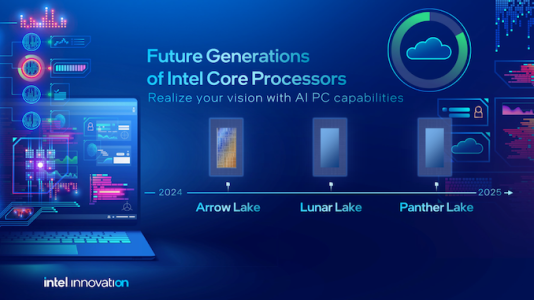
  • PantherLake.png
    PantherLake.png
    283.5 KB · Views: 24,049
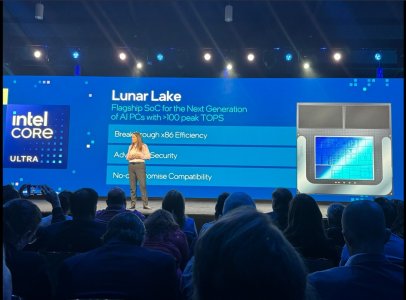
  • LNL.png
    LNL.png
    881.8 KB · Views: 25,534
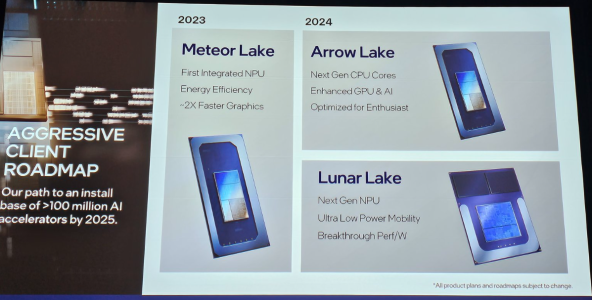
  • INTEL-CORE-100-ULTRA-METEOR-LAKE-OFFCIAL-SLIDE-2.jpg
    INTEL-CORE-100-ULTRA-METEOR-LAKE-OFFCIAL-SLIDE-2.jpg
    181.4 KB · Views: 72,443
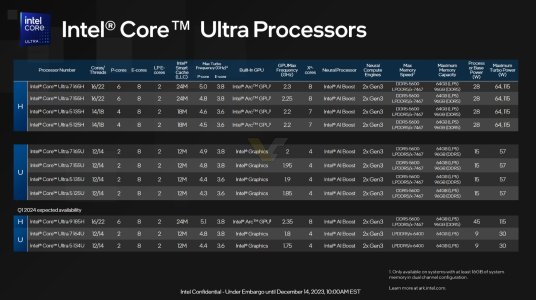
  • Clockspeed.png
    Clockspeed.png
    611.8 KB · Views: 72,329
Last edited:
I think Apple will be full steam ahead regardless. And I suspect the M5 will be another decent step. For sure the IPC increase hasn’t been that great since the M1. Though their biggest increase since M1 has been the M3 -> M4. Everest to Donan, right? Seems like it’s a new core,
Donan is the codename for the M4 SoC as a whole. We don't know the CPU core codename, as Apple doesn't expose it anymore. So we call it Donan-P/M4-P and Donan-E/M4-E.
 

PTL-U

PTL-H

CPU4P + 4LPE4P + 8E + 4LPE
GPU???12 Xe3
How many GPU cores will PTL-U have?
One rumour I saw said 4 Xe3 cores, but that sounds bizarre.

If PTL-U is a successor of LNL (which has 8 cores), then going to down to 4 cores would be a regression.
 
One rumour I saw said 4 Xe3 cores, but that sounds bizarre.

If PTL-U is a successor of LNL (which has 8 cores), then going to down to 4 cores would be a regression.
I would hope 8 Xe3. But that’s on 18A right? So maybe they lower it because low yields, idk.
 
This graph just makes Intel's and AMD's cores look even worse lol. How is Apple stagnating so hard and still producing cores on par or better than AMD and Intel :cry:
Apple doesn't need to worry about legacy they can add custom instructions in the ARM architecture they control their software and hardware if something is not needed they can cut it from the core we will have to accept it they have very high independence something AMD/Intel lacks they only need to design for their use AMD/Intel Design scalable from couple of cores to 100s of cores much different Target i bet if you give such freedom to both they can make similar cores to apple it's not ISA never was it's how you design it and integrate with SW
 
This is from flashroom.

Panther Lake-U/H 12Xe
Panther Lake-H 4Xe

I wouldn't read too much into it though. Intels U lineup is a budget line nowaydays, 12 Xe doesn't make sense unless they have a special lineup for the premium segment similar to Lunar Lake.
 

PTL-U

PTL-H

CPU4P + 4LPE4P + 8E + 4LPE
GPU???12 Xe3
How many GPU cores will PTL-U have?
4 Xe³ cores/32EUs* /512 ALUs

* If BMG new Xe Core organizations still is maintained for Celestial
I would hope 8 Xe3. But that’s on 18A right? So maybe they lower it because low yields, idk.
The 4 Xe³ GPU tile is on Intel 3. The 12 Xe³ GPU tile is on N3E.

Intel will be going to use Intel 3 a lot in the future because they sold a 49% stake in Ireland Intel 3 fab 34 for Apollo Global and they need to provide wafer usage and revenue.
 
what exactly about Apple's core design makes it unsuitable for servers? If anything, large core-private caches would be better suited for server workloads since they would be able to deal with mediocre memory and L3 latencies better. The area of their cores are not bad either. They excel at lower power, much like a server core should.
There are many reasons why we won't see Apple M-series CPUs in servers anytime soon.

In the server market, many factors matter much more than performance. These include the software and hardware ecosystem, relationships with OEMs, upgradeability and maintainability, and others.

Even AMD is struggling to increase its market share in the server market despite having pretty good CPUs, not to mention Ampere.

From my perspective, Intel and AMD are fine with the server market. Server SKUs with all Skymont cores are expected to be very interesting.

Clock speed doesn't matter. All that matters is per core performance. Clock speed is just one way to achieve that. Apple achieves that using IPC.
The excuse of clock speed used to work when ARM cores were much weaker than X86 cores. Oh sure ARM cores are more efficient, but look how much faster x86 is in 1T!

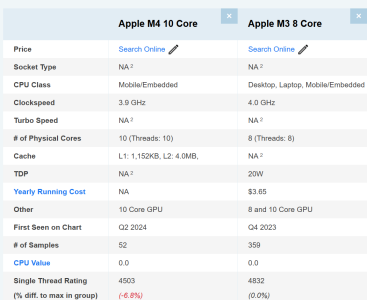
Clock speeds do matter. In terms of IPC, the P core in Apple M4 is 8-12% faster than M1. Most of the performance improvement comes from higher clock speeds. At the same time, the power consumption of one core has increased more than two times despite being on a much newer node. That's the price Apple pays to have a wider design. The power consumption scales much faster than with simpler Intel and AMD designs.
 
Arguably ~12%+. And yet they still consume much less power than their competitors even with the power draw increase.
IPC is currently more important for Intel and AMD because they are behind.
Sure different product segments are targeted by Apple but it’s not even close in the product areas in which they all have offerings.


Looks like some premilinary Zen5 9900X ST leaks are here and it doesn’t add up well.

It appears to be slightly slower than 14900K and hence a lot slower than ARL top sku. Doesn’t bode well for Zen5.
Unless ARL seriously reins in power usage, does it matter?

Personally, I considered Alder Lake and Raptor Lake a total failure long before the excessive wattage started cooking them.

Sure, Z5 seems disappointing compared to Z4 but I haven't taken Intel's power hungry chips seriously for years now.


Looks like some premilinary Zen5 9900X ST leaks are here and it doesn’t add up well.

It appears to be slightly slower than 14900K and hence a lot slower than ARL top sku. Doesn’t bode well for Zen5.
Pure copium by the usual suspects. Zen 4 was more behind Raptor Cove in Passmark ST (14%), versus the numbers seen in composite ST ratings (https://topic.expreview.com/CPU/# shows 11% ST difference ). The difference in the composite ST score was basically just in the ST boost clock (6.2 vs 5.7Ghz which is around 9%; this perfectly matches the Specint 1T results that put RaptorCove at marginally better spot of around 2%).

If Lion Cove reaches 5.7Ghz with 14% IPC, it would put it at 109 in the above composite 1T rating from Expreview. For 9950X (5.7Ghz), if it lives up to the 16% IPC uplift it gets the same rating of 109.
 
Back
Top