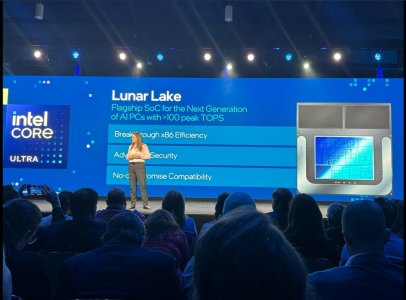
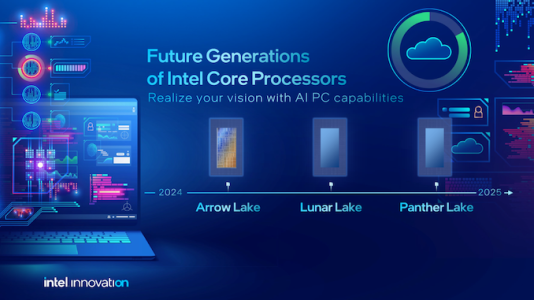
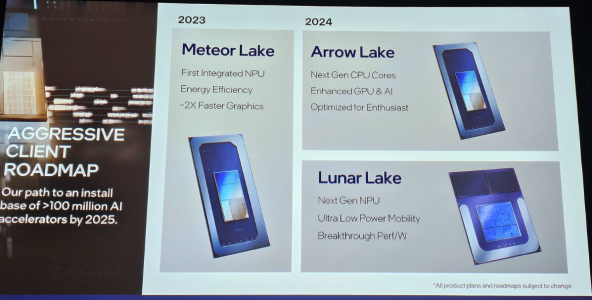
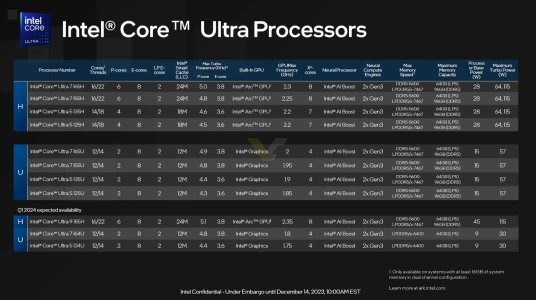
Discussion Intel Meteor, Arrow, Lunar & Panther Lakes + WCL Discussion Threads

Page 351 - Seeking answers? Join the AnandTech community: where nearly half-a-million members share solutions and discuss the latest tech.

Tigerick

Senior member
Apr 1, 2022
919
834
106
Wildcat Lake (WCL) Preliminary Specs

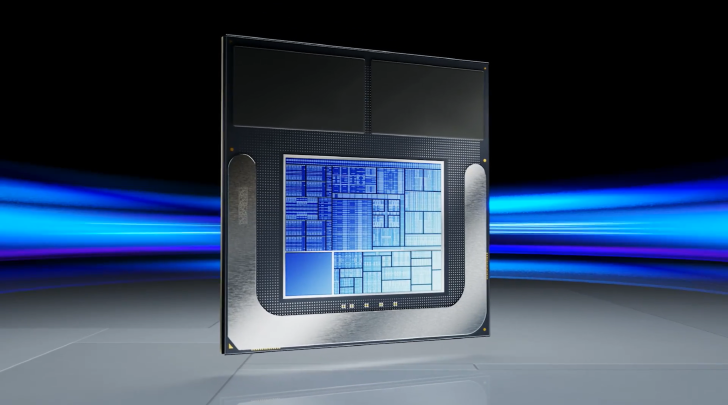
Intel Wildcat Lake (WCL) is upcoming mobile SoC replacing ADL-N. WCL consists of 2 tiles: compute tile and PCD tile. It is true single die consists of CPU, GPU and NPU that is fabbed by 18-A process. Last time I checked, PCD tile is fabbed by TSMC N6 process. They are connected through UCIe, not D2D; a first from Intel. Expecting launching in Q2/Computex 2026. In case people don't remember AlderLake-N, I have created a table below to compare the detail specs of ADL-N and WCL. Just for fun, I am throwing LNL and upcoming Mediatek D9500 SoC.
Intel Alder Lake - NIntel Wildcat LakeIntel Lunar LakeMediatek D9500
Launch DateQ1-2023Q2-2026 ?Q3-2024Q3-2025
ModelIntel N300?Core Ultra 7 268VDimensity 9500 5G
Dies2221
NodeIntel 7 + ?Intel 18-A + TSMC N6TSMC N3B + N6TSMC N3P
CPU8 E-cores2 P-core + 4 LP E-cores4 P-core + 4 LP E-coresC1 1+3+4
Threads8688
Max Clock3.8 GHz?5 GHz
L3 Cache6 MB?12 MB
TDP7 WFanless ?17 WFanless
Memory64-bit LPDDR5-480064-bit LPDDR5-6800 ?128-bit LPDDR5X-853364-bit LPDDR5X-10667
Size16 GB?32 GB24 GB ?
Bandwidth~ 55 GB/s136 GB/s85.6 GB/s
GPUUHD GraphicsArc 140VG1 Ultra
EU / Xe32 EU2 Xe8 Xe12
Max Clock1.25 GHz2 GHz
NPUNA18 TOPS48 TOPS100 TOPS ?


PPT1.jpg
PPT2.jpg
PPT3.jpg


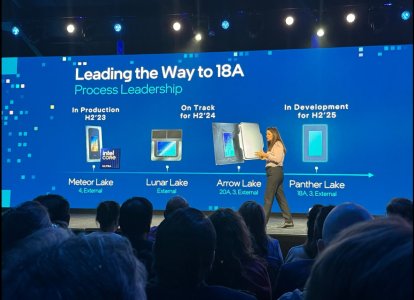
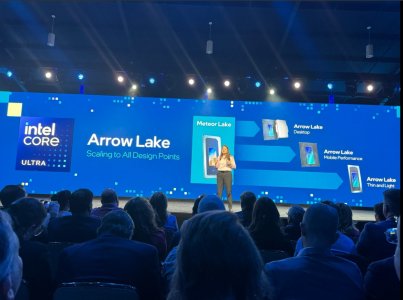
As Hot Chips 34 starting this week, Intel will unveil technical information of upcoming Meteor Lake (MTL) and Arrow Lake (ARL), new generation platform after Raptor Lake. Both MTL and ARL represent new direction which Intel will move to multiple chiplets and combine as one SoC platform.

MTL also represents new compute tile that based on Intel 4 process which is based on EUV lithography, a first from Intel. Intel expects to ship MTL mobile SoC in 2023.

ARL will come after MTL so Intel should be shipping it in 2024, that is what Intel roadmap is telling us. ARL compute tile will be manufactured by Intel 20A process, a first from Intel to use GAA transistors called RibbonFET.


LNL-MX.png
 

Attachments

  • PantherLake.png
    PantherLake.png
    283.5 KB · Views: 24,034
  • LNL.png
    LNL.png
    881.8 KB · Views: 25,527
  • INTEL-CORE-100-ULTRA-METEOR-LAKE-OFFCIAL-SLIDE-2.jpg
    INTEL-CORE-100-ULTRA-METEOR-LAKE-OFFCIAL-SLIDE-2.jpg
    181.4 KB · Views: 72,435
  • Clockspeed.png
    Clockspeed.png
    611.8 KB · Views: 72,321
Last edited:

Hulk

Diamond Member
Oct 9, 1999
5,228
3,862
136
So lunar as it’s won deal is probably kind of a one-off, I mean Panther Lake will replace it but you’ll also see a step back on the tiling (just nothing like MTL mess) and I assume on-package memory might be rolled back or something?

I can’t see Intel actually doing a Lunar Lake successor and some PTL U skus, so this is fine, as long as PTL has good enough battery and all.
From what I have been hearing in various videos with Intel employees, the tile layout will be changing based on the needs to the product. LNL is small and highly focused on power, to minimal tiles.

I would expect ARL to have a layout more like MTL. CPU tile, GPU tile, I/O tile, etc... 8 P cores and 16 E's will make the CPU complex large enough to warrant it's own tile. No need for a LPE Island on desktop and the E's will have access to the LLC. As the core count grows (and total silicon area) it makes sense that the SoC to contain more tiles to increase yields and reuse tile complexes.
 

The Hardcard

Senior member
Oct 19, 2021
343
433
136
What small ST uplift? Is 50% a small uplift?
I think Lion Cove should manage 5.8GHz and even If not, Skymont will not clock as high as 5GHz, you can forget about that.
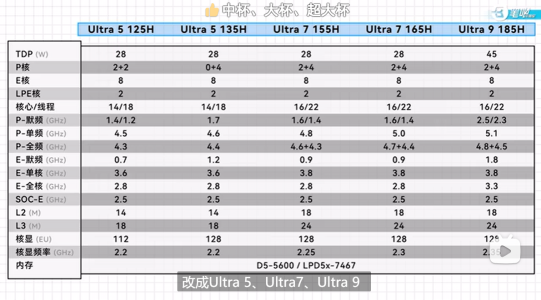
According to Intel, Lion Cove supposedly provides >50% more performance in who knows what, that would mean <4.5GHz boost for Skymont in case of 5.8GHz for Lion Cove and 15% difference in IPC.
View attachment 100712
Even LNL has 4 Lion Coves and is a 15W CPU configurable to 30W, so 8 Lion Cove cores in a CPU with >55-125W TDP doesn't look like a problem. If you compared performance of 8 Lion cores vs 8 Skymont cores and had >=75W TDP(>=9W per core), then you would see a big difference in performance in my opinion.

Yeah, we can argue that spamming E-cores within the same area and power would provide better CB score, but even 8P+16E already has 24 cores and 32 threads including HT. How many of us can use this amount of threads? What SoC you want (>32 cores), looks more likely to happen for server than for desktop(laptop).

What I am interested in is, If Intel will do a Pentium with 8 Skymont cores or not? That would be a very capable SoC in my opinion.
Also, a key aspect of E core spamming was the fact that a block of 4 Es fit in the space of 1 P while providing about double the multithreaded throughput. I think Lion Cove and Skymont have a different relationship.
 

Wolverine2349

Senior member
Oct 9, 2022
525
179
86
What small ST uplift? Is 50% a small uplift?
I think Lion Cove should manage 5.8GHz and even If not, Skymont will not clock as high as 5GHz, you can forget about that.
According to Intel, Lion Cove supposedly provides >50% more performance in who knows what, that would mean <4.5GHz boost for Skymont in case of 5.8GHz for Lion Cove and 15% difference in IPC.
View attachment 100712
Even LNL has 4 Lion Coves and is a 15W CPU configurable to 30W, so 8 Lion Cove cores in a CPU with >55-125W TDP doesn't look like a problem. If you compared performance of 8 Lion cores vs 8 Skymont cores and had >=75W TDP(>=9W per core), then you would see a big difference in performance in my opinion.

Yeah, we can argue that spamming E-cores within the same area and power would provide better CB score, but even 8P+16E already has 24 cores and 32 threads including HT. How many of us can use this amount of threads? What SoC you want (>32 cores), looks more likely to happen for server than for desktop(laptop).

What I am interested in is, If Intel will do a Pentium with 8 Skymont cores or not? That would be a very capable SoC in my opinion.

50% is big. Though I remember hearing Arrow Lake Lion Cove cores would have a clock speed regression and would top at 5.5GHz and its IPC was only 10-15% better. If it clocks at 5.8GHz that exceeds expectations and really is not a clock speed regression from 13th and 14th Gen. Yes I know 14th Gen can tehcially go to 6GHz or some cases 6.2GHz, but it so so unstable at those settings it does not count. 5.8GHz is more like for 13th and 14th Gen max when stable and if Arrow Lake has that no clock speed regression afterall compared to Raptor Cove.
 

Thunder 57

Diamond Member
Aug 19, 2007
4,207
6,995
136
In one of those videos with the engineers the Intel guy kind of admitted that while the point of the LPE Island was to be able to shut down most of the SoC during low compute workloads, but the LPE was to weak to really be useful. The much stronger (he said 4x) Skymont Island will be much more effective in this capacity for mobile. Meteor Lake was a test bed of sorts as I speculated earlier in this thread. They definitely learned from it for LNL.

That sounds about right. Certainly helps explain the 38% and 68% numbers they gave for Skymont. They were compared to MTL LP e-cores. At least they figured out they weren't serving their intended purpose and are axing them in favor of a much more potent e-core.
 

Hitman928

Diamond Member
Apr 15, 2012
6,748
12,474
136
It was deleted for whatever reason
But it went like this
Arrow Lake S sample:
P-core 5.7GHz
P-core (all core) 5.4GHz
E-core (all core) 4.6GHz

Those don’t line up with Intel’s claims of the P core have 50% higher performance at <14% IPC improvement, but who knows, there’s still a lot of grey area right now for all these claims.
 

coercitiv

Diamond Member
Jan 24, 2014
7,447
17,752
136
Those don’t line up with Intel’s claims of the P core have 50% higher performance
It's a claim of 50% higher performance in LNL, where the frequency delta between the core types is probably much higher and Skymont is (probably) disadvantaged in terms of access to a fast L3 as well.
 
  • Like
Reactions: Hitman928

Hulk

Diamond Member
Oct 9, 1999
5,228
3,862
136
Those don’t line up with Intel’s claims of the P core have 50% higher performance at <14% IPC improvement, but who knows, there’s still a lot of grey area right now for all these claims.
Using CB R23 MT. If Lion Cove can do 5.4GHz nT and is +14% over Raptor Cove in CB R23 and Skymont is +2% compared to Raptor Cove in CB R23 and can do 4.6GHz nT then the resulting score should be just over 48,000.

Further more based on AMD's pre release info I can predict Zen 5 will do about 45,000 in CB R23 MT.

ARL vs Zen 5 is shaping up to be very much like RPL and Zen 4.

For applications and games that mainly utilize <=8 cores ARL and Zen 5 will be quite comparable with wins and losses going to what architecture inherently best suits the application or game in question.

When we move to applications stressing 9 to 12 cores Zen 5 should have a slight advantage due to those additional Skymont cores having to compete with Zen 5 cores. Fortunately for Intel few applications fall into this category, they either use less than 8 cores or will use all available, which is the next case.

For "ridiculously" multithreaded applications ARL will have a slight advantage based on my prediction that ARL will have perhaps 5% more total compute. But I have a feeling that Zen 5 will again be more efficient, especially when fully loaded in this scenario.

So for better or worse there will be no clear winner. Just two great choices both having strengths and weaknesses.
 

FlameTail

Diamond Member
Dec 15, 2021
4,384
2,762
106
According to LG Representative, Lunar Lake supply situation is concerning it seems.


Yeah, the site is Wccfkek, but the original source is a Korean website.

We are concerned that Lunar Lake is about half a year behind AMD and Qualcomm (Snapdragon X Elite). Intel is a company that does not often experience product release delays, so I think Intel is also very concerned. The product release schedule is more in the hands of Intel and Microsoft than us.

We want to release the next product faster than other companies, but it depends on the efforts of our engineers.

- LG Electronics's Yoon-seok Lee
 

DavidC1

Platinum Member
Dec 29, 2023
2,021
3,157
96
That sounds about right. Certainly helps explain the 38% and 68% numbers they gave for Skymont. They were compared to MTL LP e-cores. At least they figured out they weren't serving their intended purpose and are axing them in favor of a much more potent e-core.
So what? They said it'll outperform Raptor Cove in both Int and FP per clock. Lion Cove is less than 14% faster compared to their "efficient" core.
Those don’t line up with Intel’s claims of the P core have 50% higher performance at <14% IPC improvement, but who knows, there’s still a lot of grey area right now for all these claims.
In Lunarlake, Skymont acts as a higher performing LPE core. So the clocks will be lower than in implementations that acts as a multi-threaded boost.
 

Kolebasz

Junior Member
Nov 15, 2023
1
1
41
Those don’t line up with Intel’s claims of the P core have 50% higher performance at <14% IPC improvement, but who knows, there’s still a lot of grey area right now for all these claims.
The claim was 50% higher perf in LNL, not in general. Which seems reasonable, considering all other claims.

According to Intel, LP Skymont in LNL has 38% higher IPC than LP Crestmont in MTL, while the overall single threaded perf is about 2x better. If we accept both claims and the IPC comparison was made at 2.5GHz(my guess), the Skymonts in LNL should reach ~3.6GHz.

Then there are the claims that Skymont on ring is RPC+2%, Skymont on ring is Skymont off ring+5%, and that LNC is RWC+14%. There are many variables, but in LNL, LNC should be around Skymont+15-20% IPC-wise.

So back to the first claim, the P core would need 4.5-4.7Ghz to achieve 50% better perf than the E core in LNL.
Does it seem believable?
 
  • Like
Reactions: Hulk

Magio

Member
May 13, 2024
198
239
76
According to LG Representative, Lunar Lake supply situation is concerning it seems.


Yeah, the site is Wccfkek, but the original source is a Korean website.

I honestly think the statements from the LG guy are more about corporate gamesmanship than they are about a real worry about LNL supply.

We know that the wafer orders Intel has with TSMC are significant, we know there shouldn't be huge surprises with the yields considering N3B is a mostly known quantity by now and we know that Intel is insistent that it will launch on time, so all in all the idea that LNL would be MIA or a paper launch until March next year is dubious.

However, just because LNL will be available late Q3/early Q4 and in plentiful quantity by the holidays doesn't mean every OEM will have their fill by then. Like all chipmakers, Intel will be playing favorites with who it supplies and in what quantity in the early days of LNL. If I had to bet, I'd say that there's a good chance OEMs like Dell, HP, Lenovo or Asus got a better deal than LG on that front, if only due to the relative strength of their pre-existing ties to Intel.

So if you're LG and not quite happy with what you're getting before March, throw a statement in the wild about your "worries" that sorta hints you'll be looking elsewhere (AMD, Qualcomm) if Intel can't meet your demands. You don't really want to take that tone in internal conversations with Intel, but a statement in the media sends a message in a softer manner.
 

Wolverine2349

Senior member
Oct 9, 2022
525
179
86
So what? They said it'll outperform Raptor Cove in both Int and FP per clock. Lion Cove is less than 14% faster compared to their "efficient" core.

Do you think Skymont will be good enough in latency as well as IPC and all around real world performance (like RAM XMP overclocking and PCIe acess and such without the Lion Cove cores) so I could buy a Core Ultra 285K or 275K in October disable the Lion Cove P cores and overclock Skymont cores to 5GHz so that it performs like a 12-16 5GHz all P core equivalent (HT disabled as I would disable HT if I had a hypothical 12 P core ALder/Raptor Lake CPU) or maybe slightly better equivalent across all gaming and latency sensitive work loads?

I have so badly been wanting a homogenous non hybrid CPU with more than 8 cores on a single die/ring bus/CCX-CCD/tile form weither INtel or AMD on a modern arch with modern IPC. Last one to have it was Comet Lake which is outdated Skylake based IPC and PCIe Gen 3.

The news was depressing as neither Intel nor AMD had such a CPI coming up. Until the hope of Skymont e-cores being so much better than expected is speculated meaning they could be the new all 12-16 P core Raptor Lake substitute and I only have to wait until October for the CPU setup I have been wanting for like 2 years now.

The set and forget best gaming solution 12-16 strong cores homogenous arch with HT/SMT disabled on single die/ring bus/CCX-CCD/tile with Golden/Raptor IPC or better at 4.8GHz to 5GHz. And yes the more than 8 cores for the game starting to use them which will only increase. and as such, such setup would work best for games of all types passed 15 years and modern games that had heterogenous arch like Starfield and Elden Ring. And games that hate dual CCD/CCX crossing which is most.

Maybe only have to wait until October to get my dream all 10-16 P core 5GHz Golden Cove/Raptor Cove equivalent in Core Ultra with Skymont cores only enabled and slight overclocked?
 

AMDK11

Senior member
Jul 15, 2019
484
424
136
As far as I know, the full LionCove design has SMT (HTT), but especially for the LunarLake design they cut out all the logic (transistors) to support it. Since they can strip/slim down the architecture for different projects, it means you can provide a smaller Predictor, ROB, Decoder, UOP Cache, Scheduler or fewer execution units, which is a new level of project customization to your needs.

Since they managed to sacrifice a large part of the LionCove logic/transistors to reduce surface area and lower power consumption, it is not impossible that in ArrowLake we will see a full version of the architecture with e.g. a larger ROB or a prediction device.

The LionCove slide in LunarLake shows that the prediction block is up to 8x larger, which does not rule out a smaller version for Lunar.
 

Hitman928

Diamond Member
Apr 15, 2012
6,748
12,474
136
The claim was 50% higher perf in LNL, not in general. Which seems reasonable, considering all other claims.

According to Intel, LP Skymont in LNL has 38% higher IPC than LP Crestmont in MTL, while the overall single threaded perf is about 2x better. If we accept both claims and the IPC comparison was made at 2.5GHz(my guess), the Skymonts in LNL should reach ~3.6GHz.

Then there are the claims that Skymont on ring is RPC+2%, Skymont on ring is Skymont off ring+5%, and that LNC is RWC+14%. There are many variables, but in LNL, LNC should be around Skymont+15-20% IPC-wise.

So back to the first claim, the P core would need 4.5-4.7Ghz to achieve 50% better perf than the E core in LNL.
Does it seem believable?

Hopefully they can get higher than that in 1t boost with the mobile P-cores, but if they are really trying to keep power down in LNL, maybe they limit it to that range.
 

Hulk

Diamond Member
Oct 9, 1999
5,228
3,862
136
As far as I know, the full LionCove design has SMT (HTT), but especially for the LunarLake design they cut out all the logic (transistors) to support it. Since they can strip/slim down the architecture for different projects, it means you can provide a smaller Predictor, ROB, Decoder, UOP Cache, Scheduler or fewer execution units, which is a new level of project customization to your needs.

Since they managed to sacrifice a large part of the LionCove logic/transistors to reduce surface area and lower power consumption, it is not impossible that in ArrowLake we will see a full version of the architecture with e.g. a larger ROB or a prediction device.

The LionCove slide in LunarLake shows that the prediction block is up to 8x larger, which does not rule out a smaller version for Lunar.
Yes. Intel has stressed that unlike previous designs Lion Cove is an architecture and not a core. So there may be Lion Cove based architecture cores with and with HT. I personally don't think we'll see HT in Intel client in the near future. Looks like they are set on P's for ST and E's for MT. Server is another matter though.
 

AMDK11

Senior member
Jul 15, 2019
484
424
136
Yes. Intel has stressed that unlike previous designs Lion Cove is an architecture and not a core. So there may be Lion Cove based architecture cores with and with HT. I personally don't think we'll see HT in Intel client in the near future. Looks like they are set on P's for ST and E's for MT. Server is another matter though.
I'm not talking about HTT (SMT) itself, but that the IPC of the LionCove variant in ArrowLake may differ due to the more extensive core, where energy efficiency and space savings play a less important role than performance.
 

CouncilorIrissa

Senior member
Jul 28, 2023
765
2,782
106
It was deleted for whatever reason
But it went like this
Arrow Lake S sample:
P-core 5.7GHz
P-core (all core) 5.4GHz
E-core (all core) 4.6GHz
The leaker does not tolerate screenshots of his tweets and recently btfo'd a bunch of his subscribers.

You're free to share the stuff he leaks, just with mentioning his name and without screenshots and copy pasting the tweets I believe.
 
Last edited:

gdansk

Diamond Member
Feb 8, 2011
4,688
7,924
136
The leaker does not tolerate screenshots of his tweets and recently btfo'd a bunch of his subscribers.

You're free to share the stuff he leaks, just with mentioning his name and without screenshots.
It was named "Donbas Coal Miner"? Weird. No idea who he is to be so paranoid.
 

Joe NYC

Diamond Member
Jun 26, 2021
3,951
5,481
136
Too soon to count the chickens. Zen5 big cores may still be superior. LNC as of now is subpar. LNC has a rumored 14% IPC uplift over RWC. But RWC has a 4% IPC regression over RPC due to tile latency I think. In effect, LNC has only ~10% IPC uplift over RPC.

Also, LNC has ~5% clock regression over RPC (6GHz -> rumored 5.7GHz). So, overall performance of LNC over RPC maybe only in single digit (well, too many assumptions here). Yet to see ARL LNC in action. Things may improve. But hard to say as of now.

As I mentioned in an earlier post, Arrow Lake is going to get the double whammy of the memory latency hit. So, it may be 14% - 4% - 4% = 6% and that's before the clock speed regression of some 5%.

Edit: Another thing, the curve of LNC > RWC) showed higher performance gains in middle of the frequency range and significantly narrowing at high clock speeds. Possibly under 10% IPC gain at highest clock speeds, but higher than 14% at mid-range of frequencies.


majord

Senior member
Jul 26, 2015
509
711
136
It's all just rumors, but Re the leaked clocks. It does seem odd that LNC would cop a Frequency regression , yet Skymont would score a frequency boost.

Yes it's further down the VF curve which could explain it somewhat, but it's also a much much wider higher IPC core than its predecessor its derived off, and is still chasing extremely high density looking at it.

at the least it would surely be getting pushed way out of efficiency by those clocks. in an effort to get competitive all core perf in the top end.