• We’re currently investigating an issue related to the forum theme and styling that is impacting page layout and visual formatting. The problem has been identified, and we are actively working on a resolution. There is no impact to user data or functionality, this is strictly a front-end display issue. We’ll post an update once the fix has been deployed. Thanks for your patience while we get this sorted.

Discussion Intel current and future Lakes & Rapids thread

Page 921 - Seeking answers? Join the AnandTech community: where nearly half-a-million members share solutions and discuss the latest tech.
Considering that EMR holds up his own on per core perf against Genoa, and simply gets outclassed due having 33% less cores
Emerald Rapids consumes too much power to achieve this feat. And at least in 2P configuration, the top-end Emerald Rapids struggles against the "lowly" EPYC 9554:


(yes it's Phoronix, but their test suite for server CPUs is much better than desktop)

Yes it was better than Sapphire Rapids, but eh too little too late.

I'd say GNR, which will have core count parity with Turin and upgraded performance per core, is gonna more than hold its own against Turin, it'll even beat it in a fair amount of use cases.

Again, it's on them to prove such claims. Granite Rapids being "Redwood Cove+" does not inspire much confidence.
 
I don't think there's much buying of ARM server parts beyond the self made chips like Gravitron.
Agreed. The last independent player here seems to be Ampere (used by Oracle).

For x86 compatibility, I imagine the cloud vendors would choose Epyc dense over any E core Xeon. That's probally not changing.
x86 compatibility is becoming less important every year for cloud vendors as many SW has been ported to Arm and Arm-based server CPU have become competitive. Though of course that doesn't mean x86 is going to disappear any time soon.

As far as AVX-512 goes, in the server market I don't think it has enough uses outside of HPC to be a significant differentiator. OTOH for large databases uses hardware accelerators might play a role, though I'm not sure it's a big part of the market (but admittedly one with huge margins).
 
I don't think there's much buying of ARM server parts beyond the self made chips like Gravitron.

For x86 compatibility, I imagine the cloud vendors would choose Epyc dense over any E core Xeon. That's probally not changing.
Keeping ARM out of the server space is reason enough to keep going with Dense and E core parts.

By the way:
Intel-Xeon-6780E-STH-KVM-STFB-1-Benchmark.jpg

That's bonkers performance for Sierra Forest. It's a perfect Cloud and VM chip, which is where the real ARM server threat is.
 

(Speculation) R1S specs:
  • Granite Rapids P-core based
  • Single-socket only
  • It is likely scaling only to ~80 cores, not 128 cores, since it is a 6700 series package
  • We expect lower cost and core count CPUs as well
  • We would expect the TDP for low-core-count CPUs to be in the 150-200W range, with the maximum TDP, given the LGA4710 socket, in the 350W range. Take these as approximates, but they should be close, given the socket.
  • 136 lanes of PCIe Gen5
  • Up to 64 lanes of CXL 2.0
  • 8-channel DDR5-6400 or MCRDIMM capable
 
but maybe only some parts of CWF? I doubt is the compute tile, although it will take time to ramp up 18A and I doubt they can produce enough wafers for PTL, CWF and DMR for 2025. Even at good yields.

Edit: Although PTL looks more like late 25/early 26

Edit2: the most reasonable explanation is that he is confusing CWF with Falcon.
 
Last edited:

Surprisingly a nice jump over the previous workstation CPU. Mostly due to software optimization. Cost wise seems competitive.
 
Seems like an Intel sponsored (as in they paid him) review. He has the whole system and decides not to test it in typical consumer benchmarks? What stopped him? Intel obviously. I get that it's a workstation CPU but still not comparing it with 9950X seems wrong from a journalistic point of view.

Same thing observed here: https://www.storagereview.com/review/intel-xeon-w7-2595x-review-sapphire-rapids-refresh

1726107289980.png

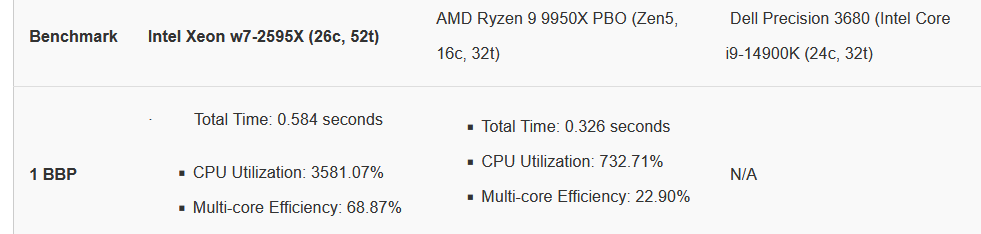
The stupid expensive CPU loses to 9950X but the reviewer is lauding the "better" multi-core efficiency? What the hell you twisted dude??? IT LOST, despite more cores and more threads!

I have no more words because what I really want to say is not appropriate for these forums.

The 100 BBP scores are even worse, if the 9950X score isn't a typo (60 seconds vs. 3.76 seconds???)
 
The stupid expensive CPU loses to 9950X but the reviewer is lauding the "better" multi-core efficiency? What the hell you twisted dude??? IT LOST, despite more cores and more threads!

I have no more words because what I really want to say is not appropriate for these forums.

The 100 BBP scores are even worse, if the 9950X score isn't a typo (60 seconds vs. 3.76 seconds???)

Not trying to defend the review (per se), but when it comes to Xeon-Ws, the best comparisons will be to Threadripper Pro due to platform features and other considerations.

Let's be honest, Sapphire Rapids is never going to be that good, no matter how many people insist otherwise. If the rehashed Sapphire Rapids shows up better than did earlier revisions, they can at least get a gold star for that.
 
Seems like an Intel sponsored (as in they paid him) review. He has the whole system and decides not to test it in typical consumer benchmarks? What stopped him? Intel obviously. I get that it's a workstation CPU but still not comparing it with 9950X seems wrong from a journalistic point of view.

[...]

The stupid expensive CPU loses to 9950X but the reviewer is lauding the "better" multi-core efficiency? What the hell you twisted dude??? IT LOST, despite more cores and more threads!
I think you need to chill a bit, it's starting to seem like you care more about brands than technology.

Wendel's review is done for people who know what they are doing and know what they want, and he's very clear about the positives and negatives of the platform. The best thing about Wendel reviews is the insights you get that you'll probably not see in other reviews focused on performance metrics only. The man likes to test and tinker and then tinker some more, and then he's able to report his findings in a nice manner. He's an asset to our community.
 
The best thing about Wendel reviews is the insights you get that you'll probably not see in other reviews focused on performance metrics only. The man likes to test and tinker and then tinker some more, and then he's able to report his findings in a nice manner. He's an asset to our community.
And I'm complaining that he didn't do enough of testing and tinkering in this case. And what's with that white fan on the CPU heatsink? I care about content. Don't care if it's Wendel or Dr. Ian Cuttress. My issue is just that he has that system. Do something with it, other than the usual workstation stuff. What about games? What about a core to core latency test? What about making a benchmarks list showing weaknesses and strengths? It just looked more like a marketing video to me.
 
Playing games on workstation is plainly stupid. Period. A consumer CPU will do a better job for way less money.
But, to be fair, the storagereview review is not even comparing Xeon to the competition (the Threadrippers) and Level1techs speaks about a Xeon advantage because "It's overclockable" (Threadripper are too, btw)? Sorry to say but If you buy a WORKstation it's very unlikely you'll overclock it, nor you will run it with the case open with additional fan just laying on the CPU cooler. Moreover, I was not able to find the details of the Threadripper platform. It was done on a TRX50 or WRX90 mainboard (the Bandwidth changes a lot)?
That, and the Xeon being faster practically only on AI workloads but not pointing out that those loads are probably, in most cases, better served with a GPU. So IMO these reviews are kinda "Meh" and missing too many points to be considered exhaustive.
 
Seems like an Intel sponsored (as in they paid him) review. He has the whole system and decides not to test it in typical consumer benchmarks? What stopped him? Intel obviously. I get that it's a workstation CPU but still not comparing it with 9950X seems wrong from a journalistic point of view.

He compared it to a Threadripper 7970X, what is wrong about that? 9950X is from a completely different consumer platform.
 
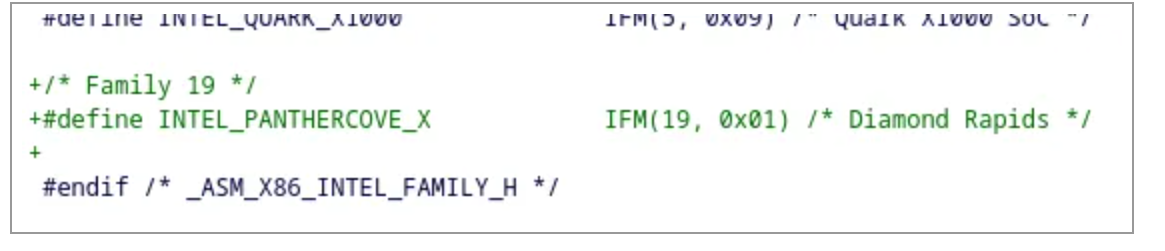
It appears Diamon Rapids will use Panther Cove. Panther Lake will have Cougar Cove. Earlier Nova Lake was supposed to have Panther Cove according to Raichu. So it looks like late 2026 at the earliest.

1727150263659.png
 
It appears Diamon Rapids will use Panther Cove. Panther Lake will have Cougar Cove. Earlier Nova Lake was supposed to have Panther Cove according to Raichu. So it looks like late 2026 at the earliest.
Which explains why Intel barely mentioned anything about the successor to Granite Rapids, since it's 2 years away according to that info.

You sure about the client names? You'd think Panther is Panther and Nova is Cougar.
 
Which explains why Intel barely mentioned anything about the successor to Granite Rapids, since it's 2 years away according to that info.

You sure about the client names? You'd think Panther is Panther and Nova is Cougar.
From the Reddit forums the folks were saying that Panther Lake is Cougar Cove/Darkmont.
Nova Lake is Coyote Cove/Arctic Wolf.

(Apparently internally Intel refers to Coyote Cove as Panther Cove still. But externally it didn’t make sense for them to reference Panther Cove with a generation past Panther Lake.)
 
Back
Top