
-
We’re currently investigating an issue related to the forum theme and styling that is impacting page layout and visual formatting. The problem has been identified, and we are actively working on a resolution. There is no impact to user data or functionality, this is strictly a front-end display issue. We’ll post an update once the fix has been deployed. Thanks for your patience while we get this sorted.
You are using an out of date browser. It may not display this or other websites correctly.
You should upgrade or use an alternative browser.
You should upgrade or use an alternative browser.
Discussion Intel current and future Lakes & Rapids thread
Page 471 - Seeking answers? Join the AnandTech community: where nearly half-a-million members share solutions and discuss the latest tech.
Good luck with that!More to the point, this is about long term strategy. Business that's lost to AMD can still be won back. But an ecosystem shift to ARM may well be irreversible.
Things which don't generate a short term profit are the first to go. At most a year or two in the future, any more and the stock market losses interest.
Watching out only for next quarter's results has and will continue to slowly kill (mostly Western) companies.
Last edited:
You know, when I originally saw that pic I initially wasn't that impressed. I mean, my humble 6900K at 4.3ghz can theoretically hit 1 teraflops, though I'm not sure it could sustain it.
Then I saw it was double precision and not single precision and then it all made sense 😱😳
How's this:
We know Alder Lake is H2'21 at the earliest, because Intel only has one day left in H1 at this point. Raptor Lake is the next product which we would expect in H2'22 if Intel is actually going to "Deliver Annual Cadence". That would make Meteor Lake H2'23 if it's next in line and the production schedule doesn't slip.
You don't know whether Intel plans a co-exist with MTL and RPT for a while like they did with CML and ICL. You don't have any timelines for 2023 and you don't factor in that the 1 year cadence isn't set in stone in every case, RKL-S and ADL-S is much less than 1 year. To summary, this very basic 2022 overview doesn't say anything about a specific MTL availability during 2023 or 2024. What can be said is that MTL is very likely a mobile first product. And for sure MTL can be a H2 2023 product, however some people like IntelUser2000 claiming Meteor Lake is a very late 2023, early 2024 product which is complete speculation at this point.
You guys completely misunderstood this.
So according to this Sapphire Rapid has 26 cores per socket at about 2.7Ghz. The power consumption of a server with 2 of these inside, including DDR5 and all the rest is ... 800W😵
EDIT:
It obviously also depends on how much RAM the system has.
The following comparison is obviously apples to oranges but IMO significant enough that I just can't not make it:
I can order a dual-socket Dell PowerEdge 7525 with 2x Epyc 7713 (225W) with 128 cores (instead of 52 though yeah, only with 2 GHz base clock), fit it with up to and including 14 x 64GB 3200MT/s dimms, before it starts to complain that the 800W PSU is not enough.
Bear in mind the PSU definitely has a safety margin, so even with 16 such dimms it absolutely is drawing less than 800W!
If this is anywhere near accurate and goes aganst 5nm 96 core Genoa (and the 128 Core successor) ....
104 cores/208 threads. 52 cores per socket. Each chip has a TDP of 400W. The power numbers quoted were for both chips combined.

uzzi38
Platinum Member
You don't know whether Intel plans a co-exist with MTL and RPT for a while like they did with CML and ICL. You don't have any timelines for 2023 and you don't factor in that the 1 year cadence isn't set in stone in every case, RKL-S and ADL-S is much less than 1 year. To summary, this very basic 2022 overview doesn't say anything about a specific MTL availability during 2023 or 2024. What can be said is that MTL is very likely a mobile first product. And for sure MTL can be a H2 2023 product, however some people like IntelUser2000 claiming Meteor Lake is a very late 2023, early 2024 product which is complete speculation at this point.
Actually I can't believe I'm saying this but I actually mostly agree with Mikk here. Rather, I'm expecting MTL and RPL to co-exist at least for a period of time, with potentially MTL-M launching first, then -P and -S coming at the end of the year.
Although I'd probably be less venemous in my wording

uzzi38
Platinum Member
52 cores per node.You guys completely misunderstood this.
104 cores/208 threads. 52 cores per socket. Each chip has a TDP of 400W. The power numbers quoted were for both chips combined.
2 sockets per node.
It's not difficult to understand.
EDIT: Also, it''s not 400W per chip. There's DRAM power mixed in there as well as PSU ineffciencies and whatnot. Each chip is probably ~300W, maybe even less.
Last edited:

DrMrLordX
Lifer
You guys completely misunderstood this.
104 cores/208 threads. 52 cores per socket. Each chip has a TDP of 400W. The power numbers quoted were for both chips combined.
That was my assumption when I saw the power figure, but that's not what they actually said . . .
Also, it''s not 400W per chip. . . . Each chip is probably ~300W, maybe even less.
While there are plenty of obvious jokes about Intel and 400W chips, I do think it's honestly a bit hard to say for certain. Intel has made some 400W Xeon chips in the past. Of course there's probably plenty of models that come in at various TDPs to support their different customers.
uzzi38
Platinum Member
While there are plenty of obvious jokes about Intel and 400W chips, I do think it's honestly a bit hard to say for certain. Intel has made some 400W Xeon chips in the past. Of course there's probably plenty of models that come in at various TDPs to support their different customers.
No, I saw that because it's 800W per node. A node includes more than just the CPUs alone.
Of course Intel has done 400W CPUs before, but I don't see anything that actually suggests the pair of 26c chips here are both also 400W chips each.
52 cores per node.
2 sockets per node.
It's not difficult to understand.
EDIT: Also, it''s not 400W per chip. There's DRAM power mixed in there as well as PSU ineffciencies and whatnot. Each chip is probably ~300W, maybe even less.
The details of SPR were leaked quite a while ago. TDPs of 370W for the largest chips. It was also mentioned that the final chip may have a TDP of 400W, but last I checked, that leaker wasn’t exactly reliable. Anyone claiming these chips are using 400-800W for a 26 core chip is trolling.
EDIT: The latest leaks I’ve seem have the top SPR chip (56c) at 370W and a 64 core genoa chip at 320 (or 350 according to one person). Unsure about higher core genoa chips. Both chips are going to be beasts.
Anyway, GB5: Alder Lake, 14 cores, 20 threads, 945 mhz/4253mhz, 1258/6831. The curious thing is that this appears to be an HP machine. So I am rather curious if Intel will indeed launch in Q3. Appears to be a laptop chip. Stock speeds based on multiplier are 400 mhz - 4.5 ghz. The chip also appears to be gimped, as it is turning in lower scores than TGL-U.

Last edited:

Hulk
Diamond Member
The details of SPR were leaked quite a while ago. TDPs of 370W for the largest chips. It was also mentioned that the final chip may have a TDP of 400W, but last I checked, that leaker wasn’t exactly reliable. Anyone claiming these chips are using 400-800W for a 26 core chip is trolling.
EDIT: The latest leaks I’ve seem have the top SPR chip (56c) at 370W and a 64 core genoa chip at 320 (or 350 according to one person). Unsure about higher core genoa chips. Both chips are going to be beasts.
Anyway, GB5: Alder Lake, 14 cores, 20 threads, 945 mhz/4253mhz, 1258/6831. The curious thing is that this appears to be an HP machine. So I am rather curious if Intel will indeed launch in Q3. Appears to be a laptop chip. Stock speeds based on multiplier are 400 mhz - 4.5 ghz. The chip also appears to be gimped, as it is turning in lower scores than TGL-U.
About that single thread GB5 score. Do you think we are correct in assuming that is Gracemont @4.5GHz pulling that 1258 score? If so I'm impressed. If it's Golden Cove at some unknown frequency then I don't think we learn much.

IntelUser2000
Elite Member
About that single thread GB5 score. Do you think we are correct in assuming that is Gracemont @4.5GHz pulling that 1258 score? If so I'm impressed. If it's Golden Cove at some unknown frequency then I don't think we learn much.
That's too high. At 1000-range it makes sense but this is 15% better. Since high clocks need low density designs it doesn't make sense either. The leak from igorslab showed Gracemont cluster having 3.4GHz burst for 1-4 cores, and I don't think it'll be too far off.
This assumes 30% perf/clock gain over Tremont, which is huge since I believe Tremont to be at Ivy Bridge level, but some like Ian are saying it performs like a Haswell Celeron(Haswell without AVX). If AVX explains the discrepancy then having full AVX2 will make Gracemont within 5% of Sunny Cove.
however some people like IntelUser2000 claiming Meteor Lake is a very late 2023, early 2024 product which is complete speculation at this point.
We are all speculating. It's been known for a long time that Meteor Lake would have been after Alderlake if not for the 1-year delay.
They said using tricks they brought down the 1-year timeframe down to 6 months. I can see that for a super low volume product like Ponte Vecchio. Also with today's complicated processes you need a pipe cleaner.
Meteor Lake launching end of 2023 also matches with the low KWPM and EUV machine orders for 2023.
You have some here saying that Intel won't make 7nm in 2024 and in the other end of the spectrum some say they'll be able to get it in majority of the products by 2023. I split the difference and based on the 1-year selling period needed for a product it'll be end of 2023 in low volume. I actually believe 7nm will do better than 10nm and signal a possible recovery for them.
Look at Sapphire Rapids. End 2021? I've seen people saying that as well. Now we know that it'll be H1 2022, a full year after Icelake-SP. I've been disappointed so many times with dates that I always take the latter end of projections.
Great if they can do it early 2023. I doubt it though. No need to hang on to me like @mikk does it's not a big deal!
Last edited:
uzzi38
Platinum Member
Genoa is 320W TDP default with a cTDP of 350W, and that's for the top end 96c part.The details of SPR were leaked quite a while ago. TDPs of 370W for the largest chips. It was also mentioned that the final chip may have a TDP of 400W, but last I checked, that leaker wasn’t exactly reliable. Anyone claiming these chips are using 400-800W for a 26 core chip is trolling.
EDIT: The latest leaks I’ve seem have the top SPR chip (56c) at 370W and a 64 core genoa chip at 320 (or 350 according to one person). Unsure about higher core genoa chips. Both chips are going to be beasts.
Also, SPR is 350W TDP by default. In any case, I don't expect that these TDPs mean anything for the comparisons here given we're:
1. Talking about ES chips that don't have final power/perf characteristics.
2. Looking at an SPR chip clocked at 3.5GHz in such a heavy workload as Linpack, which can take advantage of AVX-512.
I certainly don't expect the 56c versions to clock this high under the same workloads.

coercitiv
Diamond Member
This discussion about SPR 26c managing to use the entire socket TDP reminds of a small observation I made a while ago:
I'm still surprised that @eek2121 is still clinging to the traditional way of TDP interpretation and thinking 350W+ TDP for a 26c part is bad and people are trolling.
I don't see how people can judge SPR as a power hog based on TDP alone, not when we've already seen TGL-H managing a near-linear efficiency curve as the 8-core die uses 80W+ all by itself.
Having such low efficiency to start is not good at all, but being able to catch up in efficiency at higher power levels means they may actually seek those high performance levels to improve their figures relative to the competition. As far as I can tell, high performance levels also play well with the inclusion with HBM on the package.
I'm still surprised that @eek2121 is still clinging to the traditional way of TDP interpretation and thinking 350W+ TDP for a 26c part is bad and people are trolling.

Apple and Intel become first to adopt TSMC's latest chip tech
Taiwanese company remains vital partner for American tech giants
 asia.nikkei.com
Intel, America's biggest chipmaker, is working with TSMC on at least two 3-nm projects to design central processing units for notebooks and data center servers in an attempt to regain market share it has lost to Advanced Micro Devices and Nvidia over the past few years. Mass production of these chips is expected to begin by the end of 2022 at the earliest.
"Currently the chip volume planned for Intel is more than that for Apple's iPad using the 3-nanometer process," one of the sources said.
Nikkei has a mixed track record, particularly regarding timing, so I'm not going to read much into that "end of 2022 at the earliest" remark. But the idea of Intel being one of the first on 3nm with both client and server chips is interesting.
Nikkei has a mixed track record, particularly regarding timing, so I'm not going to read much into that "end of 2022 at the earliest" remark. But the idea of Intel being one of the first on 3nm with both client and server chips is interesting.
Yeah, and Intel CEO revealed that months ago. How everybody missed that?
About that single thread GB5 score. Do you think we are correct in assuming that is Gracemont @4.5GHz pulling that 1258 score? If so I'm impressed. If it's Golden Cove at some unknown frequency then I don't think we learn much.
That's too high. At 1000-range it makes sense but this is 15% better. Since high clocks need low density designs it doesn't make sense either. The leak from igorslab showed Gracemont cluster having 3.4GHz burst for 1-4 cores, and I don't think it'll be too far off.
This assumes 30% perf/clock gain over Tremont, which is huge since I believe Tremont to be at Ivy Bridge level, but some like Ian are saying it performs like a Haswell Celeron(Haswell without AVX). If AVX explains the discrepancy then having full AVX2 will make Gracemont within 5% of Sunny Cove.
We are all speculating. It's been known for a long time that Meteor Lake would have been after Alderlake if not for the 1-year delay.
They said using tricks they brought down the 1-year timeframe down to 6 months. I can see that for a super low volume product like Ponte Vecchio. Also with today's complicated processes you need a pipe cleaner.
Meteor Lake launching end of 2023 also matches with the low KWPM and EUV machine orders for 2023.
You have some here saying that Intel won't make 7nm in 2024 and in the other end of the spectrum some say they'll be able to get it in majority of the products by 2023. I split the difference and based on the 1-year selling period needed for a product it'll be end of 2023 in low volume. I actually believe 7nm will do better than 10nm and signal a possible recovery for them.
Look at Sapphire Rapids. End 2021? I've seen people saying that as well. Now we know that it'll be H1 2022, a full year after Icelake-SP. I've been disappointed so many times with dates that I always take the latter end of projections.
Great if they can do it early 2023. I doubt it though. No need to hang on to me like @mikk does it's not a big deal!
From what we know so far about Gracemont, it looks to be faster than Skylake. The i5 6500 is a 4c/4t chip that runs at around 3.6 ghz, which scores 1001/3372 according to AnandTech. An 8 core variant would score around 1001/6700. Assuming integer and (non AVX) FP performance is similar to skylake, Add in faster AVX (which Gracemont has) and more cache (which Gracemont has) and you end up with a score which looks like something above.
That being said, I agree with you. If Goldmont is active at all, it is clocked down super low.
The ES chips used in Intel’s test system for GPU drivers were locked at 800mhz.
This discussion about SPR 26c managing to use the entire socket TDP reminds of a small observation I made a while ago:
I'm still surprised that @eek2121 is still clinging to the traditional way of TDP interpretation and thinking 350W+ TDP for a 26c part is bad and people are trolling.
I am unsure of what you mean by that comment. Golden Cove is not big enough to use that kind of juice. We have seen the die shots.
Intel TDP in the enterprise world is actually as advertised. No shenanigans (at least for the chips I have worked with).
EDIT: To give you an idea of the power efficiency of Golden Cover, laptops as low as 15 watts will have Golden Cove cores.
except he didnt? Gelsinger said they were going to use TSMC nodes for intel, he absolutely did not say they were going to buy out 3nm wafers from under apple and AMD. Also lets not forget that intel and TSMC are competitors, assuming the rumor is real its likely intel payed way more that apple or AMD ever would. None of it really makes sense, unless you throw away half the article and only consider that intel is probably going to be using some 3nm capacity.Yeah, and Intel CEO revealed that months ago. How everybody missed that?
To me it just sounds like the author has ulterior motives to stir the pot. Bolting on totally made up garbage in otherwise a legitimate article isn't a new tactic by any means.
All Intel product lines today are compromised from rival designs from TSMC 7nm. Soon that disadvantage will rise as Intel rivals change to TSMC 5nm. Intel foundry didn't manage to keep up with TSMC so Intel didn't have any other option than to go also TSMC foundry. And when Intel go to that TSMC bandwagon they use that they still got - money to get best process available sooner than their rivals. They should have done it few years ago, but there was internal games at Intel that prevented doing that, but those are now resolved(they get rid of Murthy)
except he didnt? Gelsinger said they were going to use TSMC nodes for intel, he absolutely did not say they were going to buy out 3nm wafers from under apple and AMD.
Because he didn't want to admit to such a big order while going after the Biden Bux?
It does fit with the wpm and EUV order estimates. The 7 nm product in 2023 is going to be token at best.
coercitiv
Diamond Member
Tiger Lake H has shown good performance/watt scaling even at 90-100W for an 8-core chip. That's 10+ watts/core and we're talking Willow Cove, GC will use more at ISO clocks. If GC shows similarly "close to linear scaling" in the same frequency domain as WC then it could easily draw 12W per core in a 26 core SKU because it can make good use of that power. That's 310W from cores alone.I am unsure of what you mean by that comment. Golden Cove is not big enough to use that kind of juice. We have seen the die shots.
EDIT: To give you an idea of the power efficiency of Golden Cover, laptops as low as 15 watts will have Golden Cove cores.
Intel Sapphire Rapids for consumers:
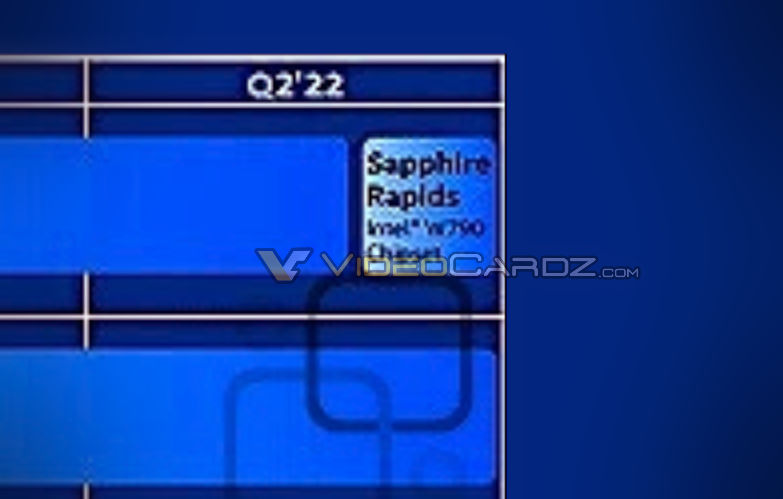
 videocardz.com
Intel Sapphire Rapids HEDT appears in a roadmap with W790 chipset - VideoCardz.com
Intel Sapphire Rapids for consumers There has been a lot of talks recently on future HEDT processors from AMD and Intel. It seems that consumers waiting for a next-gen upgrade for 16+ core systems might need to wait a bit longer. We received a partial roadmap featuring Intel Sapphire Rapids...
videocardz.com
uzzi38
Platinum Member
EDIT: To give you an idea of the power efficiency of Golden Cover, laptops as low as 15 watts will have Golden Cove cores.
And at max clocks each core will be capable of consuming over 20W. The same as Tiger Lake does right now, mind you.
That's a really meaningless statement.
TRENDING THREADS
-
 Discussion Zen 5 Speculation (EPYC Turin and Strix Point/Granite Ridge - Ryzen 9000)
- Started by DisEnchantment
- Replies: 25K
-
Discussion Intel Meteor, Arrow, Lunar & Panther Lakes + WCL Discussion Threads
- Started by Tigerick
- Replies: 25K
-
 Discussion Intel current and future Lakes & Rapids thread
- Started by TheF34RChannel
- Replies: 24K
-

-
