Oh, Q2 PC results. Duh.Isn't it clear enough? Maybe this is better written. It has nothing to do with design wins or DC; Q2 has only 17 days left.

-
We’re currently investigating an issue related to the forum theme and styling that is impacting page layout and visual formatting. The problem has been identified, and we are actively working on a resolution. There is no impact to user data or functionality, this is strictly a front-end display issue. We’ll post an update once the fix has been deployed. Thanks for your patience while we get this sorted.
You are using an out of date browser. It may not display this or other websites correctly.
You should upgrade or use an alternative browser.
You should upgrade or use an alternative browser.
Intel Broadwell-K & Skylake (non-K) desktop CPUs to launch in Q2-2015
Page 12 - Seeking answers? Join the AnandTech community: where nearly half-a-million members share solutions and discuss the latest tech.

sm625
Diamond Member
So either Intel just won a bunch of design wins, or they're expecting Devil's Canyon to sell like hotcakes. Probably the former.
It is true that INTC's weekly chart has been looking great for the last year. It is actually right up there among the technically strongest DOW components. But unlike HP, JNJ, or MMM, it never broke out, until recently. And by recently I mean 3 weeks ago. That's when it broke, not today. Today's move is interesting but clearly a big move has been long in the making. But since the chart has looked so technically strong for a whole year without any faults at all, I cant help but see it as simply fed funny money in rotation.


ithehappy
Senior member
Replaced by? Would it be worth it to wait for Skylake?In Q1 2015 the 4930K have been replaced, and Skylake is not out for another 3 months.
Haswell-E.Replaced by? Would it be worth it to wait for Skylake?
And I don't think there's enough information on Skylake to comment on that.
ithehappy
Senior member
Thanks.Haswell-E.
And I don't think there's enough information on Skylake to comment on that.
billclutterman
Member
AMD lost their road map and are submerged in Skylake somewhere. Details at 11

frozentundra123456
Lifer
AMD lost their road map and are submerged in Skylake somewhere. Details at 11
No, they didn't lose their map, they were using iphone gps.
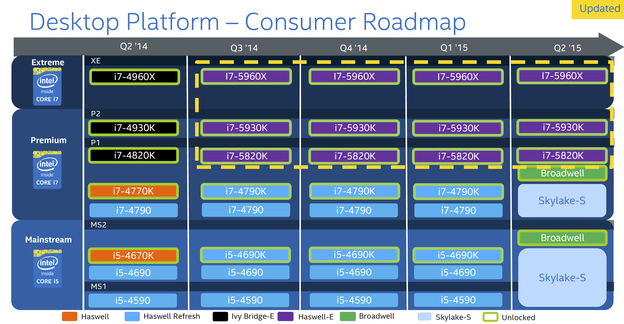
Fjodor2001
Diamond Member
Wow, really weird. Skylake-S and Broadwell-K for desktop released at the same after all if this is true.
So is the intention that the unlocked desktop CPUs will be one generation behind the rest of the desktop models going forward? What's the point in that. Is Intel intentionally making the unlocked K variants so unattractive that it will be phased out and eventually killed, so they'll have less SKUs to maintain? Or what other reasons could they have?
So is the intention that the unlocked desktop CPUs will be one generation behind the rest of the desktop models going forward? What's the point in that. Is Intel intentionally making the unlocked K variants so unattractive that it will be phased out and eventually killed, so they'll have less SKUs to maintain? Or what other reasons could they have?

Fjodor2001
Diamond Member
Skylake-S DT/AIO Platform (All IO possibilities):

Some observations:
* No HDMI 2.0 (only 1.4): So no external 4k @ 60 Hz, wider color space, etc. 😡 Also, it's weird that there's a note at the top right saying "DP/HDMI 40/23 @ 60 Hz", likely implying Full 4K Ultra High Definition (4K UHD, i.e. 4096 x 2304 resolution) @ 60 Hz, because that is not supported on HDMI 1.4 at that frame rate. Maybe the note only applies to AIO PCs when the display is built into the PC itself, iMac style?
* I wonder what they intend to use the proximity sensor, battery/charger and touch screen for on AIO PCs? Perhaps having the PC turn it self on when someone gets into proximity and stuff like that? :hmm:
Some observations:
* No HDMI 2.0 (only 1.4): So no external 4k @ 60 Hz, wider color space, etc. 😡 Also, it's weird that there's a note at the top right saying "DP/HDMI 40/23 @ 60 Hz", likely implying Full 4K Ultra High Definition (4K UHD, i.e. 4096 x 2304 resolution) @ 60 Hz, because that is not supported on HDMI 1.4 at that frame rate. Maybe the note only applies to AIO PCs when the display is built into the PC itself, iMac style?
* I wonder what they intend to use the proximity sensor, battery/charger and touch screen for on AIO PCs? Perhaps having the PC turn it self on when someone gets into proximity and stuff like that? :hmm:
Last edited:

NTMBK
Lifer
It will have HDMI 2.0. And it will also have DP1.3.
And if we had to believe that slide there would only be 2 SATA ports.
Who cares about SATA? Anyone building a Skylake system without a PCIe SSD is doing it wrong. 2 legacy SATA ports seems about right.
Who cares about SATA? Anyone building a Skylake system without a PCIe SSD is doing it wrong. 2 legacy SATA ports seems about right.
How? Those SSD's are more expensive, and the performance is more than enough.

ShintaiDK
Lifer
Who cares about SATA? Anyone building a Skylake system without a PCIe SSD is doing it wrong. 2 legacy SATA ports seems about right.
There is 6 SATA ports 😉
Fjodor2001
Diamond Member
It will have HDMI 2.0. And it will also have DP1.3.
Any source confirming that?
I think you are going to have to expect this kind of co-mingling of generations to continue.
Pretty sure it's DDR3L only for the U/Y models and DDR4 for everything else. I guess we will have to wait to see what DDR4 pricing looks like but I think it's still expected to be bad until the end of 2015. At some point you have to get some volume going for DDR4 so using the least important models to OEMs to get it going does make sense.
H81 is pretty much what OEMs use. Remember it is still only that one 4+2 model.
It confirms CPU-world, sweclockers etc. Exactly how we expected it from their infos. In the second slide do you think Skylake only supports DDR3L and not regular DDR3?
Pretty sure it's DDR3L only for the U/Y models and DDR4 for everything else. I guess we will have to wait to see what DDR4 pricing looks like but I think it's still expected to be bad until the end of 2015. At some point you have to get some volume going for DDR4 so using the least important models to OEMs to get it going does make sense.
The chart actually reminds of the H81 capabilities. Reduced SATA ports, reduced USB3, no IO port flexibility, no SRT, no RST, only 2 display outputs etc. Seems to be an example of a Celeron/Pentium platform.
H81 is pretty much what OEMs use. Remember it is still only that one 4+2 model.
Who cares about SATA? Anyone building a Skylake system without a PCIe SSD is doing it wrong. 2 legacy SATA ports seems about right.
*facepalm* I don't even know where to begin. Don't apply your needs and wealth to everyone.
Last edited:
PCI-E SSDs should be widely available and affordable by then. Only 2 SATA ports is definitely too small, though. Undoubtedly the scenario is as Shintai mentioned -- this is a low end chipset configuration.I don't even know where to begin with how dumb this post is. Don't apply your needs and wealth to everyone.
Skylake isn't launching today...Considering the DDR4 transition, Broadwell-K seems like the better option for desktop users. Skylake should be skipped entirely. DDR4 simply isn't mass-market ready.
DDR4 is actually already available for purchase.
PCI-E SSDs should be widely available and affordable by then. Only 2 SATA ports is definitely too small, though. Undoubtedly the scenario is as Shintai mentioned -- this is a low end chipset configuration.
2 SATA ports is fine for OEM desktops. One for the HD and the other for the optical drive. SSD is still rare there, but PCI-E SSD would give them something extra to sell.
TRENDING THREADS
-
 Discussion Zen 5 Speculation (EPYC Turin and Strix Point/Granite Ridge - Ryzen 9000)
- Started by DisEnchantment
- Replies: 25K
-
Discussion Intel Meteor, Arrow, Lunar & Panther Lakes + WCL Discussion Threads
- Started by Tigerick
- Replies: 25K
-
 Discussion Intel current and future Lakes & Rapids thread
- Started by TheF34RChannel
- Replies: 24K
-

-
