• We’re currently investigating an issue related to the forum theme and styling that is impacting page layout and visual formatting. The problem has been identified, and we are actively working on a resolution. There is no impact to user data or functionality, this is strictly a front-end display issue. We’ll post an update once the fix has been deployed. Thanks for your patience while we get this sorted.

guru3dDoom Vulkan Benchmarks

Page 9 - Seeking answers? Join the AnandTech community: where nearly half-a-million members share solutions and discuss the latest tech.
Very interesting. The 480 is not a card likely to be coupled with best CPUs, so that puts a dramatic new twist on things. Of course we cannot reach broad sweeping conclusions from one chart (nor can we with one Vulkanized game), despite earlier attempts by some to paint the Dooom/Vulkan results as somewhat of a representation of all future Vulkan (or DX12) performance.

AMD's Vulkan driver shows similiar behaviour in Dota 2: https://www.computerbase.de/2016-05...agramm-dota-2-reborn-1920-1080-x4-880k-replay
 
The 480 is not a card likely to be coupled with best CPUs, so that puts a dramatic new twist on things.

That's the thing. I have a Core Q9550 and if these benchs are accurate, I'd benefit more by going with a 1060. These numbers throw a wrench in my upgrade plans.

Yes, I suppose we have to wait for more games to show up. Doom's numbers are really strange.

Those results don't match my own experience when I tested my r9 280 with a c2q 9300. I was getting easily 30-50% higher fps on Vulkan compared to ogl. Frame times were also much smoother just from the subjective feel. I tried the cpu at 3 GHz, 2.5 GHz, and 1.6 GHz and it wasn't until the 1.6 GHz underclock in Vulkan that the game felt as sluggish as it did in ogl with the cpu at 3 GHz.

280 and 480 have different architectures. It seems they scale differently in a lot of games, not just here. Nonetheless, it might be a driver or game optimization thing.


I think doom's vulkan performance needs a proper investigative journalism on cards from both sides.
 
Those results don't match my own experience when I tested my r9 280 with a c2q 9300. I was getting easily 30-50% higher fps on Vulkan compared to ogl. Frame times were also much smoother just from the subjective feel. I tried the cpu at 3 GHz, 2.5 GHz, and 1.6 GHz and it wasn't until the 1.6 GHz underclock in Vulkan that the game felt as sluggish as it did in ogl with the cpu at 3 GHz.

I agree, I'm getting huge fps and smoothness increases on my lowly 280x and lowly i7 920 CPU. The 280x is leaving it's former nvidia competition in the dust, seriously.

Driver can have as much overhead as it wants as long as it's a lower priority than the game it doesn't mean anything.
 
Last edited:
That result is really strange because Doom isn't even fully maxing out my CPU (while getting great FPS) and I'm only on an i5, not even i7.

Is it do with SSE4/special instructions? Maybe a more modern i3, and the result would be completely different.

My guess. Who, honestly not trying to be rude, still uses CPUs that old? Let alone expect amazing return using modern hardware/software?

WTB i3/AMD 4/6-core CPUs to see if it's just an age thing.
 
That result is really strange because Doom isn't even fully maxing out my CPU (while getting great FPS) and I'm only on an i5, not even i7.

Is it do with SSE4/special instructions? Maybe a more modern i3, and the result would be completely different.

I think it does have to do with the instruction sets, I remember seeing a post stating that newer drivers were using newer features on the CPU and so they had to roll back to get it to work with their old CPU.

Wish I had more details but I think that it might be playing part here.
 
I think it does have to do with the instruction sets, I remember seeing a post stating that newer drivers were using newer features on the CPU and so they had to roll back to get it to work with their old CPU.

Wish I had more details but I think that it might be playing part here.

If I remember right, that was related to TimeSpy. One of our users here had to revert to older drivers for his brother's Core 2 Duo setup (if I'm remembering all the details right.)

Might be related.
 
My guess. Who, honestly not trying to be rude, still uses CPUs that old? Let alone expect amazing return using modern hardware/software?

WTB i3/AMD 4/6-core CPUs to see if it's just an age thing.

Well the point of these modern API is to breath new life into old CPUs and allow modern ones to fly. But if they are using instruction sets that run slower on the ancient platform, it defeats that purpose imo.

Should be investigated, sadly I don't have any rig that old. hah

Though I'm positive that lots of gamers are still on C2D and C2Q/Phenom rigs, especially mainstream gamers, they don't upgrade as often.
 
My guess. Who, honestly not trying to be rude, still uses CPUs that old? Let alone expect amazing return using modern hardware/software?

WTB i3/AMD 4/6-core CPUs to see if it's just an age thing.

Who? I, for example; a Core Q9550. There are many others still with Core 2 Quads and Core i5-7x0 CPUs out there.

If the CPUs are still good enough for 1920x1080, why upgrade, especially for those who are short of cash.
 
Last edited:
GTX980Ti user here. Vulkan gives me a slight gain of ~3% or so, but it certainly doesn't feel as smooth. It feels/looks like MGPU with poor frame pacing. I take it this is an Nv only feature?
 
any update from Nvidia ? How about Shader Intrinsic on Nvidia cards?

Either Nvidia rolls out their own equivalent extensions or support the existing AMD extensions (doubt this'll ever happen) but some of those shader intrinsics are specific to AMD hardware so Nvidia might not have the appropriate hardware support these extensions ...
 
If I remember right, that was related to TimeSpy. One of our users here had to revert to older drivers for his brother's Core 2 Duo setup (if I'm remembering all the details right.)

Might be related.

Yes thank you, I couldn't remember which thread I saw that in. I wonder what would happen if they just disabled cores on the newer processor.
 
That result is really strange because Doom isn't even fully maxing out my CPU (while getting great FPS) and I'm only on an i5, not even i7.

Is it do with SSE4/special instructions? Maybe a more modern i3, and the result would be completely different.

Hard to tell. Without additional testing it's hard to isolate that. There are a number of differences between older and newer CPU's including memory bandwidth and PCIe bandwidth/generation.

Either Nvidia rolls out their own equivalent extensions or support the existing AMD extensions (doubt this'll ever happen) but some of those shader intrinsics are specific to AMD hardware so Nvidia might not have the appropriate hardware support these extensions ...

I think Nvidia would have to roll their own since it's specific to the architecture you're targetting. It could also be dependent on how much Nvidia cards stand to gain from supporting it.
 
Last edited:
q9300_vol_ogl_stats.png

q9300_vul_ogl.png


Tests performed @ 1080p Ultra with TSSAA(8x). Basically, if you're staring at a wall or in an empty area with no action, there's not much difference outside of the Vulkan renderer being smoother in frame delivery. However, once you hit any kind of action or heavier render load in general, the Vulkan renderer with AMD cards can be close to twice as fast when compared to OpenGL. My guess is that in the Hardware Unboxed review they had an almost empty area with little to no action and so the difference in the averages isn't very high.
 
Last edited:
pubchart


8320e was overclocked slightly to 3.6 GHz base, 3.8 GHz boost, and single core boost was unchanged at 4.0 GHz.
 
Last edited:
it's not the same with a Geforce

Pg4xTmn.png

Man, that's interesting. It's kinda funny because the people that will probably buy a $200-$250 video card probably have an i3/i5 and not an i7. Probably not even overclocked.

Thus, as a consequence, negating the advantage the RX480 have over the GTX1060 under Vulkan. Looks to me the GTX1060 is the better choice for lower end CPU on Vulkan. That's interesting. Sure makes thing a bit more complicated.
 
Man, that's interesting. It's kinda funny because the people that will probably buy a $200-$250 video card probably have an i3/i5 and not an i7. Probably not even overclocked.

Thus, as a consequence, negating the advantage the RX480 have over the GTX1060 under Vulkan. Looks to me the GTX1060 is the better choice for lower end CPU on Vulkan. That's interesting. Sure makes thing a bit more complicated.

it seems to be the case, not hugely unexpected considering the DX11 results we know (like the i3 tests from digital foundry), but still Vulkan was supposed to be low overhead... and AMD Vulkan is far behind even OGL on nvidia with slow CPUs...

reviews of cheaper cards definitely need to consider testing with more than just the fastest CPU available.


I would argue that unboxed is the odd man out on this one.

doom_proz_v.jpg

what do you mean? no PII and 1156 I5 to be found on this graph, also no Radeon only a 1080, and we don't know much about the testing scene used on both I guess.

also, the results you posted with a C2Q 3ghz, kind of look inline with the PII X4+RX480 on the hardware unboxed test?
 
I think Nvidia would have to roll their own since it's specific to the architecture you're targetting. It could also be dependent on how much Nvidia cards stand to gain from supporting it.

Not all extensions are specific to one hardware vendor ...

As long as the implemented built-ins follows the extensions specs then it won't matter where the spec originated so long as it's conformant ...
 
it seems to be the case, not hugely unexpected considering the DX11 results we know (like the i3 tests from digital foundry), but still Vulkan was supposed to be low overhead... and AMD Vulkan is far behind even OGL on nvidia with slow CPUs...

reviews of cheaper cards definitely need to consider testing with more than just the fastest CPU available.

true, but there is a difference between testing a slower (i3 that is currently for sale) and a cpu that is >6 years old.

I those results will again differ greatly compared to those old cpu's.
 
what do you mean? no PII and 1156 I5 to be found on this graph, also no Radeon only a 1080, and we don't know much about the testing scene used on both I guess.

also, the results you posted with a C2Q 3ghz, kind of look inline with the PII X4+RX480 on the hardware unboxed test?

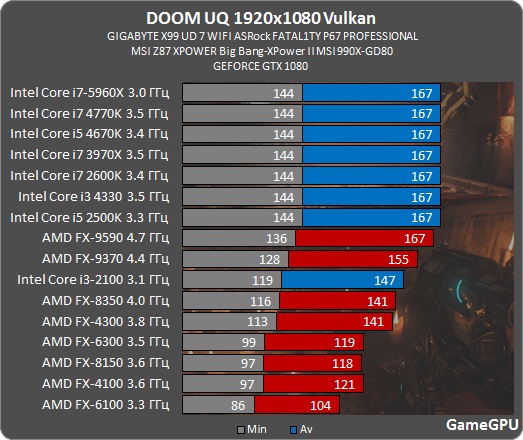
Look at the scaling, unboxed showed a 4% loss going from an overclocked 6700k to a stock x4 955. Look at GameGPU with a 1080, you see a loss of almost 40% going down to an FX6100. The 955 should be right about the performance of the 6100, maybe a tad faster.

I'm also seeing twice the performance uplift from Vulkan on the q9300 compared to unboxed results and more than GameGPU as well. The reason is simple, their tests are basically running around an empty room. These are not indicative of actual game performance. Basically, if you look at the frame time graph I posted and look only at the spot where I'm essentially looking at a wall (It's a scripted event of throwing a switch in the game) you see the fps is at it's highest and OpenGL and Vulkan perform basically the same just like you see with unboxed reviews. If you want to see performance during real gaming though, look outside of that area in the graph and you'll see a much different story.

GameGPU's benchmark is basically the same thing as well, they run around an empty room but at least they shoot a barrel and have a nest that adds some load to the scene. This is not indicative of actual in game performance. It's similar to me to looking at max fps and determining a hierarchy. I have some more data too though, I'll see if I can parse through that today and get it posted.
 
Back
Top